

Order Total (1 Item Items):
Shipping Destination:

Brougham Henry, Signed (20 results)
Skip to main search results
Search filters
Product Type
- All Product Types
- Books (6)
- Magazines & Periodicals (No further results match this refinement)
- Comics (No further results match this refinement)
- Sheet Music (No further results match this refinement)
- Art, Prints & Posters (3)
- Photographs (No further results match this refinement)
- Maps (No further results match this refinement)
- Manuscripts & Paper Collectibles (11)
Condition Learn more
- New (No further results match this refinement)
- As New, Fine or Near Fine (1)
- Very Good or Good (14)
- Fair or Poor (No further results match this refinement)
- As Described (5)
Binding
Collectible Attributes
- First Edition (11)
- Signed (20)
- Dust Jacket (No further results match this refinement)
- Seller-Supplied Images (13)
- Not Print on Demand (20)
Language (2)
Price
- Any Price
- Under US$ 25 (No further results match this refinement)
- US$ 25 to US$ 50
- Over US$ 50
Free Shipping
- Free Shipping to U.S.A. (No further results match this refinement)
Seller Location
Seller Rating
-
An Original Third Person Handwritten and Signed Letter by Henry Peter Brougham, 1st Baron Brougham to Photographer Charles Thurston Thompson
Language: English
Published by UK, 1869
Seller: Lasting Words Ltd, Northampton, UK, United Kingdom
Association Member: PBFA
Seller rating 5 out of 5 stars

Manuscript / Paper Collectible First Edition Signed
US$ 55.24
US$ 26.75 shipping
Ships from United Kingdom to U.S.A.Quantity: 1 available
Add to basketPaper. Condition: Very Good. First Edition. An Original Third Person Handwritten and Signed Letter by Henry Peter Brougham, 1st Baron Brougham to Photographer Charles Thurston Thompson. Dated 1869. A letter thanking a Mr Tomlinson for the prints of friends of his. Henry Peter Brougham, 1st Baron Brougham and Vaux, 1778 - 1868 was a British statesman who became Lord High Chancellor of Great Britain and played a prominent role in passing the Reform Act 1832 and Slavery Abolition Act 1833. Size is 183mm x 114mm. Condition is good. Light folding crease. Gum marks to rear effecting the third page. Ref19257. Signed by Author(s).
-
An Original Handwritten Letter Signed by Henry Peter Brougham.
Language: English
Published by UK
Seller: Lasting Words Ltd, Northampton, UK, United Kingdom
Association Member: PBFA
Seller rating 5 out of 5 stars
Manuscript / Paper Collectible First Edition Signed
US$ 62.14
US$ 26.75 shipping
Ships from United Kingdom to U.S.A.Quantity: 1 available
Add to basketPaper. Condition: Good. First Edition. An Original Handwritten Signed Letter by Henry Peter Brougham. Undated. A letter apologising for a delay in replying due to be being on holiday. Henry Peter Brougham Hankey first Baron Brougham and Vaux 1778-1868 was a British statesman who became Lord High Chancellor and played a prominent role in passing the 1832 Reform Act and 1833 Slavery Abolition Act. Size is 180mm x 110mm. Condition is good. Light folding creases. Gum marks to the rear blank sheet. More images can be taken upon request. Ref17707. Signed by Author(s).
-

An Original Hand Written Note and Signed by Henry Peter Brougham
Published by UK, 1840
Seller: Lasting Words Ltd, Northampton, UK, United Kingdom
Association Member: PBFA
Seller rating 5 out of 5 stars
Manuscript / Paper Collectible First Edition Signed
US$ 34.52
US$ 26.75 shipping
Ships from United Kingdom to U.S.A.Quantity: 1 available
Add to basketPaper. Condition: Good. First Edition. An Original Hand Written Clipped Paper and Signed by Hugh McCalmont Cairns. C1840. Henry Peter Brougham, 1st Baron Brougham and Vaux, 1778-1868 was a British statesman who became Lord High Chancellor and played a prominent role in passing the 1832 Reform Act and 1833 Slavery Abolition Act. Size is 110mm x 40mm. Condition is quite good. Mounted on paper. More images can be taken upon request. Ref16873. Signed by Author(s).
-

Autograph Letter Signed signed 'H. B.', to 'My dear Spiker' [sic, The Speaker], (Henry, 1778-1868, Anti-Slaver & Writer, Lord Chancellor 1830-1834, from 1830 Baron Brougham & Vaux)
Publication Date: 1840
Seller: Sophie Dupre ABA ILAB PADA, Calne, United Kingdom
Seller rating 1 out of 5 stars

Manuscript / Paper Collectible Signed
saying he is "confined with a sore throat else I should have called on you both to deliver this from Dupin", 1 side 8vo. and conjugate address leaf signed 'Brougham', Gr[afton] St[reet], 'Friday' no date, c.
-
An Original Third Person Handwritten and Signed Letter By Abolitionist Henry Peter Brougham, 1st Baron Brougham with the Maltese Stamp to the Penny Red
Language: English
Published by UK, 1843
Seller: Lasting Words Ltd, Northampton, UK, United Kingdom
Association Member: PBFA
Seller rating 5 out of 5 stars
First Edition Signed
US$ 91.14
US$ 26.75 shipping
Ships from United Kingdom to U.S.A.Quantity: 1 available
Add to basketPaper. Condition: Good. First Edition. An Original Third Person Handwritten and Signed Letter By Abolitionist Henry Peter Brougham, 1st Baron Brougham with the Maltese Stamp to the Penny Red. Dated 1843. A thank you letter for the safe arrival of an article. Henry Peter Brougham, 1st Baron Brougham 1778-1868 was a British statesman who became Lord High Chancellor and played a prominent role in passing the 1832 Reform Act and 1833 Slavery Abolition Act. Size 185mm x 110mm. Condition is good. Age toned. Slight loss to paper where the seal was broken. More images can be taken upon request. Ref17703. Signed by Author(s).
-
[John Henry Bernard, Irish churchman and philosopher] Autograph Letter Signed to [?] Brougham.
Published by 21 June ; on letterhead of Trinity College Dublin, 1900
Seller: Richard M. Ford Ltd, London, United Kingdom
Seller rating 5 out of 5 stars
Signed
Four pages, 12mo. Good, though grubby and a tad spotted, and with remains of previous mount adhering to lower-half of verso of second leaf of bifoliate (not affecting text). Begins 'My dear Brougham | I have read over the article in the Gazette on SPG, and have ascertained that Mr. White had nothing, directly or indirectly, to say to it. I think that the scope of the article precluded any mention of individual workers of recent years, as it was meant to give a general view. [.] | Everyone concerned with SPG knows the deep interest which your Father has taken in its progress, and the value of his influence. But I do not think that it would really do him honour to write a letter as you suggest. As the matter stands, no one wd. imagine (I think) that he had been slighted, [.]' Postscript claims that Brougham is mistaken 'About the origin of the Chhota Nagpur Mission'. Signed 'John H Bernard'.
-

An Original Hand Written Envelope by Henry Peter Brougham, 1st Baron Brougham
Published by UK, 1847
Seller: Lasting Words Ltd, Northampton, UK, United Kingdom
Association Member: PBFA
Seller rating 5 out of 5 stars
Manuscript / Paper Collectible First Edition Signed
US$ 52.47
US$ 26.75 shipping
Ships from United Kingdom to U.S.A.Quantity: 1 available
Add to basketPaper. Condition: Good. First Edition. An Original Hand Written Envelope by Henry Peter Brougham, 1st Baron Brougham. Dated 1847. Autograph Envelope to Reverend Lee at Edinburgh University. Henry Peter Brougham, 1st Baron Brougham and Vaux 1778-1868 was a British statesman who became Lord High Chancellor and played a prominent role in passing the 1832 Reform Act and 1833 Slavery Abolition Act. Provenance: From the family of autograph collector Emily Mary Rose Lee (1869-1949), wife of Colonel William Crawford Walton (1864-1937). Emily was the daughter of William Lee, Professor of Ecclesiastical History at the University of Glasgow from 1874 to 1886, and granddaughter of John Lee (1779-1859), Principal of Edinburgh University from 1840 to 1859. Size is 120m x 68mm. Condition is average. Light marking and age toning. More images can be taken upon request. Ref17157. Signed by Author(s).
-
Hardcover. First Edition; First Printing. Very Good in a Very Good- dust jacket. A few chips and tears to jacket edges along with some creasing. All corners of flaps are slightly clipped, not price clipped. Top corner of front flap has been torn off. ; Signed and inscribed by the author, however signature has been covered over with marker, though inscription remains. ; 8vo 8" - 9" tall; Signed by Author. Signed.
-
LETTER TO HENRY BROUGHAM, ESQ. ON LAW REFORM IN SCOTLAND.
Published by Longman, Rees, Orme, Brown & Green,, London,, 1830
Seller: Burwood Books, Wickham Market, United Kingdom
Association Member: PBFA
Seller rating 5 out of 5 stars
First Edition Signed
US$ 55.24
US$ 30.17 shipping
Ships from United Kingdom to U.S.A.Quantity: 1 available
Add to basketCondition: Very Good. First Edition. Wraps. 8vo. pp 40. Disbound (i.e. lacking covers) but otherwise in Êdecent sound condition with very clean text. Suitable for rebinding or reading and reference. Sujects considered inc Jury trial, petty criminal trials by sheriff rather than judges, cessio bonorum, abolition of sasines, 'oppressive monopoly systems' etc., publisher's cloth - on cover which is the title page is written 'To William Brown from the author.'. Signedes.
-
An Original Handwritten Letter Signed by Henry Peter Brougham to Levi Leone
Published by UK, 1856
Seller: Lasting Words Ltd, Northampton, UK, United Kingdom
Association Member: PBFA
Seller rating 5 out of 5 stars
Manuscript / Paper Collectible First Edition Signed
US$ 60.76
US$ 26.75 shipping
Ships from United Kingdom to U.S.A.Quantity: 1 available
Add to basketPaper. Condition: Good. First Edition. An Original Handwritten Letter Signed by Henry Peter Brougham to Levi Leone. Dated 1856. A letter referring to Lord Lyndhurst failed attempts to 'take the part that you were anxious he should', while expressing support for Levi's proposed measure and suggesting various allies that could speak to the recommendation. Henry Peter Brougham, first Baron Brougham and Vaux 1778-1868 was a British statesman who became Lord High Chancellor and played a prominent role in passing the 1832 Reform Act and 1833 Slavery Abolition Act. Levi Leone, 1821-1888. English jurist and statistician. His chief work, History of British Commerce and of the Economic Progress of the British Nation, 1763-1870, is considered to be a partisan account of British economic development. Size is 180mm x 115mm. Condition is good. Light folding creases. Light gum marks to rear edge and page centre. More images can be taken upon request. Ref17153. Signed by Author(s).
-

An Original Hand Written Envelope by Henry Peter Brougham, 1st Baron Brougham
Published by UK, 1855
Seller: Lasting Words Ltd, Northampton, UK, United Kingdom
Association Member: PBFA
Seller rating 5 out of 5 stars
Manuscript / Paper Collectible First Edition Signed
US$ 62.14
US$ 26.75 shipping
Ships from United Kingdom to U.S.A.Quantity: 1 available
Add to basketPaper. Condition: Good. First Edition. An Original Hand Written Envelope by Henry Peter Brougham, 1st Baron Brougham. Dated 1855. Autograph Envelope to Reverend Lee at Edinburgh University. Henry Peter Brougham, 1st Baron Brougham and Vaux 1778-1868 was a British statesman who became Lord High Chancellor and played a prominent role in passing the 1832 Reform Act and 1833 Slavery Abolition Act. Provenance: From the family of autograph collector Emily Mary Rose Lee (1869-1949), wife of Colonel William Crawford Walton (1864-1937). Emily was the daughter of William Lee, Professor of Ecclesiastical History at the University of Glasgow from 1874 to 1886, and granddaughter of John Lee (1779-1859), Principal of Edinburgh University from 1840 to 1859. Size is 120m x 68mm. Condition is good. Light marking. More images can be taken upon request. Ref17164. Signed by Author(s).
-
An Original Handwritten Letter Signed by Henry Peter Brougham to Levi Leone
Published by UK, 1856
Seller: Lasting Words Ltd, Northampton, UK, United Kingdom
Association Member: PBFA
Seller rating 5 out of 5 stars
Manuscript / Paper Collectible First Edition Signed
US$ 66.28
US$ 26.75 shipping
Ships from United Kingdom to U.S.A.Quantity: 1 available
Add to basketPaper. Condition: Good. First Edition. An Original Handwritten Letter Signed by Henry Peter Brougham to Levi Leone. Dated 1856. A letter offering to sign his certificate, being his admission to the bar at Lincoln's Inn. Henry Peter Brougham Hankey first Baron Brougham and Vaux 1778-1868 was a British statesman who became Lord High Chancellor and played a prominent role in passing the 1832 Reform Act and 1833 Slavery Abolition Act. Levi Leone, 1821-1888. English jurist and statistician. His chief work, History of British Commerce and of the Economic Progress of the British Nation, 1763-1870, is considered to be a partisan account of British economic development. Size is 180mm x 115mm. Condition is good. Light folding creases. More images can be taken upon request. Ref17153. Signed by Author(s).
-
1866 British Statesman Henry [Lord] Brougham Signed Envelope
Publication Date: 1866
Manuscript / Paper Collectible Signed
No Binding. Condition: Very Good. This 2 1/2" x 4 1/4" addressed envelope bears the large, clear signature of British politician Henry Brougham (1778-1868) in the lower left corner. Brougham served as a Member of the House of Lords for thirty-eight years (1830-1868) and as Lord High Chancellor for four (1830-1834). He played an instrumental role in the passing of the 1832 Reform Act and the 1833 Slavery Abolition Act. There is a one penny Queen Victoria postage stamp at the upper right corner as well as several round inked Penrith cancellations dated October 16, 1866. Condition: The envelope has been glued to a 4 1/2" x 6 3/8" piece of stiff paper. Generally very good condition. Signed by Author(s).
-

An Original Letter written and signed by Henry Peter Brougham, 1st Baron Brougham
Published by UK, 1847
Seller: Lasting Words Ltd, Northampton, UK, United Kingdom
Association Member: PBFA
Seller rating 5 out of 5 stars
Manuscript / Paper Collectible First Edition Signed
US$ 103.57
US$ 26.75 shipping
Ships from United Kingdom to U.S.A.Quantity: 1 available
Add to basketPaper. Condition: Good. First Edition. An Original Letter written and signed by Henry Peter Brougham, 1st Baron Brougham. The letter dated 1847 thanks the recipient for something and jokes that the writing is quite undecipherable. Henry Peter Brougham, 1st Baron Brougham and Vaux, 1778-1868 was a British statesman who became Lord High Chancellor and played a prominent role in passing the 1832 Reform Act and 1833 Slavery Abolition Act. Provenance: From the family of autograph collector Emily Mary Rose Lee (1869-1949), wife of Colonel William Crawford Walton (1864-1937). Emily was the daughter of William Lee, Professor of Ecclesiastical History at the University of Glasgow from 1874 to 1886, and granddaughter of John Lee (1779-1859), Principal of Edinburgh University from 1840 to 1859. Size is 180m x 110mm. Condition is good. Light folding creasing. More images can be taken upon request. Ref17164. Signed by Author(s).
-
[Henry William Brougham, Dean of Lismore] Autograph Letters Signed to Brougham from Canon Flemyng; and Autograph Card Signed to Brougham from his grandson Henry Brougham.
Published by Brougham's card 12 May on letterhead 'BROUGHAM HOUSE | WELLINGTON COLLEGE STATION | BERKS.' Flemyng's letter 10 March 1906 on letterhead 'Coolfin Portlaw Co. Waterford', 1904
Seller: Richard M. Ford Ltd, London, United Kingdom
Seller rating 5 out of 5 stars
Signed
Flemyng was a noted authority in the field of Irish lepidoptery, and published a number of papers on the subject between 1877 and 1919. Both items concern the Latin saying 'ne sutor ultra crepidam' or 'sutor ne supra crepidam judicaret'. HENRY BROUGHAM'S CARD: one page, five and a half inches by three and a half; addressed, with postmarked stamp, on reverse. Extremely grubby. Reads 'Dear Granpy | The Dictionary references to Sutor, ne supra crepidam (judicaret) are | PLINY 35, 10, 36, 85 | c.f. Val. Max. 8, 12, fin. | Papim is sending a few pansy-blossoms hoping you won't be jealous. with love to everyone your loving grandson | Henry Brougham'. FLEMYNG'S LETTER: four pages, 12mo. Extremely grubby, on stained, discoloured paper. Regarding the phrase 'ne sutor ultra crepidam' he 'first must confess my great forgetfulness in thinking that the i was long. [.] Of course it means "Let not the shoemaker go beyond his last." This censure was very properly addressed by Apelles to a certain Shoemaker who found fault with an ill-painted slipper in one of his pictures, but when he presumed to extend his criticism to other parts of the painting, he betrayed so much ignorance as to elicit from the painter this rebuke. We should all be slow in offering our opinions in any art or profession, with the principles of wh. we are unacquainted.' Signed 'W. W. Flemyng'.
-
The Coquet or A Political Courtship (Henry Brougham, 1st Baron Brougham and Vaux; Charles Grey, 2nd Earl Grey).
Published by London: Thomas MacLean., 1830
Seller: Wittenborn Art Books, San Francisco, CA, U.S.A.
Seller rating 5 out of 5 stars
Art / Print / Poster Signed
Condition: Good. Original lithograph. 12.5 x 10 inches. Very Good. Inserted into light matting. Published 23 November, 1830.Sitters: Henry Brougham, 1st Baron Brougham and Vaux (1778-1868), Lord Chancellor. Charles Grey, 2nd Earl Grey (1764-1845), Prime Minister. John Doyle (Dublin 1797 - 2 January 1868 London), known by the pen name H. B., was a political cartoonist, caricaturist, painter and lithographer.In his youth he learned to paint landscapes under Gaspare Gabrielli, and miniature portraits at the Royal Dublin Society's drawing school under John Comerfield. He won a gold medal in 1805. He was commissioned to paint equestrian portraits of the Marquess of Sligo and Lord Talbot, the Irish viceroy, and in 1822 he produced six prints entitled The Life of a Racehorse. That year he moved to London with his wife, Marianna Conan. His painting Turning out the Stag brought him recognition when it was exhibited at the Royal Academy in 1825.Doyle continued to exhibit miniatures until 1835, but by then he was experiencing greater success with his political cartoons, printed using the new reproductive medium of lithography, beginning in 1827. These were issued once a month during parliamentary sessions, and continued for twenty-two years. His caricatures were mostly faithful likenesses of their subjects, with little exaggeration, treated with sarcastic humor, often alluding to popular plays. They were signed with the letters H. B., constructed out of two Js and two Ds, Doyle's own initials. By 1840 he was prosperous enough to afford a fashionable house in Hyde Park, moving in the same circles as David Wilkie, Walter Scott, Samuel Taylor Coleridge, Charles Dickens, William Makepeace Thackeray, Thomas Macaulay, Thomas Moore and Samuel Rogers - but H. B.'s true identity remained a closely guarded secret until he revealed it in 1843 in a seventeen-page letter to Sir Robert Peel.In the 1840s, at the height of his popularity, indices of H.B.'s prints were published in The Times and by the publisher McLean, but his reputation faded. His later prints were gentle in their humor and drawn in a soft, indistinct style. Thackeray said his cartoons, although clever and witty, were too "genteel" to raise more than a gentlemanly smile - "You will never hear any laughing at 'H. B.'" When he died in 1868, his obituary in The Art Journal did not appear until three months after his death, and a posthumous sale of his sketches at Christie's in 1882 was canceled for lack of buyers. However, he is considered a founder of the school of British cartoon satirists represented by John Leech, John Tenniel, and his son Richard Doyle, which established the style made famous by Punch magazine. The British Museum has over 900 of his drawings in its collections.
-
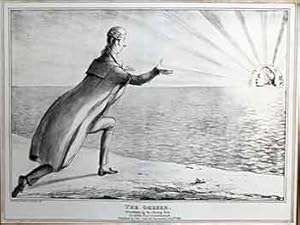
The Gheber, Worshipping the Rising Sun (Henry Brougham, 1st Baron Brougham and Vaux; King William IV).
Published by London: Thomas MacLean., 1830
Seller: Wittenborn Art Books, San Francisco, CA, U.S.A.
Seller rating 5 out of 5 stars
Art / Print / Poster Signed
Condition: Good. Original lithograph. 13 x 10 inches. Very Good. Inserted into light matting. Published 6 July, 1830.Sitters: Henry Brougham, 1st Baron Brougham and Vaux (1778-1868), Lord Chancellor. King William IV (1765-1837), Reigned 1830-37. John Doyle (Dublin 1797 - 2 January 1868 London), known by the pen name H. B., was a political cartoonist, caricaturist, painter and lithographer.In his youth he learned to paint landscapes under Gaspare Gabrielli, and miniature portraits at the Royal Dublin Society's drawing school under John Comerfield. He won a gold medal in 1805. He was commissioned to paint equestrian portraits of the Marquess of Sligo and Lord Talbot, the Irish viceroy, and in 1822 he produced six prints entitled The Life of a Racehorse. That year he moved to London with his wife, Marianna Conan. His painting Turning out the Stag brought him recognition when it was exhibited at the Royal Academy in 1825.Doyle continued to exhibit miniatures until 1835, but by then he was experiencing greater success with his political cartoons, printed using the new reproductive medium of lithography, beginning in 1827. These were issued once a month during parliamentary sessions, and continued for twenty-two years. His caricatures were mostly faithful likenesses of their subjects, with little exaggeration, treated with sarcastic humor, often alluding to popular plays. They were signed with the letters H. B., constructed out of two Js and two Ds, Doyle's own initials. By 1840 he was prosperous enough to afford a fashionable house in Hyde Park, moving in the same circles as David Wilkie, Walter Scott, Samuel Taylor Coleridge, Charles Dickens, William Makepeace Thackeray, Thomas Macaulay, Thomas Moore and Samuel Rogers - but H. B.'s true identity remained a closely guarded secret until he revealed it in 1843 in a seventeen-page letter to Sir Robert Peel.In the 1840s, at the height of his popularity, indices of H.B.'s prints were published in The Times and by the publisher McLean, but his reputation faded. His later prints were gentle in their humor and drawn in a soft, indistinct style. Thackeray said his cartoons, although clever and witty, were too "genteel" to raise more than a gentlemanly smile - "You will never hear any laughing at 'H. B.'" When he died in 1868, his obituary in The Art Journal did not appear until three months after his death, and a posthumous sale of his sketches at Christie's in 1882 was canceled for lack of buyers. However, he is considered a founder of the school of British cartoon satirists represented by John Leech, John Tenniel, and his son Richard Doyle, which established the style made famous by Punch magazine. The British Museum has over 900 of his drawings in its collections.
-
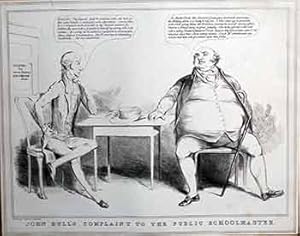
John Bull's Complaint to the Public Schoolmaster (Henry Brougham, 1st Baron Brougham and Vaux; John Bull).
Published by London: Thomas MacLean., 1829
Seller: Wittenborn Art Books, San Francisco, CA, U.S.A.
Seller rating 5 out of 5 stars
Art / Print / Poster Signed
Condition: Good. Original lithograph. 10 x 13 inches. Very Good. Light signs of foxing. Inserted into light matting.Sitters: Henry Brougham, 1st Baron Brougham and Vaux (1778-1868), Lord Chancellor. John Bull (active 1712-present), Fictitious epitomist of Englishness and British imperialism.John Doyle (Dublin 1797 - 2 January 1868 London), known by the pen name H. B., was a political cartoonist, caricaturist, painter and lithographer.In his youth he learned to paint landscapes under Gaspare Gabrielli, and miniature portraits at the Royal Dublin Society's drawing school under John Comerfield. He won a gold medal in 1805. He was commissioned to paint equestrian portraits of the Marquess of Sligo and Lord Talbot, the Irish viceroy, and in 1822 he produced six prints entitled The Life of a Racehorse. That year he moved to London with his wife, Marianna Conan. His painting Turning out the Stag brought him recognition when it was exhibited at the Royal Academy in 1825.Doyle continued to exhibit miniatures until 1835, but by then he was experiencing greater success with his political cartoons, printed using the new reproductive medium of lithography, beginning in 1827. These were issued once a month during parliamentary sessions, and continued for twenty-two years. His caricatures were mostly faithful likenesses of their subjects, with little exaggeration, treated with sarcastic humor, often alluding to popular plays. They were signed with the letters H. B., constructed out of two Js and two Ds, Doyle's own initials. By 1840 he was prosperous enough to afford a fashionable house in Hyde Park, moving in the same circles as David Wilkie, Walter Scott, Samuel Taylor Coleridge, Charles Dickens, William Makepeace Thackeray, Thomas Macaulay, Thomas Moore and Samuel Rogers - but H. B.'s true identity remained a closely guarded secret until he revealed it in 1843 in a seventeen-page letter to Sir Robert Peel.In the 1840s, at the height of his popularity, indices of H.B.'s prints were published in The Times and by the publisher McLean, but his reputation faded. His later prints were gentle in their humor and drawn in a soft, indistinct style. Thackeray said his cartoons, although clever and witty, were too "genteel" to raise more than a gentlemanly smile - "You will never hear any laughing at 'H. B.'" When he died in 1868, his obituary in The Art Journal did not appear until three months after his death, and a posthumous sale of his sketches at Christie's in 1882 was canceled for lack of buyers. However, he is considered a founder of the school of British cartoon satirists represented by John Leech, John Tenniel, and his son Richard Doyle, which established the style made famous by Punch magazine. The British Museum has over 900 of his drawings in its collections.
-
[ Edward Harbord, Lord Suffield. ] Autograph Letter Signed ('Suffield') to John Richardson of Heydon, containing a splendid assessment of the character of his friend the Lord Chancellor, Henry Peter Brougham, and reminiscences of Lord Eldon.
Published by Vernon House Park Place St James's London 22 September, 1831
Seller: Richard M. Ford Ltd, London, United Kingdom
Seller rating 5 out of 5 stars
Manuscript / Paper Collectible Signed
US$ 345.22
US$ 6.03 shipping
Ships from United Kingdom to U.S.A.Quantity: 1 available
Add to basket3pp., 4to. Bifolium In good condition, lightly aged. Laid down on the blank reverse of the second leaf is a frank (also signed 'Suffield'), addressed to 'Jn. Richardson Esqr. | Heydon | Aylsham | Norfolk' An excellent letter, containing a splendid assessment of Brougham's qualities, and a vivid reminiscence regarding his predecessor as Lord Chancellor, Lord Eldon. The identity of the book that is the subject of the letter is unclear. Suffield begins by reporting that Brougham has promised Suffield that he will 'attentively consider' Richardson's book. He explains how difficult it is to 'catch Ld. Bs. ear', and describes 'the throng, the busy anxious & generally consequential throng around him', before praising Brougham fulsomely: 'How any man can daily & hourly endure such intensity of thought as some of his duties require, interrupted & distracted as it frequently is by an infinite variety of important questions to be answered on the instant, how any man can endure this & retain his senses is to me wholly incomprehensible. Still he does endure it, his assiduity as a Judge, as my friend Docr. Lushington told me the other day, will if he continue it, kill half the profession, & in spite of all this he reads more than any of us. Books pamphlets & newspapers he has read them all, he has even by this time I dare say read your scheme, his attention being called to it by the letter which I put into his hands. You shall hear from me again when I have again an opportunity of speaking to this extraordinary personage, & that opportunity I will make after allowing him a reasonable time to have read & considered your book,' He concludes with a reminiscence of 'old Chancellor Eldon', 'an agreeable man' with whom Suffield had 'only a slight acquaintance, yet during a dull debate I used to sit by him on the Woolsack, take snuff & chat with him pleasantly on any subject that occurred to me'. Returning to Brougham he states that he has 'long been in habits of intimacy' with 'the present Chancellor', yet he has 'not conversed with him five times, & then only on business of importance, since he came into office': 'I mention these things in order to convey to you some idea of the man we have to deal with, & to account for my not having sooner urged your book upon his immediate attention, I mean your last edition'.
-
Henry Peter Brougham, First Baron Brougham and Vaux to John Watt, son of James Watt, 2 rare manuscript ALS
Published by England, 1839
Seller: Rose's Books IOBA, Harwich Port, MA, U.S.A.
Association Member: IOBA
Seller rating 1 out of 5 stars
Signed
Condition: Fine. England, 1839. Two rare and important SIGNED MANUSCRIPT letters addressed to John Watt, son of James Watt, at Aston Hall, Birmingham by Lord Brougham at Brougham Castle, 1839. One a query as to who was the first to weigh the water produced by the combination of the two airs. Red seal. The other from London on Arago (the French astronomer, Francois Arago) and the Watt memorial. Both attended this event in Paris. Each letter one page, folded, dated and signed by Lord Brougham. Signed.


![Seller image for 1866 British Statesman Henry [Lord] Brougham Signed Envelope for sale by Dennis Holzman Antiques](https://pictures.abebooks.com/inventory/md/md31194604643.jpg)