

Order Total (1 Item Items):
Shipping Destination:

Catalogue Prospectus, Signed (2 results)
Skip to main search results
Search filters
Product Type
- All Product Types
- Books (2)
- Magazines & Periodicals (No further results match this refinement)
- Comics (No further results match this refinement)
- Sheet Music (No further results match this refinement)
- Art, Prints & Posters (No further results match this refinement)
- Photographs (No further results match this refinement)
- Maps (No further results match this refinement)
- Manuscripts & Paper Collectibles (No further results match this refinement)
Condition Learn more
- New (No further results match this refinement)
- As New, Fine or Near Fine (No further results match this refinement)
- Very Good or Good (No further results match this refinement)
- Fair or Poor (No further results match this refinement)
- As Described (2)
Binding
- All Bindings
- Hardcover (No further results match this refinement)
- Softcover (2)
Collectible Attributes
- First Edition (No further results match this refinement)
- Signed (2)
- Dust Jacket (No further results match this refinement)
- Seller-Supplied Images (2)
- Not Print on Demand (2)
Language (1)
Price
- Any Price
- Under US$ 25 (No further results match this refinement)
- US$ 25 to US$ 50
- Over US$ 50
Free Shipping
- Free Shipping to U.S.A. (No further results match this refinement)
Seller Location
Seller Rating
-
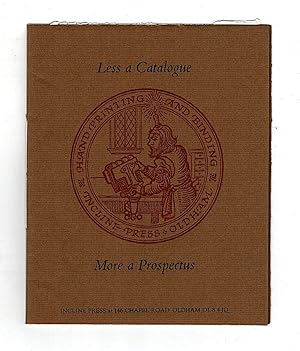
Less a Catalogue, More a Prospectus.
Published by Oldham: Incline Press, 1994., 1994
Seller: OJ-BOOKS ABA / PBFA, SOLIHULL, United Kingdom
Seller rating 4 out of 5 stars

Signed
US$ 34.35
US$ 33.35 shipping
Ships from United Kingdom to U.S.A.Quantity: 1 available
Add to basketA prospectus promoting Incline Press, its first five books, some ephemera and Incline Poetry Booklets, complete with a miniature 'Typographic Book Plates & Labels' prospectus and an Order Form. A 'PRINTSHOP REJECT | PAPER & STYLE SAMPLE | ONLY | INCLINE PRESS' tipped in. Brown printed paper wrappers with sewn pages. 7½" x 6", pp. 12 with four illustrations and other ornaments. TOGETHER WITH a handwritten letter on Press notepaper signed by Graham Moss, confirming that original blocks were used in the printing of Nursery Rhymes, the Press's first book. A prospectus in Fine condition, now housed in a clear, archival-quality, protective display pocket.
-
Preliminary Catalogue of Fixed Stars intended for a Prospectus of a Catalogue of the Stars of the Southern Hemisphere included within the Tropic of Capricorn now reducing from the Observations made in the Observatory at Paramatta [sic]
Published by Printed for Perthes and Besser, Hamburg, 1832
Seller: Hordern House Rare Books, Potts Point, NSW, Australia
Association Member: ANZAAB ILAB
Seller rating 4 out of 5 stars
Signed
Large quarto, 252 x 218 mm, pp 20, [ii], XXV; stab-sewn in the original blue-grey limp paper wrappers, with a presentation inscription on the front wrapper; preserved in a fitted quarter morocco bookform case. Very rare, a foundation work of Australian science and important in the history of world astronomy: the first Australian star catalogue, this copy inscribed by the author to Alexander Dallas Bache (1806-1867), scientist and educator, the great-grandson of Benjamin Franklin. This elusive book was probably printed in very small numbers for a specialist audience; just two copies are recorded in Australian libraries (NLA and SLNSW). Christian Carl Ludwig Rümker (1788-1862), German astronomer, arrived in England in 1809, working for the East India Company and the merchant navy, before being press-ganged into the Royal Navy in 1813. Over the next few years he began making observations, including publishing the results of work he did at Malta. Recommended with an introduction - by Captain Peter Heywood, the involuntary participant in the Bounty mutiny - to the incoming Governor of New South Wales, Thomas Macdougall Brisbane, himself a keen astronomer, he arrived as part of the official party in 1821, beginning work at Brisbane's Parramatta observatory, near Sydney, where he made several discoveries including "Encke's Comet". A bitter disagreement with Brisbane led him to resign his post, and to retreat to his new property at Picton, "Stargard". In 1826 he returned to Parramatta at the behest of Alexander Macleay, and was appointed government astronomer in December 1827, the first person to hold that title. He returned to London at the end of the decade, but another quarrel, this time with the president of the Royal Astronomical Society, Sir James South, led to Rümker finally being dismissed from British service and returning to Hamburg. Still working as an astronomer, at some point he became reconciled to Brisbane, as is shown by the present work's dedication to him as "late Governor in Chief of Australia and Founder of the Observatory at Paramatta [sic]". Rümker's later career was prolific, publishing scores of papers and being honoured with many fellowships, and continuing to work on his trail-blazing Parramatta observations. He died at Lisbon in 1862. His catalogue of stars visible in the southern hemisphere had both a purely scientific aim and a practical one. The systematic study and cataloguing of the stars visible with the aid of observatory-based telescopy in the southern hemisphere was in its infancy in the 1820s: The Royal Observatory at the Cape of Good Hope, established in 1820, was the first permanent astronomical observatory in the southern hemisphere, which points to the significance of the Parramatta Observatory being up and working by 1822. "When awarding the gold medal of the Royal Astronomical Society to Rümker, the astronomer royal, Sir George Biddell Airy, said that Rümker's dismissal was 'the greatest misfortune that happened to Southern Astronomy'" (ADB). --- On the practical side, Governor Brisbane was a naval officer who knew the importance of the stars in navigation. Rümker's work and his catalogue served both science and the Royal Navy, as he offered "Constants of Aberration and Nutation"; a "Comparison of my Observations with those made by La Caille"; and notes on "Double Stars," "Magnitudes and Colour of the Stars, Nebulas, &c" and other similar pieces. Bache, to whom Rümker presented this copy, would later play a significant role as Superintendent of the U.S. Coast Survey, which he built into the foremost scientific institution in the country before the Civil War. At the time of the presentation of this work by Rümker, however, he was a professor of natural philosophy and chemistry at the University of Pennsylvania, eventually becoming president of the college. He was "The most dominant figure in American science prior to and during the Civil War. either related to or friends with many high government officials and military and naval officers; and friend, ally, and colleague of many of the scientific luminaries of the age" (NOAA online). Interestingly, this presentation copy did not travel far from Pennsylvania as it was discovered by the dealers, since retired, Philadelphia Rare Books. They located a total of nine copies held in North American libraries. In Australia, Trove can identify just two copies, at the National Library and the State Library of NSW. Rümker, Christian Carl Ludwig (1788-1862) by G. F. J. Bergman (Australian Dictionary of Biography, Volume 2, (MUP), 1967). Christian Carl Ludwig Rümker (1788-1862), astronomer, was born on 18 May 1788 at Stargard, Mecklenburg-Strelitz, Germany, the son of J. F. Rümker, court-councillor. He showed a talent for mathematics, and his father sent him to the Builders' Academy at Berlin where in 1807 he passed the state examination as a master builder. He was disinclined to follow this trade and, after working for about two years as a teacher of mathematics in Hamburg, went to England in 1809. From 1809 to 1811 he served as a midshipman in the East India Co. and then entered the merchant navy, where he became a helmsman. Seized by a press-gang in July 1813, he accepted a position as teacher of sea cadets with officer's rank and served in H.M.S. Benbow, Montagu and Albion. In 1816 he took part in a punitive expedition against Algiers. During his Mediterranean service he made the acquaintance of Baron Franz-Xaver de Zach, an Austrian astronomer, who induced him to pursue the study of astronomy. His first publications about observations at Malta in the Edinburgh Philosophical Journal of 1819 drew the attention of other scientists to his work, with much effect on his career. Discharged from the navy in 1819 he returned to Hamburg, where he was employed as teacher at the school of navigation. Recommended to Sir Thomas Brisbane by Captain Peter Heywood, under whom he had served in the Montagu, Rümker was engaged as the.

![Seller image for Preliminary Catalogue of Fixed Stars intended for a Prospectus of a Catalogue of the Stars of the Southern Hemisphere included within the Tropic of Capricorn now reducing from the Observations made in the Observatory at Paramatta [sic] for sale by Hordern House Rare Books](https://pictures.abebooks.com/inventory/md/md31457230354.jpg)