

Order Total (1 Item Items):
Shipping Destination:

Compromises, Signed (9 results)
Skip to main search results
Search filters
Product Type
- All Product Types
- Books (9)
- Magazines & Periodicals (No further results match this refinement)
- Comics (No further results match this refinement)
- Sheet Music (No further results match this refinement)
- Art, Prints & Posters (No further results match this refinement)
- Photographs (No further results match this refinement)
- Maps (No further results match this refinement)
- Manuscripts & Paper Collectibles (No further results match this refinement)
Condition Learn more
- New (No further results match this refinement)
- As New, Fine or Near Fine (1)
- Very Good or Good (5)
- Fair or Poor (No further results match this refinement)
- As Described (3)
Binding
Collectible Attributes
Language (3)
Free Shipping
- Free Shipping to U.S.A. (No further results match this refinement)
Seller Location
Seller Rating
-
Being Married Happily Forever: 22 Secrets, 12 Strategies, and 8 Compromises
Language: English
Published by G.P. Putnam's Sons, New York, 1997
ISBN 10: 0399143211 ISBN 13: 9780399143212
First Edition Signed
Hardcover. Condition: Very Good. Dust Jacket Condition: Very Good. First Edition. BB4 - A first edition (complete numberline) hardcover book SIGNED by Tova Borgnine (first name only) and inscribed to previous owner on the front free endpaper in very good condition in very good dust jacket that is mylar protected. Dust jacket has some wrinkling, chipping and crease on the edges and corners, dust jacket and book have some bumped corners, some wrinkling on the spine edges, light discoloration and shelf wear. 9.5"x6.5", 262 pages. Satisfaction Guaranteed. Tova Borgnine (Tove Træsnæs) was a Norwegian-born American businesswoman. She was the founder of Beauty by Tova cosmetics and the widow of Hollywood actor Ernest Borgnine. Size: 8vo - over 7¾" - 9¾" tall. Signed by Author.
-
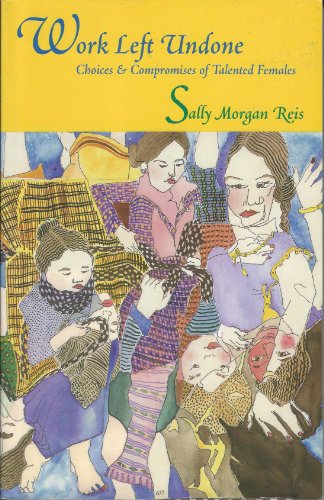
Work Left Undone: Choices & Compromises of Talented Women
Language: Chinese
Published by Creative Learning Press, Inc., 1998
ISBN 10: 0936386762 ISBN 13: 9780936386768
Signed
Trade Paperback. Condition: Very Good. Inscribed "To Meredith: To help you in your journey- Follow your dreams. Sally Reis Tute 2000." Choices and compromises of talented females. Name sticker on back cover and pink stain top of endpapers. Pages are tight and unmarked. No crease in spine. Slight edgewear. Inscribed and Signed By Author.
-

COMPROMISES
Published by Houghton, Mifflin, Boston, 1904
Seller: Second Life Books, Inc., Lanesborough, MA, U.S.A.
Association Member: ABAA ILAB SNEAB
Seller rating 4 out of 5 stars

First Edition Signed
First Edition. 8vo, pp. 277. Gray cloth, stamped in gilt. TEG. Cover lightly spotted and little scuffed at corners and ends of spine, o/w a VG tight copy. Essays.
-
Compromises of Conflicting Claims, A Century of California Law, 1760-1860
Published by Oceana, 1977
Signed
Hardcover. Condition: Good. Dust Jacket Included. Compromises of Conflicting Claims, A Century of California Law, 1760-1860, Powell, Richard R., Oceana Publications, 1977, 332p, hc w/ dj, dj bumped/scuffed/small tears, boards clean/square, CLEAN text, solid binding, SIGNED/INSCRIBED BY AUTHOR---50.00. Signed by Author(s).
-
Personalities and the Politics of European Integration: Kurt Georg Kiesinger and the Departure of Walter Hallstein, 1966/67. Sonderdruck aus: Crisis and Compromises: The European Projekt 1963-1969.
Language: English
Published by Baden-Baden, Nomos,, 2001
Seller: Göppinger Antiquariat, Göppingen, Germany
Seller rating 5 out of 5 stars

Signed
23 x 16 cm, Broschur. S. 265-284 Einband berieben und bestoßen. Handschriftliche Widmung von Philipp Gassert an Klaus Hildebrand auf dem Vorderdeckel. Sprache: Englisch Gewicht in Gramm: 550.
-
The Compromises of Life and Other Lectures and Addresses (Signed)
Published by Fox, Duffield & Company, NY,
Signed
Hardcover. Condition: Good. (October) 1903, First Printing, Good to Very Good/no dj, octavo, 478pp., blue cloth hardcover, bright gold lettering on cover & backstrip, leaf 153-154 with page-long vertical scotch-tape repair, a few pages roughly opened and some pages still uncut and unopened, gold gilt top outer leaf edges, binding tight, Presentation note Signed on front free endpaper: "To Charles R. Williams With the regards of Henry Watterson Nov 17th 1903.". Signed by Author(s).
-
THE MISSOURI COMPROMISES AND PRESIDENTIAL POLITICS 1820 - 1825 FROM THE PAPERS OF WILLIAM PLUMER, JUNIOR REPRESENTIVE FROM NEW HAMPSHIRE. (AUTOGRAPHED)
Published by Missouri Historical Society, St. Louis, 1926
First Edition Signed
Hardcover. Condition: Very Good. First Edition. ; Presentation copy: "To Edward S. Corwin with the compliments of Everett S. Brown." (Signed at the top of the front fly-leaf). Corwin taught at Princeton from 1905 to 1946 and was the author of a number of books on the United States Constitution. Not an ex-library copy. No remainder marks. Most books shipped within 24 hours. All books mailed with Delivery Confirmation. Several of the pages are uncut. The first couple of pages have a vertical crease. The boards have minor staining. Very good condition. ; Large 8vo 9" - 10" tall; xi, 155 pages; Signed by Author.
-

GRACE POUR LES OISEAUX! / ON TUE LES OISEAUX, LES INSECTES SE MULTIPLIENT, LES RECOLTES SONT COMPROMISES / ENVOI DE L'AUTEUR
Published by RULLIERE FRERES, 1912
Signed
Couverture souple. Condition: bon. R320070477: 1912. In-8. Broché. Etat d'usage, Tâchée, Dos satisfaisant, Intérieur frais. 142 pages - Nombreuses illustrations en noir et blanc in et hors texte - Taches sur le 1er plat. Coiffe en pied abimée. ENVOI DE L'AUTEUR sur la page de titre - 2 PHOTOS DISPONIBLES. . . . Classification Dewey : 598-Ornithologie.
-
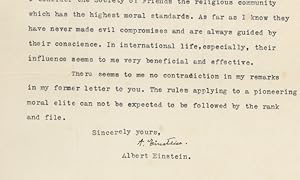
Albert Einstein, in a Critique of German Christianity's Alliance With the Nazis, Believes That?Truly Religious People?"never made evil compromises and are always guided by their conscience" (Later in life, faced with the results of war and the existential threat?of nuclear weapons, he finds likeminded peace activists?among the Quakers, who he felt set the religious example above all others in international life)
Seller: The Raab Collection, Ardmore, PA, U.S.A.
Association Member: ABAA ILAB PADA
Seller rating 4 out of 5 stars
Signed
An increasingly uncommon letter of Einstein on the role of religions, philosophy, peace, and the dangers of the atomic age (that he helped usher in)Albert Einstein believed that wars stood in the way of human progress, and he was a lifelong pacifist (though he did not believe in pacifism at any price or in all situations). He was also an active promoter of world peace, from the days of World War I right up to his death in 1955. In fact, one of his last acts before his death was to add his signature to a statement of nine scientists warning that the world risked universal annihilation unless the institution of war was abolished.?Knowing his stance, people from all over the world appealed to him to assist various causes consistent with these beliefs, and to give statements supporting individuals and groups that did so.Einstein was also not a member or follower of any organized religion. He considered himself a Jew, but was not a practicing Jew. And as for the Christian churches, he felt that it ?since Constantine has always favored the authoritarian State, as long as the State allows the Church to baptize and instruct the masses". Their conduct in the years up to World War II was worse than disappointing, he thought, as they made the devil?s bargain - the evil compromise - with the Hitler regime. Einstein addressed this saying, ?Since when can one make a pact with Christ and Satan at the same time?" He added, "The Church has always sold itself to those in power, and agreed to any bargain in return for immunity?If I were allowed to give advice to the Churches, I would tell them to begin with a conversion among themselves, and to stop playing power politics.? This idea of an evil compromise or devil's pact is central to his feelings about organized religion.There was one exception to his criticism of religions - the Quakers. Their community aims at purifying the Christian world and generating social reform by creating direct experience with God, without intervention of clergy or other expressions of church. The Quakers greatly influenced science and industry, and their community is noted for the pursuit of peace and non-violence. Thus Einstein?s views fit into their belief system. ?If I were not a Jew I would be a Quaker,? he once wrote. Speaking to a Quaker gathering in 1938, he said, "With admiration and respect I have seen, in the course of many years, how successfully and selflessly the Society of Friends has worked in the entire world to lessen human suffering and to make the teachings of Christ apply to real life. Everyone who is concerned about a better lot and a more dignified stature for humanity owes deep gratitude to the Society of Friends. This Society is an admirable testimony against the assertion that every organization by its very nature kills the spirit which has called it into life.?In 1949 the Australian pathologist Alton R. Chapple, who was a Quaker, wrote to Einstein, in the then-current climate of concern regarding the perils of the atomic age, for "a few words of leadership and hope". Einstein responded, stressing the necessity for moral courage by the individual. He said that power is often in the hands of power-loving persons who know very little restrictions when it comes to the realization of their ambitious goals; and answering negatively the question whether self-restraint on what ?productive thinkers and explorers? research might not prevent further development of means of mass destruction. He gave three main reasons: 1) The already existing means of destruction are effective enough to bring about total destruction; 2) People really devoted to the progress of knowledge concerning the physical world like Faraday or Rutherford have never worked for practical goals, let alone military goals. And nobody could know in advance what kind of application might be developed on the basis of their discoveries; and 3) People of technical skill are so numerous and so dependent economically that they cannot be expec.


