

Order Total (1 Item Items):
Shipping Destination:

Dried Specimens, Used (11 results)
Skip to main search results
Search filters
Product Type
- All Product Types
- Books (10)
- Magazines & Periodicals (No further results match this refinement)
- Comics (No further results match this refinement)
- Sheet Music (No further results match this refinement)
- Art, Prints & Posters (1)
- Photographs (No further results match this refinement)
- Maps (No further results match this refinement)
- Manuscripts & Paper Collectibles (No further results match this refinement)
Condition Learn more
- New (No further results match this refinement)
- As New, Fine or Near Fine (1)
- Very Good or Good (1)
- Fair or Poor
- As Described (9)
Binding
Collectible Attributes
- First Edition (5)
- Signed (1)
- Dust Jacket (No further results match this refinement)
- Seller-Supplied Images (10)
- Not Print on Demand (11)
Language (2)
Price
- Any Price
- Under US$ 25 (No further results match this refinement)
- US$ 25 to US$ 50 (No further results match this refinement)
- Over US$ 50
Free Shipping
Seller Location
Seller Rating
-
Dried Plant Specimens
Language: English
Published by Private, 1850
Seller: PETER FRY (PBFA), Grange- over -Sands, CUMBR, United Kingdom
Association Member: PBFA
Seller rating 5 out of 5 stars

US$ 935.36
US$ 35.65 shipping
Ships from United Kingdom to U.S.A.Quantity: 1 available
Add to basketSoft cover. Condition: Fine. Dried Plant Specimens. A delightful collection of 25 European plant specimens. Each delicately adhered to cream paper with thin strips of glued white paper. Each with neat and ornate handwritten name to lower margin.Specimens include: Gentiana Acaulis Rosenlaui, Achillea Nana, Anemone Alpina, Anemone Vernalis, Azalea Procumbens, Crocus Vernuns, Rhododendron Hissuturn, Primula Viscosa Vill, etc. Housed in contemporary blue souvenir box with gilt decoration and fabric ties. Circa 1850. Scarce item.
-

Specimens of Nice Flora; some plates with illustrations and information and some genuine dried flowers on plates
Published by Oxford: W. Baxter Bontanical Garden, 1835
First Edition
First Edition. Very good copy in quarter cloth over marble boards. Internally, plates are in very good condition. Genuine dried flowers on plates with tissue guards, well preserved. Date is suggested from date on some plates. Physical description: 6 plates with illustrations and text, 11 plates with dried flowers and tissue guards. Subjects: Flowers. Horticulture. Flowers; specimens. 3 Kg.
-

Specimens of Nice Flora; some plates with illustrations and information and some genuine dried flowers on plates
Published by Oxford: W. Baxter Bontanical Garden, 1835
First Edition
First Edition. Very good copy in quarter cloth over marble boards. Internally, plates are in very good condition. Genuine dried flowers on plates with tissue guards, well preserved. Date is suggested from date on some plates. Physical description: 6 plates with illustrations and text, 11 plates with dried flowers and tissue guards. Subjects: Flowers. Horticulture. Flowers; specimens. 1 Kg.
-
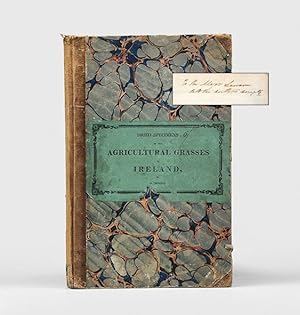
Concise Notices of the Indigenous Grasses of Ireland, Best Suited for Agriculture, with Dried Specimens of Each Kind.
Published by Mullingar: Printed by R. Purdue, 1843
Seller: Forest Books, ABA-ILAB, Grantham, LINCS, United Kingdom
Association Member: ABA ILAB PBFA
Seller rating 4 out of 5 stars

Art / Print / Poster First Edition
US$ 1,933.07
US$ 33.63 shipping
Ships from United Kingdom to U.S.A.Quantity: 1 available
Add to basketFirst edition, small folio (310 x 195 mm), [2], 8, 36 leaves of botanical drying paper containing 48 mounted specimens, each with two letterpress labels, the smaller beneath the specimen, the larger (with a detailed description printed within a greek-key decorative border) on the verso facing the specimen, collated complete with all specimens (though some are in the wrong order, i.e. no. 48 is between no. 3 and no. 4 plus a couple of similar instances), half sheep, rebacked, contemporary patterned paper boards, paper overlay over a damp patch on upper board, internally in excellent condition, with only slight signs of foxing and all specimens intact, new printed paper label to spine. The rare first edition of this most appealing publication. Privately published by John Moore the Curator of the Royal Dublin Society's Botanic Garden, Glasnevin. The second and third editions have a commercial imprint and don't look nearly as attractive and are also much more common. Such books as this are particularly rare due to the immense labour involved in their publication, and only a few copies were produced.
-
British Fungi: Consisting of Dried Specimens of the Species, Described in Vol. V., Part II. of the English Flora; together with such as may hereafter be discovered indigenous to Britain.
Published by London: Longman Rees Orme Brown Green and Longman -1843, 1836
Seller: Forest Books, ABA-ILAB, Grantham, LINCS, United Kingdom
Association Member: ABA ILAB PBFA
Seller rating 4 out of 5 stars
First Edition
US$ 2,071.64
US$ 33.63 shipping
Ships from United Kingdom to U.S.A.Quantity: 1 available
Add to basketFirst edition, 4 vols., small 4to (245 x 200 mm), printed titles and indices, 350 original mounted specimens of Fugi, with printed labels, volumes 1 and 2 contemporary morocco-backed boards (one cover detached, worn), volumes 3 and 4 publisher's boards, one lacking spine. A remarkable work in the of mycology, providing a visual and physical record of British fungi. Miles Joesph Berkeley (1803-1889), a Church of England clergyman and naturalist and to be later known as 'the father of British mycology'. He contributed the section on British fungi to Sir James Edward Smith's 'The English Flora' which was published in 5 volumes from 1824 to 1836. Here he presents the dried specimens which he had described in Smith's work. For obvious reasons fungal exsiccatae are much rarer than other species of the genus and complete set are seldom meet with. This being the only complete set to appear at auction in the past 70 years. Provenance: Andrew Fountaine library; the library of Michael Walpole (1933-2009), founding member of the Loughborough Naturalists' Club.
-
A collection of approximately 150 dried British moss specimens, 1880s & 1920s collected by Edward Step and others
Published by Unpublished 1880s-1920s, 1880
Seller: Keoghs Books, Skipton, United Kingdom
Association Member: PBFA
Seller rating 5 out of 5 stars
US$ 2,078.57
US$ 37.67 shipping
Ships from United Kingdom to U.S.A.Quantity: 1 available
Add to basket, A collection of approximately 150 dried British moss specimens from 1880s & 1920s identified as the collection of Edward Step. Some samples were exhibited by Step in 1887 and included there is a four-page typed list of British mosses and an IC & MHS exhibition card for 16 November 1887. Other 1880s collectors include W. West and J.H. Lewis. The 1920s samples came mostly from Surrey, other specimens are from Yorkshire and Ireland. All are mounted on bifolia with some folded into fascicules, mostly with ink manuscript details to upper covers, including scientific name, place and date. Edward Step (1855-1931), was an author of popular and specialist naturebooks. He wrote on botany, zoology and mycology, publishing between 1894 and 1941 (posthumously) , book boxes rubbed and worn, front joints are cracked and boards loosely held, one spine is partially detached, one lower board is water damaged, incorrect titles to front of boxes, crude labels to spines, some mounts are foxed, a few mounts are empty where specimens were not collected, one pastedown has noting in pencil, good condition , blindstamped cloth covered boxes, gilt title to front, paper title label to spine, marbled edges , 25 cm x 17 cm Book boxes ISBN:
-
Concise Notices of the Indigenous Grasses of Ireland, Best Suited for Agriculture, with Dried Specimens of Each Kind.
Published by Glasnevin: 1843, 1843
Seller: Peter Harrington. ABA/ ILAB., London, United Kingdom
Association Member: ABA ILAB PBFA
Seller rating 5 out of 5 stars
First Edition Signed
US$ 3,464.28
US$ 29.60 shipping
Ships from United Kingdom to U.S.A.Quantity: 1 available
Add to basketFirst and sole edition, presentation copy, inscribed by the author on the front free endpaper, "To the Messrs Lawson with the author's complements". An uncommon and naturally fragile work, traced in ten institutions worldwide. The Lawsons were likely the Edinburgh nurserymen Peter and Charles Lawson of Lawson & Son, founded in 1770: "prominent agricultural nurserymen of the day", whose "prizes for dissection of grasses, for kinds of cereals, and like subjects, were constant reminders of the relations of botanical study to agriculture" (Balfour, p. 47). The units "lb", "s", and "d" have been added in manuscript to each of the seed and price charts, and further minor textual corrections have been made to the sample labels. Moore (1808-1879) was the director of the Royal Dublin Society's Botanic Garden for over 40 years, including across the time of the Great Famine during which he conducted research into the potato blight. He confirmed the disease was caused by a fungus and not atmospheric conditions as was previously thought. His observations of the disease in potatoes in the Botanic Garden on 20 August 1845 are the first verified record of the disease in Ireland. The present work is part of his extensive body of research on the native grasses of the British Isles. His recommendations regarding grass species for the composition of good pasture have been cited as a precursor to contemporary techniques for ensuring varied agricultural ecosystems. Provenance: Ownership inscription of one David Black on the front free endpaper. Bookplate of the Bibliotheca Lindesiana on the front pastedown, the Balcarres shelf label with shelf mark in manuscript beneath. Isaac Bayley Balfour, A Sketch of the Professors of Botany in Edinburgh from 1670 until 1887, 1913. Small folio. With 48 grass samples mounted within paper slits, some mounted 2 to a page, with adjacent text labels printed in black within decorative frames. Woodcut depicting an auctioneer and a yacht removed from separate work and pasted to final leaf. Original half sheep, marbled paper sides, green title label printed in black to front cover, white cloth ties to both covers. Sheep stripped to spine, edges worn, boards rubbed, slight loss to title label not affecting text, foxing to contents, front inner hinge starting but firm, grass samples remarkably well-preserved and complete, a very good copy.
-
Dried specimens
Seller: Shapero Rare Books, London, United Kingdom
Association Member: ABA ILAB PBFA
Seller rating 5 out of 5 stars
US$ 1,732.14
US$ 20.18 shipping
Ships from United Kingdom to U.S.A.Quantity: 1 available
Add to basketLarge 8vo, various dried plant and flower specimens mounted onto approximately 114 leaves, each titled and numbered in manuscript, all in fine condition, leaf 22 lacks its dried flower specimen, housed green boards with black ties, corner of upper board broken; overall a fine collection of dried flowers. Attractive collection of dried specimens captioned in ink.
-
[Herbarium] 110+ dried plant specimens [Northern California] on tipped-in blanks in a repurposed 1851 Canada Business Directory
Publication Date: 1890
Seller: Boyd Used & Rare Books, Portland, OR, U.S.A.
Association Member: CBA
Seller rating 5 out of 5 stars
Hardcover. Condition: Very Good. Book repurposed as a herbarium. Embossed black leather over boards with gilt lettering on spine. A modified 692-page directory with an interleaved herbarium displaying dried plant specimens on more than 110 blank sheets. Each of the blanks has been affixed to the stub of an excised page. Specimens are evenly distributed throughout the entire book. They are typically separated by one or two original directory pages. Most specimens are intact, occasionally showing a bit of loss. Several show some crumbling or are detached. A few are fully dissipated or lost. The region of specimen collection appears to be primarily Northern California (there are a few references to Crescent City), possibly extending to Oregon (one reference). Some specimens appear to be common in Southern California. There are also a couple handwritten references to Nelson Creek (possibly in Shasta County?). The volume has no ownership identification. It was perhaps assembled by a member of a family that had emigrated from Canada to settle in California in the mid- to late-nineteenth century. The date of the creation of the herbarium is uncertain, but is likely sometime from the later-nineteenth century. [For reference, the volume was acquired in Santa Rosa, California.] The majority of specimens are identified with Latin name and occasionally common names. The identified specimens include: Buttercup, Wall Rockcress, Violet (several), Miner's lettuce, baby white eyes, baby blue eyes, Nemophila striata, fivespot, Dwarf brodiacea, Shooting star/American cowslip (Oregon), Lemon sunset, Evening primrose, Godetia, Clover, Iris, Red trillium, Elegant clarkia, Epilobium[?], Calandrinia, Mimulus/monkey flower, San Diego monkey flower, Trientalis americanis (Crescent City), Erodium, Polygonatum/Solomon's Seal, [?] conferta, Gilia capitata, Linanthus dichotomus/Evening snow, Abronia umbellata, Eryngium, Phalangium, Ranunculus/Crowfoot, Delphinium/Larkspur (Nelson Creek), Bartsia alba, Castilleja (three), Silene[?], Phlox, Salal, Cyclobothra, Calathea lutean, Isatis, Dicentra formosa, Linaria/Toadflax, Hydrocotyle/Water pennyworts, Anagallis arvensis/Scarlet pimpernel, Hypericum/St John's wort, Lupinus, Silver Bush lupine, Erythronium americanum/Yellow trout lily, and Medicago sativa/alfalfa.
-
![Seller image for McCrackan, Rev. John Henry (1856-1906); [Rondthaler, Rev. Edward, Bishop] (1842-1931). Historically Significant Journal with 59 Original Albumen Snapshot Photographs, Nine Printed Postcards, and Over a Dozen Specimens of Dried Flowers and Plants, Illustrating a Travel of an American Episcopal Clergyman John McCrackan and a Moravian Pastor from North Carolina Edward Rondthaler around Palestine in April - May 1889. for sale by Globus Rare Books & Archives](https://pictures.abebooks.com/inventory/md/md32016294947.jpg)
McCrackan, Rev. John Henry (1856-1906); [Rondthaler, Rev. Edward, Bishop] (1842-1931). Historically Significant Journal with 59 Original Albumen Snapshot Photographs, Nine Printed Postcards, and Over a Dozen Specimens of Dried Flowers and Plants, Illustrating a Travel of an American Episcopal Clergyman John McCrackan and a Moravian Pastor from North Carolina Edward Rondthaler around Palestine in April - May 1889.
Publication Date: 1889
Seller: Globus Rare Books & Archives, San Francisco, CA, U.S.A.
Seller rating 5 out of 5 stars
None. Condition: None. Small Octavo (ca. 19,5x12,5 cm or 7 ¾ x 4 ¾ in). 67 watermarked creamy laid paper leaves (8 blank). With 59 mounted original abumen photos from ca. 8x11 cm (3 x 4 ¼ in) to ca. 4x10,5 cm (1 ½ x 4 in). All photos with period manuscript ink captions by McCrackan on the mounts; most photos are also with manuscript ink dates from March to August 1889; ca. eight photos are also captioned in negative. With eight mounted period printed postcards with the views of the Holy Land and one loosely inserted printed postcard, filled in by McCrackan from the "Prussian Hospice, Jerusalem" and sent to "Misses McCrackan, Firenze, Italia." With over a dozen dried specimens of flowers and leaves of the Palestinian plants, mounted on the leaves, a loosely inserted keepsake card, or pieces of card in the envelope, mounted on the last leaf. Period presentation inscription on the first leaf: "To my dear Aunts from John. June 16, 1889." Period black full sheep journal with decorative gilt-lettered borders on both boards and the spine; decorative endpapers; all edges coloured. One photo with a crease, a couple of photos mildly faded, but overall a very good journal with interesting strong photos. Historically significant original journal with 59 rare albumen snapshot photographs, supplemented with detailed manuscript captions, printed postcards and dried plant specimens, which comprise the account of an 1889 trip to the Holy Land by two American clergymen. The journal was compiled by John Henry McCrackan, a member of the Episcopal Church in the United States, who then served as an assistant at the Christ Church Cathedral in Hartford, Connecticut. According to the inscription on the first leaf, it was most likely presented to McCrackan's wife, Cora Gertrude Bailey (1862-1924). The photographs and accompanying materials cover the period from March to August 1889, including McCrackan's travel to Palestine on April 10 - May 16. He left Naples on April 3, arrived in Jaffa a week later and stayed in Jerusalem for two weeks, celebrating Easter (April 21) and visiting Bethany and the Mount of Olives. On May 3 - 16, McCrackan travelled to Nazareth and the Sea of Galilee and back via Mount Carmel and Haifa. During that journey, he was accompanied by a noted Moravian pastor and future bishop of the Salem Moravian Congregation (since 1891), Edward Rondthaler, who visited the Holy Land with his son, Howard Edward Rondthaler (1871-1956). Over a dozen images show Jerusalem, its environs and inhabitants: "Bab el Wady - Gate of the Valley - halfway between Jaffa and Jerusalem," the interior of the Anglican Christ Church during the "Holy Week and Easter Day," the Mount of Olives and the Garden of Gethsemane, general views of Jerusalem taken from the upper and lower road to Bethany, Bethany (general view, the house of Martha and Mary, the tomb of Lazarus) and the interior of "chapel of pastor Schnaller, Bethlehem." There are also portraits of "Herr Kaminitz and family" (the owner of Hotel Jerusalem), a young waiter in the same hotel, "Bayer and family" (the owner of the Prussian Hospice in Jerusalem), and "two women grinding at the mill, Jerusalem" (an illustration to the words of Jesus from the Gospel of Matthew). Over thirty photos illustrate the trip to Nazareth and the Sea of Galilee and show biblical Shiloh and the site of Jacob's Well near Nablus (both in modern-day West Bank), Rev. Edward Rondthaler posing inside the Jacob's Well, a Nablus missionary "Mr. Carey" (posing with his family, inside the church and with his parish), the ruins of Samaria (Sebastia, West Bank), the spring at Sileh et Dahr north of Samaria, and Jezreel and Shunem (Yizre'ela and Sulam, both in north-eastern Israel). The other photos were taken in famous towns and villages, related to Jesus's ministry around the Sea of Galilee and show Keffr-Kenna (biblical Cana), "Kurun Hattin, Horns of Hattin, called the Mount of the Beatitudes" (Lower Galilee), "Jordan entering the Sea of Galilee," Capernau.
-
Herbier Parlant. Cet herbier, de 400 plantes Cryptogames et Phanrogames, se prsente comme un petit trait de botanique descriptive, illustr par des plantes sches, conserves sous sachets de cellophane. One of the rarest ÒpublicationsÓ in recent botanical literature. It consists of 16 ÒfasciculesÓ issued from June 1969 to December 1973. Each fascicule contains ca. 25 dried specimens of plant species, wrapped in cellophane, in a folding descriptive wrapper. During the first fascicule, the authors also thought to include a colour print of the plant concerned, but abandoned the idea during this first fascicule (probably because it would become too large an undertaking). One fascicule (no. 2, containing 25 specimens) is missing.
Seller: Backhuys Biological Books, Kerkwerve, Netherlands
Seller rating 5 out of 5 stars
US$ 1,017.48 30% offUS$ 712.24
US$ 21.79 shipping
Ships from Netherlands to U.S.A.Quantity: 1 available
Add to basketSold with all and any faults or missing parts 0.0.



![Seller image for [Herbarium] 110+ dried plant specimens [Northern California] on tipped-in blanks in a repurposed 1851 Canada Business Directory for sale by Boyd Used & Rare Books](https://pictures.abebooks.com/inventory/md/md32303543965.jpg)
