

Order Total (1 Item Items):
Shipping Destination:

Esther Scroll, Used (35 results)
Skip to main search results
Search filters
Product Type
- All Product Types
- Books (33)
- Magazines & Periodicals (No further results match this refinement)
- Comics (No further results match this refinement)
- Sheet Music (No further results match this refinement)
- Art, Prints & Posters (No further results match this refinement)
- Photographs (No further results match this refinement)
- Maps (No further results match this refinement)
- Manuscripts & Paper Collectibles (2)
Condition Learn more
- New (No further results match this refinement)
- As New, Fine or Near Fine (6)
- Very Good or Good (8)
- Fair or Poor
- As Described (21)
Binding
Collectible Attributes
- First Edition (4)
- Signed (2)
- Dust Jacket (No further results match this refinement)
- Seller-Supplied Images (21)
- Not Print on Demand (35)
Language (4)
Free Shipping
Seller Location
Seller Rating
-

Treasures of Jewish Art: The 1673 Illuminated Scroll of Esther Offered to a Romanian Hierarch
Language: English
Published by Center for Romanian Studies, 2002
ISBN 10: 9739432387 ISBN 13: 9789739432382
Hardcover. Condition: Very Good. No Jacket. May have limited writing in cover pages. Pages are unmarked. ~ ThriftBooks: Read More, Spend Less.
-

Catalogue of Valuable Hebrew Printed Books. The Property of the Valmadonna Trust (sold by order of the Trustees) and an Important Illustrated Manuscript Scroll of Esther, The Property of the Athenaeum, Liverpool Tuesday, 20th April, 1982, Wednesday, 21st April, 1982, at their Grosvenor Saleroom, London
Published by Sotheby Parke-Bernet & Co., London, 1982
Seller: Henry Hollander, Bookseller, Los Angeles, CA, U.S.A.
Seller rating 4 out of 5 stars

Softbound. Condition: Very Good-. Royal octavo with mild wear to the green printed boards, 144 pp., b/w and a color illustration of some of the 376 items described, index.
-

The Perfect Scribe and an Early Engraved Esther Scroll. An original article from The British Library Journal, 1997.
Published by British Library, London, 1997
US$ 12.02
US$ 15.96 shipping
Ships from United Kingdom to U.S.A.Quantity: 1 available
Add to basketBooklet - Unbound Pages. Condition: Very Good. 13 pages, 3 figures. An authentic standalone article, extracted from a larger volume. Not a reprint or reproduction, but an original work in its own right. Supplied without title page or cover. Size: 19 x 24cms. Category: British Library Journal; Cosmo Books : 29 years on ABE, 47 years taking care of customers. A bookseller you can rely on.
-
![Seller image for Valuable Hebrew printed books, the property of the Valmadonna Trust, and an important illustrated manuscript scroll of Esther, the property of the Athenaeum, Liverpool. [ Sotheby Parke Bernet & Co., auction catalogue, sale date: 20-21 April, 1982 ]. for sale by Wykeham Books](https://pictures.abebooks.com/inventory/md/md32219303335.jpg)
Valuable Hebrew printed books, the property of the Valmadonna Trust, and an important illustrated manuscript scroll of Esther, the property of the Athenaeum, Liverpool. [ Sotheby Parke Bernet & Co., auction catalogue, sale date: 20-21 April, 1982 ].
Published by Sotheby Parke Bernet & Co., London, illustrated auction catalogue for the sale held on 20th-21st April, 1982, 1982
Seller: Wykeham Books, LONDON, United Kingdom
Seller rating 4 out of 5 stars
First Edition
US$ 12.44
US$ 20.12 shipping
Ships from United Kingdom to U.S.A.Quantity: 1 available
Add to basketLaminated printed boards, small 4to, 137 pp, plates, ills. 375 lots. From the foreword: "A notable recent acquisition was that of Westminster Abbey's complete set of the Bomberg Talmud in its original binding. Sixteen volumes of this extremely rare original edition have thus been made available for inclusion in this sale. In addition to these, a strong representation of some of the least common Hebrew books has been selected for sale, including works printed in Basle, Bologna, Constantinople, Cracow, Fano, Ferrara, Isny, Lublin, Mantua, Prague, Rimini, Riva di Trento, Sabbioneta, Saloniki, Thiengen, Venice and Verona. The subjects covered include Bibles, Rabbinic Codes, Responsa, Grammars, Kabbalah, Liturgy, Philosophy and Science. Most of the great Hebrew classics, such as Bechayei, Crescas, Gersonides, Kimchi, Levita, Abarbanel, Maimonides, Nachmanides, Yehuda Ha'Levi, Sa'adya Gaon, Yakov Ben Asher, Yehuda Liwa Ben Bezalel, Shlomo Luria, Moshe Isserles, Joseph Karo, Menasseh Ben Israel, and many others are represented here in some of the rarest editions. It would be otiose to expand upon the events in Jewish history which have contributed to the scarcity of surviving books from earlier centuries and to the damaged condition of many of the furvivors. It is sufficient to say that the collection now being offered is the most notable to have appeared on the market since the sales in 1970 of the printed books collected by David Solomon Sassoon. " Indexed. Boards a little rubbed. List of estimates laid in.
-
Valuable Hebrew printed books. The property of the Valmadonna Trust, and an important illustrated manuscript scroll of Esther,: 20 & 21 April, 1982
Published by Sotheby's, London, 1982
Seller: Schoen Books, South Deerfield, MA, U.S.A.
Association Member: SNEAB
Seller rating 2 out of 5 stars

Condition: Good. Location:907 137 pages does not include prizes realized crown and base of spine torn some whiting to cover 907.
-

Condition: As New. Unread book in perfect condition.
-
Valuable Hebrew Printed Books, the Property of the Valmadonna Trust & an Important Illustrated Manuscript Scroll of Esther.
Published by London April, 1982
US$ 13.13
US$ 26.16 shipping
Ships from United Kingdom to U.S.A.Quantity: 1 available
Add to basketHb. illustrated. Estimates. Sl. Scuffed G+.
-
[Postcard] Esther scroll
Language: Hebrew
Published by Skinner, Boston, Massachusettes, 1996
Manuscript / Paper Collectible
No Binding. Condition: Very Good. No Jacket. 15 x 11 cm. Divided back. Postally used.
-
Esther Scroll : The Story of the Story
Language: English
Published by Sheffield Academic Press, 2009
ISBN 10: 056757864X ISBN 13: 9780567578648
Condition: As New. Unread book in perfect condition.
-

Esther Scroll: Its Genesis, Growth and Meaning (Jsot Supplement Series #30)
Language: English
Published by Continuum International Publishing Group - Sheffie, 1984
ISBN 10: 0905774663 ISBN 13: 9780905774664
Condition: Good. Most items will be dispatched the same or the next working day. A copy that has been read but remains in clean condition. All of the pages are intact and the cover is intact and the spine may show signs of wear. The book may have minor markings which are not specifically mentioned.
-
Whole Megilla : Reading the Tractate on the Scroll of Esther in the Babylonian Talmud
Seller: GreatBookPricesUK, Woodford Green, United Kingdom
Seller rating 5 out of 5 stars

US$ 55.70
US$ 20.12 shipping
Ships from United Kingdom to U.S.A.Quantity: 4 available
Add to basketCondition: As New. Unread book in perfect condition.
-
Esther Scroll : The Story of the Story
Language: English
Published by Sheffield Academic Press, 2009
ISBN 10: 056757864X ISBN 13: 9780567578648
Seller: GreatBookPricesUK, Woodford Green, United Kingdom
Seller rating 5 out of 5 stars
US$ 67.35
US$ 20.12 shipping
Ships from United Kingdom to U.S.A.Quantity: Over 20 available
Add to basketCondition: As New. Unread book in perfect condition.
-

Catalogue of Valuable Hebrew Printed Books and an Important Illustrated Manuscript Scroll of Esther
Published by Sotheby Parke Bernet and Co., London, 1982
Seller: PsychoBabel & Skoob Books, Didcot, United Kingdom
Seller rating 5 out of 5 stars
US$ 26.25
US$ 16.77 shipping
Ships from United Kingdom to U.S.A.Quantity: 1 available
Add to basketHardcover. Condition: Good. Hardcover auction catalogue, no dust jacket. Auction held at 11am, April 20-21, 1982. Wear to board edges and bumps to corners and spine ends, plus a few light scores and marks to front and rear. Light foxing to page block. Contents clean, spine tight. AD. Used.
-
US$ 34.48
US$ 26.16 shipping
Ships from United Kingdom to U.S.A.Quantity: 1 available
Add to basketHardcover. Spine Scuffed. Good.
-
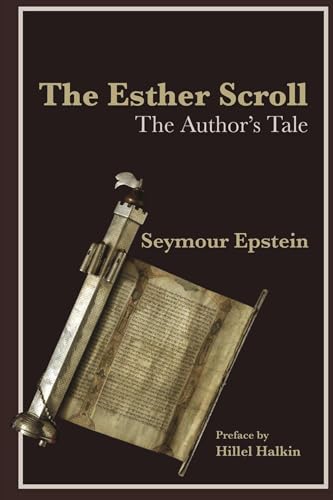
The Esther Scroll : The Author's Tale
Language: English
Published by Chicago Review Press Inc DBA Indepe, 2019
ISBN 10: 1771614684 ISBN 13: 9781771614689
Condition: Hervorragend. Zustand: Hervorragend | Sprache: Englisch | Produktart: Bücher | Seymour Epstein's The Esther Scroll: The Author's Tale is a bold thesis and a radically new interpretation of The Book of Esther that contends it was written neither as light comedy, nor as sacred history, nor as a romance, nor as a handbook for Jewish survival in the Diaspora. Rather, it is a satire on Jewish life in the Diaspora. "Epstein's argument stands all previous readings of Esther on their head" (Hillel Halkin, from the Preface).
-
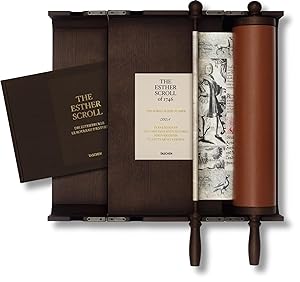
The Esther Scroll of 1746 - Facsimile, almost 21 feet long - NEW
Language: English
Published by Publisher Taschen America Llc, Los Angeles, 2013
ISBN 10: 3836517787 ISBN 13: 9783836517782
Seller: Rare Books Honolulu, Honolulu, HI, U.S.A.
Association Member: IOBA
Seller rating 5 out of 5 stars
Manuscript / Paper Collectible First Edition
Scroll in wooden case. Condition: NEW in original box. First edition, limited to 1746 copies. NEW in publisher's original box -unopened. --- --- --- --- Taschen America, 2013, text in English, German, French, Hebrew. Limited Collector's Edition of 1,746 copies, with a gilt-edged commentary volume. Facsimile scroll almost 21 feet long, in a handcrafted walnut-veneer display case 23 x 13 inches (64.2x33.5 cm), 16.3 pounds (6.4 kg), -- Please ask for shipping cost before ordering -- Richly illustrated continuous text, 6.5 m (over 21 ft) long, unfurls right to left from a leather-bound cylinder -- Clothbound and gilt-edged commentary volume by Falk Wiesemann contains an introductory essay, the biblical text of the Book of Esther in four languages and a fold-out sheet with an overview of all the illustrations with commentary volume by Falk Wiesemann in English, German, Hebrew and French, 194 pages --- A publishing triumph, this reproduction of the Esther Scroll, held by the Gottfried Wilhelm Leibniz Bibliothek in Hanover, is a richly illustrated continuous text. The original manuscript, measuring almost 7 meters long, forms the core and heart of the Jewish festival of Purim and is a unique artifact depicting the story of Esther in contemporary German, the only one of its kind. Delivered in a handcrafted walnut-veneer display case, this is a truly divine reading experience. --- Scrolling through history: A true discovery: The Esther Scroll of 1746. The use of scrolls dates back to ancient times, and one of the best known examples in history is the Esther scroll, or Hebrew megillah, which is devoted solely to the story of Queen Esther and is read on the feast of Purim. An uninhibitedly joyful festival, Purim celebrates the salvation of the Jews in the Persian empire of the 5th century under the rule of King Xerxes I. The word Purim is derived from the Hebrew "pur," meaning "lot," and refers to the fact that the Persian minister Haman determined by lot the time that all Jews should be destroyed. This circumstance, related in the Hebrew Bibles Book of Esther, is publicly read out from the megillah in the synagogue at Purim.TASCHENs facsimile of the Esther scroll is a major achievement in publishing history. It is produced from the very fine manuscript scroll held by the Gottfried Wilhelm Leibniz Bibliothek in Hanover, dated 1746 and measuring 6.5 meters long; this particular megillah is stunning not only in terms of its lavish illuminations but also because it contains a contemporary German version of the story of Esther. For many centuries, the creator of the Hanover scroll was unknown. Piecing together information from various sources, and performing his own stylistic analysis of this and other works of art from the period, author Falk Wiesemann recently made an enthralling discovery: the artist of the Hanover scroll was Wolf Leib Katz Poppers, a Jewish scribe and illustrator from Hildesheim.Limited edition of only 1,746 copiesFacsimile scroll in a handcrafted walnut veneer display caseRichly illustrated, continuous text, 6.5 m (over 21 ft) long, unfurls right to left from a leather-bound cylinderCloth-bound and gilt-edged commentary volume by Falk Wiesemann contains an introductory essay, the biblical text of the Book of Esther in four languages and a fold-out sheet with an overview of all the illustrations.
-

Sotheby's. Catalogue of Valuable Hebrew Printed Books. The Property of the Valmadonna Trust (sold by order of the Trustees) and an Important Illustrated Manuscript Scroll of Esther, The Property of the Athenaeum, Liverpool Tuesday, 20th April, 1982, Wednesday, 21st April, 1982, at their Grosvenor Saleroom, London
Published by London: Sotheby Parke-Bernet & Co., 1982
Seller: Symonds Rare Books Ltd, London, United Kingdom
Seller rating 1 out of 5 stars

First Edition
US$ 27.64
US$ 40.25 shipping
Ships from United Kingdom to U.S.A.Quantity: 1 available
Add to basketHardcover. Condition: Very Good. 1st Edition. 8vo (24.5 x 18 cm); 137, [5] pp.; 376 total lots; including index of towns and printers; estimates slip loosely inserted. Facsimile illustrations throughout, in colour and b/w. Original green printed boards; slight shelf-wear; corners and edges slightly worn. Overall, a very good copy.
-
The Scroll of Esther - Illustrated by Itzhak Tordjman.
Published by Tsofia & Milta Publications, Jerusalem, 2005
RARE edition of the Scroll of Esther in Hebrew illustrated with original paintings by J.Itzhak Tordjman (b.1956) in watercolor and mixed techniques on parchment (Collection Jack and Rachel Gindi, Los Angeles). The introduction is in English. 290x260mm. 6 text pages +12 scroll pages. Illustrated Hardcover. Cover rubbed. Cover upper corners slightly bumped. Spine edges bumped. This exquisitely illustrated edition of the Scroll of Esther is in very good condition. The book is in : Hebrew English.
-
Esther Scroll (on Wood Spindle)
Published by [18th Century?]
Seller: ERIC CHAIM KLINE, BOOKSELLER (ABAA ILAB), Santa Monica, CA, U.S.A.
Seller rating 3 out of 5 stars

Scroll. Sephardic or Mizrahi style Esther scroll, on wood spindle, measuring 11.5" tall in total. Parchment measuring approx. 5.5" tall. Minor hand corrections to the text. Brown leather tie, attached to the parchment. Spindle only, not in case.
-
Esther Scroll (Megilat Esther) Illuminated Manuscript [UNIQUE, 1/1]
Published by Jerusalem, 2002
Seller: ERIC CHAIM KLINE, BOOKSELLER (ABAA ILAB), Santa Monica, CA, U.S.A.
Seller rating 3 out of 5 stars
Scroll. Condition: Near fine condition. Housed in a custom felt covered case, in dark blue with silver lettering and decorations. A unique and beautiful Esther scroll created by Israeli artist Enya Keshet, with calligraphic manuscript text in Hebrew on soft vellum, backed in black velvet. The scroll opens with a large image of King Achashverosh in his court, in the side margin and followed by an additional fifteen bold 3.5x4" multi-colored and gilt accented vignettes of scenes from the Book of Esther along the bottom margin of the text. The illustrations have been done in a folkloric style, based on the tradition of illuminated images from 11th century Georgia. An additional prominent feature of the scroll is its inclusion of elaborate gilt accented floral and Star of David paper-cut motifs cut into the vellum, along the bottom and top margins. These paper-cuts are a defining feature of the work of the Israeli artist Enya Keshet. Each text section comprises 28 lines, framed in gold borders. Melech megilah with torah-style text in the Ashkenazi tradition. When full rolled out the scroll measures nearly 9' long and 1 1/4' tall. The very end of the scroll contains the artist's perforated signature, date and phrase "Megilot Yerushalim", all in Hebrew in the side margin. A gorgeous modern Esther Scroll lettered, decorated and illustrated in an elegant hand.
-
Megilat Esther (Scroll of Esther) [SIGNED]
Published by Avner Moriah, Jerusalem
Seller: ERIC CHAIM KLINE, BOOKSELLER (ABAA ILAB), Santa Monica, CA, U.S.A.
Seller rating 3 out of 5 stars
Signed
Scroll. Condition: fine. Limited edition. 1/180. The work is a scroll, measuring a total of 10.5x1.5', rolled up and housed in an oblong lidded decorative box. The box measures 6.5x 6.5x 20.5", in brown-beige and red leather, decorated with gilt-stamped lettering, illustrations, tooling and motifs. Interior of the box in red leather with addition decorative motifs in gilt. The scroll is #23 of a limited number 180 copies, hand-numbered and signed by the artist in pencil in the margin on the left edge, at the end of the scroll. This digital printing (printed on a Epson 9900) lavishly reproduces the original vibrant work of artist Avner Moriah in illustrating the biblical Book of Esther in stunning detail. This is the largest of three different versions of the scroll he painted between 2003 and 2005. The scroll, starting from right to left, following the Hebrew tradition, begins with a section of small amusing vignettes, displaying the central characters and other groups of people in the story, and acts as a sort of key for identifying the main forces and players within the Esther story. Block sections from the text of the scroll are reproduced in lovely calligraphy by Izzy Pludwinsky, and are surrounded and enveloped by the illustrations, creating a sense of unity between the text and the artwork. Moriah's work here, contains deep and bold hues of blues, oranges and reds, giving a sense of dynamic life, vibrancy and sensuality to the paintings with great contrasts in light and shadowed sections. The cityscapes and interiors inhabited by the characters, display detailed and ornate Islamic, and middle-eastern style geometrical patterns, motifs and architecture giving a real sense of time and place. The artist constantly plays with the viewer's perspective, with central characters oriented directly or indirectly facing the viewer giving a sense of immediacy. Interiors and landscapes stretch off away from the viewer into distant horizons which flow into expressive backgrounds, depicting castles, mountains, rugged cliffs, clouds, night skies and fire. The content of the text is rendered in simple scenes that get directly to the heart of the action, and easily convey meaning. Text in Hebrew. Lid of baox with minor scuffing. Scroll in fine condition.
-
[Esther Scroll housed in silver decorative case, untitled].
Published by Jerusalem Bezalel Circa, 1920
Seller: Shapero Rare Books, London, United Kingdom
Association Member: ABA ILAB PBFA
Seller rating 5 out of 5 stars
US$ 5,250.93
US$ 20.12 shipping
Ships from United Kingdom to U.S.A.Quantity: 1 available
Add to basketOriginal manuscript on vellum, text arranged in 14 lines, in Hebrew script, scroll housed in an elaborately decorated silver filigree case (stamped 'Made in Palestine 935'), set with five semiprecious stones (presumed Carnelian stone); scroll height 600 mm, case height 220 mm, engraved with 'Jerusalem' signature, in Hebrew. A beautiful example of a Bezalel Megillah housed in a silver case with elaborate filigree and semiprecious stones. The Bezalel school was founded in 1906 in Jerusalem by the artist and professor Boris Schatz and was the first art school to be established in the Holy Land in the 20th century. Schatz (who discussed his vision of opening an art school in the Land of Israel with Herzl when the two met in Vienna in 1903), chose to call the school Bezalel after the biblical artist Bezalel ben Uri ben Hur, mentioned in the book of Exodus as the artist chosen by God to build the Tabernacle (HaMishkan in Hebrew). According to the scripture this artist worked in silver, gold, copper, stone and wood. By founding the school Schatz aimed to establish a national style of art, blending classical Jewish, European and Middle-Eastern traditions. In addition to traditional sculpture and painting training, the school ran craft workshops that produced decorative objects in silver, leather, wood, brass and fabric, which were sold at exhibitions in Europe and the United States. Schatz's school was closed in 1929 and then reopened in the mid 1930s as the New Bezalel. In 1955 the school received its official academic acclaim and today the Bezalel Academy of Art and Design is Israel's national school of art, as well as its oldest higher education institution. The art created by Bezalel's students and professors in the first decades of the 20th century is considered the stepping stone for Israeli visual arts. The Book of Esther is part of Ketuvim (Writings), the third section of the Hebrew Bible. It tells the story of a Jewish girl named Esther who became queen of Persia and thwarted a plan by Haman to commit genocide against her people. Also called The Megillah, the book is the basis and an integral part of the Jewish celebration of Purim. Its full text is read aloud twice during the celebration, in the evening and again the following morning. Besides Song of Songs, it is the only book in the Bible that does not explicitly mention God. 'Since the Talmudic period it has been customary to write the Book of Esther on parchment in the form of a scroll, and the rules governing its production and writing are basically the same as those for a traditional Torah scroll. It is not known when and under what circumstances artistic embellishment of Esther scrolls began. The earliest extant illuminated examples emanate from 16th-century Italy, commissioned by well-to-do Italian Jews.' (Encyclopaedia Judaica).
-
[Esther Scroll housed in silver decorative case, untitled].
Published by Jerusalem Bezalel Circa, 1920
Seller: Shapero Rare Books, London, United Kingdom
Association Member: ABA ILAB PBFA
Seller rating 5 out of 5 stars
US$ 2,901.83
US$ 20.12 shipping
Ships from United Kingdom to U.S.A.Quantity: 1 available
Add to basketOriginal manuscript on vellum, text arranged in 11 lines, in Hebrew script, scroll housed in an elaborately decorated silver filigree case (unstamped), scroll height 310 mm, case height 140 mm, engraved with 'Bezalel Jerusalem' signature, in Hebrew. A beautiful example of a Bezalel Megillah housed in a silver case with elaborate filigree, surmounted by a crown. The Bezalel school was founded in 1906 in Jerusalem by the artist and professor Boris Schatz and was the first art school to be established in the Holy Land in the 20th century. Schatz (who discussed his vision of opening an art school in the Land of Israel with Herzl when the two met in Vienna in 1903), chose to call the school Bezalel after the biblical artist Bezalel ben Uri ben Hur, mentioned in the book of Exodus as the artist chosen by God to build the Tabernacle (HaMishkan in Hebrew). According to the scripture this artist worked in silver, gold, copper, stone and wood. By founding the school Schatz aimed to establish a national style of art, blending classical Jewish, European and Middle-Eastern traditions. In addition to traditional sculpture and painting training, the school ran craft workshops that produced decorative objects in silver, leather, wood, brass and fabric, which were sold at exhibitions in Europe and the United States. Schatz's school was closed in 1929 and then reopened in the mid 1930s as the New Bezalel. In 1955 the school received its official academic acclaim and today the Bezalel Academy of Art and Design is Israel's national school of art, as well as its oldest higher education institution. The art created by Bezalel's students and professors in the first decades of the 20th century is considered the stepping stone for Israeli visual arts. The Book of Esther is part of Ketuvim (Writings), the third section of the Hebrew Bible. It tells the story of a Jewish girl named Esther who became queen of Persia and thwarted a plan by Haman to commit genocide against her people. Also called The Megillah, the book is the basis and an integral part of the Jewish celebration of Purim. Its full text is read aloud twice during the celebration, in the evening and again the following morning. Besides Song of Songs, it is the only book in the Bible that does not explicitly mention God. 'Since the Talmudic period it has been customary to write the Book of Esther on parchment in the form of a scroll, and the rules governing its production and writing are basically the same as those for a traditional Torah scroll. It is not known when and under what circumstances artistic embellishment of Esther scrolls began. The earliest extant illuminated examples emanate from 16th-century Italy, commissioned by well-to-do Italian Jews.' (Encyclopaedia Judaica).
-
![Seller image for [Esther Scroll housed in silver gilt decorative case, untitled]. for sale by Shapero Rare Books](https://pictures.abebooks.com/inventory/md/md30021882537.jpg)
[Esther Scroll housed in silver gilt decorative case, untitled].
Published by Balkan 19th century
Seller: Shapero Rare Books, London, United Kingdom
Association Member: ABA ILAB PBFA
Seller rating 5 out of 5 stars
US$ 10,363.68
US$ 20.12 shipping
Ships from United Kingdom to U.S.A.Quantity: 1 available
Add to basketScroll on parchment, housed in a silver gilt case (unstamped); scroll height 7 cm., case height 19 cm. Original manuscript on vellum, text arranged in 15 lines, in Hebrew Sephardic Script. A red bead decorating the top of the case. The Book of Esther is part of the Ketuvim (The Writings), the third section of the Hebrew Bible. It tells the story of a Jewish girl named Esther who became queen of Persia and thwarted a plan by Haman to commit genocide against her people. Also called The Megillah, the book is the basis and an integral part of the Jewish celebration of Purim. Its full text is read aloud twice during the celebration, in the evening and again the following morning. Besides Song of Songs, it is the only book in the Bible that does not explicitly mention God. 'Since the Talmudic period it has been customary to write the Book of Esther on parchment in the form of a scroll, and the rules governing its production and writing are basically the same as those for a traditional Torah scroll. It is not known when and under what circumstances artistic embellishment of Esther scrolls began. The earliest extant illuminated examples emanate from 16th-century Italy, commissioned by well-to-do Italian Jews' (Encyclopaedia Judaica).
-
The Ganze Megillah (Scroll of Esther) [SIGNED]
Published by Avner Moriah, Jerusalem, 2017
Seller: ERIC CHAIM KLINE, BOOKSELLER (ABAA ILAB), Santa Monica, CA, U.S.A.
Seller rating 3 out of 5 stars
First Edition Signed
Hardcover. Condition: fine. Limited first edition. 1/100. Oblong Folio. 15x21.5". Beige clamshell box. Illustrated ceramic tile with gilt overlays and gold-brown lettering, mounted in a debossed cutout on the front cover. The box houses an illustrated leporello of the Book of Esther. This "Ganze Megilah", contains the entire contents of Avner Moriah's lavishly illustrated version of the Scroll of Esther, comprised of 20 sheets (panels) on Arsh paper, hinged with leather tape, each measuring approximately 21x14". The work reproduces the vivid colors of the original, painted in gouache and gold leaf, depicting scenes from the story to accompany the masterful calligraphy by Izzy Pludwinsky. The text appears below the illustrations. The cover panel depicts the cityscape of Shushan, and is followed by the first illustrated panel showing vignettes which act as a key to identifying the of the main characters of the story. The opening scenes of the king's feast are full of vivid color, and are densely populated with numerous figures. Throughout the work Moriah imbues the action scenes, tableaus and cityscapes with life and and vibrancy. The backgrounds are in lighter hues, and convey a wonderful sense of place and atmosphere. Lushly decorated interior scenes are filled with finely detailed and ornate Islamic-style geometric and floral designs, surrounding and engulfing the characters. The content of the text is rendered in simple scenes that get directly to the heart of the action, and easily convey meaning. When entirely folded out, the panels have total length of approximately 36 feet. The leporello is accompanied by a printed booklet in white sewn wrappers on textured paper, with gold-brown lettering on the front cover. This booklet discusses the production of the work, the artists biography, the contents of the Esther story, and contains an English translation of the Hebrew text of each of the 18 story panels. The publication is #5 of a limited number of 100 copies, from a total edition of 180, hand-numbered and signed on the final panel by the artist. This is the fifth and most recent time that the Book of Esther has been illustrated by Avner Moriah. The printing was supervised by the artist and Yair Medina, at the Jerusalem Fine Art Prints Workshop, under the Digigraphie standards, using an Epson 9900 Printer. Text in Hebrew and English. Box, binding and interior in fine condition overall.
-

The Esther Scroll. The author`s Tale.
Seller: Librería Anticuaria Antonio Mateos, Malaga, MA, Spain
Seller rating 5 out of 5 stars
The Esther Scroll. The author`s Tale.Oakville, Mosaic Press, 2019, 23 x 15 cm., cartulina editorial, 145 págs. Varios.
-
The Esther Scroll. Die Estherrolle. Le Rouleau d`Esther. Kommentarband. Herausgegeben von Falk Wiesemann
Language: German
Published by Köln, Taschen,, 2012
144, 39 S., sehr zahlreiche farbige Abbildungen, 2 Klapptafeln, Kommentar zur gleichzeitig erschienen Faksimileband. Umfangreicher und herrlich bebildeter Kommentar zur Estherrolle von Wolf Poppers aus dem Jahr 1746, dem Meisterwerk jüdischer Buchkunst. Texte in deutsch, englisch, französisch und hebräisch Sprache: Deutsch Gewicht in Gramm: 0 Querformat, Leinen, Rundumgoldschnitt, tadelloses Exemplar.
-
Esther Scroll (with Decorative Olive Wood Case)
Published by Jerusalem, 1948
Seller: ERIC CHAIM KLINE, BOOKSELLER (ABAA ILAB), Santa Monica, CA, U.S.A.
Seller rating 3 out of 5 stars
Scroll. A sephardic-style Melech Megailah. Housed in an olive wood case, carved with the image of Rachel's Tomb (Kever Rachel), measuring 21.5" tall. Black text on case, "Yerushalayim" and "Kever Rachel". Roller mechanism in the handle. Scroll prachment on whiten vellum, measuring 11.5" tall. Sections of the wood case are slighly loose and need to be tightened.
-
Esther Scroll [IRAQI]
Published by [ca. 19th century], [Iraq]
Seller: ERIC CHAIM KLINE, BOOKSELLER (ABAA ILAB), Santa Monica, CA, U.S.A.
Seller rating 3 out of 5 stars
Scroll. 17.5" (full length), 9.5" (parchment height). Scribed on dearskin. Carved wooden handles.
-
Esther Scroll (Silver Filigree)
Published by [Bezalel School?], Palestine, 1920
Seller: ERIC CHAIM KLINE, BOOKSELLER (ABAA ILAB), Santa Monica, CA, U.S.A.
Seller rating 3 out of 5 stars
Scroll. Approx. 10x2" (full scroll). 4" tall parchment. Silver filigree, with some inlaid jewels at the top. Locking mechanism on the side. Scribed on the parchment in Ashkenazi (Beis Yosef) style Hebrew script. Created in a style after the famous Bezalel Art School in Jerusalem, although note stated as such.


![Seller image for [Postcard] Esther scroll for sale by Meir Turner](https://pictures.abebooks.com/inventory/md/md32251097113.jpg)


![Seller image for Esther Scroll (Megilat Esther) Illuminated Manuscript [UNIQUE, 1/1] for sale by ERIC CHAIM KLINE, BOOKSELLER (ABAA ILAB)](https://pictures.abebooks.com/inventory/md/md32314650794.jpg)
![Seller image for Megilat Esther (Scroll of Esther) [SIGNED] for sale by ERIC CHAIM KLINE, BOOKSELLER (ABAA ILAB)](https://pictures.abebooks.com/inventory/md/md32271759028.jpg)
![Seller image for [Esther Scroll housed in silver decorative case, untitled]. for sale by Shapero Rare Books](https://pictures.abebooks.com/inventory/md/md32213757055.jpg)
![Seller image for [Esther Scroll housed in silver decorative case, untitled]. for sale by Shapero Rare Books](https://pictures.abebooks.com/inventory/md/md32213753066.jpg)
![Seller image for The Ganze Megillah (Scroll of Esther) [SIGNED] for sale by ERIC CHAIM KLINE, BOOKSELLER (ABAA ILAB)](https://pictures.abebooks.com/inventory/md/md22923094988.jpg)

