Order Total (1 Item Items):
Shipping Destination:

General Account Development Methods Using by Smyth, First Edition (19 results)
Skip to main search results
Search filters
Product Type
- All Product Types
- Books (19)
- Magazines & Periodicals (No further results match this refinement)
- Comics (No further results match this refinement)
- Sheet Music (No further results match this refinement)
- Art, Prints & Posters (No further results match this refinement)
- Photographs (No further results match this refinement)
- Maps (No further results match this refinement)
- Manuscripts & Paper Collectibles (No further results match this refinement)
Condition Learn more
- New (No further results match this refinement)
- As New, Fine or Near Fine (No further results match this refinement)
- Very Good or Good (9)
- Fair or Poor (1)
- As Described (9)
Binding
Collectible Attributes
Language (1)
Price
- Any Price
- Under US$ 25 (No further results match this refinement)
- US$ 25 to US$ 50
- Over US$ 50
Free Shipping
Seller Location
Seller Rating
-

A General Account of the Development of Methods of Using Atomic Energy. . .
Published by London, H.M.S.O. 1945 1945, 1945
Seller: Rönnells Antikvariat AB, Stockholm, Sweden
Seller rating 5 out of 5 stars

First Edition
First British edition. IV, 144 pp. Original printed wrappers, wrappers foxed.
-
A General Account of the Development of Methods of Using Atomic Energy For Military Purposes Under the Auspices of the United States Government
Published by Princeton University Press, Princeton, 1945
Seller: Denominator Books, Washington, DC, U.S.A.
Association Member: IOBA
Seller rating 5 out of 5 stars
First Edition
Hardcover. Condition: Very Good+. First printing. First general "trade" printing of the seminal public report on the Manhattan Project, #4 in Coleman's "The Smyth Report: A Descriptive Check List." Hardcover, tan cloth, very good+ condition, text clean, lacking dust jacket. Tiny price mark to upper corner of front endpaper.
-
A General Account of the Development of Methods of Using Atomic Energy for Military Purposes under the Auspices of the United States Government 1940-1945. Published in the United States of America by the Government Printing Office, Reprinted by His Majesty's Stationery Office, London. 1945.
Publication Date: 1945
Seller: Rachel Lee Rare Books, Bristol, United Kingdom
Seller rating 5 out of 5 stars
First Edition
Soft cover. Condition: Very Good. 1st Edition. iv, 144 pp. Original printed wrappers, dust-soiled, frayed at base of spine. Ex-library, with circular stamp to verso of title-page and to final leaf, also to upper cover. First British edition.
-
Atomic Energy. A General Account of the Development of Methods of Using Atomic Energy for Military Purposes under the Auspices of the United States Government.
Published by His Majesty's Stationery Office, London, 1945
First Edition
US$ 82.97
US$ 30.88 shipping
Ships from United Kingdom to U.S.A.Quantity: 1 available
Add to basketSoft cover. Condition: Good. Dust Jacket Condition: Good. 1st Edition. First English Edition of the official account of the development of the atomic bombs. Written at the request of Major General L. R. Groves, United States Army, Publication authorized August 1945. Original printed wrappers, short tears to head of upper joints, light creasing, light surface soiling. Marking to first and final printed pages. Contemporary ink ownership inscription to inside front cover. Pages: iv, 143pp, [1]. Complete. Size: 24.5cm by 15.2cm.
-
Atomic Energy: A General Account of the Development of Methods of Using Atomic Energy for Military Purposes Under the Auspices of the United States Government
Published by His Majestry's Stationery Office, London, 1945
First Edition
Original Wraps. Condition: Fair. No Jacket. First UK Edition. Some fading. Small chip to top of spine.
-
A GENERAL ACCOUNT OF THE DEVELOPMENT OF METHODS OF USING ATOMIC ENERGY FOR MILITARY PURPOSES UNDER THE AUSPICES OF THE UNITED STATES GOVERNMENT 1940-1945
Published by Washington, D. C., 1945
First Edition
Soft cover. Condition: Very Good-. Dust Jacket Condition: No Dust Jacket. First Edition, First Printing. 182 pp. Original brown wraps w/ light sunning to edges. Front cover with creases and edgewear. Contents nice.
-
A General Account of the Development of Methods of Using Atomic Energy for Military Purposes under the Auspices of the United States Government 1940-1945. Published in the United States of America by the Government Printing Office. Reprinted by His Majesty's Stationery Office.
Published by London., 1945
Seller: Manfred Nosbuesch, Kuchenheim, Germany
Seller rating 4 out of 5 stars

First Edition
IV, 143pp. Orig. printed wrappers. First British edition. - PMM 422e. - Wrappers somewhat browned along the edges. Name on title-page. Else a very good copy.
-
A General Account of the Development of Methods of Using Atomic Energy for Military Purposes
Published by GPO, Washington, DC, 1945
Seller: Ground Zero Books, Ltd., Silver Spring, MD, U.S.A.
Seller rating 5 out of 5 stars
First Edition
Wraps. Condition: Good. First Printed Edition. vii, [1],182, [4] pages, and rear cover. Wraps. Footnotes. Appendices, Cover somewhat stained and scuffed, small creases. Henry DeWolf "Harry" Smyth (May 1, 1898 - September 11, 1986) was an American physicist and diplomat. He played key roles in the development of nuclear energy, in the Manhattan Project, a member of the U.S. Atomic Energy Commission, and U.S. ambassador to the International Atomic Energy Agency. During WWII he was a member of the National Defense Research Committee's Uranium Committee and a consultant on the Manhattan Project. He wrote the Manhattan Project's first public official history, which came to be known as the Smyth Report. Smyth advocated for a comprehensive report to be released to the public following the weapon's use. Vannevar Bush, who oversaw the NDRC, agreed, and selected Smyth to write the report on the recommendation of James Conant. Groves granted Smyth unlimited access, waiving his insistence on compartmentalization. First printed edition (preceded only by typed and mimeographed editions). The report was released to the public on August 12, 1945, just days after the atomic bombings of Hiroshima and Nagasaki on August 6 and 9. Smyth was commissioned to write the report by Major General Leslie R. Groves, Jr., the director of the Manhattan Project. The Smyth Report was the first official account of the development of the atomic bombs and the basic physical processes behind them. It also served as an indication as to what information was declassified; anything in the Smyth Report could be discussed openly. For this reason, the Smyth Report focused heavily on information, such as basic nuclear physics, which was either already widely known in the scientific community or easily deducible by a competent scientist, and omitted details about chemistry, metallurgy, and ordnance. The Smyth Report was on The New York Times best-seller list from mid-October 1945 until January 1946 and was translated into 40+ languages.
-
A GENERAL ACCOUNT OF THE DEVELOPMENT OF METHODS OF USING ATOMIC ENERGY FOR MILITARY PURPOSES UNDER THE AUSPICES OF THE UNITED STATES GOVERNMENT 1940-1945
Published by Washington, D. C., 1945
First Edition
Soft cover. Condition: Very Good. Dust Jacket Condition: No Dust Jacket. First Edition, First Printing. 182 pp. Original brown wraps w/ light sunning to edges. Previous owner's names to top edge of front cover. Light dusting to edges of text block. Contents nice.
-
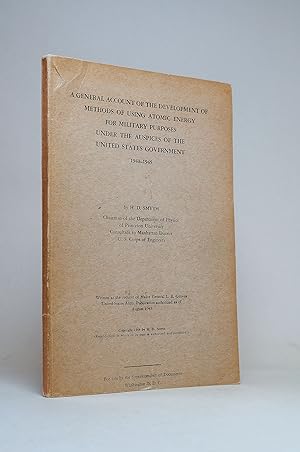
A General Account of the Development of Methods of Using Atomic Energy for Military Purposes Under the Auspices of the United States Government 1940-1945
Published by U.S. Government Printing Office, Washington, D.C., 1945
First Edition
US$ 345.70
US$ 27.12 shipping
Ships from United Kingdom to U.S.A.Quantity: 1 available
Add to basketSoft cover. Condition: Very Good. 1st Edition. Foreword by Major General L. R. Groves. vii, 182 pages. Creasing to cover at top of spine. Small chip at base of front cover. Size: 230mm Tall, 8vo. Book.
-
A General Account of the Development of Methods of Using Atomic Energy for Military Purposes Under the Auspices of the United States Government, 1940-45.
Published by Washington, D.C.: Government Printing Office, 1945
Seller: Reginald C. Williams Rare Books, Glendale, CA, U.S.A.
Association Member: IOBA
Seller rating 4 out of 5 stars
First Edition
Soft cover. Condition: Very Good. No Jacket. 1st Edition. First printed edition Preceded by the very rare lithoprint edition. Octavo. 182 pp. Publisher's printed beige cardboard wrappers. Previous owner's name and address at top margin of front wrapper (neat and legible). A very good copy. Published on August 12, 1945, only six days after Hiroshima, the remarkably full and candid account of the development work carried out between 1940 and 1945 by the American-directed but internationally recruited team of physicists, under the code name of 'Manhattan District,' which culminated in the production of the first atomic bomb. Professor Henry DeWolf Smyth of Princeton, a consultant to the 'Manhattan District' project at Los Alamos, whose commandant General L.R. Groves provided the foreword, 'The Smyth Report,' as it is familiarly known, was published at one dollar by the U.S. Superintendent of Documents. [It was preceded by a preliminary mimeographed version prepared for press use.] Earle E. Coleman, "The Smyth Report: A Descriptive Check List," Princeton University Library Chronicle 37/3 (Spring 1976); 204-218, nos. 5, 4. Printing and the Mind of Man 422e.
-
A General Account of the Development of Methods of Using Atomic Energy for Military Purposes Under the Auspices of the United States Government 1940-1945. Written at the request of Major General L.R. Groves United States Army. Publications authorized as of August 1945
Published by Washington, D.C.: U.S. Government Printing Office, 1945
First Edition
Soft cover. Condition: Very Good. No Jacket. 1st Edition. THE SMYTH REPORT ON THE MANHATTAN PROJECT (AUG 1945). The Smyth report contained a full account of the development work carried out between 1940 and 1945 by the Manhattan Project, which culminated in the production of the first atomic bomb. The printed version of the "Smyth Report" was preceded by an advance lithoprint issue, of which 1000 copies were printed, and a secret mimeographed issue of which no copies except for Smyth's master copy remain extant. Coleman, "The 'Smyth Report': A descriptive checklist," Princeton University Library Chronicle 37 (1976), pp. 204-218. Smyth, "The 'Smyth Report,'" Princeton University Library Chronicle 37 (1976), pp. 173-189. BOOK DETAILS AND CONDITION: 8vo (5 7/8 X 9 inches)- First public printing, first issue (1945 date on Colophon as required) printed light brown thick paper wraps with slight stain on front wrap. Hand-written title information on spine. At end two folding figures (no photos); vii (front wrapper serves as pp i-ii), 182 pp, near fine. Professor Greg Girolami (personal communication) notes that there appear to be two issues: the present copy and the other one both have 1945-663817 at the bottom of the final page of text. The present copy has Dor sale by the Superintendent of Documents/Washington 25, D.C. at the bottom of the printed cover. The present copy my actually be the second issue since Giralomi notes that Smyth s personal copy lacks this For sale information at the bottom of the printed cover and is probably the first issue.
-
A general account of the development of methods of using atomic energy for military purposes
Published by Sup. of Documents, Washington DC, 1945
Seller: Jeremy Norman's historyofscience, Novato, CA, U.S.A.
Seller rating 4 out of 5 stars
First Edition
Smyth, Henry DeWolf (b. 1898). A general account of the development of methods of using atomic energy for military purposes under the auspices of the United States government 1940-1945. Washington, D.C.: Superintendent of Documents, 1945. iii-vii, [1], 182pp. 230 x 150 mm. Original tan wrappers, slight wear. Fine. Bookplate. First Published Edition, First Printing, with the date "1945" in the colophon on the last printed page. Printing and the Mind of Man 422e. The Smyth report contained a full account of the development work carried out between 1940 and 1945 by the Manhattan Project, which culminated in the production of the first atomic bomb. The printed version of the "Smyth Report" was preceded by an advance lithoprint issue, of which 1000 copies were printed, and a secret mimeographed issue of which no copies except for Smyth's master copy remain extant. Coleman, "The 'Smyth Report': A descriptive checklist," Princeton University Library Chronicle 37 (1976), pp. 204-218. Smyth, "The 'Smyth Report,'" Princeton University Library Chronicle 37 (1976), pp. 173-189. .
-
A General Account of the Development of Methods of Using Atomic Energy for Military Purposes under the auspices of the United States Government 1940 - 1945 [The Smyth Report]
Published by Adjutant General's Office, Washington, D.C., 1945
Seller: Manhattan Rare Book Company, ABAA, ILAB, New York, NY, U.S.A.
Seller rating 5 out of 5 stars
First Edition Signed
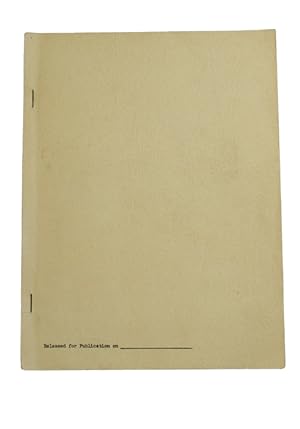
original wrappers. First edition. RARE LITHOPRINT ISSUE -THE FIRST OBTAINABLE PRINTING - OF THE FIRST ACCOUNT OF THE MANHATTAN PROJECT AND THE DEVELOPMENT OF THE ATOMIC BOMB. ONE OF SMYTH'S OWN COPIES, SIGNED BY HIM ON THE TITLE PAGE. PMM 422e. Released to the public on 12 August 1945, just six days after the bombing of Hiroshima, the "Smyth Report" (as it came to be known) contained a full account of the development work carried out between 1940 and 1945 by the Manhattan Project that culminated in the production of the first atomic bomb. The first version of the report was a mimeographed copy (identifiable by the word "secret" stamped on every page), hand-delivered by military messenger, which the recipients were required to read immediately and return to the waiting messenger. These mimeographed copies were apparently destroyed for security reasons, as no copies, either whole or in parts, have been recorded in existence except for Smyth's master copy housed at Princeton. 1,000 copies were then lithoprinted from typescript [the offered version] in the facility for reproducing secret documents in the Adjutant General's Office in the Pentagon. Provenance: Smyth was given a small number of copies for his own personal use. In the late 1970s Smyth was cleaning out his office at Princeton and found a few copies of the original lithoprinted version. At the request of Princeton University, he signed the copies and presented them to the university. This is one of those copies. It is complete, and contains three repeated leaves. Because the leaves were gathered for binding in great haste and under the pressure of tight security precautions, the surviving copies often contain missing and/or repeated leaves. No leaves are missing in this copy. References: PMM 422e; Norman 1962; Coleman, The 'Smyth Report': A Descriptive Checklist, no. 3. See: "The 'Smyth Report'" by H.D. Smyth, The Princeton University Library Chronicle, Vol. 37, No. 3, Spring 1976. [Washington, D.C.: Adjutant General's Office, 1945.] Quarto (8x10.5 in.; 265 x 201 mm), stapled in the original cream textured stiff paper covers. Printed by lithoprint from stencils made by multiple typewriters. A little (very minor) soiling to wrappers, but still fine - one of the nicest copies we've seen. RARE SIGNED. Note: A custom box can be made for this item for an additional $250.
-
General Account of the Development of Methods of Using Atomic Energy: for Military Putposes Under the Auspices of the United States Government 1940 -1945 . Written at the request of Major General L.R. Groves United States Army
Published by [printed at the Pentagon], [Washington D.C.], 1945
Seller: Heritage Book Shop, ABAA, Beverly Hills, CA, U.S.A.
Seller rating 5 out of 5 stars
First Edition
FISKE, Milan D. (illustrator). First Edition. for Military Purposes Under the Auspices of the United States Government 1940 -1945 . Written at the request of Major General L.R. Groves United States Army. [Washington D.C.: printed at the Pentagon, 1945]. First edition, advance publication copy for press use. One of 1,000 copies. Cyclostyled pages, stapled (10 3/8 x 7 7/8 inches; 264 x 200 mm.). [8], 19, [1, blank], 10, 7, [1, blank], 15, [1, blank], 9, [1, blank], 14, 15, [1, blank],17, [1, blank], 13, [1, blank], 10, 13, [1, blank], 12, 3, [1, blank], 6, 2, 3, [1, blank], 5, [1, blank], 1, [1, blank] pp. With intertextual diagrams and "Released for Publication on ____" lithographed on lower inner corner of front wrapper. With duplicate extra leaf "x-5." Complete. Original textured cream wrappers stapled in three places along inner edge. Wrappers slightly soiled. Spine with a small dampstain. Internally very clean. About fine. This is the first edition of the first description of the technical development of the atomic bomb, published on 12 August 1945, just six days after Hiroshima. Until the publication of A General Account research and development had been undertaken in conditions of the utmost secrecy and the report was also prepared in secret. However, the British and American governments decided that the widest dissemination of this "remarkably full and candid account" (PMM) was in the public interest, and this first edition was distributed to journalists for radio use on 11 August and for press use the next day. This first edition with a Foreword by L.R. Groves is described as a "lithoprint" and was printed in the Adjutant General's office in the Pentagon from a typescript. "All pertinent scientific information which can be released to the public at this time without violating the needs of national security is contained in this volume. No requests for additional information should be made to private persons or organizations associated directly or indirectly with the project. Persons disclosing or securing additional information by any means whatsoever without authorization are subject to severe penalties under the Espionage Act" (Groves, from the Foreword). Although it does not state anywhere, this copy belonged to American physicist and director of the Los Alamos National Laboratory, Norris Bradbury. In July 1944, Bradbury a naval commander, transferred to Los Alamos to work on the Manhattan Project. In 1945, Oppenheimer resigned as director of Los Alamos and recommended Bradbury for his replacement. Norman Library 1962. Printing and the Mind of Man, 422e. HBS 67805. $5,000.
-
A general Account of the Development of Methods of Using Atomic Energy for Military Purposes under the Auspices of The United States Government 1940-1945.
Seller: Herman H. J. Lynge & Søn ILAB-ABF, Copenhagen, Denmark
Seller rating 4 out of 5 stars
First Edition
London, His Majesty's Stationary Office, 1945. Orig. printed wrappers, wrappers somewhat browned. IV,144 pp. First edition printed in England - the book was first published in Washington in August 1945.
-

A General Account of the Development of Methods of Using Atomic Energy for Military Purposes
Published by Government Printing Office, Washington DC, 1945
Seller: Biblioctopus, Los Angeles, CA, U.S.A.
Association Member: ABAA ILAB IOBA
Seller rating 4 out of 5 stars
First Edition
First Edition. Publisher's printed wrappers. Octavo, 182pp. The first edition authorized for public distribution, preceded by a top secret mimeographed version in which copies were destroyed after read by recipients, and about 1000 lithoprinted copies for less secretive distribution (these are scarce but still readily available). Some general marks, rubbing and light creasing, else very good.
-

A General Account of the Development of Methods of Using Atomic Energy for Military Purposes
Published by Government Printing Office, Washington DC, 1945
Seller: Lorne Bair Rare Books, ABAA, Winchester, VA, U.S.A.
Association Member: ABAA ILAB IOBA
Seller rating 5 out of 5 stars
First Edition
First Edition. Octavo. Publisher's printed wrappers; vii, 182pp. Ink ownership signature ("David Caliri") to front wrapper; corners bumped, with minor external wear; still a tight, Very Good to Near Fine copy. First published edition of this Twentieth Century milestone, following a tiny mimeographed issue that appeared a few weeks earlier for advance distribution to the press and the scientific community. Includes a foreword by General Leslie Groves, Director of the Manhattan Project. Generally regarded as the first publicly-issued work on the subject of nuclear warfare, described by Carter and Muir as a "remarkably full and candid account of the development work carried out between 1940 and 1945 . which culminated in the production of the first atomic bomb (PMM 422e).
-
A general account of the development of methods of using atomic energy for military purposes under the auspices of the United States Government 1940-1945. . . .
Published by [Adjutant General's Office in the Pentagon], [August 12], 1945., Washington, DC:, 1945
Seller: Zephyr Used & Rare Books, Vancouver, WA, U.S.A.
Association Member: ABAA CBA ESA ILAB
Seller rating 5 out of 5 stars
First Edition
4to. [194 pp (sections all separately paginated I-XIII, A1-A5).], w/ first 4 leaves litho-printed on recto only. Cream-coloured litho-printed softcovers, w/ "Released for Publication _________" on lower front cover, dittoed notice at lower right corner of "Distributed by Technical Information Section of the Bureau of Aeronautics," stapled at gutter margin as issued (minor soiling & spotting to front cover, minor rust to staples, minor bumping to corners, light scuff to fore-edge of textblock printed in multiple grades of paper as issued w/ some sections more toned than others), still a VG- copy, numbered in ink at lower right corner. First lithoprint edition, 3rd printing of 6000 total copies prepared by secretly lithoprinting in the Pentagon (NOT 1000 copies as previously posited by Coleman & others), in sections from modified dittoed versions which had been distributed under General Groves's orders to correct the master copies with eventually whole paragraphs deleted, or added in some chapters. This copy is entirely complete, with none of the often missing pages (especially p. VI-12), duplicates, or misbound signatures which often appear due to the speed and paper requirements, and also bears the colophon 25-56388-2M on page A5-1 at the rear, indicating this was one of those printed on the high-sulphide paper often bearing signatures of varying toning. As per Arnold Kramish (1923-2010), nuclear physicist who worked Oak Ridge, TN on the Manhattan Project, and at the behest of Harry Smyth, researched the printing history before 1985 of the original report, and determined that there were 2000 copies released initially past the dittoed and mimeograph versions to the press, and senior lab people. Due to early complaints of lack of access, another 2000 were released, followed by the much demanded 3rd release, all before Princeton University Press released their published print run less than 1 month later in 1945. The famed Smyth report, released to the public just after the United States had obliterated the cities of Hiroshima and Nagasaki using the first two atomic bombs at the end of World War II -- is "a remarkably full and candid account of the development work carried out. . . by the American-directed by internationally recruited team of physicists, under the code name of Manhattan District. . . ." The introduction opens with statement that "The purpose of this report is to describe the scientific and technical developments in this country since 1940 directed toward the military use of energy from Atomic nuclei." As an aside, it should be noted that Michael Zinman has the original Arnold Kramish TLS identifying the printing history, and an article is being prepared by Brett Tomlinson, noted historian of science. See: Printing and Mind of Man, 422e; Coleman, The Smyth Report: A Descriptive Checklist, Princeton University Library Chronicle, Vol. 37, No. 3 (Spring, 1976), No. 3 (pp. 206-207); For fuller explication of Linus Pauling's dittoed version at OSU (1 of 2 known survivor copies), see blog by Ann Bahde, Serifs and Secrecy: The Smyth Report in SCARC, Nov. 2, 2021.


![Seller image for A General Account of the Development of Methods of Using Atomic Energy for Military Purposes under the auspices of the United States Government 1940 - 1945 [The Smyth Report] for sale by Manhattan Rare Book Company, ABAA, ILAB](https://pictures.abebooks.com/inventory/md/md30779890707.jpg)