

Order Total (1 Item Items):
Shipping Destination:

Invitation Lecture, Signed (11 results)
Skip to main search results
Search filters
Product Type
- All Product Types
- Books (10)
- Magazines & Periodicals (No further results match this refinement)
- Comics (No further results match this refinement)
- Sheet Music (No further results match this refinement)
- Art, Prints & Posters (No further results match this refinement)
- Photographs (No further results match this refinement)
- Maps (No further results match this refinement)
- Manuscripts & Paper Collectibles (1)
Condition Learn more
- New (No further results match this refinement)
- As New, Fine or Near Fine (1)
- Very Good or Good (6)
- Fair or Poor (No further results match this refinement)
- As Described (4)
Binding
Collectible Attributes
- First Edition (2)
- Signed (11)
- Dust Jacket (No further results match this refinement)
- Seller-Supplied Images (9)
- Not Print on Demand (11)
Language (1)
Price
- Any Price
- Under US$ 25 (No further results match this refinement)
- US$ 25 to US$ 50
- Over US$ 50
Free Shipping
- Free Shipping to U.S.A. (No further results match this refinement)
Seller Location
Seller Rating
-
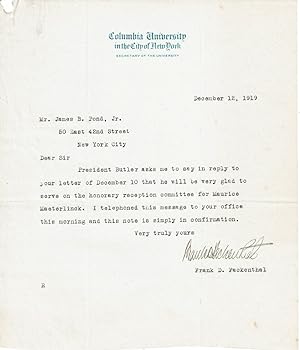
TYPED LETTER SIGNED by Columbia University's Secretary FRANK D. FACKENTHAL, the de facto administrator of the Pulitzer Prize, replying on behalf of University President Butler to James B. Pond's invitation to join his reception committee for Maeterlinck's first American lecture.
Published by New York: December 12, 1919., 1919
Seller: Blue Mountain Books & Manuscripts, Ltd., Cadyville, NY, U.S.A.
Seller rating 5 out of 5 stars

Signed
Condition: Very good. - Over 50 words typed on his 9-3/8 inch high by 8 inch wide "Columbia University / in the City of New York / Secretary of the University" stationery. Frank D. Fackenthal convey's Columbia University President Butler's reply to American impresario and lecture agent James B. Pond's invitation to serve on the committee welcoming Maurice Maeterlinck to America. Fackenthal writes "President Butler asks me to say in reply to your letter of December 10 that he will be very glad to serve on the honorary reception committee for Maurice Maeterlinck". Signed "Frank D. Fackenthal". The letter is folded for mailing and there is a small piece out from the top left corner. Very good. The American academic administrator Frank Diehl Fackenthal (1883-1968) had a long association with Columbia University. Starting as the University's chief clerk in 1906, he was elevated to the position of secretary in 1910 and subsequently served as the institution's provost from 1937 through 1948. In both of these latter capacities, he was the de facto administrator of the Pulitzer Prize from its inception. Despite Butler's opposition, he served as the University's acting president following Nicholas Murray Butler's retirement in 1945 until Dwight D. Eisenhower took over in 1948. He developed far ranging plans for the University that might have addressed the problems which led to the 1968 Columbia University Protests but were eschewed by his successors. He was successful in establishing the School of General Studies and the graduate level School of International Affairs and the Harriman Institute. After retiring from the University, he served as educational consultant to the Carnegie Corporation and president of Columbia University Press and remained a trustee of numerous institutions.James B. Pond, the American impresario and lecture agent who headed the J.B. Pond Lyceum Bureau, brought the great Belgian poet Maurice Maeterlinck to America for a series of lectures. The first lecture took place at Carnegie hall on January 2nd, 1920. Unfortunately Maeterlinck failed to carry out his intention to lecture in English because of his labored "phonetic" English. He declared his intention to continue his lectures in French and have the translation read by another person. As a result, the lecture tour was a failure and lawsuits ensued on both sides.
-

TYPED LETTER SIGNED by the Belgian Consul to New York City PIERRE MALI in response to an invitation to be part of the reception committee for a Maurice Maeterlinck lecture and reserving a box for the poet's first lecture at Carnegie Hall.
Published by New York December 11, 1919., 1919
Seller: Blue Mountain Books & Manuscripts, Ltd., Cadyville, NY, U.S.A.
Seller rating 5 out of 5 stars
Signed
Condition: Very good. New York December 11, 1919., 1919. Very good. - Over 74 words typed on 9-5/8 inch high by 8-1/2 inch wide "Consulat de Belgique / 25 Madison Avenue / New York" stationery. The Belgian Consul Pierre Mali replies to the American impressario and lecture manager James B. Pond that "it will certainly give me great pleasure to be one of the members of the honorary reception committee to welcome M. Maeterlinck on the occasion of his first lecture tour in this country." He goes on to state that he will be "glad to take a box at Carnegie Hall" once the arrangements are completed. Signed "Pierre Mali". Folded for mailing with a small chip out from the top left corner. The page has been unevenly cropped along the bottom edge, though not affecting the contents. Very good. James B. Pond, the American impresario and lecture agent who headed the J.B. Pond Lyceum Bureau, brought the great Belgian poet Maurice Maeterlinck to America for a series of lectures. The first lecture took place at Carnegie hall on January 2nd, 1920. Unfortunately Maeterlinck failed to carry out his intention to lecture in English because of his labored "phonetic" English. He declared his intention to continue his lectures in French and have the translation read by another person. As a result, the lecture tour was a failure and lawsuits ensued on both sides.
-

[Sir Charles Wheeler [Sir Charles Thomas Wheeler], the first sculptor to be President of the Royal Academy.] Autograph Letter Signed declining an invitation 'to lecture on some Aspect of Renaissance Sculpture'.
Published by 10 January ?; on his letterhead 2A Cathcard Road South Kensington SW10 London, 1961
Seller: Richard M. Ford Ltd, London, United Kingdom
Seller rating 5 out of 5 stars
Manuscript / Paper Collectible Signed
See his entry in the Oxford DNB. 1p, 4to. In good condition, lightly aged. Folded twice for postage. The year of the letter looks more like '1901' than '1961', but the letterhead names the writer as 'Charles Wheeler, C.B.E., R.A.' Addressed to 'Dear Sir' and signed 'Charles Wheeler'. Having received two letters from the unnamed recipient, he explains that the first 'got mixed with some papers sent to my Accountant and therefore was not answered'. He apologises for 'the consequent neglect'. While he is appreciative of the 'invitation to lecture on some Aspect of Renaissance Sculpture', he finds himself 'so involved with other commitments that I am compelled, with much regret, to give a negative answer'.
-
Old New York. A Lecture. Delivered at Association Hall, April 27th, 1880, Upon the Invitation of Merchants and Other Citizens of New York
Published by Dodd, Mead & Company, New York, 1880
First Edition Signed
First Edition. Octavo, brick cloth with black and gilt lettering and decoration, text block edges gilt, 59 pp, portrait frontispiece of the author. This copy inscribed by Dodge on the front endpaper, dated May 1880. Dodge was a prominent businessman known as the "Merchant Prince" of Wall Street. A good copy with staining to covers, wear to corners and spine tips, toning and slight foxing to pages, few tears to front endpaper. Signed.
-

TYPED LETTER SIGNED by the Belgian Consul to New York City PIERRE MALI in response to an invitation to meet Maurice Maeterlinck and attend his lecture, with an AUTOGRAPH NOTE penned by him as a postscript.
Published by New York December 29, 1919., 1919
Seller: Blue Mountain Books & Manuscripts, Ltd., Cadyville, NY, U.S.A.
Seller rating 5 out of 5 stars
Signed
Condition: Fine. New York December 29, 1919., 1919. Fine. - Over 55 words typed on 11 inch high by 8-1/2 inch wide "Consulat de Belgique / 25 Madison Avenue / New York" stationery. The Belgian Consul Pierre Mali replies to the American impressario and lecture manager James B. Pond that he "will be very pleased to be present at the opening lecture of M. Maeterlinck, at Carnegie Hall, on the evening of January 2nd. As you suggest, I shall meet M. Maeterlinck in the Green Room and sit on the stage during his lecture." Signed "Pierre Mali". Mali has penned a postscript in his hand at the end "I expect that Baron de Cartier the Belgian Ambassador will also be present -- ". Folded for mailing with a tiny ink line at the top. Else, fine. The Belgian Consul to New York City Pierre Mali (1856-1923) refers in his postscript to Baron Emile de Cartier de Marchienne, who was Belgian Ambassador to the United States from 1917 to 1927. James B. Pond, the American impresario and lecture agent who headed the J.B. Pond Lyceum Bureau, brought the great Belgian poet Maurice Maeterlinck to America for a series of lectures. The first lecture took place at Carnegie hall on January 2nd, 1920. Unfortunately Maeterlinck failed to carry out his intention to lecture in English because of his labored "phonetic" English. He declared his intention to continue his lectures in French and have the translation read by another person. As a result, the lecture tour was a failure and lawsuits ensued on both sides.
-

TYPED LETTER SIGNED by the progressive rabbi STEPHEN SAMUEL WISE, an early supporter of Zionism who started the "Free Synagogue" movement, in reply to James B. Pond's invitation to join his reception committee for Maeterlinck's first American lecture.
Published by New York, December 11, 1919., 1919
Seller: Blue Mountain Books & Manuscripts, Ltd., Cadyville, NY, U.S.A.
Seller rating 5 out of 5 stars
Signed
Condition: Very good. - Over 30 words typed on his 6 inch high by 8 inch wide buff "Free Synagogue / New York" stationery. Stephen Samuel Wise is pleased to accept American impresario and lecture agent James B. Pond's invitation to serve on the committee welcoming Maurice Maeterlinck to America. Wise writes "I accept with much pleasure your kind invitation to serve as a member of the Honorary Reception Committee." Signed "Stephen S. Wise". Folded for mailing, with a small piece out from the top left corner. Very good. Born in Budapest, Stephen Samuel Wise (1874-1949) emigrated to the US when his father accepted service as rabbi of Brooklyn's Congregation Baith Israel Anshei Emes. After completing his studies at Columbia University, Wise pursued rabbinical studies under several noted rabbis of the era, including Richard J.H. Gottheil, Kohut, Gersoni, Joff, and Margolis. He was appointed assistant rabbi of NYC's Congregation B'nai Jeshurun becoming the Congregation's senior rabbi later that year. Taking over as rabbi of Portland, Oregon's Congregation Beth Israel, he attacked many of the social and political ills facing the country. He soon broke with the traditional reform movement and established his "Free Synagogue" in 1907, launching a movement. Wise was an early supporter of Zionism and laid the groundwork for what became the Zionist Organization of America and served as president of the American Jewish Congress. His good friend Albert Einstein profoundly praised him in a tribute that Einstein presented at the celebration of Wise' 60th birthday. In 1914, Wise co-founded the National Association for the Advancement of Colored People (NAACP). Wise, early on, saw the threat posed by Hitler's rise in Germany and fought to shape U.S. public opinion against the growing German threat, leading efforts for a Jewish Boycott of Germany and the creation of the World Jewish Congress.James B. Pond, the American impresario and lecture agent who headed the J.B. Pond Lyceum Bureau, brought the great Belgian poet Maurice Maeterlinck to America for a series of lectures. The first lecture took place at Carnegie hall on January 2nd, 1920. Unfortunately Maeterlinck failed to carry out his intention to lecture in English because of his labored "phonetic" English. He declared his intention to continue his lectures in French and have the translation read by another person. As a result, the lecture tour was a failure and lawsuits ensued on both sides.
-
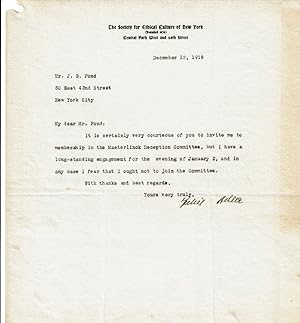
TYPED LETTER SIGNED by the influential German-American philosopher FELIX ADLER in reply to an invitation by James B. Pond to join his reception committee for Maeterlinck's first American lecture.
Published by New York, December 12, 1919., 1919
Seller: Blue Mountain Books & Manuscripts, Ltd., Cadyville, NY, U.S.A.
Seller rating 5 out of 5 stars
Signed
Condition: Very good. - Over 50 words typed on Adler's 9-1/4 inch high by 8-1/2 inch wide "The Society for Ethical Culture of New York" stationery. Responding to the American impresario and lecture agent James B. Pond's invitation to join as a member of the reception committee welcoming Maurice Maeterlinck to America, Felix Adler thanks Major Pond for the invitation and apologizes as he has "a long-standing engagement for the evening of January 2, and in any case I fear that I ought not to join the Committee". Signed in full "Felix Adler". Folded for mailing, the letter is slightly darkened along the right edge and there is a small piece out from the top left corner. Very good. The German-American philosopher Felix Adler (1851-1933) was a professor of political and social ethics. A rationalist, social reformer and religious leader, he was an influential lecturer on the subject of euthanasia arguing as Robert Ingersoll did for the rights of individuals suffering from terminal illnesses to end their pain through suicide. Adler, unlike Ingersoll, did not reject religion and argued from an ethical perspective. Born in Germany, the son of a rabbi, he moved to New York with his family when he was 6 years old. After graduating from Columbia University, Adler continued his studies at Heidelberg University with intent to become a rabbi. He was influenced by the neo-Kantian argument that, as one can neither prove nor disprove the existence of a deity or an afterlife, morality is independent of theology. Asked to give a sermon at New York's Temple Emmanu-El, where his father was head rabbi, he shocked the congregation with his sermon titled "The Judaism of the Future" which made no mention of God and made the case for a universal religion of morality. It is not surprising that this was not only the first but also the last time he was invited to lecture at the temple. He took a position as a Professor of Hebrew and Oriental literature at Cornell University where he was popular with the students but stirred controversy. He was later offered and accepted the chair of political and social ethics at Columbia University. With Joseph Seligman's assistance, Adler founded the Society Of Ethical Culture. Adler argued for the importance of "deed not creed" and set up teams of visiting nurses to serve the homebound poor who were ill and also set up a Free Kindergarten for the children of the working poor. He was the founding chairman of the National Child Labor Committee and served on the Civil Liberties Bureau (which later became the ACLU).James B. Pond, the American impresario and lecture agent who headed the J.B. Pond Lyceum Bureau, brought the great Belgian poet Maurice Maeterlinck to America for a series of lectures. The first lecture took place at Carnegie hall on January 2nd, 1920. Unfortunately Maeterlinck failed to carry out his intention to lecture in English because of his labored "phonetic" English. He declared his intention to continue his lectures in French and have the translation read by another person. As a result, the lecture tour was a failure and lawsuits ensued on both sides.An uncommon autograph.
-
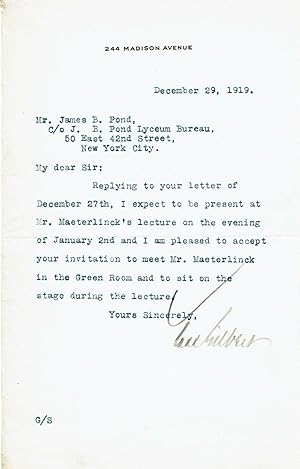
TYPED LETTER SIGNED by the prominent American architect CASS GILBERT, designer of the Woolworth Building, accepting James B. Pond's invitation to join his reception committee for Maeterlinck's first American lecture and to meet Maeterlinck in the green room prior to the lecture.
Published by New York, December 29, 1919., 1919
Seller: Blue Mountain Books & Manuscripts, Ltd., Cadyville, NY, U.S.A.
Seller rating 5 out of 5 stars
Signed
Condition: Very good. - Over 50 words typed on 8-1/2 inch high by 5-1/8 inch wide "244 Madison Avenue" stationery with an attached blank leaf. Having accepted American impresario and lecture agent James B. Pond's invitation to serve on the committee welcoming Maurice Maeterlinck to America, Cass Gilbert is further pleased to accept his invitation to meet Maeterlinck in the green room prior to the lecture. Gilbert writes ".I am pleased to accept your invitation to meet Mr. Maeterlinck in the Green Room and to sit on the stage during the lecture." Signed "Cass Gilbert". Folded for mailing, with a tiny chip to the top left corner. Very good. The American architect Cass Gilbert (1859-1934) was an early proponent of skyscrapers. He designed the Woolworth Building, which was then the tallest building in the world. Gilbert designed numerous museums, libraries, and state and federal buildings, including the United States Supreme Court building. Born in Zanesville, Ohio, he moved to St. Paul, Minnesota with his family and at age 17 joined the architectural firm of Abraham M. Radcliffe. He entered MIT's architectural program in 1878. Returning to Minnesota, he designed numerous buildings including the Minnesota State Capitol and St. Paul's Endicott Building. Moving to New York, he was commissioned to design the Alexander Hamilton U.S. Custom House. He went on to design the Woolworth Building, the support towers for the George Washington Bridge, and the U.S. Supreme Court Building among many many others.James B. Pond, the American impresario and lecture agent who headed the J.B. Pond Lyceum Bureau, brought the great Belgian poet Maurice Maeterlinck to America for a series of lectures. The first lecture took place at Carnegie hall on January 2nd, 1920. Unfortunately Maeterlinck failed to carry out his intention to lecture in English because of his labored "phonetic" English. He declared his intention to continue his lectures in French and have the translation read by another person. As a result, the lecture tour was a failure and lawsuits ensued on both sides.
-
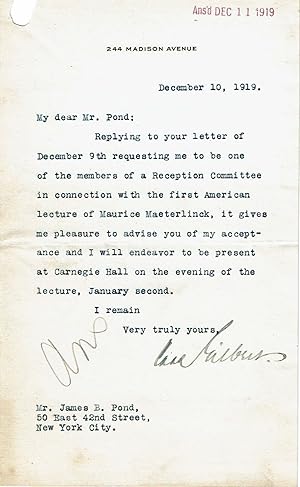
TYPED LETTER SIGNED by the prominent American architect CASS GILBERT, designer of the Woolworth Building, in reply to an invitation by James B. Pond to join his reception committee for Maeterlinck's first American lecture.
Published by New York, December 10, 1919., 1919
Seller: Blue Mountain Books & Manuscripts, Ltd., Cadyville, NY, U.S.A.
Seller rating 5 out of 5 stars
Signed
Condition: Very good. - Over 65 words typed on 8-1/2 inch high by 5-1/8 inch wide "244 Madison Avenue" stationery. Cass Gilbert is pleased to accept American impresario and lecture agent James B. Pond's invitation to join as a member of the reception committee welcoming Maurice Maeterlinck to America. Gilbert writes ".it gives me pleasure to advise you of my acceptance and I will endeavor to be present at Carnegie Hall on the evening of the lecture." Signed "Cass Gilbert". James Pond has penciled "Ans." next to the architect's signature and affixed his dated response stamp at the very top of the page. Folded for mailing, the edges of the letter are soiled and there is a small piece out from the top left corner. Very good. The American architect Cass Gilbert (1859-1934) was an early proponent of skyscrapers. He designed the Woolworth Building, which was then the tallest building in the world. Gilbert designed numerous museums, libraries, and state and federal buildings, including the United States Supreme Court building. Born in Zanesville, Ohio, he moved to St. Paul, Minnesota with his family and at age 17 joined the architectural firm of Abraham M. Radcliffe. He entered MIT's architectural program in 1878. Returning to Minnesota, he designed numerous buildings including the Minnesota State Capitol and St. Paul's Endicott Building. Moving to New York, he was commissioned to design the Alexander Hamilton U.S. Custom House. He went on to design the Woolworth Building, the support towers for the George Washington Bridge, and the U.S. Supreme Court Building among many many others.James B. Pond, the American impresario and lecture agent who headed the J.B. Pond Lyceum Bureau, brought the great Belgian poet Maurice Maeterlinck to America for a series of lectures. The first lecture took place at Carnegie hall on January 2nd, 1920. Unfortunately Maeterlinck failed to carry out his intention to lecture in English because of his labored "phonetic" English. He declared his intention to continue his lectures in French and have the translation read by another person. As a result, the lecture tour was a failure and lawsuits ensued on both sides.
-
Editions Sagesse / Aux Nourritures Terrestres 1932. In-8 broché de 50 pages au format 16,5 x 21,5 cm. Couvertures rempliées, avec titre imprimé. Dos carré muet. Plats et intérieur frais. Poème accompagnés de trois dessins hors texte par Jean Marembert. Un des 20 exemplaires numérotés sur madagascar ( n° 4 ), après 1 sur madagascar, signé par l'auteur et contenant les 3 dessins originaux. Superbe état, proche du parfait. Rare édition originale, enrichie d'une superbe dédicace autographe, signée, et datée de Fernand Marc. Exemplaire truffé d'une belle lettre autographe manuscrite signée et datée de 1933 + une invitation à une séance de lecture poétique à la Salle Villiers " Quinze Poètes, Deux Musiciens " + 6 coupures de presse.
-
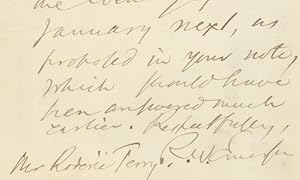
Ralph Waldo Emerson Accepts an Invitation to Deliver a Lecture in Andover, Mass. (This was at the very end of his notable lecturing career, as his final lecture took place just three months later)
Seller: The Raab Collection, Ardmore, PA, U.S.A.
Association Member: ABAA ILAB PADA
Seller rating 4 out of 5 stars

Signed
Ralph Waldo Emerson is remembered today as an essayist, lecturer, philosopher, abolitionist, and poet who led the Transcendental movement of the mid-19th century. His ideology is disseminated to us through his voluminous writings.But to his contemporaries, he was best known as a lecturer, and he delivered some 1,500 addresses In the United States and Great Britain over the course of his career. Over the period 1833-1871, Emerson often spent four to six months a year on the lecture circuit. In April 1871, just three months after this letter, Emerson?s lectures are commonly considered to have come to an end. This is so because any later lectures cannot be reconstructed. Because his most important ideas were worked out in his lectures, these lectures provide the best record we have of his evolving thought-and thus are a key to understanding of his essays and other printed works.Emerson was invited to speak at Andover, Massachusetts on January 13, 1871. Emerson?s Journal records that in September 1870, Emerson has written, ?Andover 13 January proposed,? as it had been by a Roderic Terry of that town. At another location, Emerson wrote in the name of Terry and the year 1871. His account books indeed show that Terry paid Emerson on January 13, 1871. Based on other charges Emerson specified for lectures for this period, he likely received $70 for the lecture. The content of the lecture does not appear to be published.Autograph letter signed, Concord, November 11, 1870, to Roderic Terry. "I do not foresee that any engagement will prevent me from coming to Andover on the evening of the 13th January next, as proposed in your note which should have been answered much earlier." This letter is cited in The Letters of Ralph Waldo Emerson, which notes that it was sold at City Book Auction in 1949.By the spring of 1871, Emerson?s mind was on travel. He took a trip on the transcontinental railroad, barely two years after its completion.


