Order Total (1 Item Items):
Shipping Destination:

Krimpen, Signed (6 results)
Skip to main search results
Search filters
Product Type
- All Product Types
- Books (5)
- Magazines & Periodicals (No further results match this refinement)
- Comics (No further results match this refinement)
- Sheet Music (No further results match this refinement)
- Art, Prints & Posters (No further results match this refinement)
- Photographs (No further results match this refinement)
- Maps (No further results match this refinement)
- Manuscripts & Paper Collectibles (1)
Condition Learn more
- New (No further results match this refinement)
- As New, Fine or Near Fine (No further results match this refinement)
- Very Good or Good (2)
- Fair or Poor (1)
- As Described (3)
Binding
Collectible Attributes
Language (3)
Price
- Any Price
- Under US$ 25 (No further results match this refinement)
- US$ 25 to US$ 50
- Over US$ 50
Free Shipping
Seller Location
Seller Rating
-
Book of Psalms printed according to the authorized version of the Holy Bible MDCXI (signed by van Krimpen)
Language: English
Published by Utrecht, Stichting de Roos, 1947
Seller: Antiquariaat Digitalis, Amsterdam, Netherlands
Seller rating 5 out of 5 stars

First Edition Signed
Hardcover. Condition: Very Good. 1st Edition, Limited Edition. Gilt-stamped 3/4 leather marbled boards (hardcover), 261p, 25 cm. Very good, page-edges slightly age-toned, one tiny scuff spine. Binding and typography J. van Krimpen. Signed by van Krimpen on limitation page. Edition of 175 numbered + a couple of unnumbered ex hors. Our copy is a, not numbered, ex hors copy. Signed by Author(s).
-
Roswitha Quadflieg. Raamin Presse 1973 - 1983. Rudolf E. O. Ekkart, Huib van Krimpen. [Signiertes Widmungsexemplar]
Language: Multiple languages
Published by Haarlem, Enschedé en Zonen, 1984
ISBN 10: 9070024322 ISBN 13: 9789070024321
Seller: Antiquariat Lenzen, Düsseldorf, Germany
Association Member: GIAQ ILAB VDA
Seller rating 5 out of 5 stars
First Edition Signed
4°. 28,5 x 17 cm. 21 Seiten, 13 Blatt. Original-Englischbroschur. 1. Auflage. Titelblatt mit dreizeiliger handschriftlicher Widmung von Roswitha Quadflieg. Dreisprachige Ausgabe in Deutsch, Englisch und Niederländisch. Einband lichtrandig und minimal fleckig. Sehr gutes Exemplar. Sprache: Deutsch, Englisch und Niederländisch.
-
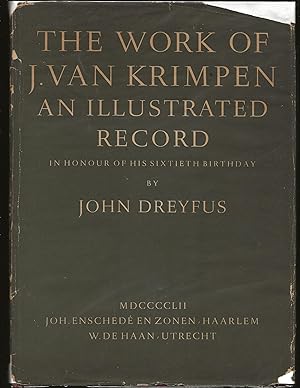
The Work of J. Van Krimpen and Illustrated Record; in Honour of his sixtieth Birthday
Published by Joh. Enschedé en Zonen, 1952
Signed
US$ 203.94
US$ 29.04 shipping
Ships from United Kingdom to U.S.A.Quantity: 1 available
Add to basketHardcover. Condition: Good. Dust Jacket Condition: Poor. Published: 1952. First Edition. Inscribed and signed by author. DESCRIPTION: Dark brown block titled DJ over red cloth. Language: English. Book Condition: Good: Light wear to corners, edges and spine ends. Clean cloth. Tightly bound with lightly spotted and toned intact endpapers. Strong hinges. Author inscription and signature dated 1952 to ffep. Clean unmarked pages. DJ Condition: Poor: Very heavy wear and large losses to upper and lower edges. See photos Pages 160. Size: 27cm by 20cm. PROVENANCE: INSCRIPTION: Tom Balston. Thomas BalstonOBE(1883-1967) was a director of the publishersDuckworth and Co. , and a noted scholar of English book production and illustration. He was also an amateur painter, having studied under Mark Gertler. Born at Bearsted,Kent, fourth son ofWilliam Edward Balston and Emily Julia (née Whitehead)who had been paper-makers since the 18th century. Their success in business led to social prominence and the Balstons were regarded as being amongst the gentry of their county. Educated atEtonandNew College, Oxford before beingcalled to the barin 1909. From 1912 to 1914, he was secretary to the publisherT. Fisher Unwin. Awarded theMilitary Crossand anO. B. E. His service in theSecond World Warcame to an end when he was invalided out after three months due to suffering frompneumonia. At Duckworth from 1921 to 1934, Balston promoted the work of Englishwood engravers. He produced several books on the history of the subject. AUTHOR: In 1940, an exhibition at the Fitzwilliam Museum in Cambridge began celebrating the quincentennial anniversary of printing. The name in its list of acknowledgements is that of John Dreyfus. Educated at Oundle and Trinity College he had been fascinated by the physical form of books and print from an early age. Taken with the new type and layout with which Morison (his future mentor) transformed The Times on 3 October 1932 Dreyfus joined the Cambridge University Press seven years later. Whilst the exhibition had been inspired by Alois Ruppel, the task of organising it fell to the Assistant Printer, Brooke Crutchley, and Dreyfus. In 1949 Dreyfus became Assistant University Printer to the Cambridge University Press, the same year his first book came out, The Survival of Baskervilles Punches. At the end of WWII, he had been the first to seek out the Dutch typographer Jan van Krimpen and make sure that he was all right. This led to a friendship and that to Dreyfuss second book, The Work of Jan van Krimpen, finely printed in van Krimpens own types in 1952. In 1954, when Stanley Morison (his mentor), decided to retire, Dreyfus was his natural successor. In 1956 he also became consultant to the Limited Editions Club of New York, specialising in fine printing, rather as the Nonesuch Press had before the war. In 1963, the great "Printing and the Mind of Man" exhibition, was staged at Olympia and the British Museum. Dreyfus had a large hand in this, and his design for the catalogue was a masterpiece of simple but logical typography. From 1968 to 1973 Dreyfus was President of the Association Typographique Internationale. He organised the Printing Historical Societys conference to celebrate the quincentenary of Caxton in 1976, becoming its president in 1991. He became general editor of the series Type Specimen Facsimiles (1963-71). Dreyfus was much in demand in the United States as well as Europe. His particular subjects were the fine printing of the last century, from William Morris and T. J. Cobden-Sanderson to Harry, Count Kessler. He was awarded the Goudy Prize of the Rochester Institute of Technology and the laureateship of the American Printing Historical Society in 1984. In 1994 the British Library published Into Print, his selected papers, and in 1996 he received a final accolade in the Mainz Gutenberg Prize. Inscribed and signed by author.
-
The Work Of Jan Van Krimpen: A Record In Honour Of His Sixtieth Birthday (Only copy Signed by Van Krimpen) ( Inscribed to Patricia Lauber)
Published by Joh. Enschedé en Zonen & Utrecht, W. De Haan, Haarlem, Netherlands, 1952
First Edition Signed
Hardcover. Condition: Very Good Minus. Dust Jacket Condition: Fair. 1st Edition. First Edition (NAP, MDCCCCLII on the title page, separate Erratum correcting page 21, line 17). 'Illustrated by Reproductions of Drawings, Specimens of Types Lettering and Bookwork.' Once listed, this will be the Only copy of the book signed by Jan Van Krimpen that is for sale anywhere on the Internet. The signed inscription reads (in stylish penmanship) 'To Patricia Lauber from J. van Krimpen, July 1953.' (See photo). Patricia Lauber was an author of many children's books. Her 'Volcano: The Eruption and Healing of St. Helens' won the Newbery Honor award in 1987. She was also 'the founding editor-in-chief of Science World, a science magazine for high school students, and she was the chief editor in science and mathematics for The New Book of Knowledge by Grolier, an encyclopedia for young people. She wrote non-fiction as well as fiction for children. In 1983, she won the Washington Post/Children's Book Guild Award for her overall contribution to children's non-fiction literature.' She lived in New Canaan, Connecticut, the town next to mine. You can see the covers in the photos. They are exceptionally clean. There's one small spot on the front and one area on the rear where the burgundy color is a little darker. There is a bump/crease at both the top and bottom corners of the front cover. There's also a little tanning at the spine ends. The gilt lettering on both the front cover and on the spine is nicely bright. All six of the cover edges are in excellent condition. There is only a speck-sized spot of rub-through at the front bottom corner, and a little spot of fraying (without rub-through) at the top corner. The book is very solidly bound from cover to cover with nicely tight pages throughout. There is a slight space over (only) the top half of the juncture between the front inside cover and front end paper. The front cover is tightly bound from top to bottom, no give. The rear cover is tightly bound from top to bottom as well, no spaces at its juncture with the rear end paper. The signed front end paper has a tan shadow over its left half. The rear end paper has a similar shadow, may have something to do with where the dust jacket's flap leaves off. The pages are exceptionally clean. Scrolling through, I haven't found any instances of soiling. There is a small tan area off the top inside corner of the title page, maybe a small slip of paper was left there. There's also a square light tanning on the frontispiece and facing title page. I'm guessing possibly a tissue guard was once there. It is not much of anything and doesn't recur on any other pages. The bump to the top corner of the front cover created a corresponding crease at the top corners of all the pages, far from the print. There are no markings in the book. There are no attachments of any kind. And the signed inscription represents the only writing to be found anywhere. You can see the dust jacket in the first few photos. There are several losses. There are also vertical tears on both sides of the spine (the protective cover, which I've always had on the jacket, mostly conceals this). There are areas at the junctures where there are no tears, so there is no detachment. There is also one small tear going horizontally across the spine, over the letter 'W'. The front, rear and spine are very clean. There's just one very small loss off the top edge of the rear flap. There is spotting/foxing on the rear flap, just a few small tan spots on the front flap. As mentioned, the dust jacket is fitted with a protective cover. 'Jan van Krimpen was a Dutch typographer, book designer and type designer. He worked for the printing house Koninklijke Joh. Enschedé. He also worked with Monotype in England, who issued or reissued many of his designs outside the Netherlands. Van Krimpen was a leading figure of international reputation in book printing during his lifetime. He designed books both in the Netherlands and for the Limited Editions Club of New York, amongst others.'. Signed by Illustrator(s).
-

1867 Remarkable Pair of Chinese Coolie Arrival Manifests for the Dutch Ship Krimpen Aan De Lek s Voyage from Macau to Havana
Published by Chinese Coolie Trade Ship Manifest, 1867
Seller: Katz Fine Manuscripts Inc., Cochrane, AB, Canada
Seller rating 5 out of 5 stars
Manuscript / Paper Collectible Signed
No Binding. Condition: Fair. No Jacket. On offer are two extremely unique 1867 Dutch ship arrival manifests, recording the names and information of 140 Chinese men who were transported from the port of Macau to Havana, Cuba to complete their indentured servitude as "coolies", working for Cuban sugar plantation owners. These manifests are for the Dutch Galley, Krimpen aan de Lek. This was the only recorded coolie importation voyage for this vessel. The Krimpen departed Macau on March 4,1867 with 368 Chinese men on board and arrived in Havana on June 27, 1867, with 363 living men. The first manifest was signed July 9, 1867 and the second signed July 10th. These dates correspond with the beginning of the coolie contracts. The manifests offer great detail on each coolie and list for each man: their contract number, Chinese name, Christian name, age, patron, job for which they are hired, location where they will work, and date their contract starts. The "patron" for all 110 men listed on the first manifest is Don José de la Portilla, a Cuban landowner. The coolies on the first manifest are being sent to Matanzas and Jagua [likely Jagüey Grande]. The patron for the 30 men on the second manifest is Mr. Antonio Hera. The coolies listed on this manifest will complete their contracts in Cienfuegos. Both documents were signed in Havana by "Caro Hermanos Watson". Caro Hermano and Watson were merchant coolie importers. They were agents working with the Compagnie Générale Transatlantique, which specialized in coolie trading. The Chinese coolie trade, a system of indentured labor that targeted young, poor Chinese men, operated from 1847-1874. Throughout this period, African slavery was slowly being abolished around the world. The coolie trade was initiated by Britain and was eventually dominated by both Britain and the United States of America. Chinese coolie laborers were sent to work in British, American and Spanish colonies, and the nature of the trade changed throughout its 27-year operation, due to social and political pressures. The coolie trade took place, in large part, between the shipping port in Macao (now a part of China, then under Portuguese rule) and Havana, Cuba (then under Spanish control). As Macau was under Portugese rule at the time of the coolie trade, they transported coolies on their vessels frequently and many of the manifests were written in Portuguese and/or Spanish. To learn more about the Chinese coolie trade and its importance in world history, click here to read our in-depth research blog on the topic. Both manifests measures 12.75x17 inches. The first one contains two large pages with writing on the front and back of one side, and on the front of the second, for a total of three pages of text. The manifest is unbound but was once held together with metal rings (still present on the first page). The writing is legible. The second manifest is one page with writing on one side. Both manifests exhibit age toning, small rips and tears, particularly at the centre folds, and the first manifest contains more signs of tearing at the creases. Spanish language. Overall Fair+. Citation: Asome, J. (2020). Coolie ships of the Chinese diaspora (1846-1874). Proverse Hong Kong. ; Manuscripts; 4to 11" - 13" tall; Signed by Author. Signed by Author(s).
-
The Words of the Masters. Reflections on the Fine Art of Type Design. [Quotes from] Frederoc W. Goudy, Victor Hammer, Rudolf Koch, Jan van Krimpen, Emil R. Weiss and Hermann Zapf.
Published by Maple Shade NJ, The Pickering Press (1982), 1982
First Edition Signed
8° (22 x 16 cm). [16] S. mit 5 Original-Holzschnitten von John DePol. Original-Karton mit Deckeltitel in Rot, gebunden mit 3 Leinenstreifen. Erste Ausgabe / 1st Edition. Eins von 75 Exemplaren / One of 75 copies. Gedruckt von Perpetua, Bulmer und den persönlichen Typen der Designer. Mit einer eigenhändigen Zueignung "for Jim" [unkenntliche Unterschrift], wohl John DePol. - Tadelloses Exemplar.


![Seller image for Roswitha Quadflieg. Raamin Presse 1973 - 1983. Rudolf E. O. Ekkart, Huib van Krimpen. [Signiertes Widmungsexemplar] for sale by Antiquariat Lenzen](https://pictures.abebooks.com/inventory/md/md31747616300.jpg)