

Order Total (1 Item Items):
Shipping Destination:

Large Historiated Initial (8 results)
Skip to main search results
Search filters
Product Type
- All Product Types
- Books (2)
- Magazines & Periodicals (No further results match this refinement)
- Comics (No further results match this refinement)
- Sheet Music (No further results match this refinement)
- Art, Prints & Posters (No further results match this refinement)
- Photographs (No further results match this refinement)
- Maps (No further results match this refinement)
- Manuscripts & Paper Collectibles (6)
Condition Learn more
- New (No further results match this refinement)
- As New, Fine or Near Fine (No further results match this refinement)
- Very Good or Good (2)
- Fair or Poor (No further results match this refinement)
- As Described (6)
Binding
- All Bindings
- Hardcover (No further results match this refinement)
- Softcover (No further results match this refinement)
Collectible Attributes
- First Edition (2)
- Signed (No further results match this refinement)
- Dust Jacket (No further results match this refinement)
- Seller-Supplied Images (7)
- Not Print on Demand (8)
Language (1)
Price
- Any Price
- Under US$ 25 (No further results match this refinement)
- US$ 25 to US$ 50 (No further results match this refinement)
- Over US$ 50
Free Shipping
- Free Shipping to U.S.A. (No further results match this refinement)
Seller Location
Seller Rating
-

Very large historiated initial 'H' (probably for the antiphon Hodie nata est beata virgo Maria for the Nativity of the Virgin Mary).
Published by Italy (Siena), c.1300., 1200
Seller: Bernard Quaritch Ltd ABA ILAB, London, United Kingdom
Association Member: ABA ILAB PBFA
Seller rating 5 out of 5 stars

First Edition
US$ 9,333.97
US$ 42.96 shipping
Ships from United Kingdom to U.S.A.Quantity: 1 available
Add to basketFirst Edition. Large initial (c.124 x 129mm), the initial in pale pink against a quadrangular background of deep blue and enclosing the Nativity of the Virgin Mary, Anne lying pensively on a wooden bed before an arched background and the infant Mary being bathed by two nurses in the foreground, the whole painted in shades of blue, pink, orange, brown, and white and with both burnished and shell gold, the verso with part of two lines of text and music in square and diamond-shaped notation on four-line red staves (stave height c.30mm); trimmed to the edges of the quadrangular blue background, slightly rubbed with some loss of burnished gold, but generally in very good condition.A very fine large initial painted in a style associated with the Master of the Gradual of Cortona, an artist named for a Franciscan gradual produced c.1290 for the church of San Francesco in Cortona (now Vatican City, BAV, MS Ross.612). The architectural setting is unusual, as is the frontal pose of the small naked infant being washed in a bath shaped like a baptismal font, a composition derived ultimately from Byzantine models. For a closely comparable initial, probably by the same hand and conceivably from the same parent manuscript, see Christie's sale of 13 July 2022, lot 3, a complete leaf with an historiated initial of the Annunciation (stave height also c.30mm). Visible beneath the initial in the upper left-hand corner is the name 'marie', doubtless a direction (or part thereof) to the artist. The text on the reverse comprises part of the antiphon '[Benedicta tu in mu]lieribus et be[nedictus fructus ve]ntris tui'. Provenance: Formerly in the Albright-Knox Art Gallery, Buffalo, NY, acquired with the Elisabeth H.Gates Fund, 1940. Language: Latin.
-

Large historiated initial 'I'.
Published by Italy (Umbria), c.1300. 13??, 1300
Seller: Bernard Quaritch Ltd ABA ILAB, London, United Kingdom
Association Member: ABA ILAB PBFA
Seller rating 5 out of 5 stars
US$ 6,222.64
US$ 42.96 shipping
Ships from United Kingdom to U.S.A.Quantity: 1 available
Add to basketLarge historiated initial (110 x 75 mm) cut from a choirbook in Latin (perhaps from the Common of Martyrs in an antiphonal), depicting a male martyr saint holding a book and a palm leaf and standing within an architectural surround and against a burnished gold ground, leafy extensions emerging from each side, the whole painted in shades of blue, pink, brown, orange, red and grey, verso with part of two lines of text and music in square notation on four-line red staves (stave height c.34 mm); trimmed to edges, some very minor creasing and rubbing (ink outline of saint's halo rubbed away), but in excellent condition.A very elegant initial in a style characteristic of Umbrian illumination of the late thirteenth and early fourteenth centuries. Itcan be compared to the oeuvres of the First Master of the Gubbio Choir Books and theMaster of the Deruta-Salerno Missals, the latter named after two Missals made for the cathedrals of Deruta and Sale rno. Language: Latin.
-
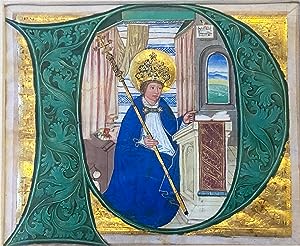
Large Historiated Initial Featuring Illuminated Miniature of a Pope
Published by np, Germany, 1491
Seller: Manhattan Rare Book Company, ABAA, ILAB, New York, NY, U.S.A.
Seller rating 5 out of 5 stars
Manuscript / Paper Collectible First Edition
Framed. Condition: Very Good. First edition. LARGE HISTORIATED INITIAL DEPICTING A POPE, FINELY ILLUMINATED IN GOLD AND RICH COLOUR. Reading from a lectern, the Pope is depicted in full regalia, wearing the distinctive triple crown, or triregnum, and holding the crucifix-topped crosier. His robe is a deep blue and likely pigmented by lapis lazuli-a mineral so valuable in Medieval Europe that is typically reserved for the Virgin Mary and occasionally referred to as blue gold. A vista of green hillsides and blue mountains is seen from a window within the miniature. Noteworthy are the multiple textiles displayed in the room, including mauve drapery as well as the lectern cloth whose embroidered design is emulated here in gold filagree. Highly intricate, monochromatic green acanthine detail adorns the body of the initial. If such handiwork does not alone merit admiration, the gilding of the initial's field as well as that of the Pope's halo showcase excellent tooling-the use of metal stamps to create blind impressions on the surface of the gold. Tooled flowers and foliage pattern the field while circles of varying design radiate around the papal triple crown. A liturgical calendar in the top right of the miniature reads "1491", providing both a terminus ad quo for the manuscript and a possible identity for the miniature's subject. Pope Innocent VIII reigned from 1484 to 1492, and so perhaps he is represented in this miniature, but it is equally possible the image simply represents a generic figure of a pope. Size as visible through frame: 125 x 102 mm (5.0 x 4.0 inches). With frame: approx. 10x9 in. S. Germany, c.1491. Some loss to the colour around the curve of the "P". Striking contrast of green, blue and burnished gold. Uncommon subject for historiated initials, with much to appreciate historically and aesthetically in this handsomely-sized piece. With linen matte and early frame (some chips on frame). Not examined out of frame. References: Joseph Hansen, Geschichte des Hexenwhns und der Hexenverfolgung im Mittelalter (Bonn: Georgi, 1907) Alan Charles Kors and Edward Peters, Witchcraft in Europe, 400-1700: A Documentary History, 2nd edn. (Philadelphia: University of Pennsylvania Press, 2001).
-
St Michael the Archangel, in a large historiated initial on a leaf from a very large Antiphonary, in Latin, illuminated manuscript on vellum [Italy (Bologna or Ferrara?), mid 15th century]
Publication Date: 1450
Seller: Maggs Bros. Ltd ABA, ILAB, PBFA, London, United Kingdom
Association Member: ABA ILAB PBFA
Seller rating 5 out of 5 stars
Manuscript / Paper Collectible
US$ 10,371.07
US$ 36.25 shipping
Ships from United Kingdom to U.S.A.Quantity: 1 available
Add to basketIlluminated with a large initial ?F? the height of two lines of text and music with extensions forming foliate borders, depicting the winged archangel Michael holding a staff and a pair of scales, the recto with two one-line initials alternately blue with red penwork or red with mauve penwork, and an 18th(?)-century folio number ?162? in red. Single leaf, c. 535 × 370 mm, ruled for five four-line red staves and square musical notation, and five lines of text written in rounded gothic textura script, with rubrics in red. Text and illumination The initial introduces the text for the feast of St Michael: ?Factum est silentium in celo dum committeret bellum draco cum Michaele archangelo ?? (There was silence in heaven while the dragon waged war with the archangel Michael ?). The main feast-day of St Michael is 29 September; throughout the Middle Ages it was (and in some contexts still is) treated as one of the main divisions of the year into four parts: the oldest universities (Oxford, Cambridge, Dublin, etc.) start their academic year with Michaelmas Term, as does the legal profession in the UK and Ireland. St Michael is usually depicted in art in one of two guises: either battling a dragon (representing Satan), as described in Revelation 12:7?12; or else, as in the present example, with a pair of scales with which to weigh souls, to decide which would go to heaven and which to hell. The style is close to that of to Giovanni di Antonio da Bologna, and our initial may be by him; see Massimo Medica in Dizionario biografico dei miniatori italiani: secoli IX?XVI, ed. by Milvia Bollati (Sylvestre Bonnard, 2004), pp. 283?85, with older bibliography. More recent is Maria Ferroni, ?Primi appunti per i corali quattrocenteschi di San Michele in Bosco a Bologna?, Rivista di storia della miniatura, 18 (2014), pp. 105?17, and Milvia Bollati, ?Noterella per Giovanni di Antonio da Bologna?, Arte a Bologna: Bollettino dei Musei Civici d?Arte Antica, 9?10, Studi in onore di Massimo Medica, ed. by Silvia Battistini and Mark Gregory D?Apuzzo (2024), pp. 330?33. Condition: some flaking of ink, and some smudging of pigments, notably the red of Michael?s cloak, and some flaking of the gold surrounding the initial.
-
The Dormition of the Virgin, in a historiated initial on a very large leaf from an Antiphonary, in Latin, illuminated manuscript on vellum. [Italy (Venice), mid to late 14th century]
Seller: Maggs Bros. Ltd ABA, ILAB, PBFA, London, United Kingdom
Association Member: ABA ILAB PBFA
Seller rating 5 out of 5 stars
Manuscript / Paper Collectible
US$ 11,753.88
US$ 36.25 shipping
Ships from United Kingdom to U.S.A.Quantity: 1 available
Add to basketIlluminated initial ?U? depicting the Virgin Mary on her deathbed, with two candles in the foreground, the haloed heads of the apostles in the background, above whom Christ rises in a radiant mandorla holding her soul, represented as a swaddled infant. Single leaf, c. 580 x 395mm, ruled for five four-line staves ruled in red, with square musical notation, and five lines of text written in a fine rounded gothic textura script, one rubric in red, the recto with 17th(?)-century folio number ?176?. Text and illumination: The rubric reads ?In laudib[us] et p[er] hor[um]. A[ntiphona]? (the antiphon for Lauds and [the following] hours) and the initial introduces the text ?Viri Galilei quid aspiciatis in celum ?? (Acts 1:11, ?Men of Galilee, why do you stand looking toward heaven??). According to medieval Eastern tradition, the Virgin Mary did not die, she fell asleep and was assumed (raised) to heaven, so the iconography of her final hour is usually called her ?Dormition? rather than death, but the corresponding feast-day in western Europe is usually called the ?Assumption? Surprisingly, the artist of the present leaf has made a mistake. This text does not belong to the feast of the Assumption of the Virgin, but the Ascension of Christ (when he ascended into heaven, forty days after the Resurrection). The style of illumination is Venetian, heavily influenced by Byzantine art ? especially in the use of green to model the shadows of the figures? faces ? due to Venice?s role as the main trading port with Byzantium (later renamed Constantinople). Specifically the style is shared with a group of manuscripts produced in Venice in the 1360s?80s; they are attributed to Giustino di Gheradino da Forlì, whose name occurs in a Gradual dated 1365 made for the Scuola Grande di Sant Maria della Carità, Venice. It is not certain whether Giustino was the artist, however, or if the name perhaps refers to the scribe. Nonetheless, until the issue can be more thoroughly investigated, Giustino has been accepted as a name of convenience for the group. On the style and works attributed to Giustino see Susy Marcon, in Dizionario biografico dei miniatori italiani: secoli IX?XVI, ed. by Milvia Bollati (Sylvestre Bonnard, 2004), pp. 315?16, with further bibliography, and Andrew Chen, 'Giustino di Gherardino da Forlì and the Antiphoners of Pavia Cathedral', Mitteilungen des Kunsthistorischen Institutes in Florenz 59 (2017): 409?19. Condition: Slight darkening at the extremities, slight rubbing to the gold, but generally in a fine state of preservation.
-
The Old Testament Prophet Tobit, in a large historiated initial on a leaf from a very large Antiphonary, in Latin, illuminated manuscript on vellum [Italy (Bologna or Ferrara?), mid 15th century]
Publication Date: 1450
Seller: Maggs Bros. Ltd ABA, ILAB, PBFA, London, United Kingdom
Association Member: ABA ILAB PBFA
Seller rating 5 out of 5 stars
Manuscript / Paper Collectible
US$ 13,828.10
US$ 36.25 shipping
Ships from United Kingdom to U.S.A.Quantity: 1 available
Add to basketIlluminated with a large initial ?P? the height of two lines of text and music with a stem extending the full height of the text, depicting a half-length prophet, his head turned towards and viewer and with one hand raised towards heavenly rays, the recto with a one-line initial in blue with dense red penwork ornament and an 18th(?)-century folio number ?42? in red. Single leaf, c. 535 × 370 mm, ruled for five four-line red staves and square musical notation, and five lines of text written in rounded gothic textura script, with rubrics in red. Text and illumination: The initial on the verso of the leaf introduces a passage from Tobit 3:15, set to music: ?Peto domine ut de vinculo improperii huius absolvas me ?? (I ask you Lord, in order that you absolve me from the fetter of this burden ?); the recto has the preceding antiphon ?Ne reminiscaris domine delicta mea vel parentum meorum ?? (Do not remember, Lord, my misdeeds or those of my parents ?), introduced by a rubric ?Sabbato .iiij. dominice mensis Septembris. Ad matutinas. Antiphona.? (i.e. the Matins antiphon for the Saturday of the 4th Sunday of September). About half of the Church year has feasts that relate to the birth (Christmas) and death (Easter) of Jesus: from the beginning of Advent (four Sundays before Christmas), until Pentecost (seven Sundays after Easter). The rest of the year, from Pentecost until the following Advent, typically comprises twenty to twenty-four more weeks (depending on whether Easter in a particular year falls late or early); the liturgical texts for this period are known as the ?Summer histories?, and are drawn from the Old Testament books of Kings, Wisdom, Job, Tobit, Judith, Esther, Ezra, and Maccabees. From late September the readings are from the Old Testament book of the prophet Tobit, as on the present leaf, which explains why he is depicted in the present initial. The figure is depicted in an active stance, as if turning his head away from the bright rays that shine down from heaven, and raising one hand, either in surprise or to shield his eyes. His draperies are modelled with a fairly loose brushwork, contrasting with the precise delineation of his features, with the joints of his fingers and the creases in his forehead and around his eyes drawn with crisp black lines. The palette consists primarily of a pink modelled with white and grey for the flesh; green with darker green shadows and yellow highlights, and pale rose with white highlights for the draperies; and a block of bright orange for the headgear; all set off against a clear unmodulated bright blue background enlivened with intricate white ornament. The style is close to that of to Giovanni di Antonio da Bologna, and our initial may be by him; see Massimo Medica in Dizionario biografico dei miniatori italiani: secoli IX?XVI, ed. by Milvia Bollati (Sylvestre Bonnard, 2004), pp. 283?85, with older bibliography. More recent is Maria Ferroni, ?Primi appunti per i corali quattrocenteschi di San Michele in Bosco a Bologna?, Rivista di storia della miniatura, 18 (2014), pp. 105?17, and Milvia Bollati, ?Noterella per Giovanni di Antonio da Bologna?, Arte a Bologna: Bollettino dei Musei Civici d?Arte Antica, 9?10, Studi in onore di Massimo Medica, ed. by Silvia Battistini and Mark Gregory D?Apuzzo (2024), pp. 330?33. Condition: an expertly repaired tear in the upper margin (not affecting the text or decoration), a medieval repair to the irregular edge of the lower margin, some flaking and smudging of the ink, but the initial itself in remarkably good condition.
-

St. John the Baptist, a large historiated initial "F" on vellum cut from an antiphonal. Italy (Perugia), c. 1310-
Publication Date: 1330
Seller: Maggs Bros. Ltd ABA, ILAB, PBFA, London, United Kingdom
Association Member: ABA ILAB PBFA
Seller rating 5 out of 5 stars
Manuscript / Paper Collectible
US$ 10,371.07
US$ 36.25 shipping
Ships from United Kingdom to U.S.A.Quantity: 1 available
Add to basketThe figure of St. John the Baptist, dressed in orange robes, with golden halo and holding a book; the initial painted in a pale brown on a blue ground with white tracery, with extension of orange and blue acanthus and gold circles. Size of initial: 75 x 62mm. A very fine representation of St. John the Baptist on an initial "F", which introduces the first Responsorium for the first Nocturne of the feast of St. John the Baptist: "Fuit homo missus a Deo cui nomen Joannes erat hic venit ut testimonium perhiberet de lumine et pararet Domino plebem perfectam". The characteristic foliate extension of the illuminated letter indicates an origin in Umbria in the first half of the fourteenth century. This can be further defined by comparing the figure of Saint John with the facial types in works by Venturella di Pietro, in particular MS. 14 in the Biblioteca Comunale di Cortona which can be attributed to him with certainty due to a note of the scribe. In particular, the figure of the Baptist can be compared with one of the apostles in the scene of the Ascension at f.161v, and our initial can therefore be attributed to an artist of his circle. Venturella di Pietro was a prolific artist active in Perugia during the first quarter of the 14th century; documents record a work for Podesta Ottaviano dei Brunelleschi, and a significant corpus of illuminations has been reconstructed. This includes a Messale and a Rituale in the Archivio Capitolare of Gubbio (MS. II C 20 A and MS. II C 15). There are also two cut-out leaves in the Victoria & Albert Museum (E371 & E378). A cutting of Christ's entry into Jerusalem which appeared as item 16 in our European Bulletin no. 25 can also be attributed to the same circle. The foliated decoration of the initial would suggest an early date for this cutting. Provenance: Almost certainly from the collection of J. W. Bradley, whose two albums of cuttings were sold at Sotheby's in 1952; this cutting has the same distinctive numbering at top outer corners as is found in lot 22. Light wear but generally very good condition. References: Elvio Lunghi, Altri "scriptoria" nella prima metà del Trecento a Perugia in: Francesco d'Assissi, Documenti e Archivi. Codici e Biblioteche, Milan, 1982, pp. 253-256. Emanuela Sesti, Aspetti della miniatura umbra nei secoli XIII e XIV in rapporto all'Ordine Francescano, Ibidem, pp. 368 & 378. Marina Subbioni, La miniatura perugina del Trecento,Perugia, Guerra Edizioni, 2003, pp. 39-71. Dizionario Biografico dei Miniatori Italiani, Milan, 2004, pp. 988-989 (article on Venturella di Pietro by Elvio Lunghi).
-

Leaf From an Illuminated Book of Hours with a Historiated Initial, Northern France, Circa 1470. Illuminated Manuscript on Vellum. Psalms 122-123, with a Large Border
Publication Date: 1470
Seller: That Guy With The Books, Kitchener, ON, Canada
Association Member: IOBA
Seller rating 4 out of 5 stars

Manuscript / Paper Collectible
No Binding. Condition: Very Good. A manuscript leaf from a late 15th century illuminated Book of Hours, produced in France. The leaf in written in Latin, and in brown ink using a gothic script. There are four one-line initials against red and blue backgrounds, and a two-line Historiated Initial featuring an unknown figure. There is also an elaborate diagonal bar border with compressed acanthus leaves and other stylized foliage, accented with liquid gold. This leaf contains excerpts from Psalms 122 123, part of Sext from the Hours of the Virgin. This leaf bears the provenance of having been sold by Maggs Bros in 1962, later ending up in the Marvin L. Colker Collection, and finally a private California collection. Some companion leaves from the same manuscript were dispersed in the Maggs Brothers sale (1962), but their current locations are unknown. A sister leaf is illustrated (Plate II) in Lister s The Miniature Defined (Cambridge, 1963). Another leaf was also recently sold at Galerie Bassenge in Paris in Auktion 123, Lot, on 17 April 2024. This manuscript is written in a 15-line format. One illuminated manuscript on vellum, 12.8 x 10.7 cm This manuscript is in very good shape, with some of the text having faded, but the illumination remaining bright and shining.

![Seller image for St Michael the Archangel, in a large historiated initial on a leaf from a very large Antiphonary, in Latin, illuminated manuscript on vellum [Italy (Bologna or Ferrara?), mid 15th century] for sale by Maggs Bros. Ltd ABA, ILAB, PBFA](https://pictures.abebooks.com/inventory/md/md32200378785.jpg)
![Seller image for The Dormition of the Virgin, in a historiated initial on a very large leaf from an Antiphonary, in Latin, illuminated manuscript on vellum. [Italy (Venice), mid to late 14th century] for sale by Maggs Bros. Ltd ABA, ILAB, PBFA](https://pictures.abebooks.com/inventory/md/md32200385357.jpg)
![Seller image for The Old Testament Prophet Tobit, in a large historiated initial on a leaf from a very large Antiphonary, in Latin, illuminated manuscript on vellum [Italy (Bologna or Ferrara?), mid 15th century] for sale by Maggs Bros. Ltd ABA, ILAB, PBFA](https://pictures.abebooks.com/inventory/md/md32200383372.jpg)

