

Order Total (1 Item Items):
Shipping Destination:

Letter Budapest, Signed (3 results)
Skip to main search results
Search filters
Product Type
- All Product Types
- Books (1)
- Magazines & Periodicals (No further results match this refinement)
- Comics (No further results match this refinement)
- Sheet Music (No further results match this refinement)
- Art, Prints & Posters (No further results match this refinement)
- Photographs (No further results match this refinement)
- Maps (No further results match this refinement)
- Manuscripts & Paper Collectibles (2)
Condition Learn more
- New (No further results match this refinement)
- As New, Fine or Near Fine (No further results match this refinement)
- Very Good or Good (1)
- Fair or Poor (No further results match this refinement)
- As Described (2)
Binding
- All Bindings
- Hardcover (No further results match this refinement)
- Softcover (1)
Collectible Attributes
- First Edition (No further results match this refinement)
- Signed (3)
- Dust Jacket (No further results match this refinement)
- Seller-Supplied Images (2)
- Not Print on Demand (3)
Language (2)
Price
- Any Price
- Under US$ 25 (No further results match this refinement)
- US$ 25 to US$ 50 (No further results match this refinement)
- Over US$ 50
Free Shipping
- Free Shipping to U.S.A. (No further results match this refinement)
Seller Location
Seller Rating
-
![Seller image for [THE FATHER OF THE MODERN NEUROPATHOLOGY CLINICS IN TURKEY] Typescript letter signed 'Ihsan Schükrü-Aksel' addressed to 'Herrn Prof. Dr. Hecht', Budapest. for sale by Khalkedon Rare Books ABA, ILAB, IOBA, ESA](https://pictures.abebooks.com/inventory/md/md30583237899.jpg)
[THE FATHER OF THE MODERN NEUROPATHOLOGY CLINICS IN TURKEY] Typescript letter signed 'Ihsan Schükrü-Aksel' addressed to 'Herrn Prof. Dr. Hecht', Budapest.
Language: German
Published by N.d., [ca. 1928-1930], Istanbul, 1928
Seller: Khalkedon Rare Books ABA, ILAB, IOBA, ESA, Istanbul, Turkey
Association Member: ABA ESA ILAB IOBA
Seller rating 5 out of 5 stars

Manuscript / Paper Collectible Signed
Soft cover. Condition: Very Good. Original TLS signed 'Ihsan Schükrü-Aksel' sent to 'Herrn Prof. Dr. Hecht', Budapest, to Psychiatrische Klinik Budapest VIII, Balassa Utca 6.". 28x21 cm. In German. 1 p. 'Bank Extra Strong' watermarked paper and 'Sinir ve Beyin Hekimi Dr. Ihsan Sükrü Aksel - Bakirköy ve Haydarpasa Nümune Hastaneleri Mütehassisi' letterhead. Text: "Sehr geeheter Herr Kollege! Ich erlaube mir Ihren eine Patientin von mir Frl. Nihat zu empfehlen, die zurzeit in Budapest ist, und möchte ich Sie bitten Ihre gütige Anempfehlungen nicht fehlen zulassen. Für Ihre Bemühungen danke ich Ihnen im voraus und zeichne und sehr ergebener.". Aksel was a Turkish / Ottoman specialist phsycian-psychiatrist. He was born in Istanbul in 1889. He graduated from Istanbul Darülfünun Medical Faculty in 1919 and started working as an assistant at "Emraz-i Akliye and Asabiye Hospital". He went to Germany for education in 1922. In Munich and Hamburg, he worked with Prof. Kraeplin, Prof. Spielmayer, Prof. Weygand and Prof. Jakob. He returned to Turkey in 1925, I was appointed as the chief of Emraz- i Akliye ve Asabiye Hospital [i.e. Mental and Nervous Diseases Hospital] and established the neuropathology laboratory. He became 'ordinarius' in 1951. In 1953, he became the dean of Istanbul University Faculty of Medicine; he prioritized the establishment of a psychiatry clinic in Çapa and established the Institute of Child Psychiatry in 1958. Signed by Author(s).
-

[ The British Military Cemetery at Solymár, Hungary. ] Long typescript, titled 'The Budapest War Cemetery', including a 'Register of the Graves in the Budapest War Cemetery', with letter by the Hungarian author, and photographs and negatives.
Published by Covering letter dated from Budapest Hungary 8 April, 1985
Seller: Richard M. Ford Ltd, London, United Kingdom
Seller rating 5 out of 5 stars
Manuscript / Paper Collectible Signed
US$ 385.07
US$ 6.01 shipping
Ships from United Kingdom to U.S.A.Quantity: 1 available
Add to basket27pp., 8vo. (The article on 'The Budapest War Cemetery' is 7pp., 8vo, and the accompanying 'Register of the Graves in the Budapest War Cemetery' is 21pp., 8vo. There is also a page of 'Abbreviations to the Register'.) A few manuscript emendations. The covering letter is addressed to 'David', and is effusive in its offer of further assistance, the author urging 'David' to rewrite the piece as he sees fit. It is signed, faintly and undecipherably. The author writes in good, but not entirely idiomatic, English, and has gone to some trouble. The article describes the wartime background to the establishment of 'The English Cemetery at Solymár', from the first man buried there, Flight Sergeant Gordon G. Pemberton, an Australian pilot of a Wellington bomber, shot down on the night of 3 April 1944. The 'Register' lists the 205 graves, each with all the information to be found on the tombstone. Also present are four strips of negatives, with one larger negative of a single image, and a contact sheet strip reproducing the 35 pictures on the negative strips. The last is annotated on the reverse in pencil. Also included are three black and white photographs (described as 'three bad prints' in the letter): one of the cemetery in snow, and the other two of Pemberton's crashed Wellington bomber.
-
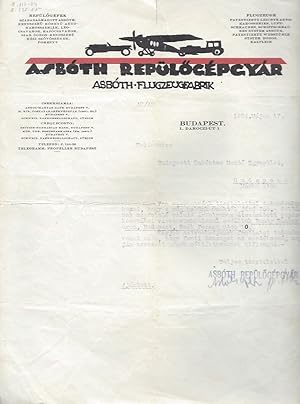
Letter to the Budapest Volunteer Ambulance Association
Published by Budapest, 1924
Seller: Földvári Books, Budapest, Hungary
Seller rating 5 out of 5 stars
Signed
Signed typed letter with "Asbóth Aircraft Factory" letterhead. "With reference to our agreement of March 20, 1924 on the s 1 pcs ambulance body, we agreed as follows: Since we cannot complete the body, you will take it over as it is today and finish it for your own account. [] We declare to each other that we have no claims against each other. [] Should the obligation to pay sales tax arise, it will be borne solely by you. Yours sincerely, Asbóth Aircraft Factory. " Oszkár Asboth (18911960) was a Hungarian aviation engineer often credited with the invention of the helicopter. .

