Order Total (1 Item Items):
Shipping Destination:

Leve Future, First Edition (5 results)
Skip to main search results
Search filters
Product Type
- All Product Types
- Books (5)
- Magazines & Periodicals (No further results match this refinement)
- Comics (No further results match this refinement)
- Sheet Music (No further results match this refinement)
- Art, Prints & Posters (No further results match this refinement)
- Photographs (No further results match this refinement)
- Maps (No further results match this refinement)
- Manuscripts & Paper Collectibles (No further results match this refinement)
Condition Learn more
- New (No further results match this refinement)
- As New, Fine or Near Fine (2)
- Very Good or Good (1)
- Fair or Poor (No further results match this refinement)
- As Described (2)
Binding
- All Bindings
- Hardcover (No further results match this refinement)
- Softcover (3)
Collectible Attributes
- First Edition (5)
- Signed (1)
- Dust Jacket (No further results match this refinement)
- Seller-Supplied Images (5)
- Not Print on Demand (5)
Language (1)
Free Shipping
Seller Location
Seller Rating
-

Couverture souple. Condition: Comme neuf. Edition originale. In-12°, broché , 441 pages.
-

Création littéraire et créatures artificielles L'Eve future Frankenstein Le Marchand de sable Ou le je(u) du miroir
Published by Éditions du Temps, 1999
First Edition
Condition: buono. Storia e Critica Literary Criticism History and Criticism Lectures d'une oeuvre bross. edit. ill. - prima edizione - volume in lingua francese OTTIME CONDIZIONI.
-
L'Eve future
Published by Paris, M. de Brunhoff, 1886
Seller: Librairie Amélie Sourget, Paris, France
Association Member: ILAB
Seller rating 4 out of 5 stars

First Edition
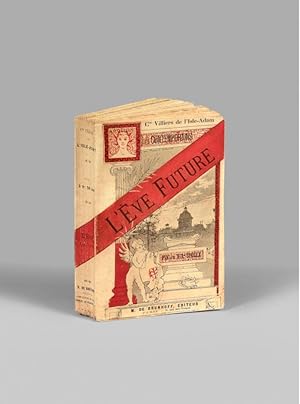
Couverture souple. Condition: Très bon. Edition originale. VILLIERS DE L'ISLE-ADAM, Auguste de. L'EVE FUTURE. Paris, M. de Brunhoff, 1886. In-8 de (2) ff., III pp., (1) f., 379 pp. Exemplaire broché, non rogné, tel que paru, étui chemise beige. ÉDITION ORIGINALE DE CE CHEF-D'UVRE DE VILLIERS DE L'ISLE-ADAM DEDIE « Aux rêveurs. Aux railleurs ». Carteret, II, 472 ; Clouzot, 277. Exemplaire de première émission, avec la couverture rouge illustrée par Gorguet. Il est enrichi d'un envoi autographe signé de l'auteur. "L'Eve future is a metaphysical fantasy in novel form attacking the evils of our mechanized civilization" (Anthologie des Conteurs du XIXe siècle). Ce chef-d'uvre romanesque de Villiers de L'Isle-Adam est une contribution au genre naissant de la science-fiction. Incarnant l'impossible quête du parfait amour, l'héroïne transfigurée par l'inventeur Thomas Edison est un robot électrifié doté de toutes les apparences humaines. Comment ne pas s'éprendre de l'automate enjôleur, génialement intelligente ? Il lui manque peut-être une âme, mais la source de cette intelligence réside dans deux phonographes en or qu'elle recèle, où sont enregistrées les pensées des plus grands poètes et métaphysiciens du siècle. Les surréalistes ont salué l'ironie du poète maudit, son humour noir et son attention au merveilleux. Alfred Jarry et Raymond Roussel ne sont pas loin. « L'Eve future est un conte aux reflets magiques : lyrisme enchanteur et ironie, non sans lourdeur, s'y mêlent pour composer, en un jeu savant, un récit fait d'ombres et de lumière. uvre étroitement liée aux Contes cruels, et, comme eux, inspirée par un idéalisme métaphysique absolu, elle est de loin l'un des meilleurs récits de l'auteur, parmi les plus curieux et les plus suggestifs » (Dictionnaire des uvres). « L'Eve future, l'uvre maîtresse de Villiers de l'Isle-Adam, témoigne, avec une extrême finesse, de la vivacité du mythe du savant fou » (P. S.) BEL EXEMPLAIRE CONSERVE BROCHE, NON ROGNE, TEL QUE PARU, ENRICHI D'UN ENVOI AUTOGRAPHE SIGNE DE L'AUTEUR A RODOLPHE SALIS. Rodolphe Salis (1851-1897) est le créateur du cabaret parisien Le Chat Noir, qu'il ouvre en 1881 et qui tire son nom d'une histoire extraordinaire d'Edgar Poe. Son ami Villiers de l'Isle-Adam fréquente avec assiduité ce lieu, symbole de l'esprit montmartrois. L'exemplaire est également enrichi d'un court passage du roman de la main de l'auteur corrigé à maintes reprises.
-
L'Ève future.
Published by Paris: M. de Brunhoff, Éditeur, 1886, 1886
Seller: Peter Harrington. ABA/ ILAB., London, United Kingdom
Association Member: ABA ILAB PBFA
Seller rating 5 out of 5 stars

First Edition
US$ 5,212.83
US$ 29.69 shipping
Ships from United Kingdom to U.S.A.Quantity: 1 available
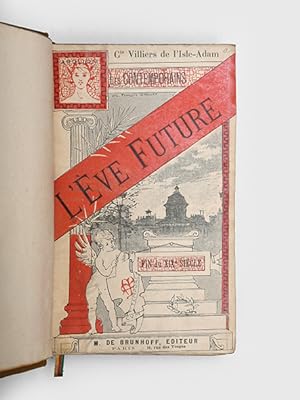
Add to basketFirst edition of Villiers' scarce science fiction novel, finely bound in "japonais" style by the Parisian bookbinder Léon Lemardeley (d.1903), known in the late 19th century for "cartonnages of notable quality" (Comparato, p. 36). The binding is a superb example of 19th-century "Japonisme", a vogue for Japanese art in France following the reopening of trade between the two countries after the Meiji Restoration in 1868. The increasing numbers of prints and ceramics imported from Japan into France had an important influence on French art, particularly on the Impressionists and Post-Impressionists. Monet, Degas, and Van Gogh each owned large collections of ukiyo-e prints; one of those in Van Gogh's possession is visible in the background of his Self-Portrait with Bandaged Ear (1889). L'Ève future, which popularized the word and concept of the "android", is the first of two influential works by Villiers de L'Isle-Adam, a proudly penurious French aristocrat, the other being his Romantic play Axël (1890). Situated somewhere between the classical myth of Pygmalion, Mary Shelley's Frankenstein, and Fritz Lang's Metropolis, L'Ève future centres on a caricature of the futurist inventor, Thomas Edison, who creates an ideal mechanical woman. A key text of the decadent movement, the work is still influential, and the 2004 Studio Ghibli sequel to Ghost in the Shell opens by quoting a line from the novel: "If our gods and hopes are nothing but scientific phenomena, then it must be said that our love is scientific as well". Frank L. Comparato, Books for the Millions: A History of the Men Whose Methods and Machines Packaged the Printed Word, 1971. Octavo (185 x 115 mm). Wrappers illustrated by François Gorguet. Attractively bound by Lemardeley (his ink stamp to front pastedown) in contemporary three-quarter calf, twin red-brown morocco labels, spine and covers ruled in gilt, sides with embossed Japanese fan design in brown, red, and gilt, silk bookmarker, original illustrated wrappers bound in. Spine slightly darkened, corners lightly rubbed, binding and contents well-preserved: a near-fine copy.
-
L'Ève future.
Published by Paris: M. de Brunhoff, Éditeur, 1886, 1886
Seller: Peter Harrington. ABA/ ILAB., London, United Kingdom
Association Member: ABA ILAB PBFA
Seller rating 5 out of 5 stars
First Edition Signed
US$ 10,425.67
US$ 29.69 shipping
Ships from United Kingdom to U.S.A.Quantity: 1 available
Add to basketFirst edition, presentation copy, inscribed by the author on the half-title, "À Edmond de Goncourt. Hommage de son admirateur, Villiers de l'Isle Adam [to Edmond de Goncourt, a tribute from his admirer, Villiers de l'Isle Adam]", and bound by Pierson, Goncourt's relieur de choix, on receipt. This is a superb presentation copy of Villiers' scarce science fiction novel, which popularized the word and concept of the "android": the recipient was the man of letters and French symbolist, Edmond Huot de Goncourt (1822-1896). Goncourt founded the Académie Goncourt which still awards one of the most prestigious French literary prizes, the Prix Goncourt. Goncourt described his first encounter with Villiers in a September 1864 entry in his journal, which he compiled with his brother Jules: "He was a typical literary bohemian or unknown poet. His hair, which was parted in the middle, kept falling in stringy locks over his eyes, and he would push back with the gestures of a maniac or an illuminati. He had the feverish eyes of a victim of hallucinations, the face of an opium eater or a masturbator, and a crazy, mechanical laugh which came and went in his throat. Altogether, something unhealthy and spectral". As well as one of the most prominent intellectuals of his time, Goncourt was also a distinguished book collector. After visiting Goncourt in the 1890s, Arthur Symons remembered that "when we came to the study, the room in which he worked, he showed me all of his own first editions, carefully bound" (Symons, p. 121). For Paul Valéry, Goncourt exemplified "the absurd lengths to which the most distinguished collector may go. After having the first editions of his friends' works bound in parchment, Edmond de Goncourt had their portraits painted on the covers by the artists he considered most appropriate to the sitters: for Daudet, Carrière; for Zola, Raffaelli. Since the books could not bear the slightest handling without damage, they were condemned to sit eternally in a glass case" (Valéry, p. 219). These parchment bindings, like the present Bradel-style cloth example, were executed by Pierson, Goncourt's "usual binder" (Galantaris, p. 166), whom he called "ce roi des cartonneurs [the king of cartoners]" and "le rare ouvrier qui a la passion de son art [the rare worker who has a passion for his art]" (quoted in Tourneux, p. 14). L'Ève future is the first of two influential works by Villiers, a proudly penurious French aristocrat, the other being his Romantic play Axël (1890). Situated somewhere between the classical myth of Pygmalion, Mary Shelley's Frankenstein, and Fritz Lang's Metropolis, L'Ève future figures a caricature of the futurist inventor, Thomas Edison, who creates an ideal mechanical woman. A key text of the decadent movement, the work is still influential - the 2004 Studio Ghibli sequel to Ghost in the Shell opens by quoting a line from the novel: "If our gods and hopes are nothing but scientific phenomena, then it must be said that our love is scientific as well". This copy later passed into the library of Pierre Bergé (1930-2017), co-founder of Yves Saint Laurent, with his bookplate. Christian Galantaris, "Le goût des Goncourt à l'honneur" in Cahiers Edmond et Jules Goncourt, 2005; Arthur Symons, The Symbolist Movement in French Literature, 1919; Maurice Tourneux, La Bibliothèque des Goncourt, 1897; Paul Valéry, Aesthetics, 1964. Octavo (185 x 115 mm). Wrappers illustrated by François Gorguet. Bound for the recipient in contemporary red percaline by E. T. Pierson (his stamp on the front pastedown), brown sheep spine label, original illustrated wrappers bound-in. Hint of sunning to spine, label lightly scuffed, extremities a little rubbed, binding otherwise bright; a couple of marks to front pastedown, discreet repair to half-title at gutter, faint toning to contents, else clean and fresh within. A very good copy.