

Order Total (1 Item Items):
Shipping Destination:

Manuscript German, Signed (9 results)
Skip to main search results
Search filters
Product Type
- All Product Types
- Books (6)
- Magazines & Periodicals (No further results match this refinement)
- Comics (No further results match this refinement)
- Sheet Music (No further results match this refinement)
- Art, Prints & Posters (No further results match this refinement)
- Photographs (No further results match this refinement)
- Maps (No further results match this refinement)
- Manuscripts & Paper Collectibles (3)
Condition Learn more
- New (No further results match this refinement)
- As New, Fine or Near Fine (No further results match this refinement)
- Very Good or Good (3)
- Fair or Poor (No further results match this refinement)
- As Described (6)
Binding
Collectible Attributes
- First Edition (1)
- Signed (9)
- Dust Jacket (No further results match this refinement)
- Seller-Supplied Images (5)
- Not Print on Demand (9)
Language (3)
Price
- Any Price
- Under US$ 25 (No further results match this refinement)
- US$ 25 to US$ 50 (No further results match this refinement)
- Over US$ 50
Free Shipping
Seller Location
Seller Rating
-

William Warner Caldwell: A Unique Manuscript Archive Of Original Poetry Songs, And Translations From The German, With Scrapbook Of Published Poetry
Language: English
Published by Unpublished / W. W. Caldwell / John W. Tufts, New York 1858 to 1880's, 1858
Seller: Arroyo Seco Books, Pasadena, Member IOBA, Pasadena, CA, U.S.A.
Association Member: IOBA
Seller rating 4 out of 5 stars

Manuscript / Paper Collectible First Edition Signed
Notebooks. Condition: Very Good. Original Manuscript. The Author's Archive Of His Sentimental Poems And Songs, With Some Translations From German. Caldwell Published Prolifically In The Newspapers In The Mid-Nineteenth Century, In Addition To At Least One Volume Of Poetry (Well-Received In The North American Review.) Four Volumes: 1. "Translations From The German Made For The John W. Tufts And Set To Music By Him For "The Normal Music Course- W. W. Caldwell". 122 Entirely Handwritten Translations, Each With Title And Date (December 1882 To February 1884), With His Neat Handwritten Account On The Last Page, Showing Tufts Paid Him A Total Of $538 For This Work. A 3/4 Calf Notebook, Quite Worn, Near Fine Internally. 2. (Untitled) Signed 3/4" Calf Notebook, Signed On First Page, Containing Approximately 188 Original Poems And Songs, And Translations Of German Poems And Songs. Most Entries Dated (March 1856 - February 1884). A Note Mentions Receipt Of $25 From Tufts, The Music Publisher. 3. Cloth Notebook, Unsigned. Approximately 52 Handwritten Original Poems And Songs, And Translations From The German. 4. Bound "Scrap Book" (3/4" Leather And Moire Silk), Hand-Titled "Poems And Translations By William W. Caldwell 1853 -" On Ffep, With 116 Very Neatly Mounted Clippings, Of His Poetry And Translations, From The Newspapers In Which They Were Originally Published. (The Book Contains 109 Poems And Translations, But Most Of The Book Is Represented In The Clippings). A Few Of The Clippings Are Hand-Corrected Or Enlarged To The Side. Signed by Author(s).
-
German Calligraphic Manuscript: Patent of Nobility for Johan, Adolf, and Frederick von Bruhl
Published by 16 April 1738, Berlin, 1738
Seller: Sanctuary Books, A.B.A.A., New York, NY, U.S.A.
Seller rating 5 out of 5 stars

Signed
Hardcover. Condition: Very Good+. Manuscript on vellum, in German. 14 leaves (+1 blank), folio (350 x 243 mm). 17 lines written in a dark brown ink in an ornate gothic bookhand, opening leaf with an elaborate penwork border, the upper half with densely drawn scrollwork that interlocks with intermittent flower buds, each additional leaf with a repeated penwork border of scrolling acanthus in free-form loops that create geometric patterns, many in-text penwork flourishes. Fol. 13r signed "Carl" of Charles VI and signed by the scribe notary E. F. F. von Glandorff. In contemporary crimson velvet (two holes in the hinges of the leaves where the cord and seal of Charles VI would have appeared, slightly thumbsoiled, some darkening to vellum; spine rubbed and velvet binding faded at edges). A fine example of German 18th-century penmanship by Von Glandorff. The three brothers von Bruhl were sons of Heinrich von Bruhl, who had been ennobled the previous year, and who became Minister of Saxony under King August.
-
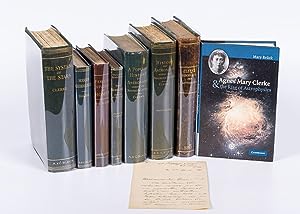
Collection of eight publications by and about Agnes Mary Clerke plus one autographed / signed manuscript-letter by Agnes Clerke [The letter answers the request of a fellow german Astronomer who complimented her on her History of Astronomy and asked for her permission to translate her latest work). The recipient is possibly german astronomer R.Engelmann who wrote about Nebula. The letter dates from 1891 and is written in perfect german (Agnes Clerke was known to have written reviews and letters in French, German, Greek and Italian). This rare collection includes the following books: 1. A.M.Clerke - Geschichte der Astronomie während des neunzehnten Jahrhunderts. Gemeinfasslich dargestellt. (Autorisierte deutsche Ausgabe von H.Maser) - First g
Published by Berlin / London, Springer / Cassell / Longmans & Green and others, 1889 - 1908., 1908
Seller: Inanna Rare Books Ltd., Skibbereen, CORK, Ireland
Seller rating 5 out of 5 stars
Signed
A mixture of first and later editions. Octavo. More than 2500 pages with many illustrations and diagrams etc. / The vintage letter has two pages filled and signed by Clerke in ink / The only modern publication within the collection is a very important monograph on Clerke by scientist Mary Brueck / Mary Brück, published by Cambridge University Press (275 pages). Original Hardcovers in bespoke protective collector's Mylar. Very good condition with only minor signs of external wear. A stunning collection of all the major publications by this important woman astronomer. Agnes Clerke paved the way for women in science and must be seen as the pioneer female astronomer. The price includes worldwide free shipping of the collection per UPS Express Courier. Agnes Mary Clerke (10 February 1842 20 January 1907) was an Irish astronomer and writer, mainly in the field of astronomy. She was born in Skibbereen, County Cork, Ireland, and died in London. Agnes Clerke was the daughter of John William Clerke (c. 18141890) who was, at the time, a bank manager in Skibbereen, and his wife Catherine Mary Deasy (b. c. 1819) whose father was a judge's registrar. She had two siblings; her older sister, Ellen Mary, was born in 1840, and her younger brother, Aubrey St. John, was born in 1843. All of the Clerke children were entirely home schooled. Following in her father's footstepswhile studying classics, he had also taken courses in astronomyshe developed an interest in astronomy from an early age, using her father's 4 inch telescope in her observations and had begun to write a history of astronomy at the age of 15. In 1861, aged 19, her family moved to Dublin, and in 1863 to Queenstown. At the age of 25, partly for health reasons together with her elder sister Ellen, she went to Italy where she stayed until 1877, chiefly at Florence, studying science, languages, and other subjects that would be useful in their later lives. In 1877 she settled in London. (Wikipedia) Upon her return, she was able to get two articles, "Brigandage in Sicily" and "Copernicus in Italy", written while she had been in Italy, published in the Edinburgh Review of October 1877. This led to her being asked by Adam and Charles Black, publishers of the Review, who also published the Encyclopædia Britannica, to write biographies of a number of famous scientists for the ninth edition of the encyclopedia. This work let to a number of other commissions, including the publication of the article on astronomy for the Catholic Encyclopedia. During her career she wrote reviews of many books, including some written in French, German, Greek, or Italian. In 1885, she published her best known work 'A Popular History of Astronomy during the Nineteenth Century', which has received recognition beyond the time it was written. Clerke was not a practical astronomer, instead collating, interpreting and summarising the results of astronomical research. In 1888 she spent three months at the Cape Observatory as the guest of the director, Sir David Gill, and his wife, and there became sufficiently familiar with spectroscopic work to be able to write about this newer branch of the science with increased clearness and confidence. In 1893 she was awarded the Actonian Prize of 100 guineas by the Royal Institution. As a member of the British Astronomical Association she attended its meetings regularly, as well as those of the Royal Astronomical Society. In 1903, with Lady Huggins, she was elected an honorary member of the Royal Astronomical Society, a rank previously held only by three other women, Caroline Herschel and Mary Somerville in 1835, and Anne Sheepshanks in 1862. Her sister, Ellen Mary Clerke (18401906), also wrote about astronomy. She was a devout Catholic all her life. The lunar crater Clerke is named after her. In 2002, the retired astronomy lecturer Mary Brück wrote a book on her, Agnes Mary Clerke and the Rise of Astrophysics. In 2017, the Royal Astronomical Society established the Agnes C.
-
Observations on the Utility of good Riflemen both in Infantry & Cavalry, with Instructions for Acquiring the Art of Taking a Good Aim, and Description of Targets [.] To which is added A Short Manual Exercise for Mounted Chasseurs as well as for Dragoons or Hussars, who are Armed with Rifle Pieces [.]. Translated from the Original German Manuscript Under the Inspection of the Author.
Published by No place, ca. 1802., 1802
Seller: Antiquariat INLIBRIS Gilhofer Nfg. GmbH, Vienna, A, Austria
Association Member: ILAB PADA VDA VDAO
Seller rating 5 out of 5 stars
Manuscript / Paper Collectible Signed
Large 4to (211 x 260 mm). English manuscript on paper (watermarked 1797). (2), 86 pp., 1 blank leaf. Text within woodcut margins. With an additional 20 hand-coloured engraved plates (some signed "Merkl", one bound as a frontispiece), many with manuscript captions, and one hand-drawn and uncoloured diagram (numbered "Plate XIV). Contemporary half green morocco over marbled boards. A manuscript from the royal library of the Duke of Clarence; a fair copy in a single hand. "Very interesting qua rifle details, targets etc. (including moving target of a man or deer)" (inserted old collector's note). Neither the author's German manuscript nor the present translation saw publication, but another copy of this manuscript, with the plates, is kept in the Royal Armories Collection (EBEN 1). - Christian Adolph Friedrich Frh. von Eben (1773-1825) was a Silesian nobleman who trained in the Prussian military. He entered the English service in 1800 (where he was styled Frederic, Baron Eben) and composed this manual in 1802, upon receiving a commission in the 10th (Prince of Wales's) Regiment of Light Dragoons. He went on to fight in the Peninsular War in the Portuguese service and became involved in a conspiracy against the government in 1817. Exiled from Portugal, he served in South America under Bolivar in the 1820s. - Binding rubbed at extremeties. Nicks to some plates, some light discolouring. Provenance: 1) William, Duke of Clarence (later King William IV), bookplate (WH within Garter, coronet above); 2) his natural son George FitzClarence, 1st Earl of Munster (1794-1842), book label ("Col. Fitz Clarence"), armorial bookplate, and gilt stamp on spine; 3) Sidney Young, armorial bookplate; acquired in 1930 by 4) Thomas Fremantle, 3rd Baron Cottesloe (1862-1956), commander of the Territorial Army and president of the Society for Army History Research.
-
Mass in B minor. Facsimile reproduction of the autograph with a commentary (in English and German) edited by Alfred Dürr. [BWV 232]. [Facsimile of the autograph musical manuscript]
Language: German
Published by Bärenreiter, Kassel ., 1965
Seller: J & J LUBRANO MUSIC ANTIQUARIANS LLC, Syosset, NY, U.S.A.
Association Member: ABAA ILAB IOBA PADA
Seller rating 5 out of 5 stars
Signed
Folio. Original publisher's dark ivory boards with dark red leather title label gilt to upper, titling gilt to spine. [256] + 12 pp. In original publisher's slipcase. Provenance American harpsichordist Louis S. Bagger (1926-2024) Slipcase slightly worn. Signed.
-
1858 German Soldier's Manuscript Poetry or Song Book. Ernst Schäfer serving in 3rd Company of the 14th Infantry Regiment from Zandt, commanded by Oberst Friedrich Binder, stationed at Lichtenau
Seller: Ian Brabner, Rare Americana (ABAA), Wilmington, DE, U.S.A.
Association Member: ABAA ESA ILAB
Seller rating 5 out of 5 stars
Signed
[Lichtenau, Germany?]. 1858. [84]pp. Notebook. 6½ x 4¼ inches. Flexible, marbled paper covers; label on upper cover with ownership inscription. Upper cover detached; sewing loosened wear and soling; old hand-stitched repairs to binding along spine; evidence of four leaves or so excised in rear; worn; leaves with dust-soiling and finger-soiling but handwriting is darkly engrossed. A manuscript document signed and dated 1867, is loosely inserted. German-language manuscript songbook with poetry kept by soldier Ernst Schäfer, primarily composed of stanzas. While musical notations are absent, many titles in the manuscript include the term "lied," meaning song in German.The compositions are predominantly non-religious, likely lean towards popular songs. Schäfer's inscription on the first page notes his service in the 3rd Company of the 14th Infantry Regiment, stationed at Lichtenau from October to December 1858. The regiment was from Zandt and that that year they were garrisoned at Lichtenau, Germersheim, and Nürnberg under the command of Oberst Friedrich Binder. ((Würdinger, Militär-Almanach für 1858 (München [1857]), pp7797, passim) The opening line of one song (p[13]) appears to make a reference to Nürnberg. The manuscript was acquired in New York State, raising the possibility that Schäfer immigrated to America, though no evidence currently supports this.
-
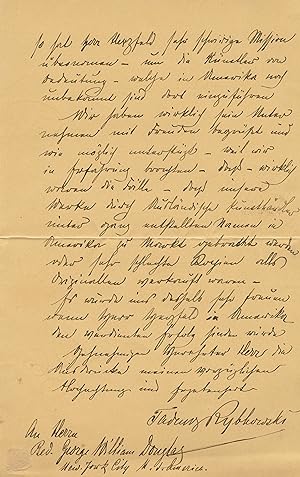
1886 German Manuscript Letter about Art from Polish Artist Tadeusz Rybkowski to Rev George William Douglas in NYC
Publication Date: 1886
Seller: Katz Fine Manuscripts Inc., Cochrane, AB, Canada
Seller rating 5 out of 5 stars
Manuscript / Paper Collectible Signed
No Binding. Condition: Good. No Jacket. On offer is a German language letter written and signed by Tadeusz Rybkowski (Polish, 1848-1926) to Reverend George William Douglas in German (1850-1926). This letter is written on Rybkowski letterhead and dated January 14, 1886. It is addressed to Rev Douglas, who is in New York. Very loose translation of the letter indicates that Rybkowski is praising Douglas for his success and discussing the purchase of artwork. BIO NOTES: Tadeusz Rybkowski - Painter and illustrator. He studied at the Krakow Academy of Fine Arts in studio Wladyslaw Luszczkiewicz, he continued from 1875 to 1877 at the Academy of Fine Arts in Vienna. In addition, private lessons Leopold Löffler and Hans Makart. After completion of education remained in Austria, where he went on trips to Italy and Germany. In 1893 he moved to Lviv, where he was a teacher of drawing at the State Industrial School. In addition, running a private school of painting and drawing for women. The most common theme appearing in his compositions are rural scenes, hunting, sledding, fairs, scenes from the life of Hutsul. He illustrated the book dealt with the wall painting. (Quoted from Artlist online). Rev. George William Douglas, D. D. , New York, Canon of the Cathedral of St. John the Divine, Director of The Churchman, Chairman of the Executive Committee of the Christian Unity Foundation, New York; , and had been rector of St. John's church on Lafayette Square, Washington, D. C. Later at Trinity Trinity Church on the Green New Haven, Connecticut; 1895 The Rev. George William Douglas becomes Rector. In 1896 Rev. George William Douglas (1850- 1926) preaches Sermon on the Work of the Parish on the Second Sunday after the Epiphany, January 19, 1896. (From Trinity New Haven CT online). The letter measures 6-3/4 x 8-1/2 inches flat folded to 6-3/4 x 4-1/2 inches (was fold again but now flat 4pp with page 1 and 3 with hand-written 2pp letter. Overall G. ; Manuscripts; 8vo 8" - 9" tall; 2 pages; Signed by Author. Signed by Author(s).
-
In 4 Theile: 1. Einleitung. - 2. Erstes Hauptstück. Von den Kanonen. - 3. Zweites Hauptstück. Von den Kanonen Lafetten. - 4. Drittes Hauptstück. Ladezeug und übringem Zubehör. 3 Bde - [EXTENSIVE ARTILLERY MANUSCRIPT IN GERMAN. ?]
Seller: Herman H. J. Lynge & Søn ILAB-ABF, Copenhagen, Denmark
Seller rating 4 out of 5 stars
Signed
Germany, Late 18th century. Folio. (32 x 20,5 cm.). 3 contemp. Half calf. (275)-351"(335) pp. (only text on front, not verso of leafs) A few illustrations in the text. A plate seems to be missing as the text refers to one. On fine thick paper. In uniform German gotic hand in brown ink. All 3 volumes are signed "Rosenstand", which must be the author. All three volumes attested with a read wax seal and signed "Haffnery". Extensive manuscript in German on artillery science.
-
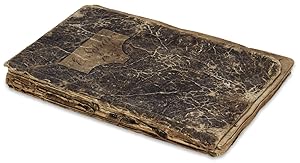
Mehlspeisen, Pasteten, und allerlei Backwerken [German Manuscript Cookery Book]
Published by N.p. [Germany], 1825
Seller: James Cummins Bookseller, ABAA, New York, NY, U.S.A.
Seller rating 5 out of 5 stars
Signed
Ink on paper, 21 pp. with two smaller leaves loosely inserted, 6 blank leaves at back. 1 vols. 8vo. Closely written in an elegant and archaic hand, comprising more than 50 recipes for a variety of puddings and pastries. The title leaf and front cover are signed Emmeline Kühl. Green lithographed wrappers with ornamental borders, titled in ink on front "Kochbuchlein . 1825", back wrapper with view of Tempelhof, Berlin. Very good Ink on paper, 21 pp. with two smaller leaves loosely inserted, 6 blank leaves at back. 1 vols. 8vo. Signed.


![Seller image for Observations on the Utility of good Riflemen both in Infantry & Cavalry, with Instructions for Acquiring the Art of Taking a Good Aim, and Description of Targets [.] To which is added A Short Manual Exercise for Mounted Chasseurs as well as for Dragoons or Hussars, who are Armed with Rifle Pieces [.]. Translated from the Original German Manuscript Under the Inspection of the Author. for sale by Antiquariat INLIBRIS Gilhofer Nfg. GmbH](https://pictures.abebooks.com/inventory/md/md30548532057.jpg)
![Seller image for Mehlspeisen, Pasteten, und allerlei Backwerken [German Manuscript Cookery Book] for sale by James Cummins Bookseller, ABAA](https://pictures.abebooks.com/inventory/md/md1221950975.jpg)