Order Total (1 Item Items):
Shipping Destination:

Manuscript Leaf, Signed (19 results)
Skip to main search results
Search filters
Product Type
- All Product Types
- Books (19)
- Magazines & Periodicals (No further results match this refinement)
- Comics (No further results match this refinement)
- Sheet Music (No further results match this refinement)
- Art, Prints & Posters (No further results match this refinement)
- Photographs (No further results match this refinement)
- Maps (No further results match this refinement)
- Manuscripts & Paper Collectibles (No further results match this refinement)
Condition Learn more
- New (No further results match this refinement)
- As New, Fine or Near Fine (1)
- Very Good or Good (6)
- Fair or Poor (No further results match this refinement)
- As Described (12)
Binding
Collectible Attributes
- First Edition (5)
- Signed (19)
- Dust Jacket (No further results match this refinement)
- Seller-Supplied Images (18)
- Not Print on Demand (19)
Language (4)
Price
- Any Price
- Under US$ 25 (No further results match this refinement)
- US$ 25 to US$ 50 (No further results match this refinement)
- Over US$ 50
Free Shipping
Seller Location
Seller Rating
-
Autograph manuscript leaf signed
Language: English
Published by Original ms, 1889
Seller: The Plantagenet King ABA : ILAB : PBFA, Birchington, KENT, United Kingdom
Association Member: ABA ILAB PBFA
Seller rating 5 out of 5 stars

First Edition Signed
US$ 172.73
US$ 33.54 shipping
Ships from United Kingdom to U.S.A.Quantity: 1 available
Add to basketSoft cover. Condition: Very Good. 1st Edition. MARTIN (Sir Theodore, 1816-1909). Autograph Manuscript Leaf Signed, quoting Heinrich Heine, dated June 1889. 1 p., 8vo, in ink on laid paper, the verso with old paper adhesions, crease and an old fold. Good. From Heinrich Heine's Poems and Ballads in Martin's hand, written out and signed is this quotation: "The rose, the lily, the sun, and the dove, I loved them all with a passion of love. That is past; now one only is dear to me, My pretty, my witty, pure, peerless she; She herself, source of all that is worthy love, Is rose, and lily, and sun, and dove." From Heine, by Theodore Martin. June 1889. Sir Theodore's acclaimed English translation of Heine's Buch der Lieder (1854) introduced the German poet's lyrical romanticism to Victorian readers and influenced later Anglophone verse renderings. This autograph transcription?made thirty-five years later?shows Martin's lasting affection for Heine's poetry. Sir Theodore Martin was a Scottish poet, translator and man of letters, best known for his translations of Heine, Horace, and Catullus, and for his monumental Life of the Prince Consort. He was also the husband of the celebrated Shakespearean actress and author of On Some of Shakespeare's Female Characters, Lady Helen (Faucit) Martin. It is rare to find a manuscript leaf like this from him. . Signed by Author(s).
-
TYPED MANUSCRIPT LEAF SIGNED, The final paragraphs of "The Americanism of Washington", signed in full by the author HENRY VAN DYKE.
Published by Circa, [1906]. [1906]., 1906
Seller: Blue Mountain Books & Manuscripts, Ltd., Cadyville, NY, U.S.A.
Seller rating 5 out of 5 stars
Signed
Condition: Good. - sc - Over 145 words typed on a 5-1/2 inch high by 8-1/2 inch wide sheet of creamy white paper. The number "-17-" is centered at the top of the page. The word "draft" is penned in blue crayon at top left of the page and there are a couple of correction marks in pencil, typed corrections, and two words corrected in ink by the author. Signed in full "Henry van Dyke" in black ink below the text with the annotation "-c-" denoting his copyright, beneath his signature. This typed signed manuscript leaf is mounted with glue along the left edge onto a sheet of 7 inch high by 5 inch wide watermarked paper which was once likely bound into a book. The manuscript leaf is soiled and folded vertically down the middle. There is a small hole to the top left corner and another tiny pin-like hole at right between the third and fourth line of type. The signature is strong and bold. A substantial portion of the final paragraph of Henry Van Dyke's great patriotic work. ".as in our power lies, the fountain of our national life from political, commercial and social corruption ; to teach our sons and daughters, by precept and example, the honour of serving such a country as America. For high in the firmament of human destiny are set the stars of faith in mankind, and unselfish courage, and loyalty to the ideal ; and while these shine the spirit and the hope of Washington and the men who stood with him shall never, never die."Together with a secretarial letter, typed on his 6-7/8 inch high by 5 inch wide personal stationery with "H.v.D. / Avalon, / Princeton, N.J." embossed at the top. The letter, in which the author mentions sending a photograph and that he will soon forward a copy of the address which he will deliver on University Day, was "dictated Feb. 2, 1906" and signed "Henry van Dyke" by his secretary.Henry Van Dyke's oration was first delivered on Washington's birthday in 1906 at the University of Pennsylvania. It was published soon thereafter.
-
AUTOGRAPH LETTER SIGNED ON HOUSE OF COMMONS LETTERHEAD, and manuscript leaf from his novel "Lady Lee's Widowhood".
Published by [London, U.K.]: 22 June 1888., 1888
Seller: Blue Mountain Books & Manuscripts, Ltd., Cadyville, NY, U.S.A.
Seller rating 5 out of 5 stars
Signed
Condition: Very good. - Letter: small octavo [7-3/8 inches high by 4-3/4 inches wide]. 128 words penned in black ink on all 4 sides of a folded, 4-sided sheet of House of Commons letterhead with the Commons seal at the top of the first side. Signed "Yours sincerely / Edward Hamley". There is occasional very light foxing to the letterhead & 2 pieces of mounting tape adhere to the right margin of the 4th side where the letter has been removed from an album. Folded once for mailing. Very good.Manuscript leaf: small quarto [9 inches high by 7 inches wide]. 83 words penned in black ink on one side of a sheet of cream watermarked paper. Folded 3 times with slight darkening down the top end of 1 vertical fold. 2 small pieces of tape adhere to the verso of the sheet where it has been removed from an album. Very good. The letter addressed to "My dear Mrs. Ford" expresses his regret that he missed her when he called on her. He congratulates her on becoming "the Mistress of Pencarrow", her family's estate and her childhood home. He goes on to complain about the House of Commons workload, though "we are not quite such slaves as we were last year." The manuscript leaf is from Hamley's novel "Lady Lee's Widowhood" and is headed "Chap. II." The page, which ends in mid-sentence describes the morning toiletries of two women characters. The first sentence of the extract reads: "Rosa, constitutionally an early riser, used to be always up before Orelia in the morning, until the latter took it into her head to have a shower-bath fitted up in the closet that opened from their room."Sir Edward Bruce Hamley [1824-1893] served in the Crimean War. He was professor of military history at the Staff College, Sandhurst from 1858 to 1877 and was Commandant of the College from 1870-1877. He was chief of the commission for the delimitation of the Balkan and Armenian frontiers [1879-80] and commanded a division in the Egyptian war of 1882. He was promoted to General in 1890. Hamley was Member of Parliament for Birkenhead from 1885 until his death in 1893.In addition to works on the Crimean War and his military manual "The Operations of War", Hamley was a short-story writer and poet, a translator of French verse, and the author of a novel "Lady Lee's Widowhood". He was a valued contributor to Blackwood's Magazine, wherein the novel first appeared in 1853. It was subsequently published in two volumes by William Blackwood and Sons in 1854. [Sadleir 1103; Wolff 2949].Both the letter and the manuscript come from the autograph collection of Mrs. Mary Ford, widow of Richard Ford who wrote the popular "Handbook for Travellers in Spain". The autograph collection [known as the Pencarrow Collection] was formed from the 1850s onwards, largely by Mary Ford in her long period of widowhood.
-
The Complete Works of Ralph Waldo Emerson (The Autograph Centenary Edition -- Complete in 12 Volumes AND with an Original Tipped-In Manuscript Leaf)
Published by The Riverside Press (Houghton Mifflin Co.), Cambridge, MA, 1904
Seller: APPLEDORE BOOKS, ABAA, WACCABUC, NY, U.S.A.
Seller rating 5 out of 5 stars
First Edition Signed
3/4 leather. Condition: Near Fine. First Edition. A very attractive example of this sumptuous collection of the "Complete Works of Ralph Waldo Emerson", bound in a lavish 3/4 dark-green morocco over marbled boards, with fine gilt-tooling at the compartments. Complete in 12 octavo volumes. The 1903-1904 "Autograph Centenary Edition", here honoring Emerson's 1803 birth. This set #67 of 600 copies issued of the "Autograph Centenary Edition", EACH SIGNED "HOUGHTON MIFFLIN & CO." AT THE LIMITATION AND EACH ALSO INCLUDING AN ORIGINAL MANUSCRIPT LEAF, IN THIS CASE AN 1854 HANDWRITTEN LETTER --ADDRESSED FROM CONCORD-- IN VOLUME I IN RALPH WALDO EMERSON'S FLOWING HAND, TAKING UP BOTH SIDES OF THE BOUND-IN SINGLE SHEET. THE ALS GRACIOUSLY OFFERS THANKS FOR EMERSON'S "ELECTION AS AN HONORARY MEMBER OF 'THE EVERETT LITERARY ASSOCIATION'", WHILE ADMITTING "I AM MUCH TO BLAME FOR ALLOWING YOUR NOTE INFORMING ME OF MY ELECTION TO REMAIN UNACKNOWLEDGED HITHERTO". The set is bright and crisp and easily VG+ to Near Fine. Top-edges bright-gilt, deckled fore and bottom-edges. Very faint mustiness to several of the volumes, clean as could be internally, with no writing or markings of any kind. Illustrated in photogravure throughout, matching marbled endsheets and pastedowns as well. A lasting, significant collection of Emerson's full body of writings. Signed.
-
The Complete Works of Ralph Waldo Emerson [WITH] Journals of Ralph Waldo Emerson 1820-1872 [LIMITED EDITION, WITH MANUSCRIPT LEAF INSERTED - COMPLETE IN 22 VOLUMES]
Published by Printed at The Riverside Press / Houghton, Mifflin and Co, Cambridge / Boston, 1903
Seller: ERIC CHAIM KLINE, BOOKSELLER (ABAA ILAB), Santa Monica, CA, U.S.A.
Seller rating 3 out of 5 stars

Signed
Hardcover. Condition: Nearly Fine. The Autograph Centenary Edition. 507/600. 22 volumes, octavo (22 by 15 cm), published between 1903 and 1914. Half-titles and volume titles in red and black; gravure frontispieces and occasional illustrations throughout on India paper, mounted; top edge gilt, other edges uncut as issued; silk ribbon markers. Sheet of Emerson's autograph manuscript inset in leaf following half-title of the first volume. Uniformly bound at the Riverside Press in three-quarter brown crushed morocco over marbled boards, with matching endleaves. Edition limited to 600 copies, numbered by hand at the limitation page (and signed for the publisher in the first volume), this being set no. 507. Spines lightly sunned, a few with light rubbing; 3 volumes with slight chips at spine caps; paper boards with occasional scuffs, else a fine set. Autograph Centenary Edition (Works); Large Paper Copy (Journals), with all of Emerson's poems, lectures, biographical sketches, letters and essays, some published here for the first time. The inset manuscript contains sixteen lines of text in black ink on blue paper, with corrections. The opening line, "The English are not particularly desirous that foreign nations should be ably represented at their court." suggests the sort of observation one might find in Emerson's English Traits (1856). References: BAL 5314 (Works); Grolier, American 100, 47.
-
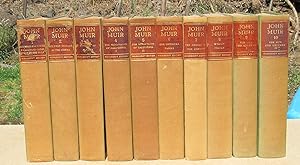
The Writings of John Muir: The Manuscript Edition. --- complete set WITH partial leaf of John Muir's handwriting taken from the manuscripts of his books -- The Story Of My Boyhood And Youth, A Thousand-Mile Walk to the Gulf, My First Summer in the Sierra, Travels in Alaska, The Mountains of California, Our National Parks, The Cruise of the Corwin, Steep Trails, The Life and Letters of John Muir
Published by Houghton Mifflin Company 1916-1924, Boston, 1916
First Edition Signed
Hardcover. Condition: Very Good. No Jacket. 1st Edition. This is a first edition complete 10 volume set of THE WRITINGS OF JOHN MUIR by John Muir, edited by William Frederic Bade with additional biographical material in volumes 9 and 10 by Bade. Edition of 750 sets, this set being number 200 with that number being handwritten in each volume on the limitation page. The sets were published over a number of years starting in 1916 and concluding in 1924. Each volume measures 231mm tall x 155mm and has a b/w frontispiece with tissue guard. The set requires approximately 410mm (16.25 inches) of shelf space when the volumes are positioned upright. The following is copied from Kimes' bibliography of John Muir's books: v. 1. Nine photogravures with printed tissues, incl. front.; 8 halftone plates of author's sketches and map tipped in. v. 2. Eight photogravures with printed tissues, inc. front.; 16 halftone plates of author's sketches and map tipped in. v. 3. Eight photogravures with printed tissues, incl. front., and map tipped in. v. 4. Eight photogravures with printed tissues, incl. front., and map tipped in. v. 5. Six photogravures with printed tissues, incl. front., and map tipped in. v. 6. Seven photogravures with printed tissues, incl. front., and map tipped in. v. 7. Five photogravures with printed tissues, incl. front.; 10 halftone plates of author's sketches and map tipped in. v. 8. Six photogravures with printed tissues, incl. front., and map tipped in. v. 9. Seven photogravures with printed tissues, incl. front., and 1 plate of author's drawing tipped in. v. 10. Five photogravures with printed tissues, incl. front., and 1 plate of author's drawing tipped in. Price: $6.00 per v. In correspondence with the Houghton Mifflin Company, we learned that The Writings was a publication of the Private Library Department and that no records were available. The set was sold by subscription only. According to the publisher's announcement of the manuscript edition, the first six volumes were to be published in the fall of 1916, and the remaining four volumes would be published as soon as "the work of compilation and editing" could be accomplished. Since A Thousand-Mile Walk to the Gulf, included in volume one, was not published until November, 1916, the six volumes could have been available in December, but it may not have been until early in 1917. Volumes seven and eight were published in 1918; volume nine did not appear until late in 1923, and volume ten in 1924. Correspondence indicates that the war was a deterring factor in the company's publication schedule. Customers were inquiring for the last two volumes as early as 1919 and 1920. A hand-written note (Dr. Bade) on a publisher's announcement indicates that the manuscript edition, issued in a variety of formats, was completely sold. CONDITION: Each volume is bound in original green buckram, with leather title patch on spine lettered in gilt, with front and bottom edges of text block uncut, and with each volume hand-numbered (all volumes have the same number which indicates that this is not a mixed set). The spines have faded to tan (usual for this binding) and the leather title patches have some usual wear with loss to the patches of volume 1, volume 2, and volume 3. No previous owner marks or writing on any pages, no foxing, solid bindings, complete.PHOTOS ARE OF ACTUAL ITEM BEING OFFERED. Signed by Author(s).
-
Leaves of Grass. 3 Vols. (# 2 of 32 copies) WITH full page hand corrected - with 15 changes to the text -Manuscript Leaf from "Specimen Days & Collect," along with three additional volumes from The Complete Writings of Walt Whitman. Issued under the editorial supervision of his literary executors, Richard Maurice Bucke, Thomas B. Harned, and Horace L. Traubel; with additional bibliographical and critical material prepared by Oscar Lovell Triggs. Printed in 32 copies - this the true first and complete collection [6 of 10 Volumes]
Published by G. P. Putnam's Sons, Knickerbocker Press, New York, 1902
Seller: ERIC CHAIM KLINE, BOOKSELLER (ABAA ILAB), Santa Monica, CA, U.S.A.
Seller rating 3 out of 5 stars
Signed
Hardcover. Condition: Near fine condition. 2/32, signed by the publisher, Jeanette L. Gilder and the notary. Quarto. 294, 323, 318pp. with Vol. IV, 282pp., Vol. V, 300pp., Vol. VII, 309pp. Publisher's Deluxe original light brown Morocco binding with decorative gilt, green and pink floral design, gilt ruling on covers and spine; raised bands. Inside covers in light brown Morocco with gilt floral design with red accents, gilt ruling and floral inlay in purple and green with gilt outline on green leather square in centers. Top edges gilt. Bottom and foredge untrimmed. Green silk moire endpapers. Silk ribbon markers. No. 2 of 32 sets of the Author's Manuscript Edition, numbered and signed by the publisher on colophon, retaining the original manuscript leaf in volume one. Printed on Whatman handmade paper with frontispiece in two states, the manuscript leaf bound into the first volume, preceded by certification leaf signed by Jeanette L. Gilder, with seal and signature of the notary, dated May 19, 1902. Two frontispiece portraits of Whitman, one in color, one in b/w, etched by Jaques Reich from the same photograph by Thomas Eakins, with printed tissue guard indicating it to be Whitman's last photograph. Title page with elaborated floral design in green, title printed in red, and green lettering in green double frame. The enclosed manuscript page is from Whitman's "Specimen Days & Collect," first printed by Rees Welsh & Co., Philadelphia, 1882, on page 180., and reproduced in the New England Magazine, New Series. August, 1892, Volume VI, No. 6, and quoted Sylvester Baxter in "Walt Whitman in Boston," pp. 714721, on page 717. The manuscript consists of twenty-two lines (8 x 4 5/8") with fifteen hand corrections in the text. With three additional volumes, IV, V, and VII, from the same set of "The Complete Writings of Walt Whitman," 2/32, all signed and numbered by the publisher.
-
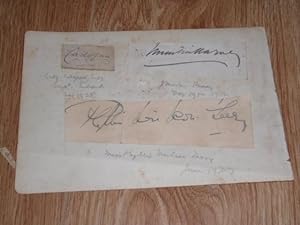
Condition: Good. The writing is in a neat hand. The verse reads: "Pte is my nickname Ireland is our nation Parliament house belonged to us Since Ireland was a nation. When I am in my lonely cell and not a word is spoken may the prison Governor break his neck, That put me Oakem ." It is Signed by the writer. His signature is difficult to read and more research is required to ascertain who he was exactly. The first name in the title is a poor effort at deciphering his signature. On the verso are three other autographs Lady Cadogan (1925), J. Martin Hussy(?) (1912), Phyllis Neilson Terry. Size: 17.5 x 12.5 Cms. (7 x 5 Inches approx). Signed by Author(s).
-

The Treaties of 1778 and Allied Documents. ( Cahier I of '' Historical Documents Institut Français de Washington'' ). With manuscript dedication leaf of the Interparlementary Union - The American Group.
Seller: Antiquariaat Wim de Goeij, Kalmthout, ANTW, Belgium
Association Member: ILAB
Seller rating 5 out of 5 stars
Signed
7. Baltimore, The John Hopkins Press, 1928, in-8°, 26,5 cm, xxv pp + 70 pp, publisher's half cloth, no dustwrapper. Tipped in at the first fly leaf is a printed ex-dono with the holograph signatures of the 18 members of the Interparliamentary Union - The American Group - February 25, 1928. The printed text of the ex dono states that M. Pierre Etienne Flandin, Député, receives this book as a token of gratitude, from the American group of the Interpaliamentary Union. M. Flandin was their host in Paris during the 24th conference - August 25 - 30 - 1927. Signed by e.g. Senator Theodore E. Burton (President) , Andrew Montagu, Edgar Howard, Fred. A. Brittan , J.G.Cochran, Roy G. Fitzgerald , Stephen Porter , .
-
Autograph Manuscript Leaf from a Speech in Praise of Women
Published by [London, 1872
Seller: James Cummins Bookseller, ABAA, New York, NY, U.S.A.
Seller rating 5 out of 5 stars
Signed
Published at p. 213 of Mark Twain's Sketches, New and Old (Hartford: American Publishing Company, 1875). Ink on paper, 16 lines, page numbered 7 at top, with a couple of changes while writing. 1 vols. 8vo. An outstanding manuscript leaf of a humorous talk by Mark Twain on women, his "Speech at a Scottish Banquet in London", delivered in 1872 in response to the toast of "The Ladies" [I feel that if I] were to talk hours I could not do my great theme completer or more graceful justice than I have now done in simply quoting that poet's matchless words. The phases of womanly nature are infinite in their variety. Take any type of woman, & you shall find in it something to respect, something to admire, something to love . It is well known that Clemens was extraordinarily devoted to his wife and daughters, and this is a remarkable testimony to his great love of Women throughout history and literature. Only one other leaf of this manuscript is known to have survived. The manuscript is in a copy of the deluxe edition of Word Shadows of the Great, The Lure of Autograph Collecting (New York: Frederick A. Stokes, 1930), the acclaimed book by legendary autograph dealer Thomas F. Madigan, with two typed letters, signed, from Madigan to a New York collector, one conveying this manuscript and book. Matted. In a fine copy of Word Shadows of the Great, no. 298 of 300 copies, original Japan vellum spine and boards and slipcase, with original glassine (some chipping and toning to glassine) Ink on paper, 16 lines, page numbered 7 at top, with a couple of changes while writing. 1 vols. 8vo Published at p. 213 of Mark Twain's Sketches, New and Old (Hartford: American Publishing Company, 1875). Signed.
-
ILLUMINATED LEAF FROM A MEDIEVAL ENGLISH MANUSCRIPT BIBLE, Oxford, c.1240
Published by N, N, 1240
Seller: Kay Craddock - Antiquarian Bookseller, Melbourne, VIC, Australia
Association Member: ANZAAB ILAB
Seller rating 5 out of 5 stars
Signed
Single leaf, from a Bible illuminated in the workshop of William de Brailes, 18.5 cm. x 13.5 cm., 54 double column lines (ten lines per inch) of ruled Latin gothic script written in brown ink on vellum, with rubricated chapter numbers, two small two-line initials and marginalia in red & blue; mounted, glazed and framed. *The text is Revelation 14:15-18:14, beginning 'et alius angelus exivit de templo, clamans voce magna . . .' ['And another angel came out from the temple crying with a loud voice to him that sat upon the cloud: Thrust in thy sickle, and reap, because the hour is come to reap: for the harvest of the earth is ripe . . .'] . William de Brailes is one of only two 13th century English illuminators whose name can be associated with surviving works. His surname indicates that he was probably born in Brailes, Warwickshire, and he is known to have maintained a workshop in Oxford from circa 1230 to circa 1260. Signed.
-

Manuscript on paper, entitled on first leaf of text "Secret and Truthful Story of the Capture of the Bandits."
Seller: Jonathan A. Hill, Bookseller Inc., New York, NY, U.S.A.
Seller rating 5 out of 5 stars
Signed
39; 41 folding leaves. Two parts in one vol. Large 8vo (277 x 187 mm.), orig. semi-stiff wrappers with orig. manuscript title slip, new stitching. [Japan:] after 1782. The story of the life of Ishikawa Goemon ?????? (1558-94), a legendary bandit of the late "Warring States" period. Historical sources pertaining to Ishikawa's life are extremely sparse, amounting to only a few mentions of his execution by being boiled in a vat of oil in Kyoto in 1594, on the order of the warlord Toyotomi Hideyoshi. The dearth of written sources notwithstanding, in the popular imagination and in artistic expression, Ishikawa became a Robin Hood-like figure who stole in order to give to the poor, and his execution would have been due to his failed attempt to assassinate Hideyoshi. Ishikawa Goemon featured in Kabuki plays of the Edo period. Zokkinhiseidan was never published in the Edo period, circulating only in manuscript form. We find no copy in North America. The earliest known manuscript dates from 1782, and the most recent from 1876. However, other evidence suggests that the book was written as early as before 1776. The contents can be divided into four sections: 1) a discussion of Ishikawa's ancestors; 2) Ishikawa's birth in Iga province, his study of ninjutsu, and his travel to Kyoto; 3) his activities as a bandit; 4) Ishikawa breaking into Hideyoshi's bedroom, his capture and execution by boiling. The authorship of our book is unknown, but there are some clues. Some copies contain a Preface signed "Higashitake Zank? ????," "Takei Zank? ????," or "Zank?, the recluse of T?bu castle" ??????? This has led scholars to speculate that the author might have been Masaki Zank? ????, a known Edo-period storyteller. This conjecture is unproven, however. Very good copy, some thumbing and dampstaining. ? Hosaya Tomoko ????, "Ishikawa Goemon jitsuroku Zokkinhiseidan ni tsuite" ???????????????????, Rikky? daigaku Nihongaku kenky?jo nenp? 8 (2011): pp. 114-22.
-
Manuscript on paper, entitled on first leaf of Vol. I: "Hakuh? shinpen" ???? ["New Writings on Naval Artillery"]
Seller: Jonathan A. Hill, Bookseller Inc., New York, NY, U.S.A.
Seller rating 5 out of 5 stars
Signed
Ten pages of manuscript illus. in the first vol. plus a number of graphs & tables in the text. 724 folding leaves. Eleven parts in 12 vols. 8vo (265 x 185 mm.), orig. semi-stiff wrappers, new stitching. [Japan]: 1847. The most complete copy known of one of the two Japanese translations of J. N. Calten's Leiddraad bij het Onderrigt de Zee-Artillerie (Dutch eds.: 1832, 1842, and 1847). In the second quarter of the 19th century, Japan had an urgent need to update its artillery and learn more about the artillery of its international adversaries. Artillery had been used in the warfare that preceded the establishment of the Tokugawa shogunate in the early 17th century, but with the advent of peace, such weaponry had been strictly controlled. In the early 19th century, the European powers became more active in the waters around Japan, seeking access to Japanese ports, and several armed encounters with European ships resulted. The shogunal government sponsored the translation of European works on artillery and ordered new coastal batteries built. As the Dutch were already present in Japan as the only European nation allowed to trade, and a number of Japanese scholars were proficient in Dutch, books in that language, such as Calten's, were translated first (Éric Seizelet, "La naissance de l'artillerie japonaise moderne à la fin de l'époque d'Edo (1830-1868)," Revue historique, no. 702 [2022]: pp. 319-60). The first volume contains a glossary of Dutch and Japanese terms, a discussion of weights and measures, illustrations of gunpowder-making tools and concepts of ballistics, and a section on calculating. This introductory volume, containing a grand index, is signed and dated by the translator, Fujii, in 1847. The first section of the manuscript proper opens with a translation of Calten's original Preface, dated 1831. A discussion about gunpowder follows. The second section concerns guns and their different kinds (cannon, howitzers, etc.). Other sections cover gun carriages, munitions (solid cannonballs, grapeshot, etc.), tools and other necessities, handguns and rifles, and, crucially, the efficient operation of guns. These sections feature a number of ballistic calculations, graphs, and tables with data for different types of guns. The text ends with a discussion of the defense and attack of coastal positions. Calten was a captain and professor of military science in the Dutch navy. Fujii (style name Tadashi ?) initially worked at the bakufu's astronomical bureau in Edo but later returned to Kaga domain in the Ch?bu region of Honshu. In 1840, he contributed to the work Eibunkan ??? [Mirror of the English Language]. This appears to be the most complete surviving copy of this text; NIJL lists a number of manuscripts, and all are far more incomplete. Our set seems to lack sections of Parts 3 and 9. Calten's book had been separately translated by Udagawa Y?an ????? in 1843. Whereas Udagawa's translation was eventually printed in 1854, Fujii's remained in manuscript form and was never published. Fine set, preserved in a chitsu, unimportant and mostly marginal worming, occasionally touching characters.
-
Romantic Noble Couple Indo-Persian Miniature, North India c.1880?1900, Manuscript Leaf
Language: Persian
Published by [Anonymous workshop, North India or Deccan], Likely Lucknow, Rajasthan, or Agra, North India, 1900
Signed
No Binding. Condition: Very Good. No Jacket. Unique handmade miniature painting on a repurposed manuscript folio (illustrator). Artistic Context & Overview A late Mughal/Rajput miniature from North India, painted c.1880?1900. This refined scene captures a romantic noble couple seated in an intimate palace interior, set beneath a night sky. Such subjects typify the poetic and courtly culture of 19th-century Indo-Persian ateliers, blending Mughal elegance with local Rajput flourishes during the decline of imperial patronage. Visual/Technical Description Opaque watercolor and ink on handmade wasli, overlaid on a repurposed Persian manuscript. The painting shows intricate jewelry, patterned textiles, and a richly detailed carpet on a black-and-white chequered floor. Architecture, foliage, and drapery provide visual depth; color retention is strong with delicate gold accents. Minor edge wear and one corner tip lost; original margins and border details preserved. Material/Manuscript Context Executed on a dense Persian manuscript leaf, visible as continuous Nastaliq script across the reverse. This hybrid object reflects 19th-century North Indian practice, using valuable calligraphic paper for miniature art. Paper shows uniform age toning and some sheen but remains structurally sound. Condition (Summary) Very Good. Stable paint surface, no overpainting or restoration detected. Minor wear confined to edges. Reverse text mostly clear, with only minor ink fading and some gloss. Provenance / Significance From a private collection of North Indian miniatures. The reused manuscript increases research and collector value, providing a window into courtly administration. Presence of a named scribe (?Abd al-Ghafoor?) and formal Persian letter format are notable. Comparable Mughal/Rajput miniatures on manuscript have realized $850?$1,250 at Bonhams and Christie?s (2022?2024). Translation & Analysis (front and reverse) Reverse: Persian formal correspondence in Nastaliq script. 'To the esteemed and exalted. After greetings, peace and mercy of God upon you? This humble servant at your noble command is engaged in his duties? If you order, the matters will be sent soon? On the day?month?year?' Signed: 'Abd al-Ghafoor, your humble servant.' (No explicit date or surname beyond this name, but formula matches 19th-century North Indian court letters.) No visible text on the painting?s front; all manuscript appears on reverse. Conclusion A poetic, visually rich Indo-Persian miniature painted c.1880?1900 on a Persian manuscript leaf. Combines Mughal/Rajput romance with formal calligraphic history?an excellent collector or research piece, with named scribe, clear provenance, and strong value potential.
-
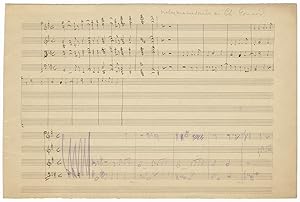
Autograph musical manuscript sketch leaf: in condensed score for an unidentified work in G major
Language: French
Seller: J & J LUBRANO MUSIC ANTIQUARIANS LLC, Syosset, NY, U.S.A.
Association Member: ABAA ILAB IOBA PADA
Seller rating 5 out of 5 stars
Signed
Oblong folio (175 x 264 mm). 30 measures in total, notated on both sides of the leaf, the initial 13 measures in black ink, the following 17 in purple pencil, possibly a continuation of the same work. With several deletions and "Notes manuscrites de Ch. Gounod" in pencil to upper right margin. Slightly worn and browned; cut from a larger leaf. "Gounod wrote in most of the major genres of his day, sacred and secular. That his reputation began to wane even during his lifetime does not detract from his place among the most respected and prolific composers in France during the second half of the 19th century." Steven Huebner in Grove Music Online. Signed.
-
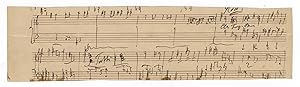
Autograph musical manuscript sketch leaf from the composer's Eighth Symphony
Seller: J & J LUBRANO MUSIC ANTIQUARIANS LLC, Syosset, NY, U.S.A.
Association Member: ABAA ILAB IOBA PADA
Seller rating 5 out of 5 stars
Signed
23 measures in total in short score. Notated in black ink on both sides of a fragment of rastrum-ruled music manuscript paper 239 x 62 mm., cut from a larger leaf, with 12 measures on recto and 11 on verso. Unsigned and undated, but ca. 1889. A working manuscript containing thematic material from the first movement of the symphony, with corrections and deletions. Slightly worn and browned; minor staining to lower margin, slightly creased at horizontal fold; trimmed at lower margin, with some loss of notation to final 6 measures of recto and final 6 measures on verso. Together with: A bust-length postcard photograph of the composer, with "Printed in Germany" to verso. Dvo?ák's Eighth Symphony, op. 88, in G major, was first performed in Prague on 2 February 1890 by the National Theatre Orchestra, with the composer conducting. Burghauser 163. Sourek 109. "In its formal aspect . the G major symphony ranks among Dvo?ák's most independent and original symphonic works." Sourek: The Orchestral Works of Antonin Dvo?ák, p. 128. "The influence of folk music is heard . clearly in the Eighth Symphony . with which Dvo?ák allegedly (?ourek) hoped 'to write something different from his other symphonies and shape the musical content of his ideas in a new manner'. The variety and diversity of those ideas is striking, and they are often expressed in a musical language peculiar to them (with imitations of natural sounds, pastoral subjects, signals, fanfares, the suggestion of a funeral march and the idiom of a chorale). Sonata form is loosely applied and gives way to a more rhapsodic unfolding of ideas, but musical coherence is maintained through related melodic motifs and above all by rhythmic structures. In both the enhancement of musical language and the relaxation of formal structure, the Eighth Symphony reflects for the first time in a large instrumental work the new poetic element in Dvo?ák's music after the spring of 1889. With Smetana, Fibich and Janá?ek he is regarded as one of the great nationalist Czech composers of the 19th century. Long neglected and dismissed by the German-speaking musical world as a naive Czech musician, he is now considered by both Czech and international musicologists Smetana's true heir. He earned worldwide admiration and prestige for 19th-century Czech music with his symphonies, chamber music, oratorios, songs and, to a lesser extent, his operas." Klaus Döge in Grove Music Online Autograph working manuscripts of Dvo?ák are quite rare, especially as relates to one of his most highly regarded works. Signed.
-

Rare Balinese palm leaf manuscript. Eight leaves, inscribed on both sides in Hindu text manuscript, binding thread intact. In near fine condition. The oldest surviving palm leaf manuscripts date back to the 5th century BCE and have been found in Nepal, Tibet and central Asia. Used as writing materials in the Indian subcontinent of Asia, the manuscripts were created to copy and preserve classical Hindu and Sudanese scriptural texts.
-
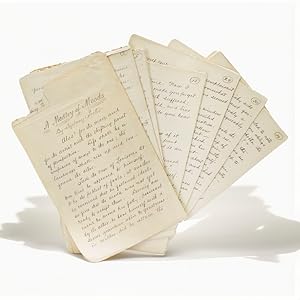
A Medley of Moods. Author's Autograph Manuscript, signed on the first leaf: "By Sydney Porter"
Publication Date: 1901
Seller: James Cummins Bookseller, ABAA, New York, NY, U.S.A.
Seller rating 5 out of 5 stars
Signed
Published in Ainslee's Magazine for December 1905; collected in Whirligigs (1910) under the title "Blind Man's Holiday". 52 pp., ink on paper, with a very few editorial corrections marked in blue. 1 vols. 8vo. A superb and substantial autograph manuscript of an early short story by pharmacist, newspaperman, and author O. Henry (William Sydney Porter, 1862-1910), written while he was in prison. The story, set in New Orleans, is titled and signed "A Medley of Moods, By Sydney Porter" and begins: "Alas! for the man and for the artist with the shifting point of perspective. Life shall be a confusion of ways to the one; the landscape shall rise up and confound the other. Take the case of Lorison. At one time he appeared to himself to be the feeblest of fools; at another he conceived that he followed ideals so fine that the world was not yet ready to accept them." Porter spent a few weeks in New Orleans when he fled to Honduras in the face of charges of embezzlement of funds from the First National Bank in Austin, Texas. The main character, Lorison, is an outcast who, though proven innocent of embezzling, is convinced that "from the moment I staked the first dollar of the firm's money I was a criminal". He meets Norah Greenway, a girl "of an untarnished, pale prettiness doomed to please" and with "a certain bright melancholy". George C. Smith, Jr., had 5 notable O. Henry manuscripts and an autograph notebook (this was the longest of the manuscripts). Nothing of this nature appeared at auction subsequently until the Joyce sale at Hanzel Galleries in 1973, when several bound manuscripts were sold. O. Henry manuscript material remains RARE. Provenance: George C. Smith, Jr., his sale Anderson Galleries, 23/24 Nov. 1937, lot 228; Alain de Suzannet (1882-1950) Small loss to the top corner of the first leaf, last three leaves torn in half and with old tape repairs. Fine. Burgundy morocco backed drop box, blue cloth chemise. Bookplate of Alain de Suzannet 52 pp., ink on paper, with a very few editorial corrections marked in blue. 1 vols. 8vo Published in Ainslee's Magazine for December 1905; collected in Whirligigs (1910) under the title ?Blind Man's Holiday?. Signed.
-
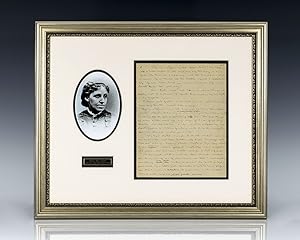
Autograph manuscript page from Louisa May Alcott's Jack and Jill, Chapter VIII, page 129. One page. The manuscript page reads, âup no capers with that child! The idea of a hot bath in the middle of the day, and him full of dinner, and croupy into the bargain! Wet a corner of a towel at the kettle-spout and polish him off if you like, but you wonât risk his life in no bath-tubs this cold day.' Miss Batâs word was law in some things, so Molly had to submit, and took Boo away, saying, loftily, as she left the room, 'I shall ask father, and do it tonight, for I will not have my brother look like a pig.' 'My patience! How the Siamese do leave their things around,'she exclaimed [crossed out a moment after'] as she surveyed her room after making up the fire and polishing off Boo. 'Iâll put things in order, and then mend up my rags, if I can find my thimble. Now, let me see,' and she went to exploring her closet, bureau, and table, finding such disorder everywhere that her courage nearly gave out. She had clothes enough, but all needed care; even her best dress had two buttons off, and her drawers were a perfect chaos of soiled ruffles, off gloves, old ribbons, boot lacings, and bits of paper. 'Oh, my heart, what a muddle! Mrs. Minot wouldn't think much of me if she could see that,' said Molly, recalling [crossed out 'that Mrs.'] how that lady once said she could judge a good deal of a little girl's character & habits by a peep at her top drawer, & went on to guess how each of the schoolmates kept hers, with great success." The final printing reads slightly differently.ÂMatted and framed opposite a photograph of Alcott. The entire piece measures 17.5 inches by 20 inches. Manuscript pages from Alcott seldom enter the market. Jack and Jill: A Village Story was originally published in 1880. The story takes place in a small New England town after the Civil War where Jack Minot and Janey Pecq are best friends and next door neighbors. Always seen together, Janey gets the nickname of Jill, to mimic the old rhyme. The two go up a hill one winter day, and then suffer a terrible accident. Seriously injured in a sledding accident, they recover from their physical injuries, while learning life lessons along with their many friends. They are helped along their journey to recovery by various activities created by their mothers.


![Seller image for The Complete Works of Ralph Waldo Emerson [WITH] Journals of Ralph Waldo Emerson 1820-1872 [LIMITED EDITION, WITH MANUSCRIPT LEAF INSERTED - COMPLETE IN 22 VOLUMES] for sale by ERIC CHAIM KLINE, BOOKSELLER (ABAA ILAB)](https://pictures.abebooks.com/inventory/md/md32150254580.jpg)

![Seller image for Leaves of Grass. 3 Vols. (# 2 of 32 copies) WITH full page hand corrected - with 15 changes to the text -Manuscript Leaf from "Specimen Days & Collect," along with three additional volumes from The Complete Writings of Walt Whitman. Issued under the editorial supervision of his literary executors, Richard Maurice Bucke, Thomas B. Harned, and Horace L. Traubel; with additional bibliographical and critical material prepared by Oscar Lovell Triggs. Printed in 32 copies - this the true first and complete collection [6 of 10 Volumes] for sale by ERIC CHAIM KLINE, BOOKSELLER (ABAA ILAB)](https://pictures.abebooks.com/inventory/md/md30649452982.jpg)


![Seller image for Manuscript on paper, entitled on first leaf of Vol. I: "Hakuh? shinpen" ???? ["New Writings on Naval Artillery"] for sale by Jonathan A. Hill, Bookseller Inc.](https://pictures.abebooks.com/inventory/md/md31837119159.jpg)