Order Total (1 Item Items):
Shipping Destination:

Perth Environs, First Edition (4 results)
Skip to main search results
Search filters
Product Type
- All Product Types
- Books (4)
- Magazines & Periodicals (No further results match this refinement)
- Comics (No further results match this refinement)
- Sheet Music (No further results match this refinement)
- Art, Prints & Posters (No further results match this refinement)
- Photographs (No further results match this refinement)
- Maps (No further results match this refinement)
- Manuscripts & Paper Collectibles (No further results match this refinement)
Condition Learn more
- New (No further results match this refinement)
- As New, Fine or Near Fine (2)
- Very Good or Good (No further results match this refinement)
- Fair or Poor (No further results match this refinement)
- As Described (2)
Binding
Collectible Attributes
- First Edition (4)
- Signed (1)
- Dust Jacket (No further results match this refinement)
- Seller-Supplied Images (3)
- Not Print on Demand (4)
Language (1)
Free Shipping
- Free Shipping to U.S.A. (No further results match this refinement)
Seller Location
Seller Rating
-

Birdwatching Perth and Environs
Published by Western Australian Museum, Perth, 1995
Seller: Muir Books [Robert Muir Old & Rare Books], PERTH, WA, Australia
Association Member: ANZAAB ILAB
Seller rating 5 out of 5 stars

First Edition
Wraps. 1st edition. 1st ed., square 8vo, pp. (iv) 19, b/w ills and maps, loosely inserted 4pp. bird list, wraps, stapled, few small brown spots front cover otherwise good. Illustrated with maps showing bird watching locations.
-
Voyage en Angleterre, en Écosse, et aux Îles Hébrides, ayant pour objet les sciences, les arts, l'histoire naturelle et les moeurs; avec la description minéralogique du pays de Newcastle, des montagnes du Derbyshire, des environs d'Édinburgh, de Glasgow, de Perth, de S.-Andrews, du duché d'Inverary et de la grotte de Fingal
Published by Paris, chez H.J. Jansen, 1797,, 1797
Seller: L'intersigne Livres anciens, Saint Xandre - La Rochelle, France
Association Member: ILAB
Seller rating 5 out of 5 stars
First Edition
Couverture rigide. Condition: Bon. Edition originale. pl. basane racinée époque, dos lisse orné, très bon exemplaire. Edition originale de ce voyage scientifique du célèbre géologue. Il reconnaît ici notamment la nature volcanique des collines du centre de l'Écosse et le basalte des Hébrides intérieures. "Faujas visited Fingal's cave which is formed of basalt. He was the first man to realize that it's origin must be volcanic. Athough not all his conclusions were right, this work remains a milestone in geology" Poggendorff I, p.724 - "In 1784 Faujas journeyed through England to Scotland; a full account was published in 1797. He narrated entertaining details of his travels and described arts, industries, and customs, but his most important observations were geological. He realized the volcanic nature of the basalt of the inner Hebrides and paid special attention to the spectacular columnar occurrence on the isle of Staffa." DSB IV.548 -Monglond IV, col. 176. in 8°, de 430pp. 1f. d'errata & 434pp. 1f. d'errata, ill de 7 planches gravées se dépl.,
-
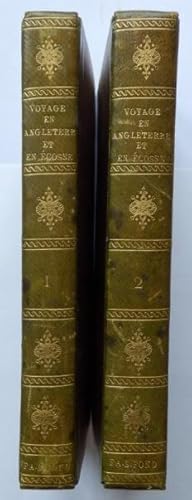
Voyage en angleterre, en Ecosse et aux îles Hébrides ; ayant pour objet les sciences, les arts, l'histoire naturelle et les moeurs ; avec la description minéralogique du pays de Newcastle, des montagnes du Derbyshire, des environs d'Edinburgh, de Glasgow, de Perth, de S.-Andrew, du duché d'Inverary et de la grotte de Fingal. Avec figures. Par B. Faujas-Saint-Fond.
Published by A Paris, Chez H. J. Jansen, 1797
First Edition
Couverture rigide. Condition: Bon. Edition originale. A Paris, Chez H. J. Jansen, 1797. 2 volumes in-8, 430pp., (2pp.), et 434pp., (2pp.). Demi-veau vert à coins de l'époque, dos lisses ornés, non rognés. 7 planches gravées hors texte, dont 6 dépliantes. Complet. Edition originale. Reliures légèrement frottées, rares rousseurs. Bel exemplaire dans une belle et solide reliure.
-
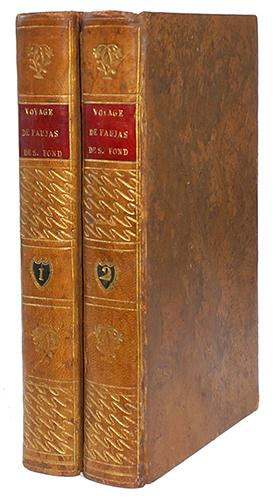
Voyage en Angleterre, en Écosse et aux îles Hébrides; ayant pour objet les sciences, les arts, l'histoire naturelle et les murs; avec la description minéralogique du pays de Newcastle, des montagnes du Derbyshire, des environs d'Édimbourg, de Glasgow, de Perth, de S.-Andrews, du duché d'Inverary et de la grotte de Fingal. Avec figures.
Published by Paris: Chez H. J. Jansen, 1797, 1797
Seller: Peter Harrington. ABA/ ILAB., London, United Kingdom
Association Member: ABA ILAB PBFA
Seller rating 5 out of 5 stars
First Edition Signed
US$ 9,344.05
US$ 29.57 shipping
Ships from United Kingdom to U.S.A.Quantity: 1 available
Add to basketFirst edition, presentation copy to Napoleon, inscribed on each half-title verso "au Général Bonaparte; l'auteur". The work gives Saint-Fond's (1741-1819) account of his travels to Britain in the year 1784, with important observations on the geology of northern England and Scotland, most notably his recognition that Fingal's Cave was a volcanic formation, which had gone unnoticed by Joseph Banks. The work also includes anecdotes of Banks, Adam Smith, John Whitehurst and the Royal Society. The work was issued in octavo and the present large paper printing on quarto sheets; an English translation followed in 1799. At the time of publication Saint-Fond was professor of geology at the Jardin des Plantes; he was later involved in the extraction to French institutions of scientific materials across Napoleonic Europe. As one of the travelling commissaires of the clumsily, but explicitly, named Commission du gouvernement pour la recherche des objets scientifiques et artistiques dans les pays conquis par les armées de la République française, established under the Directory for the purposes of pillage directed by connoisseurship and scientific expertise, Saint-Fond certainly interacted with Napoleon who himself had refined the process by inserting clauses into peace treaties ensuring that governments would hand over the items selected. One of Saint-Fond's greatest triumphs was securing the fossil skull of the Monster of Maastricht, a massive aquatic reptile from its home in Belgium. His 1799 account whereby the piece was retrieved by twelve grenadiers in exchange for an offer of 600 bottles of wine helped elevate the fossil to wide cultural fame, but current informed opinion considers the narrative to be somewhat exaggerated. At publication, Napoleon was leading French forces to repeated victories against the Austrians in northern Italy, building his reputation as a national hero. It is well known that Napoleon was much taken with the myth of Ossian - he presumably read with particular attention the passages in the book relating to Fingal's legendary cave (vol. II, p. 454). So too, he may have paid particular attention to Saint-Fond's account of his meetings with Adam Smith, where Smith praised Rousseau and Voltaire, and took Saint-Fond to a bagpipe competition, much to his displeasure (II, pp. 277-283). Napoleon read the Wealth of Nations as a young man, responding enthusiastically to the text, though later affecting disdain for the economist. For Saint-Fond's role as a commissaire, see Pierre-Yves Lacour, La République naturaliste, 2014. 2 vols, quarto (255 x 196 mm). With 7 folding engraved plates. Contemporary calf, rebacked with original spines laid down and later twin red and green labels, spine compartments and covers ruled in gilt, new endpapers. Housed in a brown solander cloth box by the Chelsea Bindery. Book label of 20th-century French collector Hubert Heilbronn to front pastedowns (transposed from earlier endpapers when they were replaced). Extremities restored and gilt retouched. Contents with general soiling, spotting, and occasional rippling, short closed tear in gutter of vol. II sigs. L-N, 5.5 cm closed tear at foot of vol. II 2E3 not affecting text. A good copy.