

Order Total (1 Item Items):
Shipping Destination:

Prompt, Signed (14 results)
Skip to main search results
Search filters
Product Type
- All Product Types
- Books (12)
- Magazines & Periodicals (No further results match this refinement)
- Comics (1)
- Sheet Music (No further results match this refinement)
- Art, Prints & Posters (No further results match this refinement)
- Photographs (1)
- Maps (No further results match this refinement)
- Manuscripts & Paper Collectibles (No further results match this refinement)
Condition Learn more
- New (No further results match this refinement)
- As New, Fine or Near Fine (5)
- Very Good or Good (1)
- Fair or Poor (No further results match this refinement)
- As Described (8)
Binding
Collectible Attributes
- First Edition (7)
- Signed (14)
- Dust Jacket (No further results match this refinement)
- Seller-Supplied Images (9)
- Not Print on Demand (14)
Language (2)
Free Shipping
- Free Shipping to U.S.A. (No further results match this refinement)
Seller Location
Seller Rating
-
Prompt. Conversations with Artificial Intelligence. SIGNED.
Published by Hourglass UK, 2023
Comic First Edition Signed
US$ 24.86
US$ 32.18 shipping
Ships from United Kingdom to U.S.A.Quantity: 1 available
Add to basketHourglass UK. 2023. First edition. 4to paperback. SIGNED by the author. Very slight signs of wear to covers o/w a lovely clean and fresh copy.
-
No binding. Vintage Holy card with small Photo. Handwritten text inside, signed G. Leblond ?, catechiste. *** Date : ca 1918 *** Location/Lieu : France *** Photographer/Credit : ANONYMOUS *** Categories : France - Religion *** Small albumen print glued on paper, good condition, light creases *** Size in inches/Taille en pouces (1 inch=2,5 cm) : about 1.00x2.48 on 3.12x4.76 mount (Paper) - Size in centimeters/Taille en centimetres : about 2.50x6.20 on 7.80x11.90 mount (Paper).
-
PROMPT - Conversations with artificial Intelligence *SIGNED First paperback edition, 1st printing thus*
Published by UK: Hourglass UK 2023, 2023
Seller: Malden Books, Kingston-upon-Thames, SURRE, United Kingdom
Seller rating 5 out of 5 stars

First Edition Signed
US$ 41.43
US$ 29.43 shipping
Ships from United Kingdom to U.S.A.Quantity: 2 available
Add to basketSoft cover. Condition: As New. No Jacket. 1st Edition. First Edition. First printing. SIGNED by the author/artist in his drawn-out style. A Fine copy of this large-format paperback, with illustrations on almost every page. Overseas buyers please read shipping terms and estimated transit times prior to ordering.' 'We are established reputable First Edition sellers and understand collectors needs in terms of accurate grading and proper packaging'. Signed by Author(s).
-

Prompt - Conversations with Artificial Intelligence >>>> A BEAUTIFUL SIGNED PAPERBACK - FIRST PRINTING THUS <<<<
First Edition Signed
US$ 131.19
US$ 26.81 shipping
Ships from United Kingdom to U.S.A.Quantity: 1 available
Add to basketSoft cover. Condition: Fine. 1st Edition. A fine paperback edition, first printing thus - no dustjacket (as issued) - All my books are always securely packed with plenty of bubblewrap in professional boxes and promptly dispatched (within 2-3 days) - SIGNED BY DAVE MCKEAN - Pictures available upon request. Signed by Author(s).
-

Pressoir prompt moulin galant
Published by Points & Contrepoints, 1960
Signed
Couverture souple. Condition: bon. ROD0010690: 1960. In-12. Broché. Bon état, Couv. partiel. décollorée, Dos satisfaisant, Intérieur frais. 54 pp. Rousseurs sur couverture. Ouvrage dédicacé. . . . Classification Dewey : 97.2-Dédicace, envoi.
-
Prompt - Conversations with Artificial Intelligence >>>> A BEAUTIFUL SIGNED & DOODLED PAPERBACK - FIRST PRINTING THUS <<<<
First Edition Signed
US$ 200.24
US$ 26.81 shipping
Ships from United Kingdom to U.S.A.Quantity: 1 available
Add to basketSoft cover. Condition: Fine. 1st Edition. A fine paperback edition, first printing thus - no dustjacket (as issued) - All my books are always securely packed with plenty of bubblewrap in professional boxes and promptly dispatched (within 2-3 days) - SIGNED & DOODLED BY DAVE MCKEAN - Pictures available upon request. Signed by Author(s).
-

Mrs. Gamp by Charles Dickens: A Facsmile of the Author's Prompt Book Foreword by Monica Dickens. Introduction and notes by John D. Gordan.
Published by New York: New York Public Library, 1956., 1956
Seller: Michael R. Thompson Books, A.B.A.A., Los Angeles, CA, U.S.A.
Seller rating 1 out of 5 stars

First Edition Signed
Large octavo. Frontispiece reproduction of a plate by Phiz, collotype facsimile illustrations. Some light soiling. Very good. Presentation copy, inscribed by Gordan in 1957. First edition.
-
"Arno Müller, Zöblitz i. Sa., Werkstatt für Bauarbeiten, Gas- und Wasser-Anlagen Badeeinrichtungen Reparaturen prompt.". Rechnungs-Briefpapier (Druck Zöblitz, Paul Knäbchen) mit Firmenzeichen (Mundlos Nähmaschinen).
Published by Zöblitz, 14. Juni, 1928
Seller: WILFRIED MELCHIOR · ANTIQUARIAT & VERLAG, Spreewaldheide, Germany
Seller rating 5 out of 5 stars
Signed
- Quittiert mit eigenhändiger Unterschrift.
-
Give Us an Unobstructed Mississippi: A Memorial to Congress to Secure an Adequate Appropriation for a Prompt and Thorough Improvement of the Mississippi River
Published by John J Daly Printers, St Louis, MO, 1877
Seller: Old New York Book Shop, ABAA, Atlanta, GA, U.S.A.
Seller rating 5 out of 5 stars
First Edition Signed
Flexible Cloth. Condition: Fine. First Edition. 39p duodecimo. Signed by the author as "The Author Feb, 1878" on an engraved bookplate from Dartmouth College Library but was not ascessioned. A fine copy in brown flexible cloth, gilt titled.
-
This Is a Prompt (Signed)
Published by Jeffrey Charles Henry Peacock, UK, 2008
Seller: Marcus Campbell Art Books, London, United Kingdom
Association Member: ABA ILAB PBFA
Seller rating 4 out of 5 stars

First Edition Signed
US$ 165.72
US$ 25.47 shipping
Ships from United Kingdom to U.S.A.Quantity: 1 available
Add to basket7 single cards. Condition: Very good. First Edition. 16 x 24cm seven individual cards, six signed, five signed and numbered: 222/300, 210/300, 35/300, 236/300188/300, 2 of the cards stamped and addressed to art critic Louisa Buck. An artist's text-based work.
-

Albumblatt (1 S. quer 8 to, dünnes Papier, etwas gebräunt, mit aufgezogenem Illustriertenbild), in Tinte mit Ort und Jahr eigenhändig signiert Wien 1931.
-
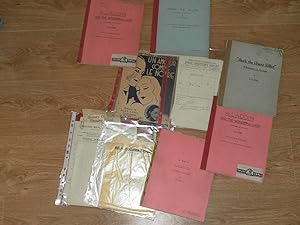
Hardcover. this small archive contains approximately items: (1) There are 7 items relating to Mr. Staines's stint as Repertory Producer at The Alexandra Theatre Bormingham. Included are 3 tyoed letters signed from Basil Thomas (2) and the General Manager (1) of the Alexandra Theatre regarding the terms of contract for his work as producer for the Derek Selberg Repertory Company & issues relating to other members of the cast. These are dated January & February 1945. In June of the same year a J.P. Flavell of "Castle Mona" in Coventry writes asking for Staines to fulfil a promise he made in an interview in 1942 in which he promised the immediate return of the the local repertory company. He is asked to make every effort to make this possible.There is a mss. double page lined wages sheet with details of the artists salaries for the week ending 14 Sept' 45. Two other letters, one from an accountant in London who he has asked to deal with his tax affairs & another from the Alexander Theatre with his earnings details to the end of November '45; (2) There are about 30 items pertaining to his work with the Theatre Royal, York from 1945-57 including 1945 & 46 mss. salary list; weekly summary of takings for various productions in 1949/50: Dick Whittington; 1951: Puss in Boots & Jack the Giant Killer; a folio salary sheet for the artists in Jack the Giant Killer & correspondence from a theatrical supplier in London re wigs for the same play; weekly summary takings sheets for Babes in the Wood & correspondence from the theatre regarding his pay & royalty fees in 1953; Weekly takings sheets for Aladdin & payments & royalties to Staines; a press cliiping from the Yorkshire Evening Post refers to Staines appearance on BBC TV & theatrical issues in 1954; there is a flyer advertising attractions at the theatre & a letter outlining his pay, bothin January 1957; (3) There are 13 pieces relating to the Opera House, Scarborough 1950-58 including weekly takings summary sheets, stage director's reports; a fine programme for Aladdin, December 26th, 1953; two telegrams with love from "Norah" in 1954; s letter from Lester on Equestrian Hotel Scarborough notepaper in September 1958 expresses surprise to read of his resignation from the Theatre Royal. there is a typescript of verse for "If murdering be required." (4) This section includes 5 typescript bound vols. of plays he produced: Sinbad, Aladdin (2), Jack the Giant Killer & Cinderella. These were his own working copies and most have notes and are highlighted & some have loose insertions; 38 almost postcard size cards with decoratively embossed borders with writing in black ink on each side. One side has what appears to be verse and the other has set numbers. They appear to be prompt cards and they look to be a lot earlier than the other material. (5) Finally there are 9 pieces of sheet music all in French: Un Amour comme Le Noir (Copyright date 1935); Pierre Dudan/Jack Hotte On Prend L'Cafe au Lait au Lit with text in French & Dutch (Copyright date 1940); Jacques Larue & Sylviano. Si vous voulez savoir (Serenade Espagnole). Copyright date (1943); Frenesie (1946); Franz Winkler. Etoile des Neiges (1950); Jacques Larue & Louiguy. Cerisier rose et Pommier blanc (1950); Jean Lenoir & J.R. Baltel & Alex Padou. Voulez vous Danser Grand Mere; Georges Guetary & Andrex. Beuscher Arpege Succes. a large folding sheet with a number of songs; A. Prevost & Fred Dolys. Le Chant de la Liberte sur les motifs de la Marche de L'Armee Secrete. The last 3 are undated. Range from fair to good with some writing & with signature of Mme Cadet (? or possibly Caolet?) & another signature on some of the covers. An interesting archive of theatrical material. Signed by Author(s).
-
![Seller image for Horace Greeley, Who Would Sign the Bail Bond for Jefferson Davis, Writes Mrs. Davis and the Union General Overseeing the Davis Family, Insisting That Davis Was Not Guilty of Lincoln's Assassination and that He Be Given a Prompt and Fair Trial ("Mrs. D. seems to be laboring [under] distressing apprehension which it is the object of my letter to remove.?) for sale by The Raab Collection](https://pictures.abebooks.com/inventory/md/md31430445740.jpg)
Horace Greeley, Who Would Sign the Bail Bond for Jefferson Davis, Writes Mrs. Davis and the Union General Overseeing the Davis Family, Insisting That Davis Was Not Guilty of Lincoln's Assassination and that He Be Given a Prompt and Fair Trial ("Mrs. D. seems to be laboring [under] distressing apprehension which it is the object of my letter to remove.?)
Seller: The Raab Collection, Ardmore, PA, U.S.A.
Association Member: ABAA ILAB PADA
Seller rating 4 out of 5 stars
Signed
The letter had to pass through US government screeners: "If it be your duty to read the letter, I certainly have no objection."A search of public sale records going back over 40 years fails to turn up any other letter of Greeley on the Davis matter, nor have we seen one.At the end of the Civil War, Jefferson Davis was arrested and imprisoned at Fortress Monroe, on the coast of Virginia. He was placed in irons for three days. Davis was indicted for treason a year later. While in prison, Davis arranged to sell his Mississippi estate to one of his former slaves. After two years of imprisonment, he was released on bail of $100,000 which was posted by prominent citizens of both Northern and Southern states, including Horace Greeley, Cornelius Vanderbilt and Gerrit Smith.During and after the Civil War, Greeley's political course was highly controversial. His reluctance to support Lincoln's renomination in 1864 lost him some popular support, as did his premature efforts to bring about an armistice and peace negotiations. After the war, he joined the Congressional Radicals in supporting equality for the freedmen. The Tribune also advocated the impeachment of President Andrew Johnson. At the same time, Greeley favored measures to restore relations with the South. In 1867, he recommended Jefferson Davis?s release from prison, and he signed Davis's bail bond.Varina Davis, wife of the Confederate president, saw in Greeley a friend once the war had ended. Greeley received a letter from her dated June 22, 1865, written at Savannah, Ga., where she and her family were detained under a sort of military restraint. The conspicuous charge against Mr. Davis was made by the Bureau of Military Justice, of being accessory to the assassination of President Lincoln. The letter implored Greeley to insist upon a speedy trial of her husband upon that charge, and upon all other supposed cruelties that were alleged he had inflicted. A public trial was prayed, that the accusations might be publicly met, and her husband vindicated. To this letter Greeley answered Mrs. Davis, and directed it to the care of General Birge at Savannah. The morning of the next day Greeley went to an attorney, saying that he could not believe the charge against Davis true. Greeley asked Shea to become professionally interested in behalf of Davis.This is the very letter Greeley wrote Mrs. Davis and directed to Birge. Autograph letter signed, on his The Tribune letterhead, New York, June 27, 1865, to General. ?I enclose a letter to Mrs. Varina Davis, wife of Jefferson Davis, in reply to one just received from her. I do not [foresee] that you will wish to read it, but not knowing what will be your orders, I deem it proper to do so, and to say that if it be your duty to read the letter, I certainly have no objection. Mrs. D. seems to be laboring [under] distressing apprehension which it is the object of my letter to remove.?A search of public sale records going back over 40 years fails to turn up any other letter of Greeley on the Davis matter, nor have we seen one.When pressed to explain why he was helping Davis, Greeley said he was being denied a timely trial, and besides, the nation needed to heal from its wounds. Greeley was, predictably, the most irascible, telling the infuriated New York Union League Club: "Gentlemen,.I arraign you as narrow-minded blockheads, who would like to be useful to a great and good cause, but don?t know how. Your attempt to base a great, enduring party on the hate and wrath necessarily engendered by a bloody civil war, is as though you should plant a colony on an iceberg which had somehow drifted into a tropical ocean.?
-

President Herbert Hoover Insists on Prompt Ratification of the Naval Treaty of 1930 That Limited Submarine Warfare and Shipbuilding (?The national interest in having a Naval Treaty brought to a conclusion is so great, I feel that I must ask that it should be dealt with at the earliest possible date.?)
Seller: The Raab Collection, Ardmore, PA, U.S.A.
Association Member: ABAA ILAB PADA
Seller rating 4 out of 5 stars
Signed
The London Naval Conference of 1930, involving the United States, Britain, Japan, France and Italy, was the third in a series of five meetings, formed with the purpose of placing limits on the naval capacity of the world?s largest naval powers. The purpose of the meetings was to promote disarmament in the wake of the devastation of the First World War; they began with the Washington Conference of 1921?22 and concluded with the London Conference of 1935. After an unsuccessful meeting in Geneva in 1927, Great Britain, the United States, Japan, France, and Italy gathered in London in 1930 to make a new attempt at revising and extending the terms of the Five Power Treaty of 1922. In 1927, Great Britain and the United States could not agree on naval cruiser limits; however, representatives of the two governments continued to work on a compromise measure. By 1930 both sides were anxious to reach a deal to avoid an all out arms race and, importantly, forced their naval officers to take a back seat to their diplomats in the negotiations. The result was the Treaty for the Limitation and Reduction of Naval Armament, signed April 22, which regulated submarine warfare and limited naval shipbuilding.President Hoover favored the treaty, but some naval officers opposed the limitations, and they had friends in Congress. Rather than oppose the treaty outright, their strategy was to postpone ratification until they could build up sufficient support to kill the treaty (as had been done with the Versailles Treaty).Typed letter signed, as President, on White House letterhead, June 26 1930, to Sen. George H. Moses, refusing a postponement, and insisting on prompt consideration of the treaty. ?I have your letter of June 24th enclosing the request of a number of senators that the proposed extra session of the Senate be deferred until next November. I realize fully the great strain which has been placed upon the Senate by this long, continued session. On the other hand, the national interest in having a Naval Treaty brought to a conclusion is so great, I feel that I must ask that it should be dealt with at the earliest possible date.?The U.S. Senate approved the treaty in July of 1930 and ratifications were exchanged in October.


