Order Total (1 Item Items):
Shipping Destination:

Seven Pillars Wisdom, Signed (10 results)
Skip to main search results
Search filters
Product Type
- All Product Types
- Books (10)
- Magazines & Periodicals (No further results match this refinement)
- Comics (No further results match this refinement)
- Sheet Music (No further results match this refinement)
- Art, Prints & Posters (No further results match this refinement)
- Photographs (No further results match this refinement)
- Maps (No further results match this refinement)
- Manuscripts & Paper Collectibles (No further results match this refinement)
Condition Learn more
- New (1)
- As New, Fine or Near Fine (1)
- Very Good or Good (No further results match this refinement)
- Fair or Poor (No further results match this refinement)
- As Described (8)
Binding
- All Bindings
- Hardcover (6)
- Softcover (No further results match this refinement)
Collectible Attributes
Language (1)
Price
- Any Price
- Under US$ 25 (No further results match this refinement)
- US$ 25 to US$ 50 (No further results match this refinement)
- Over US$ 50
Free Shipping
- Free Shipping to U.S.A. (No further results match this refinement)
Seller Location
Seller Rating
-

Seven Pillars of Wisdom a triumph.
Published by Jonathan Cape. London First Trade edition second impression August, 1935
Seller: Patrick Pollak Rare Books ABA ILAB, SOUTH BRENT, DEVON, United Kingdom
Seller rating 4 out of 5 stars

Signed
US$ 346.20
US$ 33.61 shipping
Ships from United Kingdom to U.S.A.Quantity: 1 available
Add to basketpp. 672. Portrait frontispiece, 53 plates, 4 folding maps. Original tan cloth, some fading, a little foxing at the ends, overall a very good copy. *TOGETHER WITH : Lawrence of Arabia Memorial leaflet, 3-page text BIFOLIUM signed in upper case print, not autograph, by 7 supporters of the fund, including ALLENBY, BERNARD SHAW, WINSTON CHURCHILL. PLUS 2 newscuttings by RONALD STORRS AND 2 others, related.
-
SEVEN PILLARS OF WISDOM A TRIUMPH
Published by Jonathan Cape, London, 1935
Seller: Reagan's Rare Books, Moseley, VA, U.S.A.
Seller rating 5 out of 5 stars

First Edition Signed
Bound by Bayntun-Riviere. Condition: Fine. First Trade Edition. LAWRENCE, T. E Seven pillars of wisdom: a triumph London. Jonathan Cape, [1935]. First trade edition. Quarto. 672pp. With a photogravure portrait frontispiece of Lawrence (from the plaster bust by Eric Kennington), 53 plates (four in colour), and four folding maps. Bound by Bayntun-Riviere (stamp-signed to front turn-in) in contemporary gilt-tooled brown morocco, A.E.G., marbled endpapers Housed in custom tan cloth slipcase. An immaculate copy. A handsomely bound copy of the first trade edition of Lawrence's magisterial account of the Arab Revolt during the First World War. .
-
War in the Desert, the first and previously unpublished abridged text of Seven Pillars of Wisdom, copy #51 of the publisher's finely bound quarter goatskin issue, numbered and signed by the editor
Published by Castle Hill Press, Salisbury, 2016
Seller: Churchill Book Collector ABAA/ILAB/IOBA, San Diego, CA, U.S.A.
Association Member: ABAA ILAB IOBA
Seller rating 5 out of 5 stars
First Edition Signed
Quarter leather. First edition. This is the first and limited edition of the first version of Seven Pillars of Wisdom intended for general publication. It was prepared in autumn 1922 by T. E. Lawrence and his literary mentor and friend, Edward Garnett, abridged from the 1922 'Oxford' text. Fittingly, it was the final act of outstanding editorial scholarship and fine press publication by Lawrence's official biographer, Jeremy Wilson (1944-2017), that rescued this text from oblivion.This copy is hand-numbered "51" by Wilson on the limitation page and signed by Wilson at the end of the Introduction. Of a total edition of 227 numbered copies, only 45 were bound thus for subscribers, in quarter tan-orange goatskin over brown linen cloth-covered sides, the contents bound with deep blue endpapers featuring an illustration of Lawrence's ceremonial dagger, gilt top edges, and white and brown silk head and tail bands. The book is housed in a brown linen cloth-covered slipcase. This copy is as-new, among the publisher's last copies, acquired by us directly from the publisher, the binding pristine, the contents immaculate.The strikingly beautiful "sleeping dagger" indigo endpapers bear special note; according to Wilson: "Among the designs I suggested for War in the Desert was a photograph of Lawrence's dagger and belt, lying on the ground, Our printer came back with this, to my surprise converted into a night-time image ("During the day he'd have been wearing it".)" Seven Pillars of Wisdom is the story of T. E. Lawrence's (1888-1935) remarkable odyssey as instigator, organizer, hero, and tragic figure of the Arab revolt against the Ottoman Empire during the First World War, which he began as an eccentric junior intelligence officer and ended as "Lawrence of Arabia."The saga of how Seven Pillars was written and published is tortuous.Lawrence nearly completed a massive first draft in 1919, only to lose it when his briefcase was mislaid at a train station. This first draft was never recovered. At a fever pitch, Lawrence wrote a new 400,000 word draft in 1920. Lawrence followed this punishing burst of writing with an equally brutal editing process. In 1922, a 335,000 word version was carefully circulated to select friends and literary critics - the famous "Oxford Text". George Bernard Shaw called it "a masterpiece".In the autumn of 1922, Lawrence and Garnett prepared the abridgement published here. "Between them, they extracted from the many-sided complexities of Seven Pillars a richly observed travel book combined with a fast-moving adventure-story." Lawrence thought well of it. Nonetheless, on Shaw's advice, Lawrence canceled the abridgement "at a very late stage, when the completed draft was about to go to the publishers."It is difficult to understate the consequences for Lawrence; undoubtedly the book would have brought him financial security and acclaim. Instead, not until 1926 was a different, edited and abridged "Subscribers' Edition" produced a lavish edition of fewer than 200 complete copies that cost Lawrence far more than he made. To recover the loss, Lawrence finally authorized an edition for the general public - but one even further abridged and titled Revolt in the Desert. Only in the summer of 1935, in the weeks following Lawrence's death, was the Subscribers' Edition text finally published for circulation to the general public.However, the fuller "Oxford Text" - a third longer than the shortened text which became so famous - would not be republished until 1997.And this first abridged version, War in the Desert the first version prepared for the public and very nearly published in 1923 remained unknown for more than 90 years. The text was used as bank security for financing for the 1926 Subscriber's Edition and then subsequently held by Cape as security against advance royalties until the Revolt in the Desert abridgement was delivered. Nonetheless, it remained virtually unknown until this magnificent, long-overdue edition.
-
Seven Pillars of Wisdom, an out-of-series set of the limited parallel text edition featuring both the 1922 "Oxford" and 1926 "Subscribers" texts, in the publisher's quarter Morocco bindings and publisher's slipcase
Published by Castle Hill Press 1997/2008, Fordingbridge, 1997
Seller: Churchill Book Collector ABAA/ILAB/IOBA, San Diego, CA, U.S.A.
Association Member: ABAA ILAB IOBA
Seller rating 5 out of 5 stars
First Edition Signed
Quarter leather. This is one of a precious few limited sets of the Parallel Text edition of the 1922 "Oxford' and 1926 "Subscribers" versions of Seven Pillars of Wisdom. This is unequivocally the most textually comprehensive published edition of T. E. Lawrence's magnum opus, featuring 1,000 dual-column pages in two large volumes. It was painstakingly prepared and published by Jeremy Wilson (1944-2017), Lawrence's official biographer and co-founder of Castle Hill Press. Per the publisher's limitation statement, the edition was limited to 50 sets, of which sets numbered 1-37 were bound in quarter goatskin and sets numbered i-xiii were "reserved". The 37 sets are bound in the publisher's quarter brown Morocco goatskin with brown buckram sides, the contents bound with brown endpapers, brown top edge stain, and silk head and tail bands. The two volumes are housed in the publisher's stout, unadorned brown buckram slipcase.We have now handled five of these sets, one of which was marked "hors séries" in Jeremy Wilson's characteristic red ink in lieu of a limitation number - the only set thus marked of which we are aware. The set on offer here is the only of which we are aware with an entirely blank limitation. Jeremy's widow and partner in Castle Hill Press, Nicole Wilson, kindly consulted her records for us and confirmed for us that, to her knowledge, this is the only set thus. Seven Pillars is the story of Thomas Edward Lawrence's (1888-1935) remarkable odyssey as instigator, organizer, hero, and tragic figure of the Arab revolt against the Ottoman Empire during the First World War, which he began as an eccentric junior intelligence officer and ended as "Lawrence of Arabia." This time defined Lawrence with indelible experience and celebrity, which he spent the rest of his short life struggling to reconcile and reject, to recount and repress. Lawrence famously resisted publication of Seven Pillars during his lifetime. When Lawrence died in 1935 following a motorcycle crash, his magnum opus was rushed into print in the only version readily available - the 1926 "Subscribers" abridgement. Few realize that the celebrated text released to the world as "Complete and Unabridged" in 1935 is, in fact, a significantly abridged version. Even more remarkable, the full 1922 "Oxford Text" - a third longer was not published until 1997. Jeremy Wilson took this text from the manuscript in the Bodleian Library and T. E. Lawrence's annotated copy of the 1922 Oxford Times printing. When preparing the limited editions of the Oxford Text, Wilson's Castle Hill Press also undertook the painstaking, mammoth task of creating this parallel text two large volumes containing complete texts of the 1922 and 1926 versions, typeset side-by-side in double columns, aligning the beginning of each sentence that exists in both texts so that readers can see at a glance exactly what was omitted and what was revised, illuminating the significant differences in style and content between the two texts. Beyond the subjective questions of literature, in terms of both autobiography and history, "the 1922 text is, without question, superior to that of 1926. In the abridgement process, Lawrence cut out numerous personal reflections, some of which were important The historical record, likewise often fell victim to abridgement because of the cuts, [the narrative] does not always account for Lawrence's time or seem to square with independent records. Worse still, the frustrations and abandoned plans of 1917-18 were largely suppressed in the 1926 text" This parallel text is the only available means for readily distinguishing the significant differences between the two texts of one of the most significant works of twentieth century literature. First, limited, numbered, and signed edition.
-
Seven Pillars of Wisdom. A triumph.
Published by Jonathan Cape, London., 1935
Seller: Peter Ellis, Bookseller, ABA, ILAB, London, United Kingdom
Seller rating 5 out of 5 stars
First Edition Signed
US$ 2,423.38
US$ 20.17 shipping
Ships from United Kingdom to U.S.A.Quantity: 1 available
Add to basketFirst edition for general circulation, trade issue. Quarto. 672 pages. Various illustrators, chief among them being Eric Kennington. Preface by A.W. Lawrence. Loosely inserted is the appeal for the Lawrence of Arabia Memorial (folded sheet). Publisher's variant binding of full dark brown calf with gilt crossed scimitars on front and rear covers as with the usual cloth binding.Loosely inserted is an Autograph Letter Signed by A.W. Lawrence (the author's brother) and dated 12 March 27 with the Talbot Road address: about 100 words to Mrs B.M.D. Marr, including ''My brother, T.E. Lawrence, is at present in India & I am dealing with his correspondence. my copy of [The Revolt in the Desert] is likely to be on loan for a long time to come. It contains, I believe, most of what is now publishable; some personal remarks found in the larger book have been excluded as they cannot be made public during the life-time of the people mentioned. I may add that my brother is personally responsible for this abridgement.'' Also loosely inserted is the announcement (folded sheet) for the Lawrence of Arabia Memorial in which Winston Churchill was involved.Letter: folded once; very good in the original hand-addressed envelope. Memorial insert: some spotting; very good. Book: some rubbing to spine and corners of covers. Very good. Rare variant.
-
Seven Pillars of Wisdom. A Triumph
Published by London Jonathan Cape September 1935, 1935
Seller: OJ-BOOKS ABA / PBFA, SOLIHULL, United Kingdom
Seller rating 5 out of 5 stars
First Edition Signed
US$ 3,808.16
US$ 33.61 shipping
Ships from United Kingdom to U.S.A.Quantity: 1 available
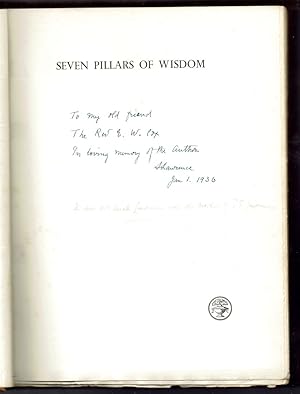
Add to basketThird English and first published edition, fifth impression, Cambridge issue. INSCRIBED, 'To my old friend The Rev E. W. Cox in loving memory of the author [.] S Lawrence Jan. 1. 1936', by Lawrence's mother, Sarah (1861-1959) to the clergyman and schoolmaster E. W. Cox, who was a friend and neighbour of the Lawrence family, and who taught Lawrence and his three eldest brothers at Oxford High School. Quarto (257 x 190mm), pp. 672; frontispiece and 47 photogravure plates by John Swain & Son after Augustus John, Eric Kennington, Lawrence, and others, 4 folding maps printed by The Chiswick Press, Ltd in red and black and bound to throw clear, 7 illustrations in the text of which 3 full-page; some variable, generally light spotting; original brown buckram gilt by A. W. Bain & Co., Ltd, upper board blocked in gilt with text and crossed sword design, spine lettered gilt, top edges brown, others uncut, original beige dust wrapper lettered in black, not price-clipped; spine and wrappers slightly marked, extremities slightly rubbed and creased, short tears and chips at edges, otherwise a very good copy of the uncommon dust wrapper. Custom-built slipcase. Seven Pillars of Wisdom was first printed in 1922 in an edition of eight copies for Lawrence's use, of which only six survive. It was followed by the 'Subscriber's' or 'Cranwell' edition in 1926, published privately in an edition of c. 211 copies and, as Lawrence wrote to the bookseller Henry Sotheran Ltd on 24 April 1925, 'this thing is being given only to my friends and their friends. No copies are for sale.' Finally, after Lawrence's death in May 1935, it was published in a trade edition by Jonathan Cape in July 1935. Such was the book's popularity that the first impression of 60,000 copies was quickly exhausted and second, third and fourth impressions were printed in August 1935, and then this fifth impression in September 1935. Due to high demand, the fifth and sixth impressions were printed at the Alden Press, Oxford and the University Press, Cambridge (as here). The recipient of this copy contributed a memoir of T. E. Lawrence as a schoolboy to T.E. Lawrence by his Friends, and a memoir of Lawrence's brother Frank to The Home Letters of T.E. Lawrence and his Brothers, and remained in contact with Sarah Lawrence until her death in 1959. O'Brien A042.
-
Seven Pillars of Wisdom. A Triumph
Published by Jonathan Cape, London and at Toronto, 1935
Seller: James Cummins Bookseller, ABAA, New York, NY, U.S.A.
Seller rating 5 out of 5 stars
Signed
First trade edition. First trade edition. Frontispiece bust of the author, 4 folded maps and 47 plates. 672 pp. 1 vols. 4to. A choice association copy, inscribed on the front free-endpaper: "The 7 Pillars / A Major, Capital work of history and personality. / Höchstes Glück der Erdenkinder/ Ist nur die Persönlichkeit / Ronald Storrs / 19 IX 35" And on the portrait, facing p. 62, Storrs has signed his name both in English and Arabic. The quotation is from Goethe's West-Östlicher Diwan (The greatest happiness of the children of earth / is only personality). Lawrence's superb narrative of the Arab Revolt of 1916-1918, from the library of one of the major figures in these events, erudite and accomplished diplomat, Sir Ronald Storrs, Oriental Secretary at the British agency in Cairo, under Sir Eldon Gorst, and then Lord Kitchener and Sir Henry McMahon. It was from Cairo that the revolt in the Hejaz was funded, orchestrated, and joined to British strategy in the Middle East. It was Storrs the political officer who brought Lawrence to the conference at Jiddah, for his company as well as his judgment. And it was Lawrence who then impressed the Arab leaders, played his spectacular role as the revolt succeeded, and then entered into the mythology of the twentieth century. A SUPERB ASSOCIATION. O'Brien A042 Original tan buckram. Fine (spine ends lightly bumped, front inner hinge tender) Frontispiece bust of the author, 4 folded maps and 47 plates. 672 pp. 1 vols. 4to. Signed.
-
Seven Pillars of Wisdom - SIGNED and INSCRIBED by E M Forster
Published by London Cape 1935, 1935
Seller: John Atkinson Books ABA ILAB PBFA, Harrogate, United Kingdom
Association Member: ABA ILAB PBFA
Seller rating 5 out of 5 stars
First Edition Signed
US$ 27,695.74
US$ 29.58 shipping
Ships from United Kingdom to U.S.A.Quantity: 1 available
Add to basketA first edition, first printing, published by Cape in 1935 - first trade edition. A near fine book in very good (or better) supplied dust wrapper. PRESENTATION COPY FROM LAWRENCE'S GREAT FRIEND, THE WRITER AND ONE OF THE VERY FEW EARLY READERS OF 'SEVEN PILLARS OF WISDOM', E M FORSTER: 'T. H. M from E. M. F in memory of Clouds Hill, July 1935'. This work was published on July 30th, 1935, two months after the death of T. E. Lawrence and E M Forster has inscribed it to their mutual friend 'T.H.M' either on, or the day after, publication day and this was followed by Forster's review of this first trade edition which appeared in 'The Listener' magazine on July 31st 1935. The simple, humble inscription in this copy, 'T. H. M from E. M. F in memory of Clouds Hill, July 1935' can be interpreted with much greater depth. Lawrence had purchased his Clouds Hill home whilst stationed at the nearby Bovington Camp. The recipient is Lance Corporal Thomas Henderson Middleton, who served with Lawrence in the Tank Corps, whom Forster would have met during one of his stays at Clouds Hill. Lawrence remembers (in a letter to Bernard and Charlotte Shaw) a group of people in the cottage at one time with Middleton as fighting on the big leather sofa at Clouds Hill with Pat Knowles. Forster's own relationship with Middleton was mentioned in a letter dated 10 December 1925 from Lawrence to E. Palmer: "I went down to Cambridge last Sunday, and there E. M. F. sat, large as life. We talked about you and Middleton, and the world generally. M. writes more letters to him than you do. Then M. always was talkative". It can be traced further through Forster's own correspondence; a letter to Lawrence dated 15 October 1927 indicates the pair's acquaintance: 'I write in bed, it is Edinburgh and the not very early morning. I got here last night, after lecturing to the English Association at Middlesbrough and Darlington. Does Middleton come from Middlesbrough or is that a dream?'. The following year, Forster stayed with Middleton, again writing to Lawrence: 'I stopped a night 10 days ago with Middleton in Barracks at Scarborough. He took a great deal of trouble to make me comfortable - succeeded of course, but that is another and an easier matter'. Forster has inscribed this copy to 'T.H.M from E.M.F' in the same way that Lawrence inscribed his copy: 'E. M. F from T. E. S'. This strong familiarity is clearly evident, along with the importance of their time spent at Clouds Hill with Lawrence, as Forster has considered it remarkable enough to present a copy to this person on this, the publication day, of the first publicly available copy of Lawrence's magnum opus. We are certainly not aware that E. M. Forster took the trouble to present copies of this work to anybody else. Forster would also contribute a chapter to 'T. E. Lawrence by his friends' in the 'Post-War general views'. Forster's final words in this chapter were: 'I do not want to sum T.E up. These are only a few notes, to be added to the common stock. I will finish them by recording that his was pleased by what I wrote to him about the Mint, and that he was also pleased when I helped to sell the proofs of the Seven Pillars for the benefit of another friend of his, to whom he had given them. All these are scraps. The real framework, the place where his spirit will never cease to haunt, is Clouds Hill, and the gay motto over its doorway is the one beneath which I see him at rest.' His final letter to T. E. Lawrence, dated 4th May 1935, is particularly poignant: 'Dear T. E. When would it be possible for you to have me to stop for a few days at Clouds Hill? Would about May the 20th be any good? Yours ever EMF' T. E. Lawrence died from injuries received on May 13th. ASSOCIATION COPIES OF THIS, THE 1935 FIRST TRADE EDITION, ARE VERY SCARCE INDEED AND THIS, FROM HIS CLOSE FRIEND, E. M. FORSTER IS EXCEPTIONAL.
-
"my reluctant book. must come to a head and be finished with." - A 4 December 1923 autographed letter signed from T. E. Lawrence "of Arabia" to his friend and patron, "Father of the Royal Air Force" and then-Chief of the Air Staff Sir Hugh Trenchard, asking special permission for leave to attend to publication decisions about what would become the famous Subscriber's Edition of Lawrence's magnum opus, Seven Pillars of Wisdom
Publication Date: 1923
Seller: Churchill Book Collector ABAA/ILAB/IOBA, San Diego, CA, U.S.A.
Association Member: ABAA ILAB IOBA
Seller rating 5 out of 5 stars
Signed
Letter. This 4 December 1923 autograph letter signed by T. E. Lawrence is noteworthy in multiple respects, including: for referencing an important meeting about what would become the Subscriber's issue of Seven Pillars of Wisdom; for being written to Lawrence's great friend and patron, Hugh Trenchard, the head and "father" of the Royal Air Force; for highlighting the contradictions inherent to Lawrence's supposedly anonymous enlistment in the R.A.F.; for being signed with Lawrence's true name, which he had already effectively abandoned. The letter is also replete with Lawrence's characteristic liberties with punctuation and grammar, which so amusingly belied his remarkable erudition."Curtis & the rest have been pressing me about my reluctant book: and I feel that the thing must come to a head and be finished with."The letter is written entirely in Lawrence's hand on the first and third panels of a single, folded sheet of 9 x 7 inches (22.86 x 17.78 cm) watermarked ("Waverley Pen Vellum") stationery folded once to make four 4.5 x 7 inches (11.43 x 17.78 cm) panels. The letter is dated "4 . XII . 23" with the salutation "Dear Sir Hugh". The body of the letter reads in full: "Curtis & the rest have been pressing me about my reluctant book: and I feel that the thing must come to a head and be finished with. It worries me too much as it is: and I'm not in the mood (or the position) to afford more worries. So I want to meet them in Oxford over the coming week-end. And am putting in an application for a pass for Saturday, Sunday & Monday next. (Dec. 8.9.10). You see my clothes are in London, & I'll have to draw them there before (& return them after) the Oxford visit. My poor 'bike is gone & trains are slow. So I estimate the three days as necessary to do all the business properly. I was on defaulters last week, which would normally prevent my getting leave for a month. Wherefore I write to you to ask you to do what you promised. It's a pity, because I've tried here not to presume in any way, and this means breaking the standard I had set up. However perhaps it is justifiable." Lawrence signed "TELawrence" below his valediction "yours sincerely". A two-line post script, underlined, follows: "Please ask the A. G. to be careful. If I'm kicked out of this I'm done."ConditionCondition is good plus, Lawrence's ink clear and distinct. The stationery is complete, though spotted and with a horizontal and vertical fold bisecting each panel, ostensibly from original mailing. Initials at the head of the first panel, just below the date, are plausibly those of Trenchard. The letter is protected in a clear, removable, archival sleeve housed within a rigid, full blue Morocco goatskin folder with a gilt-printed front cover, gilt-ruled turn-ins framing gray paper pastedowns within, and an integral, printed cardstock insert.Lawrence "of Arabia"During the First World War, Thomas Edward "T. E." Lawrence (1888-1935) experienced a transformative odyssey as instigator, organizer, hero, and tragic figure of the Arab Revolt against the Ottoman Empire, which he began as an eccentric junior intelligence officer and ended as "Lawrence of Arabia". He spent the rest of his famously short life struggling to variously reconcile, reject, share, and repress this indelible experience, which was eventually recounted in his magnum opus, Seven Pillars of Wisdom. The "Father of the Royal Air Force""Father of the Royal Air Force" Hugh Montague Trenchard, First Viscount Trenchard (1873-1956) began his military career as a "dashing cavalry officer full of high Victorian bravado" who attracted the notice of his superiors for "blunt words, boundless energy, and stern discipline of men under his command." At forty, Trenchard asked for leave to learn to fly at his own expense and then joined the Royal Flying Corps, which had been formed only months before. There "his age and military experience saw him appointed to the staff" and "he recognized more quickly than most officers of his.
-
".your free copy shall be distinguished somehow beyond the ordinary copies. We can write in it, or add or subtract something, to make it quite peculiar. I owe you the very greatest thanks for your help when I was low in the list." - A 7 September 1925 autograph letter signed by T. E. Lawrence "of Arabia" to John G. Wilson, "the most famous English bookseller of his time", a critical supporter of the legendary 1926 Subscriber's edition of Seven Pillars of Wisdom, and one of the select few to receive a complimentary copy from Lawrence
Publication Date: 1925
Seller: Churchill Book Collector ABAA/ILAB/IOBA, San Diego, CA, U.S.A.
Association Member: ABAA ILAB IOBA
Seller rating 5 out of 5 stars
Signed
Letter. This 7 September 1925 autograph letter from T. E. Lawrence "of Arabia" to John G. Wilson, "the most famous English bookseller of his time", a critical supporter of the legendary 1926 Subscriber's edition of Seven Pillars of Wisdom, and one of the select few to receive a complimentary copy from Lawrence. The letter is noteworthy not only for the association, but for timing and content, as Lawrence was struggling to fill subscriptions for his magnum opus."your free copy shall be distinguished somehow beyond the ordinary copies I owe you the very greatest thanks for your help"The letter is addressed and dated at the top right of the first panel "338171 AC II Shaw | Hut 105 | R.A.F. Cadet College | Cranwell | Lincs. | 7. IX. 25". Following Lawrence's salutation "Dear Wilson" the letter reads: "My "sample" has only choked off one subscriber, to date. It can't be helped. I see you have put yourself down for a paying copy. But you must also lend me your bibliophilic experience so that your free copy shall be distinguished somehow beyond the ordinary copies. We can write in it, or add or subtract something, to make it quite peculiar. I owe you the very greatest thanks for your help when I was low in the list. One of your subscribers puzzles me. I have bookedF. R. Richmond Esq.8A Kensington Palace GardensLondon W. 8. and alsoF. R. Richmond Esq.Holm FoundryCathcartGlasgow.Are these two men, or one? There were two Richmonds, you told me: but surely not to F. R.'s. That seems almost incredible. Lord Bute didn't get a copy: because Lady Bute is giving him one:"Following his valediction "yours sincerely" and signature "T E Shaw." there is a postscript: "My move to the Air Force has broken the thread of my proof-correcting, & thrown me back."Condition The letter is written in black ink on a single sheet of laid, watermarked ("ORIGINAL BLACKFRIARS MILL") paper measuring 8.875 x 6.9375 inches, folded once to form four 4.375 x 6.9375 inches panels. Lawrence wrote on the first and third of these panels. Condition is very good. The paper is complete, with no loss, tears, or appreciable wear other than an additional horizontal fold from original posting. The paper shows light overall soiling to the first and fourth (outer) panels and perhaps a faint hint of spotting to the lower front panel. Lawrence's ink remains clear and unfaded. The letter is protected within a clear, removable, archival sleeve housed within a rigid crimson cloth folder."Lawrence of Arabia"During the First World War, Thomas Edward "T. E." Lawrence (1888-1935) experienced a transformative odyssey as instigator, organizer, hero, and tragic figure of the Arab Revolt against the Ottoman Empire, which he began as an eccentric junior intelligence officer and ended as "Lawrence of Arabia". He spent the rest of his famously short life struggling to variously reconcile, reject, share, and repress this indelible experience, which was eventually recounted in his magnum opus, Seven Pillars of Wisdom. Hiding and writing in the R.A.F.As part of his effort to evade his celebrity, in August 1922 Lawrence enlisted in the Royal Air Force first under the name "John Hume Ross" and, later, "Thomas Edward Shaw" a name he used until his death. Hence, from that time forward, he seldom signed with his original surname. By December 1922, Lawrence had, with a close circle of friends, "decided to produce 100 copies of the Seven Pillars, at thirty guineas a copy, if so many subscribers can be found." So September 1925 found Lawrence officially Aircraftsman Shaw, residing in "Hut 105" of the R. A. F. Cadet College at Cranwell trying to both duck and recount the events that had made him so uncomfortably famous. By the time Lawrence wrote this letter to Wilson in 9 September 1925, he was well into the elaborate preparation of, and corresponding expenses for, his famous Subscriber's edition of Seven Pillars of Wisdom. Subscribers were fewer than had been hoped and Wilson was to prove of material help.