Order Total (1 Item Items):
Shipping Destination:

Stereotyp, Signed (5 results)
Skip to main search results
Search filters
Product Type
- All Product Types
- Books (5)
- Magazines & Periodicals (No further results match this refinement)
- Comics (No further results match this refinement)
- Sheet Music (No further results match this refinement)
- Art, Prints & Posters (No further results match this refinement)
- Photographs (No further results match this refinement)
- Maps (No further results match this refinement)
- Manuscripts & Paper Collectibles (No further results match this refinement)
Condition Learn more
- New (No further results match this refinement)
- As New, Fine or Near Fine (No further results match this refinement)
- Very Good or Good (No further results match this refinement)
- Fair or Poor (No further results match this refinement)
- As Described (5)
Binding
- All Bindings
- Hardcover (4)
- Softcover (No further results match this refinement)
Collectible Attributes
- First Edition (No further results match this refinement)
- Signed (5)
- Dust Jacket (No further results match this refinement)
- Seller-Supplied Images (3)
- Not Print on Demand (5)
Language (1)
Price
- Any Price
- Under US$ 25 (No further results match this refinement)
- US$ 25 to US$ 50 (No further results match this refinement)
- Over US$ 50
Free Shipping
- Free Shipping to U.S.A. (No further results match this refinement)
Seller Location
Seller Rating
-

Alterität und Stereotyp. Die Funktion des Fremden in den "International Novels" von E. M. Forster und D. H. Lawrence.
Published by G. Narr (Mannheimer Beiträge zur Sprach- und Literaturwissenschaft, Band 37), Tübingen,, 1998
Seller: Antiquariat Johannes Herlyn, Freiburg, Germany
Seller rating 5 out of 5 stars

Signed
fester Einband. XVIII, 840 S. (23 cm) OPp. 1. Aufl.; mit persönlicher Widmung der Verfasserin. Starke Blei-Anstreichungen am Rand bis S. 75 und noch vereinzelt; sonst guter Zustand. Auflage: 1 ISBN 3823350374 /// /// intern4a9d0v /// ///.
-
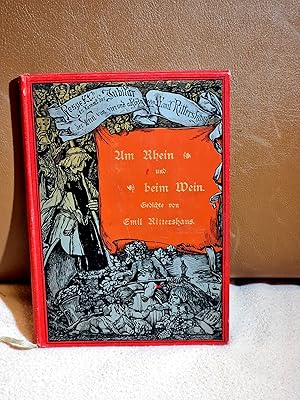
Am Rhein und beim Wein. Gedichte von Emil Rittershaus. 2. Stereotyp-Ausgabe, 3. Tausend. Widmungsexemplar des Verfassers mit doppelseitiger, 24-zeiliger Widmung aus dem Jahre 1885 an den Komponisten Franz Wüllner.
Published by Ernst Keil, Leipzig, 1885
Seller: Antiquariat Friederichsen e. K., Hamburg, Germany
Association Member: BOEV
Seller rating 5 out of 5 stars
Signed
Mit 95 Seiten, 2 n.n. Blätter ( Verlagsanzeigen ). Illustrierter, goldgeprägter roter Oln mit umlaufendem Goldschnitt und Lesebändchen, 8° ( 18,5 x 12,5 cm ). Auf dem vorderen Vorsatz mit langer lyrischer handschriftlicher Widmung von Rittershaus, signiert und datiert *Barmen, Mai 1885*. *Mit des Weinstocks grünen Ranken Sind umsponnen diese Strophen - Such in ihnen nicht Gedanken Eines ernsten Philosophen! - Wenn im grünen Buchenlaube Hell die Nachtigallen schmettern, bei dem duftigen Trank der Traube Magst Du in dem Büchlein blättern°.* ( gewidmet dem Tondichter Franz Wüllner (?)). Der Einband ist etwas berieben, gering fleckig, Ecken und Kanten teils gering bestoßen. Innen ist das Papier gebräunt, hinterer Vorsatz mit montierter Notiz. Insgesamt von guter Erhaltung. >>>Christoph Adolph Franz Maria Wüllner (* 28. Januar 1832 in Münster - 7. September 1902 in Braunfels war ein deutscher Komponist, Dirigent und Professor.>>Christoph Adolph Franz Maria Wüllner (* January 28, 1832 in Münster - September 7, 1902 in Braunfels was a German composer, conductor and professor.<<< ( Weight 200 grams )( Storage location SR )( More pictures on request ) / Item 25338.
-
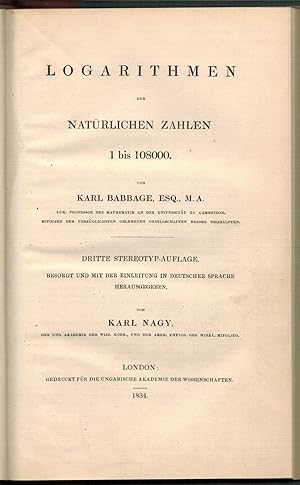
Logarithmen der Natürlichen Zahlen 1 bis 108.000. Von Karl Babbage, Esq., M.A. [.] Dritte Stereotyp-Auflage, besorgt und mit der Einleitung in deutscher Sprache herausgeben, von Karl Nagy.
Published by London, gedruckt für die Ungarische Akademie der Wissenschaften, 1834., 1834
Seller: Antiquariat INLIBRIS Gilhofer Nfg. GmbH, Vienna, A, Austria
Association Member: ILAB PADA VDA VDAO
Seller rating 5 out of 5 stars
Signed
8vo. XVI, IV-XIV, 201, (1) pp. 20th century quarter calf over cloth boards, with gilt title on spine. A handsome, fresh copy; red ink stamps of the Kensington Public Libraries on first leaf of 'Vorwort' and final leaf of errata. Very rare bilingual German/Hungarian translation of Babbage's work on logarithms, printed at the expense of the Hungarian Academy of Sciences apparently in order to convey Babbage's work to interested readers within the Austro-Hungarian Empire. Karl Nagy himself was inspired by Babbage's work to produce his own little-known calculating machine, for which records survive only in manuscript and in a rare Hungarian monograph of the period. - It was Babbage's experience in constructing his logarithmic tables which convinced him that such numerical exercises could be better produced by mechanical means. His work on a "Difference Engine", a mechanical computer, was intended to accomplish this laborious chore. The relationship between Karl Nagy (1797-1868) and Babbage (1791-1871) is based on few sources including the present work. In a letter to Babbage dated 9 April 1833, Nagy expresses his admiration for Babbage's tables and his intention to introduce his countrymen to them, in effect asking permission to produce the present translation. Nagy also appears to have met Babbage during the former's short spell in London. Recently-unearthed manuscripts in Hungary show that Nagy in fact drew up plans for constructing his own difference engine based on Babbage, which he published in a small monograph in 1837 in Vienna (cf. Andràs Holl, Nagy Károly, Charles Babbage és a Számoló Masinák). - The German and Hungarian prefaces found in the present work are identical, but are not mere translations of Babbage's own preface to the English editions of 1827 and 1831. Instead, Nagy recounts his 'discovery' of Babbage and praises the English tables on several counts: firstly, on their accuracy, and secondly, on their ease of use. At the end of the preface Nagy gives an interesting discussion of his attempts to use different colours of paper to reduce translucence (which confuses the reader attempting to look up small, similar figures). He finds the best colour to be a light green paper stock manufactured by a Mr Bonson, but "because this paper would be too expensive for some, I have allowed for half of the edition to be printed on white paper". It is signed by Nagy from London, dated 1 October 1834. - The present copy was bound with a German title-page and preface (*1-8) as well as a Hungarian preface (A2-7) and the corrected tables (B1-N8, O5), featuring a list of units and conversions in Hungarian printed on the verso of the last leaf of tables. German libraries including the Bayerische Staatsbibliothek, for example, hold copies bound with neither the Hungarian nor the English forewords; however other copies, including those at Cornell and NYPL, are bound with the English title and preface as well as the German and Hungarian. - All early editions (1827, 1831, and the present 1834) of Babbage's tables are rare in census. COPAC shows just one UK copy of this edition, at the British Library; OCLC adds US copies at Cornell and the NYPL. - On Nagy's translation cf., e.g., "Briggsian Logarithms", pp. 109-113 in Tracts for Computers, Issue 13 (1926); and on Nagy and Babbage cf. Holl, Nagy Károly, Charles Babbage és a számoló masinák (1997).
-
Logarithmen der Natürlichen Zahlen 1 bis 108000. Von Karl Babbage, Esq., M. A Dritte Stereotyp-Auflage, besorgt und mit der Einleitung in Deutscher Sprache herausgeben, von Karl Nagy.
Published by London, "gedruckt für die Ungarische Akademie der Wissenschaften", 1834
Seller: Editio Altera, Bronxville, NY, U.S.A.
Seller rating 2 out of 5 stars

Signed
8vo. xvi pp; iv-xiv pp, 201 pp, (1). Mid-20th century quarter calf over cloth boards, with gilt title on spine. A handsome, fresh copy; red ink stamps of the Kensington Public Libraries on first leaf of 'Vorwort' and final leaf of errata. On Nagy's translation cf eg "Briggsian Logarithms", p. 109-113 in Tracts for Computers, Issue 13 (1926); and on Nagy and Babbage cf Holl, Nagy Károly, Charles Babbage és a számoló masinák (1997). Very rare bilingual German / Hungarian translation of Babbage's work on logarithms, printed at the expense of the Hungarian Academy of Sciences apparently in order to convey Babbage's work to interested readers within the Austro-Hungarian empire. Karl Nagy himself was inspired by Babbage's work to produce his own little-known calculating machine, for which records survive only in manuscript and in a rare Hungarian monograph of the period (see below). - It was Babbage's experience in constructing his logarithmic tables which convinced him that such numerical exercises could be better produced by mechanical means. His work on a "Difference Engine," a mechanical computer, was intended to accomplish this laborious chore. The relationship between Karl Nagy (1797-1868) and Babbage (1791-1871) is based on few sources including the present work. In a letter to Babbage dated April 9th, 1833, Nagy expresses his admiration for Babbage's tables and his intention to introduce his countrymen to them, in effect asking permission to produce the present translation. Nagy also appears to have met Babbage during the former's short spell in London. Recently-unearthed manuscripts in Hungary show that Nagy in fact drew up plans for constructing his own difference engine based on Babbage, which he published in a small monograph in 1837 in Vienna (cf Andràs Holl, Nagy Károly, Charles Babbage és a Számoló Masinák). - The German and Hungarian prefaces found in the present work are identical, but are not mere translations of Babbage's own preface to the English editions of 1827 and 1831. Instead, Nagy recounts his 'discovery' of Babbage and praises the English tables on several counts: firstly, on their accuracy; and secondly, on their ease of use. At the end of the preface Nagy gives an interesting discussion of his attempts to use different colors of paper to reduce translucence (which confuses the reader attempting to look up small, similar figures). He finds the best color to be a light green paperstock manufactured by a Mr Bonson, but "because this paper would be too expensive for some, I have allowed for half of the edition to be printed on white paper". It is signed by Nagy from London, dated the 1st October 1834. - The present copy was bound with a German title page and preface (*1-8) as well as a Hungarian preface (A2-7) and the corrected tables (B1-N8, O5), featuring a list of units and conversions in Hungarian printed on the verso of the last leaf of tables. German libraries including the Bayerische Staatsbibliothek, for example, hold copies bound with neither the Hungarian nor the English forewords; however other copies, including those at Cornell and NYPL, are bound with the English title and preface as well as the German and Hungarian. - All early editions (1827, 1831, and the present 1834) of Babbage's tables are rare in census. COPAC shows just one UK copy of this edition, at the British Library; OCLC adds US copies at Cornell and the NYPL.
-
Don Juan. Oper von W. A. Mozart. Vollst. Clavierauszug. Stereotyp-Ausgabe. Beigebunden: Titus. Oper in 2 Aufzügen von W. A. Mozart. Vollständiger Clavier-Auszug. Stereotyp-Ausgabe.
Published by Berlin, bei F. Weidle., 1843
Seller: Antiquariat Rainer Schlicht, Berlin, Germany
Association Member: GIAQ ILAB VDA
Seller rating 5 out of 5 stars
Signed
Ca. 17,2 x 27 cm. Illustr. Titelblatt, 185 Seiten, 1 Seite Personenverzeichnis; Illustr. Titelblatt, 1 Seite Personenverzeichnis, 88 Seiten. Halbleinenband der Zeit. [Don Giovanni: KV 527; La Clemenza di Tito, KV 621]. Beide Opern ohne Platten-Nummer. Singstimmen in deutscher und italienischer Sprache. Jeweils mit lithographiertem Titel mit Darstellungen aus der Oper (signiert: G. Böhmer), Noten ebenfalls lithographiert. Einbandkanten berieben, Ecken etwas bestoßen, leicht stockfleckig bzw. gebräunt (Titelblätter stärker).


![Seller image for Logarithmen der Natürlichen Zahlen 1 bis 108.000. Von Karl Babbage, Esq., M.A. [.] Dritte Stereotyp-Auflage, besorgt und mit der Einleitung in deutscher Sprache herausgeben, von Karl Nagy. for sale by Antiquariat INLIBRIS Gilhofer Nfg. GmbH](https://pictures.abebooks.com/inventory/md/md31480347867.jpg)