Order Total (1 Item Items):
Shipping Destination:

System Logic Ratiocinative Inductive, First Edition (10 results)
Skip to main search results
Search filters
Product Type
- All Product Types
- Books (10)
- Magazines & Periodicals (No further results match this refinement)
- Comics (No further results match this refinement)
- Sheet Music (No further results match this refinement)
- Art, Prints & Posters (No further results match this refinement)
- Photographs (No further results match this refinement)
- Maps (No further results match this refinement)
- Manuscripts & Paper Collectibles (No further results match this refinement)
Condition Learn more
- New (No further results match this refinement)
- As New, Fine or Near Fine (No further results match this refinement)
- Very Good or Good (3)
- Fair or Poor (No further results match this refinement)
- As Described (7)
Binding
Collectible Attributes
- First Edition (10)
- Signed (No further results match this refinement)
- Dust Jacket (No further results match this refinement)
- Seller-Supplied Images (8)
- Not Print on Demand (10)
Language (1)
Price
- Any Price
- Under US$ 25 (No further results match this refinement)
- US$ 25 to US$ 50 (No further results match this refinement)
- Over US$ 50
Free Shipping
Seller Location
Seller Rating
-
A SYSTEM OF LOGIC, RATIOCINATIVE AND INDUCTIVE; BEING A CONNECTED VIEW OF THE PRINCIPLES OF EVIDENCE AND THE METHODS OF SCIENTIFIC INVESTIGATION
Published by Harper and Brothers, Publishers, New York, 1846
Seller: Second Story Books, ABAA, Rockville, MD, U.S.A.
Seller rating 4 out of 5 stars

First Edition
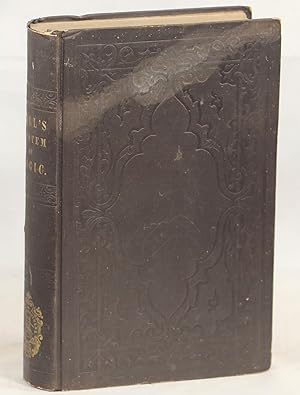
Hardcover. First U.S. Edition. Octavo, v, xii, 503 pages. In Fair condition. Bound in the publisher's brown cloth bearing gilt lettering to the spine. Boards have moderate plus wear including some chipping to the joints edges, slight off color soiling, some scratches and slight age darkened spine. Blind-stamped designs to the front/rear. Text block has moderate wear including age toning to the edges. Previous owner's name to the front pastedown and fly leaf. Heavy foxing to the end papers and moderate foxing throughout the interior. First U.S. edition. NOTE: Shelved in Netdesk office, Case #5. 1397348. FP New Rockville Stock.
-
A System of Logic ratiocinative and inductive being a connected view of the principles of evidence and the methods of scientific investigation.
Published by London Longmans Green Reader and Dyer, 1875
Seller: Shapero Rare Books, London, United Kingdom
Association Member: ABA ILAB PBFA
Seller rating 4 out of 5 stars
First Edition
US$ 472.50
US$ 20.52 shipping
Ships from United Kingdom to U.S.A.Quantity: 1 available
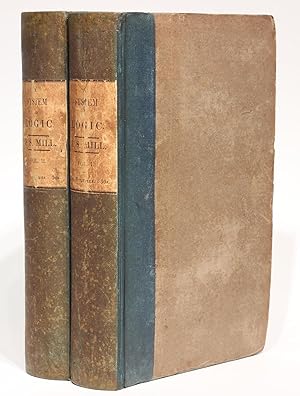
Add to basketNinth edition; 2 vols (22.5 x 15 cm); minor spotting, hinges cracked at endpapers; publisher's pebble-grain blue-green cloth, covers ruled in blind, printed labels to spines, a trifle rubbed at extremities, very good; xx, 563, [1]; xv, [1], 557, [1]pp. The first posthumous edition of J.S. Mill's (1806-1873) greatest work of pure philosophy. First published in 1843, A System of Logic was the result of twelve years of labour in which Mill attempted to find a coherent method of scientific inquiry that could explain the operation of 'moral and social phenomena' (Preface) in the real world. As a result, the book courted great controversy from its first publication in 1843, receiving criticism from defenders of more traditional systems of ethics rooted in metaphysics and theology.
-

A System of Logic, Ratiocinative and Inductive, Being a Connected View of the Principles of Evidence, and the Methods of Scientific Investigation. Vol. 1
Published by London: John W. Parker, 1843
Seller: Mark Westwood Books PBFA, Hay-on-Wye, HEREF, United Kingdom
Association Member: PBFA
Seller rating 5 out of 5 stars

First Edition
US$ 556.68
US$ 26.00 shipping
Ships from United Kingdom to U.S.A.Quantity: 1 available
Add to basketCondition: Very Good. Volume I only. First edition. pp: xvi, 580. Very good copy in contemporary half-calf, corners rubbed. End papers a little spotted.
-
A deductiv és inductiv logika rendszere, mint a megismerés elveinek és a tudományos kutatás módszerének el?adása. Az eredeti VII-dik kiadása után, a Magyar Tud. Akadémia megbízásából, fordította Szász Béla, M. Kir. egyetemi tanár. [A System of Logic, Ratiocinative and Inductive: Being a Connected View of the Principles of Evidence and Methods of Scientific. Translated From the Seventh Edition by Béla Szász.]
Published by Ráth Mór, Budapest, 1877
Seller: Földvári Books, Budapest, Hungary
Seller rating 4 out of 5 stars
First Edition
First Hungarian edition. First Hungarian edition. In three volumes. In later half cloth. Gilt title on spine. XXII, 481, (1); (4), 496; XIV, 514 p. First Hungarian edition of Mill's A System of Logic, translated by Béla Szász. In this work Mill formulated the five principles of inductive reasoning that are known today as Mill's Methods. The work is important in the philosophy of science, and more generally, it outlines the empirical principles Mill would use to justify his moral and political philosophies. . Pages slightly over-trimmed that effects page numbers in the first volume. Ownership inscription and stamp on title page and on its verso in the first and the third volume. Ownership stamp on the title page verso in the second volume. Occasional foxing. Overall in fine condition. In three volumes. In later half cloth. Gilt title on spine.
-
A System of Logic, Ratiocinative and Inductive; Being a Connected View of The Principles of Evidence and the Methods of Scientific Investigation
Published by Harper & Brothers, Publishers, New York, 1846
Seller: Evening Star Books, ABAA/ILAB, Madison, WI, U.S.A.
Association Member: ABAA ILAB IOBA
Seller rating 5 out of 5 stars
First Edition
Hardcover. Condition: Good+. First American edition. Large 8vo. [3], iv-xii, [1], 2-593, [1], [2] (pages of publisher's advertisements), [2] pp. Brown cloth with decorations in blind on the boards, lettering and publisher's device in gold on the spine. Evans 46-4655. Macminn, Hainds, and McCrimmon 56. Oxford DNB, Jose Harris, "Mill, John Stuart (18061873)." A dense thesis divided into six books. Mill discusses various types of knowledge, propositions, fallacies, and writes on the use of logic for moral and social sciences. The Oxford DNB offers a comment on the history of the publication: "On its initial publication in 1843 A System of Logic attracted little public comment, a silence that betokened, according to one contemporary, R. H. Hutton, not lack of interest but sheer terror among the book-reviewing community at the thought of incurring the crossfire of Mill's dialectical powers. Within a very few years, however, it was to become one of the most influential and controversial works of the mid-nineteenth century." A discoloration on the front board, rubbing to the boards' edges, a crossed-out name on the title page and some foxing to the leaves.
-

A System of Logic, Ratiocinative and Inductive, Being a Connected View of the Principles of Evidence, and the Methods of Scientific Investigation.
Published by John W. Parker, New York, 1843
First Edition
First edition of this classic work on logic. Octavo, original cloth. In very good condition with some wear to the cloth and overall toning. Housed in a custom half morocco clamshell box made by the Harcourt Bindery. First editions in the original cloth are rare. "The statement that John Stuart Mill was Britain's most important philosopher in the 19th century looks like a bold assertion, but in fact it should not be even mildly controversial⦠Mill has no serious rivals" (Dictionary of 19th-Century Philosophers II:792). One of Mill's most important works, System of Logic is "the first major installment of his comprehensive restatement of an empiricist and utilitarian position" (Encyclopedia of Philosophy), setting forth "the fundamentals of the human or 'moral' sciences" (Mander & Sell, 794). "The book had a rapid success, beyond the expectations of its author, and was for many years the standard authority with all who took his side in the main philosophical questions. Mill, in fact was recognized as the great leader of the empirical as opposed to what he called the intuitional school; and few men have had a more marked influence upon the rising intellect of the time" (DNB).
-
A System of Logic, Ratiocinative and Inductive, Being a Connected View of the Principles of Evidence, and the Methods of Scientific Investigation. Two volumes.
Published by John W. Parker, London, 1843
Seller: Milestones of Science Books, Ritterhude, Germany
Seller rating 5 out of 5 stars
First Edition
Hardcover. Condition: Very Good. 1st Edition. 8vo (221 x 142 mm). xvi, 580; xii, 624 pp. Original publisher's half cloth, spines with original printed paper labels (rebacked with original spines laid down, minor rubbing to boards and extremities, paper labels browned and soiled, spine cloth spotted, gathering b in vol. I unstitched), pages uncut. Text little age-toned, tear at lower blank margin of one leaf repaired. Provenance: both volumes inscribed to title-page versos, 'John Commins, 1845' and 'Given to Wm. Merryfield, December 24th 1859'. A very good, clean, unfoxed and unmarked set. ---- Kress C.6398. FIRST EDITION of Mill's popular and infuential treatise on inductive logic. In this work Mill formulates just five principles of inductive reasoning (known as Mill's Methods) which determine whether causes and effects are connected. This method produced a system which became an important source for all the experimental sciences. Mill's book is important in the philosophy of science, and more generally, insofar as it outlines the empirical principles Mill would use to justify his moral and political philosophies. It had a strong influence on scientists such as Dirac. An article in "Philosophy of Recent Times" has described it as an 'attempt to expound a psychological system of logic within empiricist principles. - Visit our website for additional images and information.
-

A System of Logic, Ratiocinative and Inductive.
Published by John W. Parker, West Strand, London, 1843
Seller: Athena Rare Books ABAA, Fairfield, CT, U.S.A.
Seller rating 5 out of 5 stars
First Edition
Condition: Bound. FIRST EDITION. Volume 1: 2 leaves (4 pp.) with advertisements for "Works by William Howitt" + 1 blank leaf + TP + [iii]-vii = Preface + [ix]-xvi = Contents + [1]-580; Volume 2: 2 leaves (4 pp.) with advertisements for "Works by William Howitt" + 1 blank leaf + TP + [iii]-xii = Contents + half-title (with Herschel quote on verso) + [3]-624, Octavo. First Edition (MacMinn, p. 56).This is the first edition of Mill's brilliant first book wherein he makes the "first major installment of his comprehensive restatement of an empiricist and utilitarian position." (EP, Vol. 5, p. 315) The book "had a rapid success, beyond the expectations of its author, and was for many years the standard authority with all who took his side in the main philosophical questions. Mill, in fact, was recognized as the great leader of the empirical school. few men have had a more marked influence upon the rising intellect of the time." (DNB) It is nearly impossible to accurately and comprehensively summarize the book's salient and important points in so small a space. The Encyclopedia of Philosophy gives two and a half full pages of exposition to the work and then devotes another nine pages to an article entitled: "Mill's Methods of Induction". In short, despite over two thousand years of philosophical consideration of logic based on deduction, Mill abandons that approach and provides an analysis and proof for logic based on the principles of induction working solely from the human experiences of sensation. An incredible tour de force by one of the leading intellects of English philosophy. 1843" inscribed on the inside front cover of both volumes. Internally, very crisp, bright and untrimmed. One small bit of contemporary ink marginalia in the Contents of Volume1. A lovely copy of a set very difficult to find in any condition. Extremely rare in this state. ADDITIONAL PHOTOS AVAILABLE UPON REQUEST.
-

A system of logic, ratiocinative and inductive, being a connected view of the principal evidence, and the methods of scientific investigation
Published by John W. Parker, London, 1843
Seller: B & L Rootenberg Rare Books, ABAA, Sherman Oaks, CA, U.S.A.
Seller rating 1 out of 5 stars

First Edition
FIRST EDITION. Contemporary calf, spine gilt with twin labels, small portion of head of spine of Vol. I missing, marbled edges and endpapers; blank endleaves spotted as usual in most copies, text in excellent condition. First edition of the author's most important work in pure philosophy. He here gives an account not only of logic, but of the methods of science and their applicability to social as well as purely natural phenomena. "Mill called himself a 'philosopher of experience'; he believed that all knowledge of the universe is derived from sensory observation, and he opposed those who claimed that some knowledge of synthetic truth is either innate or acquired by rational insight." Mill joined the debate over scientific method which followed on from John Herschel's 1830 publication of A preliminary discourse on the study of natural philosophy, which incorporated inductive reasoning from the known to the unknown, discovering general laws in specific facts and verifying these laws empirically. William Whewell took an opposing point of view in his 1837 History of the inductive sciences followed in 1840 by Philosophy of the inductive sciences, presenting induction as the mind superimposing concepts on facts. Laws were self-evident truths, which could be known without need for empirical verification. Mill countered Whewell's propositions in his Logic; with his methods of induction, like Herschel's, laws were discovered through observation and induction, and required empirical verification. Mill's Logic seeks to diminish the value of knowledge achieved deductively that is, by deriving particulars from universals and to vindicate the importance of knowledge derived inductively, by the accumulation of evidence from particulars. This, his most comprehensive and systematic philosophical work, presented Mill's thoughts on inductive logic and the shortcomings of the use of syllogisms (arguments derived from general principles, in which two premises are used to deduce a conclusion) to advance deductive logic. Initially Mills defines his general terms, and then further examines deduction and induction. He distinguishes between uniformity of "togetherness," where properties that exist at the same time and can be measured or counted so as to give our knowledge a formal order, and uniformity of sequence, where properties are more "causal" and laws must be established with the "eliminative methods of induction." Even mathematics, claimed Mill, is, in a way, inductive. The remainder of the work discusses a variety of operations of the mind, such as observation, abstraction and naming, which are presupposed in all induction or instrumental to more complicated forms of induction, as well as revealing fallacies of reasoning. Mill (1806-1873), a British philosopher, economist, and moral and political theorist, has been called the most influential English-speaking philosopher of the 19th century. His works include books and essays covering logic, epistemology, economics, social and political philosophy, ethics, and religion. DSB, IX, pp. 383-385; Stanford, Encyclopedia of Philosophy; William Stafford, John Stuart Mill.
-
A system of logic, ratiocinative and inductive, being a connected view of the principles of evidence, and the methods of scientific investigation.
Seller: Antiquariaat A. Kok & Zn. B.V., Amsterdam, Netherlands
Seller rating 5 out of 5 stars
First Edition
US$ 4,046.10
US$ 33.65 shipping
Ships from Netherlands to U.S.A.Quantity: 1 available
Add to basketLondon, John W.Parker, 1843. 2 vols. XVI,580, XII,624 pp. Raised and gilt tooled contemp. full calf, rubbed, top of spines & corners slightly damaged, two small stamp on endpapers. Scarce first edition of Mill's first important work. In this work Mill formulated the five principles of inductive reasoning that are known as Mill's methods.


![Seller image for A deductiv és inductiv logika rendszere, mint a megismerés elveinek és a tudományos kutatás módszerének el?adása. Az eredeti VII-dik kiadása után, a Magyar Tud. Akadémia megbízásából, fordította Szász Béla, M. Kir. egyetemi tanár. [A System of Logic, Ratiocinative and Inductive: Being a Connected View of the Principles of Evidence and Methods of Scientific. Translated From the Seventh Edition by Béla Szász.] for sale by Földvári Books](https://pictures.abebooks.com/inventory/md/md30352351684.jpg)