

Order Total (1 Item Items):
Shipping Destination:

Unconditional Surrender by Waugh, Signed (7 results)
Skip to main search results
Search filters
Product Type
- All Product Types
- Books (7)
- Magazines & Periodicals (No further results match this refinement)
- Comics (No further results match this refinement)
- Sheet Music (No further results match this refinement)
- Art, Prints & Posters (No further results match this refinement)
- Photographs (No further results match this refinement)
- Maps (No further results match this refinement)
- Manuscripts & Paper Collectibles (No further results match this refinement)
Condition Learn more
- New (No further results match this refinement)
- As New, Fine or Near Fine (2)
- Very Good or Good (1)
- Fair or Poor (No further results match this refinement)
- As Described (4)
Binding
- All Bindings
- Hardcover (7)
- Softcover (No further results match this refinement)
Collectible Attributes
Language (2)
Price
- Any Price
- Under US$ 25 (No further results match this refinement)
- US$ 25 to US$ 50 (No further results match this refinement)
- Over US$ 50
Free Shipping
Seller Location
Seller Rating
-
The Sword of Honour Trilogy: Men At Arms; Officers and Gentlemen; Unconditional Surrender. Includes an original wonderful interesting letter from Evelyn Waugh discussing class.
Language: English
Published by Chapman and Hall, UK, 1952
Seller: Lasting Words Ltd, Northampton, UK, United Kingdom
Association Member: PBFA
Seller rating 5 out of 5 stars

First Edition Signed
US$ 1,648.92
US$ 26.61 shipping
Ships from United Kingdom to U.S.A.Quantity: 1 available
Add to basketThree-Quarter Leather. Condition: Fine. First Edition. 1st Edition 1952-1961.Includes an original wonderful interesting letter from Evelyn Waugh discussing class. Dated 1957. First editions of each volume in the author's acclaimed Sword of Honour Trilogy. Men at Arms, 1952; Officers and Gentlemen, 1955, Unconditional Surrender, 1961. Beautifully bound by the famous book binders Bayntun Riviere of Bath. Bound up in a modern blue half leather morocco calf with gilt and hand marbled boards and endpapers. Gilt to top edge. Purpose made slip case. Books are fine and very bright. Contents very good. A lovely bright set. More images can be taken upon request. RefA1234. Signed by Author(s).
-

The Sword of Honour Trilogy: Men At Arms; Officers and Gentlemen; Unconditional Surrender.
Published by Chapman and Hall 1952-1961, London, 1952
First Edition Signed
First editions of each volume in the author's acclaimed Sword of Honour Trilogy. Octavo, 3 volumes, finely bound in full morocco by The Harcourt Bindery with gilt titles and ruling to the spine in five compartments within raised gilt bands, gilt borders to the front and rear panels, gilt inner dentelles stamp-signed by the Harcourt Bindery, all edges gilt, marbled endpapers. In fine condition. A nice set. Housed in a custom cloth slipcase. An exceptional presentation. The Sword of Honour trilogy of novels about World War II, is largely based on the author's own experiences as an army officer and some critics ague the crowning achievement Waugh's career. Its central character is Guy Crouchback, head of an ancient but decayed Catholic family, who at first discovers new purpose in the challenge to defend Christian values against Nazi barbarism, but then gradually finds the complexities and cruelties of war too much for him. "Sword of Honour was the climax of [Waugh's] career as a novelist . . . Here in his final work there run together the two styles, of mischief and gravity, that can be noted in his writing from the beginning . . . He may justifiably have thought of it as crowning his work" (Frank Kermode). Waugh received the 1952 James Tait Black Memorial Prize for Men at Arms. The trilogy is considered by many critics to be the finest novel series of the Second World War.
-

The Sword of Honour Trilogy: Men At Arms; Officers and Gentlemen; Unconditional Surrender.
Published by Chapman & Hall 1952-1961, London, 1952
First Edition Signed
First editions of each volume in the author's acclaimed Sword of Honour Trilogy. Octavo, 3 volumes, original cloth. Association copy, inscribed by the author on the front free endpaper of Officers and Gentlemen, "For Darling Daphne, Beloved Bigamist, from Evelyn." The recipient, Daphne Fielding (1904â"1997) was a British socialite and writer whose memoirs and biographical works offered a vivid portrait of aristocratic life in the early twentieth century. Born Daphne Vivian, daughter of the 4th Baron Vivian, she married Henry Thynne, 6th Marquess of Bath, and became Marchioness of Bath before their divorce in 1953. Fielding was closely connected to the "Bright Young Things"â"a group of bohemian aristocrats and artists whose flamboyant lifestyles captured public imagination in interwar Britainâ"and maintained friendships with many prominent literary figures, including Evelyn Waugh. Waugh, who shared her interest in the idiosyncrasies of upper-class life, dedicated his 1957 novel The Ordeal of Gilbert Pinfold to Fielding and her best-known works included The Nearest Way Home (1970), a memoir of her unconventional upbringing, and The Duchess of Jermyn Street (1978), a biography of her mother-in-law, Daisy Fellowes. With wit, candor, and an insiderâs perspective, Fielding documented a vanishing world of privilege, eccentricity, and decline within the British upper classes. Each volume is near fine to fine in a near fine dust jacket. Officers and Gentleman is price-clipped. From the library of Daphne Fielding. A wonderful association. The Sword of Honour trilogy of novels about World War II, is largely based on the author's own experiences as an army officer and some critics ague the crowning achievement Waugh's career. Its central character is Guy Crouchback, head of an ancient but decayed Catholic family, who at first discovers new purpose in the challenge to defend Christian values against Nazi barbarism, but then gradually finds the complexities and cruelties of war too much for him. "Sword of Honour was the climax of [Waugh's] career as a novelist . . . Here in his final work there run together the two styles, of mischief and gravity, that can be noted in his writing from the beginning . . . He may justifiably have thought of it as crowning his work" (Frank Kermode). Waugh received the 1952 James Tait Black Memorial Prize for Men at Arms. The trilogy is considered by many critics to be the finest novel series of the Second World War.
-

The Sword of Honour Trilogy: Men At Arms; Officers and Gentlemen; Unconditional Surrender.
Published by Chapman and Hall 1951-1961., London, 1951
First Edition Signed
First editions of each volume in the author's acclaimed Sword of Honour Trilogy. Octavo, 3 volumes, original cloth. Men At Arms is an association copy, lengthily inscribed by the author to Patrick Balfour on the front free endpaper, "For Patrick with love from Evelyn Sept 6th 1952 I say why not read the copy you bought to a friend in the forces instead of exchanging it. There are too many homes which still lack one E Sept 16th." Evelyn Waugh (1903-1966) and Patrick Balfour (1904-1976) first met at Oxford in the early 1920s, and later in that decade were members of the social set known as The Bright Young Things, satirized in Waugh's 1930 novel Vile Bodies. In the book, Balfour serves as a model for Lord Balcairn - the gossip columnist on the fictitious Daily Excess, whose column, written under the name Mr Chatterbox, is taken over by the central character, Adam Fenwick-Symes. In real life, Balfour - who was heir to the Barony of Kinross - wrote a gossip column for the Evening Standard, and was one of a number of aristocratic young men employed by mass circulation newspapers to recount the exploits of their friends and relations. Waugh often teasingly referred to Balfour as 'Mr Gossip'. The two men got to know each other well as war correspondents in Abyssinia (part of present day Ethiopia) during the Second Italian-Abyssinian war of 1935-36. The war provided much of the material for Scoop, Waugh's satire of the newspaper industry, published in 1938. Waugh also drew on aspects of Balfour's life for the character of Lord Kilbannock in the Sword of Honour Trilogy set over the course of the Second World War. In the novels, Ian Kilbannock is a former journalist, working for the military as a press liaison officer. He plays a recurring, and increasingly significant role, in the development of the plot. Balfour himself, who became Lord Kinross on the death of his father in 1939, worked as Director of the Publicity Department in the British Embassy in Cairo in the latter stages of the war, having previously served in naval intelligence. A witty inscription, perhaps reflecting Waugh's concerns about a book which when published "had what is called a 'mixed reception'" (Christopher Sykes, Evelyn Waugh, 1975), and which he advised Nancy Mitford to "leave. until you have read the whole of the national library. I sent it [to her] with full preliminary warnings." From the library of Patrick Balfour, 3rd Baron Kinross. Each are near fine to fine in near fine dust jackets. An exceptional association. The Sword of Honour trilogy of novels about World War II, is largely based on the author's own experiences as an army officer and some critics ague the crowning achievement Waugh's career. Its central character is Guy Crouchback, head of an ancient but decayed Catholic family, who at first discovers new purpose in the challenge to defend Christian values against Nazi barbarism, but then gradually finds the complexities and cruelties of war too much for him. "Sword of Honour was the climax of [Waugh's] career as a novelist . . . Here in his final work there run together the two styles, of mischief and gravity, that can be noted in his writing from the beginning . . . He may justifiably have thought of it as crowning his work" (Frank Kermode). Waugh received the 1952 James Tait Black Memorial Prize for Men at Arms. The trilogy is considered by many critics to be the finest novel series of the Second World War.
-

UNCONDITIONAL SURRENDER (AN AUTHOR SIGNED FIRST PRINTING)
Published by CHAPMAN AND HALL,UK, 1961
First Edition Signed
US$ 1,305.39
US$ 26.81 shipping
Ships from United Kingdom to U.S.A.Quantity: 1 available
Add to basketHardcover. Condition: Very Good. Dust Jacket Condition: Very Good. 1st Edition. UK1ST.EDITION.1ST.PRINTING.VG HARDBACK IN A NEAR VG DUSTWRAPPER WITH A SUNNING SPINE.THIS COPY IS SIGNED BY EVELYN WAUGH IN INK ON THE HALF TITLE PAGE.53. Signed by Author(s).
-
Sword of Honour. The Trilogy which includes: Men at Arms, Officers and Gentlemen, and Unconditional Surrender
Published by London: Chapman and Hall, 1955-62, 1955
Seller: Adrian Harrington Ltd, PBFA, ABA, ILAB, Royal Tunbridge Wells, KENT, United Kingdom
Association Member: ABA ILAB PBFA
Seller rating 5 out of 5 stars
First Edition Signed
US$ 2,267.26
US$ 40.02 shipping
Ships from United Kingdom to U.S.A.Quantity: 1 available
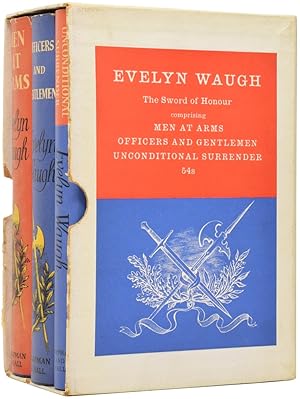
Add to basketFirst Edition. [Military saga] FIRST COLLECTED EDITION, SIGNED by the author. 3 volumes. Octavo, pp.314, 335, 311. Navy blue cloth hardcovers, titles in gilt to spine, top edges tinted blue, in original jackets designed by Val Biro. In the publisher's pictorial slipcase adverting the set for sale at 54s. Light wear only, minor sunning, leading edge of box rubbed; near fine. The complete trilogy, offered for the first time as a box set, comprising the then-current printings of each book; the first two titles are the second printings and the final volume (being the signed one) is a first edition. Seemingly a rare item, not recorded in the Bibliography of Evelyn Waugh. Callil and Toibin; Modern Library (200 Best Novels in English since 1950). Signed.
-
[Sword of Honour Trilogy, comprising:] Men at Arms; [with] Officers and Gentlemen; [and] Unconditional Surrender [Signed by Biro]
Published by Chapman & Hall [through 1961], London, 1952
Seller: Fine Editions Ltd, Willow Street, PA, U.S.A.
Association Member: IOBA
Seller rating 5 out of 5 stars
First Edition Signed
Hardcover. Condition: Fine. Dust Jacket Condition: Fine. First Edition. Three fine First Impression octavo volumes, each signed on the front jacket flap by the legendary illustrator Val Biro (1921-2014). vi,314; [10],335; [8],311. Original publisher's blue cloth, spines stamped in gilt, top edges stained blue; bright red, blue, yellow, and white dust jackets by Biro. Men at Arms (1952): Fine, tight and square with bright gilt and rich top stain; about Fine jacket (just a degree of fading to spine panel, the end of which are briefly rubbed), priced 12s/6d on publisher's label over printed price. Officers and Gentlemen (1955): Fine and unread (top stain lightly spotted); Fine jacket (spine panel barely lightened), priced 12s/6d. Unconditional Surrender (1961): Fine and apparently unread (single pinhead stain to fore-edge); about Fine jacket (price-clipped), completely unfaded, vibrant and bright. In all, a superb set, rarely seen seen in such condition, let alone signed (no other such set we know of exists). Davis XXVI, XXX, XXXV. Burgess 99, pp. 61-62. Callil and Toibin 200, 39. "Sword of Honour is not merely the story of one man's battles; it is the whole history of the European struggle itself, told with verve, humour, pathos and sharp accuracy." (Burgess). Never planned as a trilogy. Following Officers and Gentlemen, the second installment, Waugh decided he had said all he had to say about Guy Crouchback, heir of a declining aristocratic English Roman Catholic family who, like Waugh, participated in the Dakar expedition, served a stint with the commandos, experienced the débâcle on Crete, and ended the war in Yugoslavia. But Waugh later changed his mind and completed the sequence with Unconditional Surrender. In 1966, he pruned, revised and issued the trilogy as Sword of Honour (the title is drawn from the ceremonial sword, the "Sword of Stalingrad," made "at the King's command," to be presented in recognition of the sacrifices the Soviets had made against the Nazis.) But, according to Burgess, "Most readers prefer to take the items severally and in their unrevised form." In the event, the trilogy is generally regarded as Waugh's greatest achievement in fiction, with its "fine war reportage and superb comic action." According to Christopher Sykes (Waugh's biographer), the trilogy is "the very highest class of English fiction . . . not surpassed by any other book he wrote." Waugh received the James Tait Black Memorial Prize for Men at Arms. Note: With few exceptions (always noted), we only stock books in exceptional condition, with dust jackets carefully preserved in archival, removable polypropylene sleeves. All orders are packaged with care and posted promptly. Satisfaction guaranteed.


![Seller image for [Sword of Honour Trilogy, comprising:] Men at Arms; [with] Officers and Gentlemen; [and] Unconditional Surrender [Signed by Biro] for sale by Fine Editions Ltd](https://pictures.abebooks.com/inventory/md/md22493946451.jpg)