About this Item
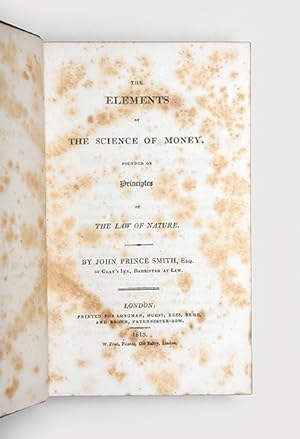
First edition. The work defends free trade and opposes devaluation and paper currency on grounds of natural law. It was written in the context of the Bullion Report, sharply increasing public debt with the Napoleonic Wars, and the expansion of paper currency. Smith charts the nature of money, its history, the variations in its value, its increase by commerce, the duties of the state to uphold fair coinage, and the banking system. Smith opposes paper currency, as threatening the ruin of the state, and as inherently inflationary. Primarily a barrister, Smith (1774-1822) edited the New Law Journal (3 vols., 1804-6) and published a collection of reports of cases in the king's bench between 1803 and 1806. His major legal case was acting as counsel for Daniel Isaac Eaton who published Thomas Paine's Age of Reason. He took a close interest in economics, and aside from this work also published Advice for the Petitioners Against the Corn Bill (1815). In 1817, he was appointed second fiscal officer of British Guiana. The currency of the colony remained the Dutch guilder, despite British control, and he was not able to enact his ideas. His son, John Prince Smith (jr.,1809-1874), achieved greater fame as a political economist and free trade liberal, moving to Germany and helping to introduce British free trade economics to the country. He was influenced by his father's writings in the subject. WorldCat locates seven copies in British institutions (BL, Birmingham, Cambridge, Edinburgh, London, LSE, and Sheffield) and just two further copies worldwide (Tokyo and Wyoming). No copy is listed at auction by Rare Book Hub, nor could one be traced in commerce. Goldsmiths' 20071; Kress B.6226. Octavo (216 x 131 mm). Contemporary calf, red morocco label. A little worn, contents foxed, still a very good copy.
Seller Inventory # 166458
Contact seller
Report this item