About this Item
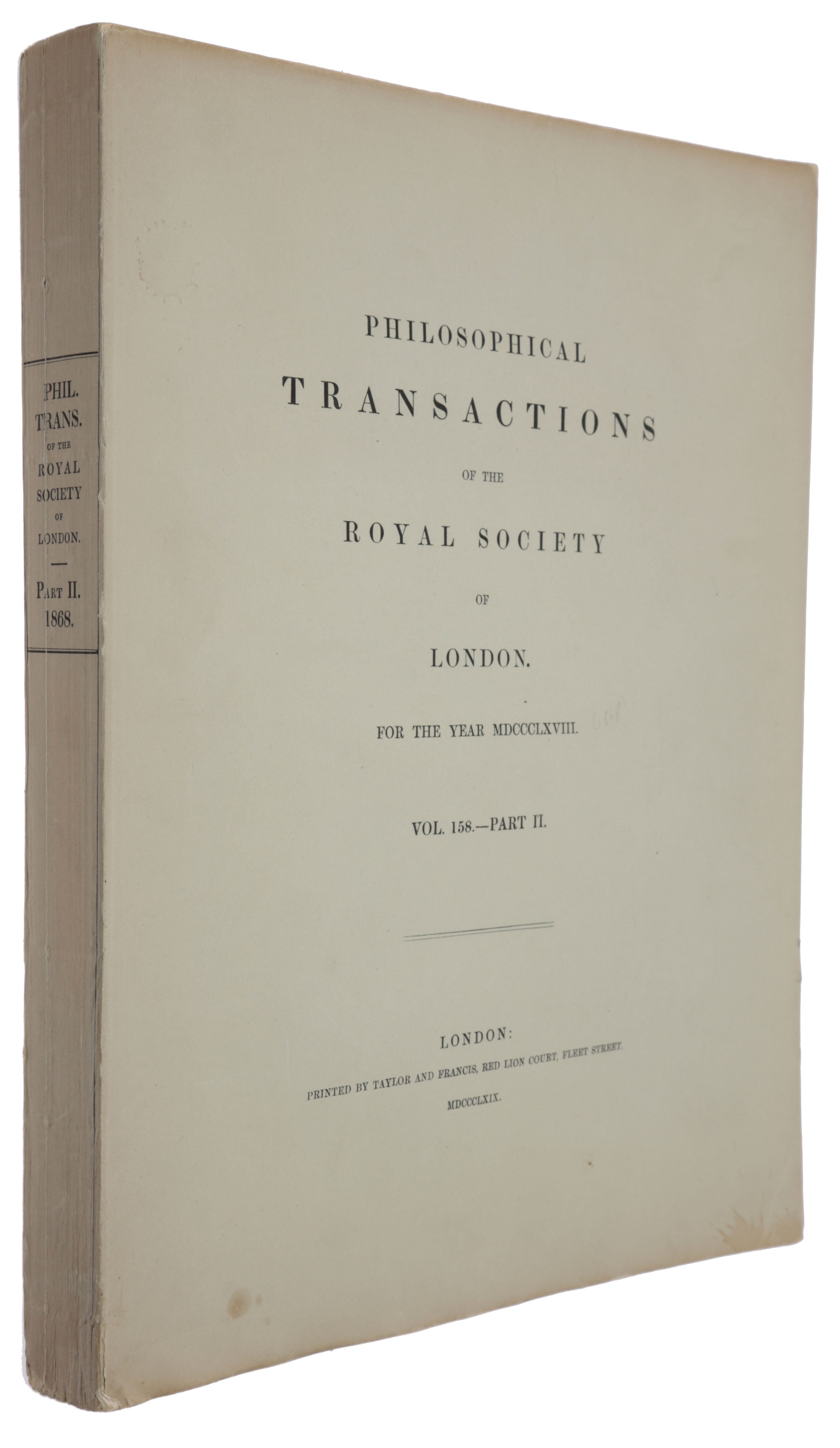
EXPERIMENTAL PROOF THAT LIGHT IS ELECTROMAGNETIC WAVES. First edition, journal issue in the original printed wrappers, of the last of Maxwell?s five important papers on the foundations of electromagnetic theory published between 1855 and 1868, here accompanied by the Abstract of the paper published at least six months earlier. In this paper Maxwell finally gives experimental proof that light consists of electromagnetic waves, which he had postulated in his fourth paper, the epoch-making ?A dynamical theory of the electromagnetic field? (1865). ?[Michael] Faraday (1791-1867) had abandoned the notion of ?action at a distance? for the concept of the ?fields of force? surrounding bodies by which they act upon one another electromagnetically ? Clerk Maxwell (1831-79), who may well be judged the greatest theoretical physicist of the nineteenth century, was happy to acknowledge his debt to Faraday; for what he did was to construct the mathematical theory of the field ? the developed field-theory, expressed in twenty equations, was purely and elegantly mathematical? (PMM 355). In the present paper, Maxwell casts the equations describing the electromagnetic field in the simplified form we now know as ?Maxwell?s equations?: these four equations replaced the twenty in ?A dynamical theory.? In ?A dynamical theory? Maxwell showed that electromagnetic waves should propagate with a speed equal to the ratio of the electrostatic and electromagnetic units of charge. To prove his postulate on the nature of light, it was therefore necessary to accurately measure this ratio and compare it with direct measurements of the speed of light. Maxwell describes this experiment and its results in the first part of the present paper: he finds that the ratio is about 3% below the speed of light according to a recent measurement by the French physicist L?on Foucault (1819-68). The second part of the paper gives a simplified formulation of the equations describing the electromagnetic field. In ?A dynamical theory? ?Maxwell remarked that the equations might be condensed, but ?to eliminate a quantity which expresses a useful idea would be rather a loss than a gain in this stage of our enquiry.? He had in fact simplified the equations in his fifth major paper, the short but important ?Note on the electromagnetic theory of light? (1868), writing them in integral form, based on four postulates derived from electrical experiments. This may be called the electrical formulation of the theory, in contrast with the original dynamical formulation. It was later independently developed by Heaviside and Hertz and passed into the textbooks. It has the advantage of compactness and symmetry? (Everitt, pp. 108-9). ?Maxwell?s 1868 paper was of considerable historical importance, for it set forward his theory in the simple form in which it was taken up and developed by others? (Hendry, p. 226). Although that volume of the Phil. Trans. is 'for 1868', it is dated 1869 on the title page, so the present Abstract was published at least six months earlier than the Phil. Trans. article. ?In 1861 the British Association formed a committee under [William] Thomson?s (1824-1907) chairmanship to determine a set of internationally acceptable electrical standards following the work of [Wilhelm] Weber (1804-91). At Thomson?s urging, a new absolute system of units was adopted, similar to Weber?s, but based on energy principles rather than on a hypothetical electrodynamic force law. The first experiment was on the standard of resistance, and in 1862 Maxwell was appointed to the committee to help with that task? (DSB). ?The work of the British Association?s committee on electrical standards had not stopped with the production of a standard of resistance. The next task on their agenda stemmed from James? [i.e., Maxwell?s] prediction of electromagnetic waves which travelled at a speed equal to the ratio of the electromagnetic and electrostatic units of charge ? earlier measurements of this ratio by.
Seller Inventory # 6356
Contact seller
Report this item