About this Item
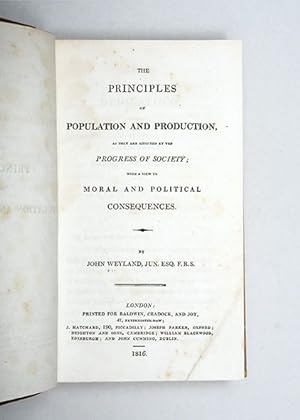
First edition of an important criticism of Malthus's Principles of Population, which Malthus responded to in the appendix to his fifth edition of the Principles the following year. Though Malthus rejected Weyland's conclusions in his response, he respected his adversary, thinking much higher of the work than the other object of the appendix, James Grahame's Inquiry into the Principle of Population: "a slight work without any very distinct object in view. Mr. Weyland's work is of a much more elaborate description [and] has also a very definite object in view" (Malthus, Principles, 1817, pp. 388, 397-8). John Weyland (1774-1854), a magistrate and a writer on the poor laws, praised Malthus for having raised the subject of population from the level of academic discussion to that of scientific inquiry. However, his conclusion on the subject of population was the exact opposite, advocating an increase in population. Weyland argued that a society in which one-third of the population lived in towns had "arrived at its point of non-reproduction" (Weyland, Principles, p. 109). With infant mortality higher in towns, the state should "keep an additional set of healthy breeders for the community; and that all unnecessary expense may be spared, it must place them in situations most favourable to child-bearing, and to the health of children, and most favourable also to their morals, that is to say, in the country villages" (ibid, p. 172). Weyland consequently encouraged the expansion of parish relief in the countryside to encourage reproduction, a proposal which horrified Malthus, who pictured, if Weyland's proposals were adopted, an endpoint of the whole of the working classes on poor relief: "what a dreadful picture does it present! what a scene of equality, indolence, rags and dependence, among one-half or three fourths of the society" (Malthus, Principles, 1817, p. 417). Despite Malthus's horror, "Weyland's principal object was to show that the poor laws were both beneficent and necessary, and were not a cause of pauperism, which he attributed to a lack of moral and religious instruction among the poor. Although his assertion that the population had reached a state of 'non-reproduction' was demonstrably absurd (despite the lack of issue from his own marriage), his advocacy of poor relief for large families where the wage-earner could not provide for all his children interested promoters of family allowances a century later" (ODNB). Einaudi 6027; Goldsmiths' 21429; Kress B.6837; Malthus MH.2.24; see Bonar, Malthus and his work, pp. 376-380 and James, Population Malthus, pp. 372-374. Octavo (205 x 124 mm). Recent quarter sheep, twin black and purple labels, marbled sides. With half-title. Binding fine save for light sunning to spine, contents generally clean save for light foxing at extremities and light stain to pp. 84-5 and 94-5, pp. 454-8 bound upside down; a very good copy.
Seller Inventory # 152875
Contact seller
Report this item