


A Symbolic Analysis of Relay and Switching Circuits
SHANNON, Claude Elwood
Published by American Institute of Electrical Engineers [AIEE], New York, 1938
Used
From
SOPHIA RARE BOOKS, Koebenhavn V, Denmark
Seller rating 5 out of 5 stars

AbeBooks Seller since January 18, 2013
This specific copy is no longer available. Here are our closest matches for A Symbolic Analysis of Relay and Switching Circuits by SHANNON, Claude Elwood.
About this Item
Description:
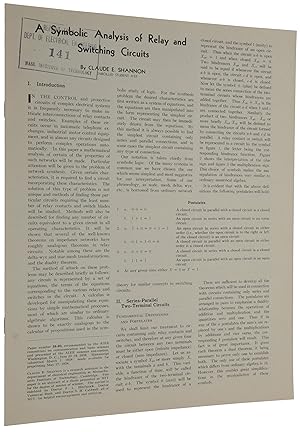
Boolean Algebra and the Design of Switching Circuits. First edition, in the form Shannon's own department circulated three months before the bound journal reached its subscribers, of the paper that made the design of switching circuits a deductive science. In the summer of 1937 Claude Shannon, a twenty-one-year-old research assistant at MIT, was running Vannevar Bush's differential analyser - a room-sized analog computer whose motions were governed by a control circuit of about a hundred relays - when he saw that the open-and-closed behaviour of those relays mapped exactly onto the true-and-false of Boolean logic. The observation looked elementary; its consequence was that the design of switching networks could be lifted out of intuitive cut-and-try and carried out within a rigorous algebra. He worked it up over that summer at Bell Telephone Laboratories and over the following year as his MIT master's thesis. The paper appeared in 1938 in three closely related forms; the present item is the second of them - the typeset offprint the American Institute of Electrical Engineers supplied to MIT's Electrical Engineering Department on 16 September 1938 for redistribution within the department, three months ahead of the bound Transactions. In its eleven typeset pages the paper opens with four postulates now found in some form in every text on switching theory: 0 0 = 0; 1 + 1 = 1; 1 + 0 = 0 + 1 = 1; 0 1 = 1 0 = 0; and 'at any given time either X = 0 or X = 1'. From these, with a single convention - Xab the hindrance between terminals a and b, 0 the closed circuit and 1 the open one - Shannon builds, across thirty-six figures, a complete calculus for relay networks: the canonical series-parallel form, the expansion of a switching function in any subset of its variables, the equivalence transformations, the duality theorem for planar networks, and the realisation of symmetric functions. The paper's fifth section then turns the calculus to engineering, in five worked examples: a selective relay that responds to one, three, or four of its inputs but not to two; an electric combination lock that opens only to its buttons pressed in the right order; a vote-counter; a base-translator; and - the example for which the paper is most remembered - a binary full-adder, the first published electrical circuit derived from a symbolic-Boolean framework, and the schematic germ of every digital computer that followed. What gave the algebra its force was economy as much as rigour. Shannon framed the problem in his opening sentence as that of the automatic telephone exchange, and set two explicit goals: to find, for a required behaviour, a circuit equivalent to any other that realised it, and to find the one needing the fewest relay contacts. The second answered to the largest engineering enterprise of the age. A telephone exchange was a machine built almost wholly of relays - by mid-century a single automatic exchange might operate more than a thousand of them to set up one call, and the Bell System counted its relays in the hundreds of millions - so that a method for proving two contact networks equivalent, and for choosing the leaner, turned every contact saved into a cost not paid across tens of thousands of installations. The algebra gave the exchange engineer, for the first time, a way to prove a circuit minimal rather than merely workable. The paper exists in three states, each in a different physical form. The earliest is the AIEE Advance Copy preprint of June 1938, twenty-eight typewritten quarto leaves with Shannon's thirty-six figures drawn by hand, distributed to delegates of the Summer Convention; the latest is the bound Transactions volume 57 of December 1938, the normal journal channel. The present copy is the state between the two: a properly typeset offprint, pulled from the same plates as the bound journal - the verso carries the AIEE's 'Preprinted from TRANSACTIONS' legend and the dated stamp 9/16/38 - which the AIEE supplied to MIT's El. Seller Inventory # 5553
Bibliographic Details
Title: A Symbolic Analysis of Relay and Switching ...
Publisher: American Institute of Electrical Engineers [AIEE], New York
Publication Date: 1938
Edition: First edition.
Top Search Results from the AbeBooks Marketplace

Seller Image
A Symbolic Analysis of Relay and Switching Circuits [later generation copy of the MIT Preprint of the AIEE paper]
Published by
American Institute of Electrical Engineers [AIEE], New York, 1938
Used
Wraps
Seller: Kuenzig Books ( ABAA / ILAB ), Topsfield, MA, U.S.A.
Seller rating 5 out of 5 stars
Wraps. Condition: Near Fine. Later printing. Later printing. [1]-10, [2] pages. 10 7/8 x 8 3/8 inches. Copied loose leaves stapled upper left. A later generation copy the MIT Preprint of the AIEE paper. Copy quality is not ideal, but it is readable and a copy from Shannon's personal files. Wraps. We offer a later generation copy of the previously unrecorded MIT preprint of Claude Shannon's AIEE paper "A Symbolic Analysis of Relay and Switching Circuits," a pivotal paper in the history of computing. (see #1.5 in COLLECTOR'S NOTES). This paper (often referred to as Shannon's famous Master's Thesis) is a fundamentally important work in the history of computing. It demonstrates how to combine the mathematical rigor of Boolean logic with the engineering practice of building circuits, a discipline previously more of an experimental art form than a true engineering discipline. This work provided the foundation for computer circuit design as we know it today, without which the phenomenal growth of computing (see Moore's Law) could not have happened. "In 1936 [after obtaining the degrees of Bachelor of Science in Electrical Engineering and Bachelor of Science in Mathematics at the University of Michigan, Shannon] accepted the position of research assistant in the Department of Electrical Engineering at the Massachusetts Institute of Technology. The position allowed him to continue studying toward advanced degrees while working part-time for the department. The work in question was ideally suited to his interests and talents. It involved the operation of the Bush differential analyzer, the most advanced calculating machine of that era Also of interest was a complex relay circuit associated with the differential analyzer that controlled its operation and involved over one hundred relays. In studying and servicing this circuit, Shannon became interested in the theory and design of relay and switching circuits. He had studied symbolic logic and Boolean algebra at Michigan in mathematics courses and realized that this was the appropriate mathematics for studying such two-valued systems. He developed these ideas during the summer of 1937, which he spent at Bell Telephone Laboratories in New York City, and, back at MIT, in his master's thesis, where he showed how Boolean algebra could be used in the analysis and synthesis of switching and computer circuits." (Sloane and Wyner pp xi-xii) The American Institute of Electrical Engineers recognized the significance of Shannon's thesis and invited the young Claude Shannon, an "Enrolled Student AIEE," to present an abstract of his thesis at the June 1938 Summer AIEE conference while still enrolled at MIT. "The thesis, his first published paper, aroused considerable interest when it appeared in 1938 in the AIEE Transactions. In 1940, it was awarded the [1939] Alfred Noble Prize of the combined engineering societies of the United States, an award given each year to a person, not over thirty, for a paper published in one of the journals of the participating societies." (Sloane and Wyner, pp. xi-xii). Herman H. Goldstine notes: "This surely must be one of the most important master's theses ever written.The paper was a landmark in that it helped change digital circuit design from an art to a science." (Goldstine, pp 119-120) "Shannon's paper, written in 1937 at Bell Labs, proved in theory what George Stibitz was demonstrating empirically at Bell Labs at just about the same time with his famous 'Model K' relay calculator.Shannon proved that the two-valued algebra developed by George Boole could be implemented electrically by telephone relays and used as a basis for designing computer circuits." (Origins of Cyberspace) PROVENANCE: The personal files of Claude E. Shannon (unmarked). One of ten examples in Shannon's files. REFERENCES: (citing the regular AIEE Transactions publication) Sloane and Wyner, "Claude Elwood Shannon Collected Papers," #1 Hook and Norman, "Origins of Cyberspace," #363. Swartzlander, Earl E. Jr., "Computer Design Development. Seller Inventory # 29642
A symbolic analysis of relay and switching circuits
Published by
American Institute of Electrical Engineers, New York, 1938
Used
First Edition
Seller: SOPHIA RARE BOOKS, Koebenhavn V, Denmark
Seller rating 5 out of 5 stars
First edition. SHANNON'S FAMOUS MASTER'S THESIS . First edition of Shannon's famous master's thesis. Herman Goldstein has called the thesis "masterful . surely one of the most important master's theses ever written . a landmark in that it helped to change digital circuit design from an art to a science" (The Computer From Pascal to Von Neumann, pp. 119-120). "Claude Shannon, in his master's thesis entitled 'A Symbolic Analysis of Relay and Switching Circuits,' submitted to MIT on August 10, 1937, showed that the two-valued algebra developed by George Boole could be used as a basis for the design of electrical circuits . This thesis became the theoretical basis for the electronics and computer industries that were developed after World War II" (). "In 1936 [Shannon] accepted the position of research assistant in the Department of Electrical Engineering at the Massachusetts Institute of Technology. The position allowed him to continue studying toward advanced degrees while working part-time for the department. The work in question was ideally suited to his interests and talents. It involved the operation of the Bush differential analyzer, the most advanced calculating machine of that era . Also of interest was a complex relay circuit associated with the differential analyzer that controlled its operation and involved over one hundred relays. In studying and servicing this circuit, Shannon became interested in the theory and design of relay and switching circuits. He had studied symbolic logic and Boolean algebra at Michigan in mathematics courses, and realized that this was the appropriate mathematics for studying such two-valued systems. He developed these ideas during the summer of 1937, which he spent at Bell Telephone Laboratories in New York City, and, back at MIT, in his master's thesis, where he showed how Boolean algebra could be used in the analysis and synthesis of switching and computer circuits. The thesis, his first published paper, aroused considerable interest when it appeared in 1938 in the AIEE Transactions. In 1940 it was awarded the Alfred Noble Prize of the combined engineering societies of the United States" (Collected Papers, pp. xi-xii). "In his paper, Shannon proved that Boolean algebra and binary arithmetic could be used to simplify the arrangement of the electromechanical relays then used in telephone routing switches, then turned the concept upside down and also proved that it should be possible to use arrangements of relays to solve Boolean algebra problems. Exploiting this property of electrical switches to do logic is the basic concept that underlies all electronic digital computers. Shannon's work became the foundation of practical digital circuit design when it became widely known among the electrical engineering community during and after WW2. The theoretical rigor of Shannon's work completely replaced the ad hoc methods that had previously prevailed" (history-/ModernComputer/thinkers/). ABPC/RBH records three copies: Bonham's New York, June 14, 2014; Christie's New York, June 14, 2006; Christie's New York, February 23, 2005 - OOC copy. The OOC copy realized $15,600. Provenance: "General Electric Co., Salt Lake City' hand-written on top edge of text block. "Shannon (1916-2001), who died in February after a long illness, was one of the greatest of the giants who created the information age. John von Neumann, Alan Turing and many other visionaries gave us computers that could process information. But it was Claude Shannon who gave us the modern concept of information - an intellectual leap that earns him a place on whatever high-tech equivalent of Mount Rushmore is one day established . "And that's not even counting the master's dissertation Shannon had written 10 years earlier - the one where he articulated the principles behind all modern computers. 'Claude did so much in enabling modern technology that it's hard to know where to start and end,' says [Robert] Gallager, who worked with Shannon in the 1960s. 'He had this amazing clarity of vision. Einstein had it, too - this ability to take on a complicated problem and find the right way to look at it, so that things become very simple.' "For Shannon, it was all just another way to have fun. 'Claude loved to laugh, and to dream up things that were offbeat,' says retired Bell Labs mathematician David Slepian, who was a collaborator of Shannon's in the 1950s. Shannon went at math like a stage magician practicing his sleight of hand: 'He would circle around and attack the problem from a direction you never would have thought of,' says Slepian - only to astonish you with an answer that had been right in front of your face all the time. But then, Shannon also had a large repertoire of real card tricks. He taught himself to ride a unicycle and became famous for riding it down the Bell Labs hallways at night-while juggling. ('He had been a gymnast in college, so he was better at it than you might have thought,' says his wife Betty, who gave him the cycle as a Christmas present in 1949.) "At home, Shannon spent his spare time building all manner of bizarre machines. There was the Throbac (THrifty ROman-numerical BAckward-looking Computer), a calculator that did arithmetic with Roman numerals. There was Theseus, a life-sized mechanical mouse that could find its way through a maze. And perhaps most famously, there was the 'Ultimate Machine' - a box with a large switch on the side. Turn the switch on, and the lid would slowly rise, revealing a mechanical hand that would reach down, turn the switch off, and withdraw - leaving the box just as it was. "'I was always interested in building things with funny motions,' Shannon explained in a 1987 interview with Omni magazine (one of the few times he spoke about his life publicly). In his northern Michigan hometown of Gaylord, he recalled, he spent his early years putting together model planes, radio circuits, a radio-controlled model boat and even a telegraph system. And when he entered the. Seller Inventory # 5212
Buy Used
US$ 25,000.00
Free Shipping
Ships from Denmark to U.S.A.
Ships from Denmark to U.S.A.
Quantity: 1 available
A Symbolic Analysis of Relay and Switching Circuits [MIT Preprint of the AIEE paper]
Published by
American Institute of Electrical Engineers [AIEE], New York, 1938
Used
Wraps
Seller: Kuenzig Books ( ABAA / ILAB ), Topsfield, MA, U.S.A.
Seller rating 5 out of 5 stars
Wraps. Condition: Good. [1]-11, 12 pages. 10 15/16 x 8 1/2 inches. Stapled self-wrappers. Hand-applied ink-stamp upper left "A Reprint from the Dept. of Electrical Engineering 141 Mass. Institute of Technology" partially covering the title and author of the paper. Spine refolded many times (presumably for reading), multiple marginal edge tears, fraying and several marginal chips. There is also sun darkening to the foreedge of the front wrapper. The text is effectively complete except for a paper puncture/tear to the last two leaves with minor effect to the text of a figure and table but with no loss of meaning. With all a rare survival of an important item. Wraps. We offer an example of the rare MIT preprint of Claude Shannon's AIEE paper "A Symbolic Analysis of Relay and Switching Circuits," a pivotal paper in the history of computing. (see #1.5 in COLLECTOR'S NOTES below for printing precedence). This paper (often referred to as Shannon's famous Master's Thesis) is a fundamentally important work in the history of computing. It demonstrates how to combine the mathematical rigor of Boolean logic with the engineering practice of building circuits, a discipline previously more of an experimental art form than a true engineering discipline. This work provided the foundation for computer circuit design as we know it today, without which the phenomenal growth of computing (see Moore's Law) could not have happened. "In 1936 [after obtaining the degrees of Bachelor of Science in Electrical Engineering and Bachelor of Science in Mathematics at the University of Michigan, Shannon] accepted the position of research assistant in the Department of Electrical Engineering at the Massachusetts Institute of Technology. The position allowed him to continue studying toward advanced degrees while working part-time for the department. The work in question was ideally suited to his interests and talents. It involved the operation of the Bush differential analyzer, the most advanced calculating machine of that era Also of interest was a complex relay circuit associated with the differential analyzer that controlled its operation and involved over one hundred relays. In studying and servicing this circuit, Shannon became interested in the theory and design of relay and switching circuits. He had studied symbolic logic and Boolean algebra at Michigan in mathematics courses and realized that this was the appropriate mathematics for studying such two-valued systems. He developed these ideas during the summer of 1937, which he spent at Bell Telephone Laboratories in New York City, and, back at MIT, in his master's thesis, where he showed how Boolean algebra could be used in the analysis and synthesis of switching and computer circuits." (Sloane and Wyner pp xi-xii) The American Institute of Electrical Engineers recognized the significance of Shannon's thesis and invited the young Claude Shannon, an "Enrolled Student AIEE," to present an abstract of his thesis at the June 1938 Summer AIEE conference while still enrolled at MIT. "The thesis, his first published paper, aroused considerable interest when it appeared in 1938 in the AIEE Transactions. In 1940, it was awarded the [1939] Alfred Noble Prize of the combined engineering societies of the United States, an award given each year to a person, not over thirty, for a paper published in one of the journals of the participating societies." (Sloane and Wyner, pp. xi-xii). Herman H. Goldstine notes: "This surely must be one of the most important master's theses ever written.The paper was a landmark in that it helped change digital circuit design from an art to a science." (Goldstine, pp 119-120) "Shannon's paper, written in 1937 at Bell Labs, proved in theory what George Stibitz was demonstrating empirically at Bell Labs at just about the same time with his famous 'Model K' relay calculator.Shannon proved that the two-valued algebra developed by George Boole could be implemented electrically by telephone relays and used as a b. Seller Inventory # 28871