
Synopsis
The literary debut of an electrifying talent that gives the historical novel an exhilarating dose of originality, style, and visionary energy.
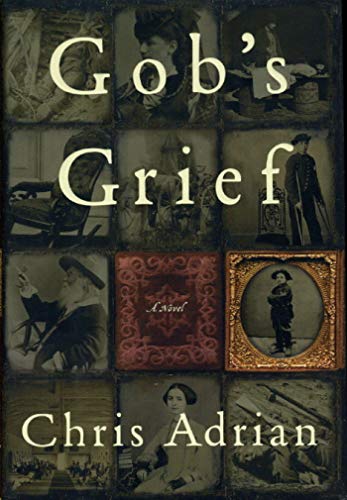
Gob's Grief recounts the lives of Gob and Tomo Woodhull, fictional twin sons of the real Victoria Woodhull, the nineteenth-century proto-feminist. In August of 1863, Tomo, who is eleven years old, runs off to the Civil War and dies in his first battle. Gob grows up in a profound state of grief, and by the time that he's an adult studying to be a doctor in New York City, he has begun to make real a dream to build a machine that might bring Tomo—indeed, all the war dead—back to life.
As Gob's obsessions deepen, we are taken from the battlefields at Chickamauga Creek to the society balls of New York, from innocent childhoods in Homer, Ohio, to the building of the Brooklyn Bridge; and as the machine grows, so does the amazing cast of real and imagined characters: Walt Whitman, ministering lovingly to the Civil War wounded; Mrs. Woodhull and her sister Tennessee, doing business on Wall Street and riding churning tides of scandal; Gob's friend Will Fie, a war veteran who builds a house from glass images of suffering and death; Maci Trufant, Victoria Woodhull's protégé and Gob's great love; and even unnatural Pickie Beecher, a child who seems to float sinisterly between the living and the dead. These disparate lives come together in support of Gob's endeavor, but the abolition of death and the success of his machine may come at a price more hideous and awful than any of them can know.
Both convincing in its portrayal of the collective madness America went through after the carnage of the Civil War, and otherworldly in its contemplation of obsessive grief and longing, Gob's Grief is at once an announcement of a major talent, and an extraordinary achievement in literary art.
"synopsis" may belong to another edition of this title.
About the Author
Chris Adrian was born in Washington, D.C. A graduate of the Iowa Writers’ Workshop, he is currently a medical student in Virginia. Part of this novel first appeared in The New Yorker under the title “Every Night for a Thousand Years” and was subsequently collected in Best American Short Stories 1998. His fiction has also appeared in The Paris Review, Zoetrope, Ploughshares, and Story.
From the Inside Flap
debut of an electrifying talent that gives the historical novel an exhilarating dose of originality, style, and visionary energy.
Gob's Grief recounts the lives of Gob and Tomo Woodhull, fictional twin sons of the real Victoria Woodhull, the nineteenth-century proto-feminist. In August of 1863, Tomo, who is eleven years old, runs off to the Civil War and dies in his first battle. Gob grows up in a profound state of grief, and by the time that he's an adult studying to be a doctor in New York City, he has begun to make real a dream to build a machine that might bring Tomo indeed, all the war dead back to life.
As Gob's obsessions deepen, we are taken from the battlefields at Chickamauga Creek to the society balls of New York, from innocent childhoods in Homer, Ohio, to the building of the Brooklyn Bridge; and as the machine grows, so does the amazing cast of real and imagined characters: Walt Whitman, ministering lovingly to the Civil War wounded;
Reviews
Blending history and fiction in the tradition of E.L. Doctorow's Ragtime, this skillfully imagined first novel follows Walt Whitman as the poet unwittingly aids the son of early radical feminist Victoria Woodhull in constructing a machine to bring back the Civil War dead; indeed, to abolish death altogether. While he is mourning a young soldier who dies in his care, Walt is directed by a message from the dead man to befriend Victoria's son, Dr. George Washington Woodhull, better known as Gob, on a stagecoach in 1868. In 1863, Gob's twin brother, Tomo, ran away to war and was killed. Wracked by guilt at having let his brother go off alone, Gob strikes a bargain with "a mad hedge wizard" known as the Urfeist, who agrees to teach Gob to "defeat death." Will Fie, who has also lost a brother, is compelled by restless spirits to join Gob's cause; wild boy Pickie Beecher, the first product of Gob's labors, calls the machine his brother; Gob's love, Maci Trufant, receives scribbled pleas from her own dead brother, who has seized control of her left hand. The story is repeated from each new character's vantage--gentle, disbelieving Walt is the most sympathetically crafted narrator--and though this allows for an admirably meticulous plot, it hampers the pacing and distances the reader from the difficult, unusual characters. Much like Gob's creation, the novel is a collection of fabulous parts in need of a heart to power them, yet impressing as a flight of fancy. (Jan. 16)from which this novel stemmed, was anthologized in Best American Short Stories 1998.
Copyright 2001 Cahners Business Information, Inc.
Adrian's novel was reborn from a story that first appeared in The New Yorker in 1997, just as in the novel itself an 11-year-old bugler, Tomo, killed during the battle of Chickamauga, is reborn from a machine designed by his grief-stricken twin brother, Gob, in the years following the Civil War. It is difficult to categorize this fantastical tale of the obsession, longing, and madness that comes with war and its aftermath. Gob and Tomo are the fictional sons of a real woman, 19th-century suffragette Victoria Woodhull, who is fairly rendered. Yet for all the accuracy, this is anything but a historical novel. As indicated earlier, its basic premise involves the construction of a machine to bring back the Civil War dead. The blurring of the lines between reality and madness is made most abundantly clear in the story of Maci Trufant, Gob's love, who also lost a brother to the war. Her left hand becomes a vehicle through which he speaks, while her right hand continues to write speeches for Woodhull. Highly imaginative, this is a "large," complex, thought-provoking work sure to arouse much discussion. Most public libraries will want at least one copy, as will academic libraries collecting new and/or experimental fiction.
-DDavid W. Henderson, Eckerd Coll. Lib., St. Petersburg, FL
Copyright 2001 Reed Business Information, Inc.
English poet and critic Alvarez, who is best known for The Savage God (1972)--which combines a study of suicide and Sylvia Plath with an account of his own attempt to take his life--now has written another, far different memoir, attempting to explain where it all went right in his life. He begins with his childhood as the sickly son of deeply unhappy parents. Alvarez courted danger as a way of overcoming his infirmities and found in the "deadly ballet" of the Battle of Britain--Messerschmitts and Spifires dancing and dueling across the London sky--an image of beauty and risk that would never leave him. And, yet, poetry and the literary life were his first loves as an adult, and he describes the excitement of his early successes at Oxford and as poetry critic at the Observer ("a fresh young tadpole in the puddle of poetry"). Profiles of his mentors, including V. S. Pritchett and R. P. Blackmur, as well as descriptions of his encounters with Auden, Berryman, Lowell, Hughes, and Plath are acutely perceptive and full of rich anecdote. Those Spitfires still dancing in his mind's eye, however, Alvarez abandoned the literary life to indulge his "fascination with how other people function." Soon he was writing about poker players, rock climbers, and North Sea oil drillers, seeing for himself "the world of action, where people take real risks with their bodies or machinery or money." And escaping his father's fate, a man "who had spent his life in a business he didn't care for and had never been anywhere." The best memoirs always go beyond anecdote to give us the shape of a life. Free-falling between art and action, between despair and exhilaration, Alvarez struggled to find a shape for his conflicted life, and we share his surprise and his joy that it all went right. A remarkable book about a remarkable life. Adrian's very adept first novel has its provenance in a short story called "Every Night for a Thousand Years," which the author published in 1997 and which now serves as a chapter in this novel. Adrian blends two fictional techniques, in a mesmerizing combination, by taking the kind of authentic Civil War-era historical fiction made popular by Charles Frazier's 1997 prizewinning Cold Mountain and wedding it to the provocative, reality-bending tendencies found in magic realism. Victoria Woodhull was a famous American feminist and suffragette in the latter half of the nineteenth century. Adrian invents a son for her, nicknamed Gob, who becomes a physician after the end of the awful war between the Union and the Confederacy. His main interest lies in building a machine that will bring his young brother, Tomo, who was killed in the fighting, back to life. Gob is a friend of the famous poet Walt Whitman and also becomes friends with a young man who worked as a photographer's apprentice during the war. Also populating Gob's world are spiritual beings, for Mrs. Woodhull's entourage is sensitive to paying attention to what the spiritual world has to say. As one character says, "By May of 1862, it seemed . . . that madness had become the national pastime." Displaying both talent and knowledge, Adrian captures the very tenor of that national madness in the pages of this completely compelling novel. Reviews will be positive, as will word of mouth, so expect demand. Brad Hooper
Copyright © American Library Association. All rights reserved
Excerpt. © Reprinted by permission. All rights reserved.
Walt dreamed his brother's death at Fredericksburg. General Burnside, appearing as an angel at the foot of his bed, announced the tragedy:"The army regrets to inform you that your brother, George Washington Whitman, was shot in the head by a lewd fellow from Charleston." The general alit on the bedpost and drew his dark wings close about him, as if to console himself. Moonlight limned his strange whiskers and his hair. Burnside's voice shook as he went on. "Such a beautiful boy. I held him in my arms while his life bled out. See? His blood made this spot." He pointed at his breast, where a dark stain in the shape of a bird lay on the blue wool. "I am so very sorry," the General said, choking and weeping. Tears fell in streams from his eyes, ran over the bed and out the window, where they joined the Rappahannock, which had somehow come north to flow through Brooklyn, bearing the bodies of all the late battle's dead.
In the morning Walt read the wounded list in the Tribune. There it was: "First Lieutenant G. W. Whitmore." He knew from George's letters that there was nobody named Whitmore in his company. He walked through the snow to his mother's house. "I'll go and find him," he told her.
Washington, Walt quickly discovered, had become a city of hospitals. He looked in half of them before a cadaverous-looking clerk told him he'd be better off looking at Falmouth, where most of the Fredericksburg wounded still lay in the field hospitals. He got himself on a government boat that ran down to the landing at Aquia Creek, and went by railroad to the neighborhood of Falmouth, seeking Ferret's Brigade and the Fifty-first New York, George's regiment. Walt stood outside a large brick mansion on the banks of the Rappahannock, somebody's splendid residence converted to a hospital, afraid to go in and find his mangled brother. He took a walk around the building, gathering his courage, and found a pile of amputated limbs, arms and legs of varying lengths, all black and blue and rotten in the chill. A thin layer of snow covered some of them. He circled the heap, thinking he must recognize his brother's hand if he saw it. He closed his eyes and considered the amputation; his brother screaming when he woke from the ether, his brother's future contracting to something bitter and small.
But George had only gotten a hole in his cheek. A piece of shell pierced his wispy beard and chipped a tooth. He had spit blood and hot metal into his hand, put the shrapnel in his pocket, and later showed it to his worried brother, who burst into tears and clutched him in a bear hug when they were reunited in Captain Francis's tent, where George sat with his feet propped on a trunk and a cigar stuck in his bandaged face.
"You shouldn't fret," said George. "I couldn't be any healthier than I am. And I've been promoted. Now you may call me Captain Whitman." But Walt could not help fretting, even now that he knew his brother was alive and well. A great, fretting buzz had started up in his head, inspired by the pile of limbs, and the smell of blood in the air, and by ruined Fredericksburg, all broken chimneys and crumbling walls across the river. Walt stayed in George's tent and, watching him sleep, felt a deep thrilling worry. He wandered around the camp, and as he passed by a fire in an enclosure of evergreen branches piled head high against the wind, he met a soldier. They sat down together by the fire, and the soldier told Walt hideous stories about the death of his friends. "He put his head in my lap and whispered goodbye to his mama," the soldier said. "And then he turned his eyes away from me and he was dead." Walt put his face in the evergreen wall, smearing his beard with fresh sap, and thought how it smelled like Christmas.
Ten days later, Walt still couldn't leave. He stood by and watched as George moved out with the healthy troops on Christmas Day, then idled in the deserted campground, watching the interminable caravans of army wagons passing and passing into the distance. Near at hand, some stragglers crossed his line of sight — a large young man leading a mule that pulled a wagon, on top of which perched a fat man cursing in French. When all were gone, and the campground empty, Walt went up to the brick mansion and made himself useful, changing dressings, fetching for the nurses, and just sitting with the wounded boys, with the same excited worry on him as when he watched George sleep. Back in Brooklyn a deep and sinister melancholy had settled over him. For the past six months Walt had wandered the streets with a terrible feeling in him — Hell under his skull bones, death under his breast bones, and a feeling that he would like most of all to life down under the river and sleep forever. But in the hospital that melancholy was gone, scared off, perhaps, by all the shocking misery around him, and it had been replaced by a different sort of sadness, one that was vital, not still; a feeling that did not diminish his soul, but thrilled it.
When Walt finally left Falmouth, it was to watch over a cargo of wounded as they traveled through the early-morning darkness back to Aquia Creek, where they were loaded on a steamer bound for Washington. With every jolt and shake of the train, a chorus of horrible groans wafted through the cars. Walt thought it would drive him insane. What saved him was the singing of a boy with a leg wound. The boy's name was Hank Smith. He'd come all the way from divided Missouri, and said he had a gaggle of cousins fighting under General Beauregard. He sang, "Oh, Susannah" over and over again, and no one told him to be quiet.
"About this title" may belong to another edition of this title.
Other Popular Editions of the Same Title

Search results for Gob's Grief: A Novel

Stock Image
Gob's Grief: A Novel
Seller: World of Books (was SecondSale), Montgomery, IL, U.S.A.
Seller rating 5 out of 5 stars

Condition: Good. Item in good condition. Textbooks may not include supplemental items i.e. CDs, access codes etc. Seller Inventory # 00087620036
Stock Image
Gob's Grief: A Novel
Seller: Once Upon A Time Books, Siloam Springs, AR, U.S.A.
Seller rating 4 out of 5 stars

hardcover. Condition: Good. This is a used book in good condition and may show some signs of use or wear . This is a used book in good condition and may show some signs of use or wear . Seller Inventory # mon0000591796
Stock Image
Gobs Grief
Seller: World of Books (was SecondSale), Montgomery, IL, U.S.A.
Seller rating 5 out of 5 stars
Condition: Good. Item in very good condition! Textbooks may not include supplemental items i.e. CDs, access codes etc. Seller Inventory # 00078844000
Stock Image
Gob's Grief : A Novel
Published by
Broadway Books, 2001
ISBN 10: 0767902815
ISBN 13: 9780767902816
Used
Hardcover
First Edition
Seller: Better World Books, Mishawaka, IN, U.S.A.
Seller rating 5 out of 5 stars
Condition: Good. 1st. Former library copy. Pages intact with minimal writing/highlighting. The binding may be loose and creased. Dust jackets/supplements are not included. Includes library markings. Stock photo provided. Product includes identifying sticker. Better World Books: Buy Books. Do Good. Seller Inventory # GRP64976297
Stock Image
Gob's Grief: A Novel
Seller: Wonder Book, Frederick, MD, U.S.A.
Seller rating 5 out of 5 stars
Condition: Very Good. Very Good condition. Very Good dust jacket. A copy that may have a few cosmetic defects. May also contain light spine creasing or a few markings such as an owner's name, short gifter's inscription or light stamp. Seller Inventory # J05A-03233
Stock Image
Gob's Grief: A Novel
Seller: Wonder Book, Frederick, MD, U.S.A.
Seller rating 5 out of 5 stars
Condition: Very Good. Signed Copy . Good dust jacket. Inscribed by author on title page. Seller Inventory # A01A-02657
Stock Image
Gob's Grief
Published by
Broadway Books, New York, New York, U.S.A., 2001
ISBN 10: 0767902815
ISBN 13: 9780767902816
Used
Hardcover
Seller: The Yard Sale Store, Narrowsburg, NY, U.S.A.
Seller rating 5 out of 5 stars
Hardcover. Condition: Good. RELIABLE library withdrawal with a NICE dust jacket in the plastic, protective cover. Stamped at the page edge, then markered, the card pocket page has been clipped by the library. Light scuff to the plastic covers. This edition is PRESENTABLE! Seller Inventory # XHCLibDec4VI67
Stock Image
Gob's Grief: A Novel
Seller: ThriftBooks-Atlanta, AUSTELL, GA, U.S.A.
Seller rating 5 out of 5 stars
Hardcover. Condition: Good. No Jacket. Former library book; Pages can have notes/highlighting. Spine may show signs of wear. ~ ThriftBooks: Read More, Spend Less. Seller Inventory # G0767902815I3N10
Stock Image
Gob's Grief: A Novel
Seller: ThriftBooks-Atlanta, AUSTELL, GA, U.S.A.
Seller rating 5 out of 5 stars
Hardcover. Condition: As New. No Jacket. Pages are clean and are not marred by notes or folds of any kind. ~ ThriftBooks: Read More, Spend Less. Seller Inventory # G0767902815I2N00
Stock Image
Gob's Grief
Seller: Library House Internet Sales, Grand Rapids, OH, U.S.A.
Seller rating 4 out of 5 stars
Hardcover. Condition: Good. Dust Jacket Condition: Good. Years after his brother, Tomo, is killed during the Civil War, a grieving Gob Woodhull, the son of nineteenth-century feminist Victoria Woodhull, concocts a scheme to build a machine that can restore all the war dead to life. Moderate edgewear on the boards. Moderate shelf wear. Please note the image in this listing is a stock photo and may not match the covers of the actual item. Book. Seller Inventory # 123649904