
Items related to The History of Visual Magic in Computers: How Beautiful...
The History of Visual Magic in Computers: How Beautiful Images are Made in CAD, 3D, VR and AR - Softcover
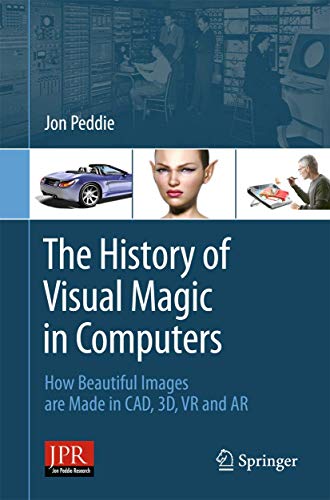
Synopsis
If you have ever looked at a fantastic adventure or science fiction movie, or an amazingly complex and rich computer game, or a TV commercial where cars or gas pumps or biscuits behaved liked people and wondered, “How do they do that?”, then you’ve experienced the magic of 3D worlds generated by a computer.
3D in computers began as a way to represent automotive designs and illustrate the construction of molecules. 3D graphics use evolved to visualizations of simulated data and artistic representations of imaginary worlds.
In order to overcome the processing limitations of the computer, graphics had to exploit the characteristics of the eye and brain, and develop visual tricks to simulate realism. The goal is to create graphics images that will overcome the visual cues that cause disbelief and tell the viewer this is not real.
Thousands of people over thousands of years have developed the building blocks and made the discoveries in mathematics and science to make such 3D magic possible, and The History of Visual Magic in Computers is dedicated to all of them and tells a little of their story.
It traces the earliest understanding of 3D and then foundational mathematics to explain and construct 3D; from mechanical computers up to today’s tablets. Several of the amazing computer graphics algorithms and tricks came of periods where eruptions of new ideas and techniques seem to occur all at once. Applications emerged as the fundamentals of how to draw lines and create realistic images were better understood, leading to hardware 3D controllers that drive the display all the way to stereovision and virtual reality.
"synopsis" may belong to another edition of this title.
About the Author
Dr. Jon Peddie is one of the pioneers of the graphics industry, and formed Jon Peddie Research (JPR) to provide customer intimate consulting and market forecasting services. Peddie lectures at numerous conferences on topics pertaining to graphics technology and the emerging trends in digital media technology. Recently named one of the most influential analysts, he is frequently quoted in trade and business publications, and contributes articles to numerous publications including – as well as appearing on – CNN and TechTV.
From the Back Cover
If you have ever looked at a fantastic adventure or science fiction movie, or an amazingly complex and rich computer game, or a TV commercial where cars or gas pumps or biscuits behaved liked people and wondered, “How do they do that?”, then you’ve experienced the magic of 3D worlds generated by a computer.
3D in computers began as a way to represent automotive designs and illustrate the construction of molecules. 3D graphics use evolved to visualizations of simulated data and artistic representations of imaginary worlds.
In order to overcome the processing limitations of the computer, graphics had to exploit the characteristics of the eye and brain, and develop visual tricks to simulate realism. The goal is to create graphics images that will overcome the visual cues that cause disbelief and tell the viewer this is not real.
Thousands of people over thousands of years have developed the building blocks and made the discoveries in mathematics and science to make such 3D magic possible, and The History of Visual Magic in Computers is dedicated to all of them and tells a little of their story.
It traces the earliest understanding of 3D and then foundational mathematics to explain and construct 3D; from mechanical computers up to today’s tablets. Several of the amazing computer graphics algorithms and tricks came of periods where eruptions of new ideas and techniques seem to occur all at once. Applications emerged as the fundamentals of how to draw lines and create realistic images were better understood, leading to hardware 3D controllers that drive the display all the way to stereovision and virtual reality.
"About this title" may belong to another edition of this title.
Search results for The History of Visual Magic in Computers: How Beautiful...

Seller Image
The History of Visual Magic in Computers: How Beautiful Images are Made in CAD, 3D, VR and AR
Seller: Gate City Books, GREENSBORO, NC, U.S.A.
Seller rating 5 out of 5 stars

Condition: good. USED book in GOOD condition. Great binding, pages and cover show normal signs of wear from use. Seller Inventory # GCM.3HRJ
Stock Image
The History of Visual Magic in Computers : How Beautiful Images Are Made in CAD, 3D, VR and AR
Published by
Springer London, Limited, 2013
ISBN 10: 1447149319
ISBN 13: 9781447149316
Used
Softcover
Seller: Better World Books, Mishawaka, IN, U.S.A.
Seller rating 5 out of 5 stars
Condition: Very Good. 2013th Edition. Pages intact with possible writing/highlighting. Binding strong with minor wear. Dust jackets/supplements may not be included. Stock photo provided. Product includes identifying sticker. Better World Books: Buy Books. Do Good. Seller Inventory # 18014839-6
Seller Image
The History of Visual Magic in Computers
Published by
Springer Nature Singapore Jul 2013, 2013
ISBN 10: 1447149319
ISBN 13: 9781447149316
New
Taschenbuch
Seller: BuchWeltWeit Ludwig Meier e.K., Bergisch Gladbach, Germany
Seller rating 5 out of 5 stars
Taschenbuch. Condition: Neu. This item is printed on demand - it takes 3-4 days longer - Neuware -If you have ever looked at a fantastic adventure or science fiction movie, or an amazingly complex and rich computer game, or a TV commercial where cars or gas pumps or biscuits behaved liked people and wondered, 'How do they do that ', then you've experienced the magic of 3D worlds generated by a computer.3D in computers began as a way to represent automotive designs and illustrate the construction of molecules. 3D graphics use evolved to visualizations of simulated data and artistic representations of imaginary worlds. In order to overcome the processing limitations of the computer, graphics had to exploit the characteristics of the eye and brain, and develop visual tricks to simulate realism. The goal is to create graphics images that will overcome the visual cues that cause disbelief and tell the viewer this is not real. Thousands of people over thousands of years have developed the building blocks and made the discoveries in mathematics and science to make such 3D magic possible, and The History of Visual Magic in Computers is dedicated to all of them and tells a little of their story.It traces the earliest understanding of 3D and then foundational mathematics to explain and construct 3D; from mechanical computers up to today's tablets. Several of the amazing computer graphics algorithms and tricks came of periods where eruptions of new ideas and techniques seem to occur all at once. Applications emerged as the fundamentals of how to draw lines and create realistic images were better understood, leading to hardware 3D controllers that drive the display all the way to stereovision and virtual reality. 448 pp. Englisch. Seller Inventory # 9781447149316
Buy New
US$ 64.06
US$ 26.74 shipping
Ships from Germany to U.S.A.
Ships from Germany to U.S.A.
Quantity: 2 available
Seller Image
The History of Visual Magic in Computers : How Beautiful Images Are Made in Cad, 3d, VR and AR
Seller: AHA-BUCH GmbH, Einbeck, Germany
Seller rating 5 out of 5 stars
Taschenbuch. Condition: Neu. Druck auf Anfrage Neuware - Printed after ordering - If you have ever looked at a fantastic adventure or science fiction movie, or an amazingly complex and rich computer game, or a TV commercial where cars or gas pumps or biscuits behaved liked people and wondered, 'How do they do that ', then you've experienced the magic of 3D worlds generated by a computer.3D in computers began as a way to represent automotive designs and illustrate the construction of molecules. 3D graphics use evolved to visualizations of simulated data and artistic representations of imaginary worlds. In order to overcome the processing limitations of the computer, graphics had to exploit the characteristics of the eye and brain, and develop visual tricks to simulate realism. The goal is to create graphics images that will overcome the visual cues that cause disbelief and tell the viewer this is not real. Thousands of people over thousands of years have developed the building blocks and made the discoveries in mathematics and science to make such 3D magic possible, and The History of Visual Magic in Computers is dedicated to all of them and tells a little of their story.It traces the earliest understanding of 3D and then foundational mathematics to explain and construct 3D; from mechanical computers up to today's tablets. Several of the amazing computer graphics algorithms and tricks came of periods where eruptions of new ideas and techniques seem to occur all at once. Applications emerged as the fundamentals of how to draw lines and create realistic images were better understood, leading to hardware 3D controllers that drive the display all the way to stereovision and virtual reality. Seller Inventory # 9781447149316
Buy New
US$ 68.99
US$ 35.47 shipping
Ships from Germany to U.S.A.
Ships from Germany to U.S.A.
Quantity: 2 available
Stock Image
The History of Visual Magic in Computers: How Beautiful Images are Made in CAD, 3D, VR and AR
Seller: Versandantiquariat Felix Mücke, Grasellenbach - Hammelbach, Germany
Seller rating 5 out of 5 stars
paperback. Condition: Gut. Seiten; Eintrag/Stempel vorne im Buch, Artikel stammt aus Nichtraucherhaushalt! EM4996 Sprache: Deutsch Gewicht in Gramm: 1. Seller Inventory # 1199280
Buy Used
US$ 45.62
US$ 69.77 shipping
Ships from Germany to U.S.A.
Ships from Germany to U.S.A.
Quantity: 1 available
Seller Image
The History of Visual Magic in Computers | How Beautiful Images Are Made in Cad, 3d, VR and AR
Seller: preigu, Osnabrück, Germany
Seller rating 5 out of 5 stars
Taschenbuch. Condition: Neu. The History of Visual Magic in Computers | How Beautiful Images Are Made in Cad, 3d, VR and AR | Jon Peddie | Taschenbuch | Englisch | 2013 | Springer London | EAN 9781447149316 | Verantwortliche Person für die EU: Springer Heidelberg, Tiergartenstr. 17, 69121 Heidelberg, buchhandel-buch[at]springer[dot]com | Anbieter: preigu. Seller Inventory # 106152213
Buy New
US$ 56.12
US$ 81.40 shipping
Ships from Germany to U.S.A.
Ships from Germany to U.S.A.
Quantity: 5 available
Stock Image
The History of Visual Magic in Computers: How Beautiful Images are Made in CAD, 3D, VR and AR Jon Peddie
Seller: BUCHSERVICE / ANTIQUARIAT Lars Lutzer, Wahlstedt, Germany
Seller rating 5 out of 5 stars
Condition: gut. 2013. The History of Visual Magic in Computers: How Beautiful Images are Made in CAD, 3D, VR and AR In englischer Sprache. pages. Seller Inventory # BN459146
Buy Used
US$ 215.47
US$ 46.45 shipping
Ships from Germany to U.S.A.
Ships from Germany to U.S.A.
Quantity: 1 available