

Order Total (1 Item Items):
Shipping Destination:

Abdullah Bey (10 results)
Skip to main search results
Search filters
Product Type
- All Product Types
- Books (7)
- Magazines & Periodicals (1)
- Comics (No further results match this refinement)
- Sheet Music (No further results match this refinement)
- Art, Prints & Posters (2)
- Photographs (No further results match this refinement)
- Maps (No further results match this refinement)
- Manuscripts & Paper Collectibles (No further results match this refinement)
Condition Learn more
- New (No further results match this refinement)
- As New, Fine or Near Fine (2)
- Very Good or Good (6)
- Fair or Poor (No further results match this refinement)
- As Described (2)
Binding
Collectible Attributes
Language (5)
Free Shipping
- Free Shipping to U.S.A. (No further results match this refinement)
Seller Location
Seller Rating
-

Revue des etudes d'Azerbaidjan.= Azerbaycan yurt bilgisi. Ayda bir nesrolunur. Owner: Ahmet Caferoglu. Yil: 3. Sayi: 25. II. Kânun 1934.
Language: Turkish
Published by Bürhaneddin Matbaasi, Istanbul, 1934
Seller: Khalkedon Rare Books ABA, ILAB, IOBA, ESA, Istanbul, Turkey
Association Member: ABA ESA ILAB IOBA
Seller rating 5 out of 5 stars

Soft cover. Condition: Very Good. Paperback. Roy. 8vo. (24 x 17 cm). In Turkish; title is in French and Turkish. 40 p. Revue des etudes d'Azerbaidjan.= Azerbaycan yurt bilgisi. Ayda bir nesrolunur. Owner: Ahmet Caferoglu. Yil: 3. Sayi: 25. II. Kânun 1934.
-
Revue des etudes d'Azerbaidjan.= Azerbaycan yurt bilgisi. Ayda bir nesrolunur. Owner: Ahmet Caferoglu. Yil: 2. Sayi: 14. Subat 1933.
Language: Turkish
Published by Bürhaneddin Matbaasi, Istanbul, 1933
Seller: Khalkedon Rare Books ABA, ILAB, IOBA, ESA, Istanbul, Turkey
Association Member: ABA ESA ILAB IOBA
Seller rating 5 out of 5 stars
Soft cover. Condition: Very Good. Paperback. Roy. 8vo. (24 x 17 cm). In Turkish; title is in French and Turkish. 49-95 pp. Revue des etudes d'Azerbaidjan.= Azerbaycan yurt bilgisi. Ayda bir nesrolunur. Owner: Ahmet Caferoglu. Yil: 2. Sayi: 14. Subat 1933.
-
Revue des etudes d'Azerbaidjan.= Azerbaycan yurt bilgisi. Ayda bir nesrolunur. Owner: Ahmet Caferoglu. Yil: 2. Sayi: 16. Nisan 1933.
Language: Turkish
Published by Bürhaneddin Matbaasi, Istanbul, 1933
Seller: Khalkedon Rare Books ABA, ILAB, IOBA, ESA, Istanbul, Turkey
Association Member: ABA ESA ILAB IOBA
Seller rating 5 out of 5 stars
Soft cover. Condition: Very Good. Paperback. Roy. 8vo. (24 x 17 cm). In Turkish; title is in French and Turkish. 145-192 pp. Revue des etudes d'Azerbaidjan.= Azerbaycan yurt bilgisi. Ayda bir nesrolunur. Owner: Ahmet Caferoglu. Yil: 2. Sayi: 16. Nisan 1933.
-
Revue des etudes d'Azerbaidjan.= Azerbaycan yurt bilgisi. Ayda bir nesrolunur. Owner: Ahmet Caferoglu. Yil: 2. Sayi: 13. 2. Kânun 1933.
Language: Turkish
Published by Bürhaneddin Matbaasi, Istanbul, 1933
Seller: Khalkedon Rare Books ABA, ILAB, IOBA, ESA, Istanbul, Turkey
Association Member: ABA ESA ILAB IOBA
Seller rating 5 out of 5 stars
Soft cover. Condition: Very Good. Paperback. Roy. 8vo. (24 x 17 cm). In Turkish; title is in French and Turkish. 48 p. Revue des etudes d'Azerbaidjan.= Azerbaycan yurt bilgisi. Ayda bir nesrolunur. Owner: Ahmet Caferoglu. Yil: 2. Sayi: 13. 2. Kânun 1933.
-
La Lyre Turque - Primera edición - FIRMADO Y DEDICADO
Published by Vienne, 1902
Seller: Libros de Ultramar Estudio y Coleccionismo, Granada, GR, Spain
Seller rating 4 out of 5 stars

First Edition Signed
Encuadernación de tapa blanda. Condition: Muy bien. 1ª Edición. Primera edición, tapa blanda, Dr. Abdullah Bey, editorial Vienne, son 175 páginas, firmado y dedicado por el autor Abdullah Ceudet al militar Suizo J. Richter, con ex libris, con desgaste en el lomo, tapa y contratapa en buen estado, prefacio por Gustave Kahn, sobre unas dimensiones de 18.5 x 12.5 cm, editado en 1902 en Paris, se encuentra en muy buen estado. Firmado por el autor.
-
La Lyre Turque
Published by Vienne, 1902
Seller: Libros de Ultramar Estudio y Coleccionismo, Granada, GR, Spain
Seller rating 4 out of 5 stars
First Edition Signed
Encuadernación de tapa blanda. Condition: Muy bien. 1ª Edición. Primera edición, tapa blanda, Dr. Abdullah Bey, editorial Vienne, son 175 páginas, firmado y dedicado por el autor Abdullah Ceudet al militar Suizo J. Richter, con ex libris, con desgaste en el lomo, tapa y contratapa en buen estado, prefacio por Gustave Kahn, sobre unas dimensiones de 18.5 x 12.5 cm, editado en 1902 en Paris, se encuentra en muy buen estado. Firmado por el autor.
-
Bedaiul Hattatiyye Miner-Ravdatin Nebeviyye. Calligraphy. Text In Persian
Language: Persian
Published by Istanbul, 1993
First Edition
BINDING - Hardcover. Condition: CONDITION - Used/ Good. Dust Jacket Condition: Jacket - Fair. with some wear. 1st Edition. 149 Pages. Illustrated. External Wear. Text In Persian.
-
[CAUCASUS / NEW AZERBAIJAN] Azerbaycan yurt bilgisi. Ayda bir nesrolunur. Owner: Ahmet Caferoglu. 1-37 (1932-1954) (All published).
Language: Turkish
Published by AYB, Istanbul, 1932
Seller: Khalkedon Rare Books ABA, ILAB, IOBA, ESA, Istanbul, Turkey
Association Member: ABA ESA ILAB IOBA
Seller rating 5 out of 5 stars
Magazine / Periodical First Edition
Hardcover. Condition: Very Good. 1st Edition. Three contemporary blue cloths, the last issue is in original wrappers. Roy. 8vo. (24 x 17 cm). Text in Turkish and Azerbaijani. Each issue is around 48 p. The first twelve-issue volume of the periodical, published under the administration of Ahmet Caferoglu (1899-1975) in Istanbul, began to be published in 1932, the second volume in 1933, and the third and last volume was published in 1934. After a long hiatus, the 37th issue of the periodical was tried to be continued as the publication organ of the Association for the Promotion of Azerbaijan Culture in February 1954, but there was no other issue since this attempt was not successful. The aim of publishing the journal is to form a research committee and illuminate the common aspects (literature, history, sociology, etc.) of Azerbaijan and Turkey, which are of the same race. In the journal, in which valuable research in the fields of history, historical geography, philology, literature, and folk literature were published, articles on subjects such as music, folklore, and art history were included in addition to Anatolian history and literature by going outside of Azerbaijan. The writer's staff, including the last issue of the journal, is as follows: Abdullahoglu Hasan, Abdülbaki (Gölpinarli), Abdullah Battal (Taymas), Abdülkadir Süleyman (Inan), A. Zeki Velidi (Togan), Sadik Babazâde, Ahmet Caferoglu, Fuad Köprülü, Mahmut Rag?p Kösemihalzâde, Sadik San'an, Sadettin Nüzhet (Ergun), Selim Refik, M. Sakir (Ülkütasir), M. Serefettin (Yaltkaya), Akdes Nimet (Kurat), Besim Atalay, Halil Hasmehmetli, Cafer Seyit Ahmet (Kirimli), Mehmet Halit (Bayri), M. Fahreddin Mirzazâde, Mehmet Ali Resulzâde, Mir Aziz Seitli, Sefi Rustambeyli, Süreyya Taliphanbeyli, Adnan Cahit (Ötüken), Bedriye Sabit, A. N. Hakimbay, Fevziye Abdullah (Tansel), M. Mehmetzâde, Mükrimin Halil (Yinanç), Habip Sahir, A. Zeynel (Akkoç), Ziyaeddin Fahri (Findikoglu), Mirza Bala, J. Eckmann, Muharrem Ergin, Serafeddin Erel, Aziz Özer, Hakki Türkekul. According to the OCLC (4187810), as of 2023 September, the set is located at 35 libraries worldwide; the thirteen American institutions holding the set are Harvard Library, Columbia University Libraries, Princeton University Library, Penn Libraries, University of Michigan, Ohio State University Libraries, University of Chicago Library, University of Washington Libraries, Portland State University, University of Texas Libraries, UC Berkeley Libraries, Stanford University, and UCLA.
-
Manuscript catalogue with drawings of Devonian fossils from the Abdullah Bey's collection
Language: French
Published by Istanbul, 1869
Seller: Antiquariat Steffen Völkel GmbH, Seubersdorf, Germany
Seller rating 5 out of 5 stars
Art / Print / Poster
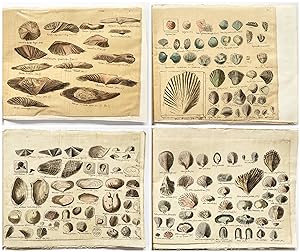
Collection of 3 manuscripts with over 600 watercolor and ink drawings of Devonian fossils in the Bosporus Strait from the collection of Abdullah Bey (Karl Eduard Hammerschmidt). Each drawing is numbered according to the corresponding specimen in the collection and includes the species name. The interesting aspect is that the specimens are not ordered by number, but by species/family. Signed and dated (Constantinople, 22.09.1869) by Eloi Beral on one of the manuscripts. This is in various regards almost a manuscript catalogue of a part of Abdullah Bey's extensive fossil collection. This collection is especially valuable as it serves as a testament to this part of his specimen collection, given that most of the geology collection from Istanbul and the Bosporus region has been lost due to multiple fires and a recent earthquake in 1999. It includes drawings of fossils found in the following locations: Arnavutköy (Istanbul), Kuruçesme, Baltalimani, Rumeli Hisari, Kartal, Pendik, Kanlidja, Tchauchbachi, Yusa Tepe, Tchiboukly. Abdullah Bey, originally Karl Eduard Hammerschmidt, (1800-1874) was an Austrian-born Ottoman scientist and physician. He specialized in mineralogy, geology, and fossil science.Engaged in the Vienna Uprising of 1848, Abdullah Bey sought refuge in the Ottoman Empire following its suppression, adopting Islam and the name Abdullah upon arrival in Istanbul. He represented the Ottoman government at the Paris Exhibition of 1867. He brought 3 collections to the Exposition Universelle: the first one, the one who contains the specimens included in our manuscripts, was formed of around 1200 Devonian fossils from the Bosporus region and earned him the gold medal of that year's exhibition. At that moment, this was the greatest and largest fossile collection from Istanbul. Since the number of specimens listed in our collection (1189) is very similar to the declared numbers of specimens that won him the gold medal in the Paris exhibition of 1867, we believe it is safe to assume that the drawings depict the specimens exhibited in Paris. Part of this collection ended up being gifted by Abdullah Bey to the Paris Natural History Museum. The other two collection were: one of entomology (for which he received another gold medal), and a herbarium of 20 leaves (for which he received the bronze medal). In 1872, Abdullah Bey decided to donate another part of his collection of Devonian fossils from the Bosphorus area to the Cabinet of Natural History of Madrid, a collection now located in the Museo Nacional de Ciencias Naturales de Madrid. The reason for this was most likely his wish to foster international connections between museums. On the way from Turkey to Madrid, some parts of the shipment have been lost: most importantly, the inventory list of the specimens, but also 1 of 3 other publications regarding his collection, as well as possibly 26 plates with illustrations pertaining to one of the 2 publications that have been delivered. Other parts of his collection have been donated to museums in St. Petersburg, Italy and Austria. He is unanimously considered a pioneer in the ares of Turkish geology, entomology and paleontology, having first introduced the terms and concepts of geology to Turkey. Geological mappings and findings in Turkey were scarce and significantly delayed. The first crude geological map of the city was created by French entomologist Guillaume-Antoine Olivier in 1801. The second geological map, produced by Philippe Edouard Poulletier de Verneuil, appeared in 1837, while the first modern colored geological map was made years later by Russian Prince Piotr Alexandrovich de Tchihatcheff (1856-1869). This highlights the significance of Abdullah Bey's contributions, as his work provided crucial insights into an area that, at the time, was largely geologically unexplored. At the Imperial School of Medicine in Istanbul. in 1871, the Ottoman Empire inaugurated its first natural history museum under the name 'Le Musée d'Histoire Naturelle d'École Impériale de Médecine de Constantinople'. Dr. Abdullah Bey facilitated the transportation of thousands of samples to Istanbul through his collaboration with European naturalists. Not only did he establish a prestigious museum in the Ottoman Empire, but he also cemented his place in history as a pioneer of one of the most significant impacts of the French Enlightenment on scientific endeavors within the Islamic world. After Abdullah Bey's sudden death in 1874, the museum's activities slowed, and the collection was moved to Istanbul University's Geology Faculty. Unfortunately, the collection was destroyed in the Vefa Fire of 1918, leading to the permanent loss of Istanbul's only natural history museum. Éloi Béral (1838-1908) was a French engineer and politician. After graduating from the École Polytechnique, he became a mining engineer in 1861 and later served as the prefect of Lot. Although unsuccessful in his initial bid for a legislative seat in 1877, he eventually became a senator in 1883, focusing on mining issues. In 1869, as noted in one of these notebooks, Eloi Beral was sent on a mission to the Ottoman Empire. During this assignment, he explored Abdullah Bey's collection of Bosporus fossils and created drawings of the exhibited specimens. You can find more pictures on our website. --- -Fossiles Devoniens de la rive droite du Bosphore / Arnautkeuy Kourou-Tchesme Bebek Balta Liman (801 a 850) et (901 a 979) Roumely-Hissar (877 a 890). 93 drawings on 8 sheets [ca. 15 x 18 cm.]. Species included: Cryphoeus, Eulima, Loxonema, Eronyptalus, Pterinoea Pentamerus Cerebratula, Pterina, Bivalve, Spirifer, Orthis, Leptoena, Strophonema. --- - Fossiles Devoniens des Rives de la Mer de Marmara a Kartal et Pandyk comprenant les n.os 980 a 1190. (Constantinople, 22. 09.1869). 165 drawings on 9 sheets [ca. 15 x 20 cm]. Species included: Phacops, Cryphoeus, Ortoceras, Rhynconella, Calyptroea, Cerebratula, Spirifer, Orthis, Leptoena. --- - Fossiles Devoni.
-
Collection of over 100 watercolor drawings of fossils from the Bosporus Strait, most probably collected by Abdullah Bey.
Language: German
Published by (Turkey) ca. 1870., 1870
Seller: Antiquariat Steffen Völkel GmbH, Seubersdorf, Germany
Seller rating 5 out of 5 stars
Art / Print / Poster
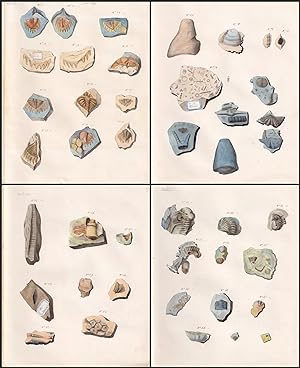
Size of the sheets: ca. 25,5 x 20,5 cm. The drawings depict fossil specimens collected from various places around the Bosporus Strait and Istanbul: Arnavutköy, Kartal, Kanlidja, Stenia, Yeni-Keui, Guenk-Sou, Tarabya. With an additional contemporary ink and watercolor drawing on thin linen, that shows a few of the fossils included on 3 of the other sheets. Probably made by the same person perhaps an initial drawing. Very beautiful, finely executed drawings of numerous fossils from the Bosporus region. The place where the specimens were collected is noted on the upper part of the sheet, in pencil handwriting. The specimes are numbered (1-73) with the exception of the last 13 drawings which remain unnumbered - and ordered according to number and location, but lacking any taxonomic rank. Some of the specimens are drawn with their respective labels, which indicates they were part of an extensive collection of fossils. In the case of one label, the number in the collection is mentioned as well and it corresponds to the numbering within the manuscript, which further proves that the numbering associated to the drawings correspondents to the number in the actual classification of the specimens. As there have not been many collections of fossils recorded in Turkey during the second half of the 19th century, we will put forward the hypothesis that the drawings depict a part of Abdullah Bey's collection of fossiles, which, at that time, was the largest collection of fossils in Turkey. We were not able to locate drawings of the same fossil specimens in other documents of Abdullah Bey's collection. These drawings are different from the fossils in the other collection (1869) we are in posession of and that depicts the specimens which won him the gold medal in the Paris exhibition of 1867 (although the place of collection often overlaps). This means these drawings were most likely made on another ocassion and by another person, possibly by Abdullah Bey himself. It is already known that he has made drawings of the specimens in his collection before there are manuscript drawings by him in the posession of the Natural History Museum in Vienna. Since the drawings lack any form of classification - other than by where they were collected - we can assume this collection of drawings shows rare, at that time unidentified specimens. The manuscript seems to have been done intentionally with the purpose of serving as a kind of catalogue for the unidentified species of those respective areas. Abdullah Bey, originally Karl Eduard Hammerschmidt, (1800-1874) was an Austrian-born Ottoman scientist and physician. He specialized in mineralogy, geology, and fossil science.Engaged in the Vienna Uprising of 1848, Abdullah Bey sought refuge in the Ottoman Empire following its suppression, adopting Islam and the name Abdullah upon arrival in Istanbul. He represented the Ottoman government at the Paris Exhibition of 1867. He brought 3 collections to the Exposition Universelle: the first one was formed of around 1200 Devonian fossils from the Bosporus region and earned him the gold medal of that years exhibition. At that moment, this was the greatest and largest fossile collection from Istanbul. Part of this collection ended up being gifted by Abdullah Bey to the Paris Natural History Museum. The other two collections were: one of entomology (for which he received another gold medal), and a herbarium of 20 leaves (for which he received the bronze medal). In 1872, Abdullah Bey decided to donate another part of his collection of Devonian fossils from the Bosphorus area to the Cabinet of Natural History of Madrid, a collection now located in the Museo Nacional de Ciencias Naturales de Madrid. The reason for this was most likely his wish to foster international connections between museums. On the way from Turkey to Madrid, some parts of the shipment have been lost: most importantly, the inventory list of the specimens. Other parts of his collection have been donated to museums in St. Petersburg, Italy and Austria. He is unanimously considered a pioneer in the areas of Turkish geology, entomology and paleontology, having first introduced the terms and concepts of geology to Turkey. Geological mappings and findings in Turkey were scarce and significantly delayed. The first crude geological map of the city was created by French entomologist Guillaume-Antoine Olivier in 1801. The second geological map, produced by Philippe Edouard Poulletier de Verneuil, appeared in 1837, while the first modern colored geological map was made years later by Russian Prince Piotr Alexandrovich de Tchihatcheff (1856-1869). This highlights the significance of Abdullah Beys contributions, as his work provided crucial insights into an area that, at the time, was largely geologically unexplored. At the Imperial School of Medicine in Istanbul, in 1871, the Ottoman Empire inaugurated its first natural history museum under the name Le Musée dHistoire Naturelle dÉcole Impériale de Médecine de Constantinople. Dr. Abdullah Bey facilitated the transportation of thousands of samples to Istanbul through his collaboration with European naturalists. Not only did he establish a prestigious museum in the Ottoman Empire, but he also cemented his place in history as a pioneer of one of the most significant impacts of the French Enlightenment on scientific endeavors within the Islamic world. After Abdullah Beys sudden death in 1874, the museums activities slowed, and the collection was moved to Istanbul Universitys Geology Faculty. Unfortunately, the collection was destroyed in the Vefa Fire of 1918, leading to the permanent loss of Istanbuls only natural history museum. The fact that specimens of fossils from the Bosporos Strait are so scarce mainly due to the consequent poor luck of the geology museums that housed them makes the present collection even more valuable. This offers important insight into the early days of the development of the paleontology and geology fields.


![Seller image for [CAUCASUS / NEW AZERBAIJAN] Azerbaycan yurt bilgisi. Ayda bir nesrolunur. Owner: Ahmet Caferoglu. 1-37 (1932-1954) (All published). for sale by Khalkedon Rare Books ABA, ILAB, IOBA, ESA](https://pictures.abebooks.com/inventory/md/md31640431253.jpg)