

Order Total (1 Item Items):
Shipping Destination:

After Abraham Rademaker (11 results)
Skip to main search results
Search filters
Product Type
- All Product Types
- Books (6)
- Magazines & Periodicals (No further results match this refinement)
- Comics (No further results match this refinement)
- Sheet Music (No further results match this refinement)
- Art, Prints & Posters (1)
- Photographs (4)
- Maps (No further results match this refinement)
- Manuscripts & Paper Collectibles (No further results match this refinement)
Condition Learn more
- New (No further results match this refinement)
- As New, Fine or Near Fine (No further results match this refinement)
- Very Good or Good (No further results match this refinement)
- Fair or Poor (No further results match this refinement)
- As Described (11)
Binding
- All Bindings
- Hardcover (No further results match this refinement)
- Softcover (No further results match this refinement)
Collectible Attributes
- First Edition (No further results match this refinement)
- Signed (1)
- Dust Jacket (No further results match this refinement)
- Seller-Supplied Images (11)
- Not Print on Demand (11)
Language (1)
Price
- Any Price
- Under US$ 25 (No further results match this refinement)
- US$ 25 to US$ 50
- Over US$ 50
Free Shipping
- Free Shipping to U.S.A. (No further results match this refinement)
Seller Location
Seller Rating
-
![Seller image for [Antique print] Het Park buiten Utrecht, ca 1744. for sale by Antiquariaat Arine van der Steur / ILAB](https://pictures.abebooks.com/inventory/md/md30793336070.jpg)
[Antique print] Het Park buiten Utrecht, ca 1744.
Seller: Antiquariaat Arine van der Steur / ILAB, Den Haag, Netherlands
Seller rating 4 out of 5 stars

Copperplate engraving/etching of 'Het Park buiten Utrecht', in the Dutch province of Utrecht, as it appeared in 1744. Overall size: 81 x 110 mm; plate size: 81 x 110 mm. Very good state. Some age related discolouration. Handlaid paper. This print was part of the book 'Het verheerlykt Nederland, of Kabinet van Hedendaagsche gezigten van steden, dorpen, sloten, adelyke huizen (.)', Amsterdam, Tirion, 1745-1774.
-
![Seller image for [Antique print] De Kerk te Renswoude. for sale by Antiquariaat Arine van der Steur / ILAB](https://pictures.abebooks.com/inventory/md/md30793333118.jpg)
[Antique print] De Kerk te Renswoude.
Seller: Antiquariaat Arine van der Steur / ILAB, Den Haag, Netherlands
Seller rating 4 out of 5 stars
Copperplate engraving/etching of 'De Kerk te Renswoude', in the Dutch province of Utrecht. Overall size: 98 x 135 mm; plate size: 75 x 100 mm. Good state. Some age related discolouration. Handlaid paper. This print was part of the book 'Het verheerlykt Nederland, of Kabinet van Hedendaagsche gezigten van steden, dorpen, sloten, adelyke huizen (.)', Amsterdam, Tirion, 1745-1774.
-

2-Antique Drawings-IJSSELPOORT-IJSSELSTEIN-Rademaker-19th c.
Published by 19th c.
Seller: Pictura Prints, Art & Books, Overasselt, Netherlands
Seller rating 5 out of 5 stars

Art / Print / Poster Signed
After Abraham Rademaker (illustrator). 'SIGNED IN THE PLATE 'ROGMAN F.'; FAINT PENCIL INSCRIPTION 'VIANEN' ALTHOUGH IT DEPICTS IJSSELSTEIN.'Two small landscape views of the IJsselpoort at IJsselstein with boats, fishermen and the city gate with bridge.Made by an anonymous engraver after After Abraham Rademaker.Medium: Pen and grey wash on wove (vellin) paper.Sheet size: 13 x 10 cm (5.12 x 3.94 inch). Image size: 13 x 10 cm. (5.12 x 3.94 inch).IJSSELSTEIN, IJSSELPOORT, ABRAHAM RADEMAKER, DUTCH TOPOGRAPHY, CITY GATE | PCO-B11-BACKGROUND INFORMATIONAfter prints by Abraham Rademaker, Kabinet van Nederlandsche Outheden en Gezichten, Amsterdam, 18th century.Reference: RP-P-AO-14-9A-2 (copy after) and RP-P-1921-509 (copy after).Biography artist: Abraham Rademaker (1677-1735) was a Dutch painter, draughtsman and printmaker from Amsterdam. He is best known for his extensive topographical views of Dutch towns, castles and monuments. His series Kabinet van Nederlandsche Outheden en Gezichten (1725) contained hundreds of engravings documenting historic buildings and landscapes throughout the Netherlands and became an important visual record of Dutch architecture. Condition: good, given age. Foxing and stains in the margins. General age-related toning and/or occasional minor defects from handling. Please study scan carefully.
-
![Seller image for 't Gesigt Van de Portugeese, en Hoogduy[t]se Joden Kerken, tot Amsterdam. Veue ou perspective des eglises des juiss portuguese et allemands a amsterdam. A Prospect of the Portugese and High German Jews Churches at Amsterdam. for sale by Daniel Crouch Rare Books Ltd](https://pictures.abebooks.com/inventory/md/md30240047955.jpg)
't Gesigt Van de Portugeese, en Hoogduy[t]se Joden Kerken, tot Amsterdam. Veue ou perspective des eglises des juiss portuguese et allemands a amsterdam. A Prospect of the Portugese and High German Jews Churches at Amsterdam.
Published by [c1752]., Amsterdam,, 1752
Seller: Daniel Crouch Rare Books Ltd, London, United Kingdom
Association Member: ABA ILAB PBFA
Seller rating 4 out of 5 stars
Photograph
US$ 9,820.68
US$ 26.67 shipping
Ships from United Kingdom to U.S.A.Quantity: 1 available
Add to basketView of Amsterdam's Jewish Quarter Engraving with etching, on two sheets joined. View of the Plantage Muidergracht and the Jonas Daniël Meijerplein. The view shown from the present day Mr. Visserplien, the busy intersecti.on in central Amsterdam, depicts the Portuguese Synagogue on the left and the High German or Great Synagogue. These momumental buildings now house the Jewish Historical Museum. The first Jews to settle in Amsterdam were the Sephardim, who had been expelled from Portugal and Spain in 1493. They were joined in the following decades by the Ashkenazi from Central and Eastern Europe, the first of whom had come from Germany in 1600. In those years, the only available land for them was at the outskirts of the eastern side of the Centrum the island of Vlooienburg, surrounded by the Amstel River and the canals so they settled along the island's main street, Breestraat, which quickly became known as Jodenbreestraat. The Great Synagogue (now the Jewish Historical Museum ), and the Portuguese-Israelite Synagogue, were opened in 1671 and 1675, respectively. The Portuguese Synagogue was the place where Spinoza was placed under the ban by the Sephardic Jewish community in 1656. Pieter Stevensz. van Gunst (1659-1732), also known as Pieter Stevens van Gunst or Petrus Stephani, was a Dutch draughtsman, copperplate engraver and printmaker active in Amsterdam, London (1704), and the Dutch town of Nederhorst (1730-1731). Abraham Rademaker (1677 21 January 1735) was an 18th-century painter and printmaker from the Northern Netherlands. Rademaker was born in Lisse. According to the RKD he was a versatile artist who painted Italianate landscapes, but is known mostly for his many cityscapes and drawings of buildings that were made into print. R.W.P. de Vries, auction, 1925: 295.
-
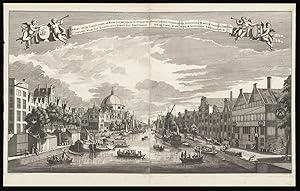
Gesicht Van De Cingelverby de Kerk Van die van de Ausburgische confessie naar Ian Roonpoorts toren tot Amsterdam. Fossa Cingens; Confessionis Augustanae Remplum transiens, Johannis que de porta rubra turrim respiciens Amstelaedamum.
Published by Leonard Schenk, [c1720]., Amsterdam,, 1720
Seller: Daniel Crouch Rare Books Ltd, London, United Kingdom
Association Member: ABA ILAB PBFA
Seller rating 4 out of 5 stars
Photograph
US$ 4,848.53
US$ 26.67 shipping
Ships from United Kingdom to U.S.A.Quantity: 1 available
Add to basketView of the Singel canal in Amsterdam as viewed from the Prins Hendrikkade Engraving with etching, on two sheets joined. The most prominent feature of the of this view is The Ronde Lutherse Kerk or Koepelkerk is a former Lutheran church. The church was built in neo-classical style and has a characteristic copper dome. It was built in 1671 by Dutch Golden Age architect Adriaan Dortsman, who also built Museum Van Loon, a magnificent private residence at the Keizersgracht. When the Lutherans left the building in 1935, it became a concert hall. In 1993 the interior and characteristic green-colored copper dome were destroyed by fire. After a renovation period of 16 months, the church was fully restored. Further down the canal the imposing Roonports tower can be seen. Leonard Schenk (fl.1720-1746) an Jan Schenk (1698-1752) were brothers working as engravers and publisher's in Amsterdam. Abraham Rademaker (1677 21 January 1735) was an 18th-century painter and printmaker from the Northern Netherlands. Rademaker was born in Lisse. According to the RKD he was a versatile artist who painted Italianate landscapes, but is known mostly for his many cityscapes and drawings of buildings that were made into print. R.W.P. de Vries, auction, 1925: 284.
-

Gesigt van den Vermaakelyken Overtoom Gelegen buyten de Leydsche Poort der Stad Amsterdam te sien naar de groote en kleyne overhaal. Vüe agreable de l'overtoom, hors de la porte de leide, pres de la ville d'astersdam
Published by Leon Schenk, Abraham Rademaker, [c1720]., Amsterdam,, 1720
Seller: Daniel Crouch Rare Books Ltd, London, United Kingdom
Association Member: ABA ILAB PBFA
Seller rating 4 out of 5 stars
Photograph
US$ 5,150.70
US$ 26.67 shipping
Ships from United Kingdom to U.S.A.Quantity: 1 available
Add to basketView of the Overtoom Engraving with etching, on two sheets joined. A view of the Overtoom in the eighteenth century. By the eighteenth century numerous country villas had been built along the Overtoom, one of the main canal's linking Amsterdam with river Schinkel, as well as pleasure gardens and numerous ale houses and shops. The Overtoom gained its name from the machine for moving a boat from one body of water to another where the level varied. Rather than with the aid of a lock, in other canal systems, the boat would be physically pulled across the land. The machine is depicted to the right of the print, consisting of two large wheels, it can be seen pulling a small boat onto the canal. Leonard Schenk (fl.1720-1746) engraver, mapmaker, and publisher in Amsterdam. Abraham Rademaker (1677 21 January 1735) was an 18th-century painter and printmaker from the Northern Netherlands. Rademaker was born in Lisse. According to the RKD he was a versatile artist who painted Italianate landscapes, but is known mostly for his many cityscapes and drawings of buildings that were made into print. R.W.P. de Vries, auction, 1925: 288.
-

't Gesigt Van de Portugeese, en Hoogduyse Ioden Kerken, tot Amsterdam. Veue ou perspective des eglises des juiss portuguese et allemands a amsterdam. A Prospect of the Portugese and High German Jews Churches at Amsterdam.
Published by [c1730]., Amsterdam, 1730
Seller: Daniel Crouch Rare Books Ltd, London, United Kingdom
Association Member: ABA ILAB PBFA
Seller rating 4 out of 5 stars
Photograph
US$ 10,095.38
US$ 26.67 shipping
Ships from United Kingdom to U.S.A.Quantity: 1 available
Add to basketView of Amsterdam's Jewish Quarter Engraving with etching, on two sheets joined. View of the Plantage Muidergracht and the Jonas Daniël Meijerplein. The view shown from the present day Mr. Visserplien, the busy intersecti.on in central Amsterdam, depicts the Portuguese Synagogue on the left and the High German or Great Synagogue. These momumental buildings now house the Jewish Historical Museum. The first Jews to settle in Amsterdam were the Sephardim, who had been expelled from Portugal and Spain in 1493. They were joined in the following decades by the Ashkenazi from Central and Eastern Europe, the first of whom had come from Germany in 1600. In those years, the only available land for them was at the outskirts of the eastern side of the Centrum the island of Vlooienburg, surrounded by the Amstel River and the canals so they settled along the island's main street, Breestraat, which quickly became known as Jodenbreestraat. The Great Synagogue (now the Jewish Historical Museum ), and the Portuguese-Israelite Synagogue, were opened in 1671 and 1675, respectively. The Portuguese Synagogue was the place where Spinoza was placed under the ban by the Sephardic Jewish community in 1656. Pieter Stevensz. van Gunst (1659-1732), also known as Pieter Stevens van Gunst or Petrus Stephani, was a Dutch draughtsman, copperplate engraver and printmaker active in Amsterdam, London (1704), and the Dutch town of Nederhorst (1730-1731). Abraham Rademaker (1677 21 January 1735) was an 18th-century painter and printmaker from the Northern Netherlands. Rademaker was born in Lisse. According to the RKD he was a versatile artist who painted Italianate landscapes, but is known mostly for his many cityscapes and drawings of buildings that were made into print. R.W.P. de Vries, auction, 1925: 295.
-
![Seller image for [Antique drawing/tekening] The castle Zuidwijk in Wassenaar/Het kasteel Zuidwijk in Wassenaar, after 1725. for sale by Antiquariaat Arine van der Steur / ILAB](https://pictures.abebooks.com/inventory/md/md30287121062.jpg)
[Antique drawing/tekening] The castle Zuidwijk in Wassenaar/Het kasteel Zuidwijk in Wassenaar, after 1725.
Seller: Antiquariaat Arine van der Steur / ILAB, Den Haag, Netherlands
Seller rating 4 out of 5 stars
View on the Huis Zuidwijk, a castle in Wassenaar, between The Hague and Leiden. After a print by Rademaker. The artist did not copy the figures, only the building and the landscape surrounding it.Inscribed at the bottom in pen and brown ink, in a later stage: "Le Chateau de Crespin: en Normandie prés de Ponteau de Mer"; on the verso with the same ink: "Gautier Leseigneur de Crespin" and nr. "8" on the top left. Further in blue ink: "Huis te Zuidtwijk". Drawing on paper, pencil, chalk, pen and grey ink, washed in grey; inscriptions in pen and brown and blue ink. Total: 174 x 228 mm. In good condition.
-

Huis ter Does.
Seller: Antiquariaat Arine van der Steur / ILAB, Den Haag, Netherlands
Seller rating 4 out of 5 stars
View on the back side of the so-called Huis ter Does, in Leiderdorp, as it looked in 1620. On the foreground a rowing boat with fishermen. Drawing after prints designed by Rademaker. In pencil, on bottom left: "Huis ter Does", in the middle, in pen and brown ink: "Le Chateau de Mauvoisin, en Normandie près de Rouen." This inscription has been crossed out with some pencil strokes. Further, on the verso, other annotations; on the top the same handwriting in pen and brown ink: "19 Anselme Seigneur de Mauvoisin"; in pen and blue ink: "Huis ter Does" and in pencil "bij Leiden." Despite the amateurish style, the drawing is very charming. Drawing on paper, pencil, pen and grey ink, washed in grey. Total: 175 x 225 mm. In good condition.
-
![Seller image for [Antique drawing] Huis te Spangen in Welstant 1550, after 1730. for sale by Antiquariaat Arine van der Steur / ILAB](https://pictures.abebooks.com/inventory/md/md22833814370.jpg)
[Antique drawing] Huis te Spangen in Welstant 1550, after 1730.
Seller: Antiquariaat Arine van der Steur / ILAB, Den Haag, Netherlands
Seller rating 4 out of 5 stars
View on the entrance of Kasteel Spangen by Overschie, as it probably looked in 1550, before it was destroyed during the 80-Years war. The castle was named after the river. On the foreground a fisherman, a horse rider and other figures.Inscribed below in pencil: "Huis te Spangen in Westland" and in pen and brown ink: "Le Chateau de Bardou: en Normandie prés d'Escovis" this inscription crossed out with a line in pencil and one in pen and blue ink.On verso further inscriptions: "Philippe Dénis de Saint Cosme, Seigneur de Bardou", crossed out with pen and blue ink. Below in pen and blue ink: "Huis te Spangen in Westland."Possibly after a composition by Abraham Rademaker. Drawing on paper, pencil, pen and grey ink, washed in grey. Total: 176 x 231 mm. In good condition.
-

Out-Gunterstein 1611.
Seller: Antiquariaat Arine van der Steur / ILAB, Den Haag, Netherlands
Seller rating 4 out of 5 stars
View on the Kasteel Gunterstein, with a long bridge on the left, as it probably looked like in 1611. All around the pond surrounding the castle many figures. Some of these were only added in the drawing, like the man with a wheelbarrow on the left foreground and the beautiful carriage led by horses on the right background. Inscribed below in pen and brown ink, in two different handwriting: "Oud Gunterstein" and "Le Chateau de Franqueville en Normandie", the latter crossed out with a line in pen. On verso further inscriptions; in pen and brown ink: "Robert Seigneur de Franqueville", below, in pen and blue ink: "Huis Oud [Gunter (crossed out)] Gunterstein." Drawing on paper, pencil, pen and grey ink, washed in grey. Total: 174 x 228 mm. In good condition.

