Order Total (1 Item Items):
Shipping Destination:

Arabic Manuscript (25 results)
Skip to main search results
Search filters
Product Type
- All Product Types
- Books (15)
- Magazines & Periodicals (No further results match this refinement)
- Comics (No further results match this refinement)
- Sheet Music (No further results match this refinement)
- Art, Prints & Posters (No further results match this refinement)
- Photographs (No further results match this refinement)
- Maps (No further results match this refinement)
- Manuscripts & Paper Collectibles (10)
Condition Learn more
- New (No further results match this refinement)
- As New, Fine or Near Fine (5)
- Very Good or Good (8)
- Fair or Poor (4)
- As Described (8)
Binding
- All Bindings
- Hardcover (21)
- Softcover (No further results match this refinement)
Collectible Attributes
- First Edition (No further results match this refinement)
- Signed (No further results match this refinement)
- Dust Jacket (No further results match this refinement)
- Seller-Supplied Images (24)
- Not Print on Demand (25)
Language (2)
Price
- Any Price
- Under US$ 25 (No further results match this refinement)
- US$ 25 to US$ 50 (No further results match this refinement)
- Over US$ 50
Free Shipping
- Free Shipping to U.S.A. (No further results match this refinement)
Seller Location
Seller Rating
-
[Islamic Devotional Manuscript with Qur'anic Verses, Attributes of Allah, and Other Prayers]
Published by [Ottoman Empire, 1730
Seller: James Cummins Bookseller, ABAA, New York, NY, U.S.A.
Seller rating 5 out of 5 stars

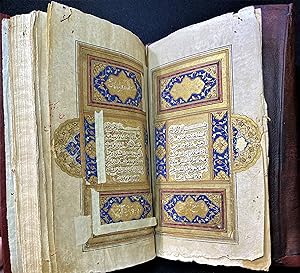
Polychrome double page ornamental opening, text in black ink in a rounded naskh hand, 8 lines per page, fully vocalized, with gold dot aya markers, all within gilt rule borders. Attributes within gilt frames (30 per page). Occasional annotations in red. 117 ff. Dated at end A.H. 1143. 1 vols. 12mo. Attractive pocket devotional with short surahs, tables of the Attributes of Allah, and other prayers. Late nineteenth century Islamic binding of red leather, plaque stamped in silver, with fore edge guard. Some minor smudging of passages, a few paper flaws. Twentieth-century ownership inscriptions on first blank. Very good plus overall Polychrome double page ornamental opening, text in black ink in a rounded naskh hand, 8 lines per page, fully vocalized, with gold dot aya markers, all within gilt rule borders. Attributes within gilt frames (30 per page). Occasional annotations in red. 117 ff. Dated at end A.H. 1143. 1 vols. 12mo.
-
[Vocabularium Italico-Arabicum]. Arabic-Italian dictionary.
Published by [Probably Egypt,, 1770
Seller: Antiquariaat FORUM BV, Houten, Netherlands
Seller rating 5 out of 5 stars
US$ 21,524.98
US$ 29.03 shipping
Ships from Netherlands to U.S.A.Quantity: 1 available
Add to basketManuscript dictionary comprising some 9,000 Arabic terms and their Italian translations. It was formerly owned by the German oriental scholar and Franciscan priest Arsenius Rehm (1738-1808), who lived in Cairo between 1769 and 1776, building a large collection of manuscripts, which he brought with him when he worked for some time at the Franciscan abbey of Frauenberg at Fulda, Hesse. After his death his collection remained at the monastery until it was purchased by the Benedictine Abbey of St Boniface (Munich) in 1852. The present volume, which had not been part of the collection proper, remained in Frauenberg, whose library was dispersed in 2021 by the Franciscan Province. "The library includes a fairly extensive Arabic dictionary of his, though not written by him. It offers only the Italian translation of the Arabic words. In the Arabic style it begins, from our perspective, at the end" (cf. Bihl).With old stamps of the Frauenberg Abbey library on the final leaf, with attribution to Arsenius Rehm in indelible pencil (ca. 1900). The binding is somewhat rubbed and scuffed; remains of old spine labels. Interior shows only occasional light staining; very well preserved.l Michael Bihl, Geschichte des Franziskanerklosters Frauenberg (Fulda, 1907), p. 137. Near-contemporary brown leather with a blind-stamped oriental rosette as a center piece and similar style corner pieces on both boards, a (partial) manuscript title label on the spine. Arabic and Italian manuscript on paper, 19 lines per extensum, paginated throughout from right to left. Pages: 494 pp.
-
"Vocabularium italico-arabicum". Arabic-Italian dictionary.
Published by [Probably Egypt, ca. 1770]., 1770
Seller: Antiquariat INLIBRIS Gilhofer Nfg. GmbH, Vienna, A, Austria
Association Member: ILAB PADA VDA VDAO
Seller rating 5 out of 5 stars
4to (174 x 219 mm). Arabic and Italian manuscript on paper. 494 pp., 19 lines per extensum, paginated throughout from right to left. Near-contemporary full leather with blindstamped oriental rosette stamp and corner decorations to both covers. Manuscript dictionary comprising some 9,000 Arabic terms and their Italian translations. It was formerly owned by the German oriental scholar and Franciscan priest Arsenius Rehm (1738-1808), who lived in Cairo between 1769 and 1776, building a large collection of manuscripts, which he brought with him when he worked for some time at the Franciscan abbey of Frauenberg at Fulda, Hesse. After his death his collection remained at the monastery until it was purchased by the Benedictine Abbey of St Boniface (Munich) in 1852. The present volume, which had not been part of the collection proper, remained in Frauenberg, whose library was dispersed in 2021 by the Franciscan Province. "The library includes a fairly extensive Arabic dictionary of his, though not written by him. It offers only the Italian translation of the Arabic words. In the Arabic style it begins, from our perspective, at the end" (cf. Bihl). - Binding somewhat rubbed and scuffed; remains of old spine labels. Interior shows only occasional light staining; very well preserved. - Old stamps of the Frauenberg Abbey library on the final leaf, with attribution to Arsenius Rehm in indelible pencil (ca. 1900). - Michael Bihl, Geschichte des Franziskanerklosters Frauenberg (Fulda, 1907), p. 137.
-
Duaa al-Qamous. Duaa al-Tamta.
Published by Persia, [1830/31 CE =] 1246 H., 1830
Seller: Antiquariat INLIBRIS Gilhofer Nfg. GmbH, Vienna, A, Austria
Association Member: ILAB PADA VDA VDAO
Seller rating 5 out of 5 stars
8vo (135 x 90 mm). 11 pp. Arabic manuscript on paper, written space 110 x 65 text area approx. Text in black with "points" in gold within the framework of various colours. Pages mounted within coloured rules. Title-page in red, purple and gold (worn with some loss). Contemporary leporello binding. Devotional invocation manuscript, bound as a leporello. Begins with "bi-hawli llah wa-quwwatihi" ("with God's power and strength"); text has been separated and continues on a previous page. Elaborately decorated title and chapter heading within ornamental borders, gilt and coloured. The name of the scribe, Muhammad Ja'far al-Lahijani (from Lâhîjân in northern Iran on the Caspian Sea), as well as the date 1246, are stated in the colophon. The work contains "Duaa al-Qamous" and "Duaa al-Tamta", which were later collected by Abbas Qumi (1877-1941 CE) in his book "Mafatih Al Jinan" (Keys to Heaven) as supplications narrated from Ahl al-Bayt. - Partially worn and damaged; lower cover shows a floral design on cloth (rubbed and chafed), the upper cover is missing. Some brownstaining and chipping; a few leaves show old repairs and marginal defects.
-

Africae descriptio IX lib absoluta
Published by Leiden, Elzevier, 1632
Seller: Hünersdorff Rare Books ABA ILAB, London, United Kingdom
Seller rating 3 out of 5 stars

US$ 1,313.67
US$ 30.21 shipping
Ships from United Kingdom to U.S.A.Quantity: 1 available
Add to basketHardcover. Condition: Fine. 3rd Edition. LEO AFRICANUS, Johannes (Al-Hassan ben Mohammed Alvazas Alfasi) Africae descriptio IX lib absoluta. Leiden, Elzevier, 1632. 2 parts in 1 volume. 24mo. 800 + [16]p. with engraved title page included in pagination. Contemporary vellum. Finely printed Elzevier pocket edition of this influential work on the history, geography, language, customs and natural history of Africa by the Arab geographer Al-Hassan (1483-1552). Born in Seville, the author spent his early years travelling throughout North Africa and the Near East. In 1517 he was caught by Christian pirates and taken to Rome, where, under the protection of Pope Leo X, he converted to Christianity and assumed the names of his benefactor. At the request of the Pope, he translated the present work into Italian from the Arabic manuscript which he had been carrying with him at the time of his capture. The present work had a considerable impact on all later writers on Africa. A fine copy. Pieters 1632.8; Willems 371; Rahir 355; see also Palau 135532.
-
Kanz al-daq??iq
Published by undated (early 18th c. C.E.)], [Ottoman lands
Seller: James Cummins Bookseller, ABAA, New York, NY, U.S.A.
Seller rating 5 out of 5 stars
Ink on on aharli paper. Text in black and red ink, 23 lines per page. 158 ff. 1 vols. 6 x 8 inches. An important compendium of Islamic jurisprudence in the Hanafi school, by ?Abd All?h ibn A?mad Nasaf? (d. A.H. 710 / 1310 C.E.). It systematically presents authoritative Hanafi rulings without extended argumentation. The introduction highlights its purpose as a concise yet comprehensive reference. A foundational Hanafi legal text, Kanz al-Daqâ'iq is an abridgment of the author's al-Wâfî, widely studied in Ottoman madrasas. Later red leather spine, cloth boards. Old paper repairs throughout, pencil page numbers in a European hand. Two ownership inscriptions dated A.H. 1128-1152 (1716-1739 C.E.). Very good Ink on on aharli paper. Text in black and red ink, 23 lines per page. 158 ff. 1 vols. 6 x 8 inches.
-
Talkhis al-fawâ?id wa taqrîb al-mütabâ?id [Commentary on al-Shatibi]
Published by [Ottoman lands, 1833
Seller: James Cummins Bookseller, ABAA, New York, NY, U.S.A.
Seller rating 5 out of 5 stars
Ink on thick burnished paper, 21 lines per page, in Levantine-style script in black ink with headings and occasional passages in red ink, dated A.H. 1249 = C.E. 1833. 448 pp. The first few pages extensively annotated in margins in a later scholarly hand, with numerous doodles and pen starts on last leaves. 1 vols. 8vo (8 x 6 inches). Ibn al-Q?s?h (1316-1399 C.E.), an eminent scholar of Qira'at and Islamic textual transmission, was born in Baghdad and studied in Egypt, where he mastered the ten canonical recitations ('ashara). He later became a renowned instructor at Madânî Mosque, where he taught many scholars. His works, particularly Siraj al-Q?ri?al-mubtadî wa Tadhkar al-Muqri?al-mutahi, are critical to the tradition of Qira'at pedagogy. This manuscript is an early nineteenth-century copy of a standard work, an extensive and detailed commentary on al-Shat?bi's ??rz al-Amani, a foundational text in the science of Qur'anic recitation. While al-Shat?bi's work is a didactic poem that systematically presents the rules of Qira'at, this commentary expands upon its meanings with in-depth linguistic, grammatical, and recitational analyses, providing a comprehensive exegesis that was widely studied by advanced scholars. The presence of extensive marginal annotations suggests active scholarly engagement, making this manuscript an invaluable resource for the study of classical Qira'at methodologies and textual transmission. A significant scholarly manuscript, offering a deeply analytical and authoritative commentary on one of the most important texts in the Qira'at tradition. Leather wallet binding with fore edge guard, boards decorated with a shamsa motif in blind, top edge marked in ink ?Sharh al-Shatibi? A bit shaken, textblock loose in binding, very good overall Ink on thick burnished paper, 21 lines per page, in Levantine-style script in black ink with headings and occasional passages in red ink, dated A.H. 1249 = C.E. 1833. 448 pp. The first few pages extensively annotated in margins in a later scholarly hand, with numerous doodles and pen starts on last leaves. 1 vols. 8vo (8 x 6 inches).
-
Kitab Al-Waqi'at fi'l-Fatawi [Kitab Al-Waghi'at Fi Al-Fatwi].
Published by [Levant,, 1290
Seller: Antiquariaat FORUM BV, Houten, Netherlands
Seller rating 5 out of 5 stars
US$ 41,854.13
US$ 29.03 shipping
Ships from Netherlands to U.S.A.Quantity: 1 available
Add to basketLengthy and well preserved 13th century Arabic manuscript law book on the fatwa, produced in the Levant by an anonymous author. A fatwa is legal advice given by a Muslim authority on request, with the purpose of resolving a religious or legal problem that has arisen among members of Islam. The person who gives the legal information is familiar with Islamic jurisprudence (fiqh) and is referred to as a mufti; the one who asks for legal advice is called Mustafti. According to the famed 13th-century Islamic jurist Ibn al-Qaayyim al-Jawziya mufti were "God's agents". The present anonymous work seems to treat the jurisprudence of the fatwa itself, rather than declaring fatwa on something. The title means "The book of (kitab) analisys or understanding (al-waaqi) of the fatwa (fi'l-Fatawi)". As described in the book itself this is the first volume of an unknown total.Fatwas were produced by jurists from the 10th century onward and in the 13th century, when the present copy was made, several important Islamic lawbooks were compiled in India at the Sultanate of Delhi.Provenance: 1963 Elghanyan to Hagop Kevorkian (1872-1962); sold at Sotheby's, 18 April 1983 (Kevorkian collection), lot 25; private collector.Binding a bit short. Shelf marks on the front pastedown. Later annotations on the 19th century front endpapers. First leaf repaired. A few minor holes throughout, paper browned, 2 quires in the middle detached. Otherwise in remarkably good condition for its age.l Schoenberg Database: 29775. Contemporary (?) blind-tooled calf, mostly covered with later calf leaving only the contemporary back cover exposed. 19th century European paper endpapers. With a loose leaf of 18th century European paper with Arabic manuscript writing on one side. Arabic manuscript, 15 to 17 lines to the page, written in clear cursive ta'liq script on brown Middle Eastern paper. With occasional red rubrication. Pages: 374 ll.
-

Original Arabic Manuscript from Timbuktu.
Published by N.p. [ca. 1780], Timbuktu [Mali], 1780
Seller: Nat DesMarais Rare Books, ABAA, Portland, OR, U.S.A.
Association Member: ABAA CBA ILAB
Seller rating 4 out of 5 stars

Timbuktu manuscript of northern Mali - (handwritten pages written in Arabic - from the same previous collection which is dated (of 21/03/1780 (24 safar 1194 Hegira). but this one has no date because it is missing a few leaves but I justify that it is from the same collection), of the same mosque and same Shaikh (master)Arabic manuscript in papers former is the 3rd of the same manuscript116 leaves and 36 pages consisting of 36 lines in black and red ink (nasghe) on strong brown paper, written in three different black inks (see photos) notes in margins.Size: 30 x 26 cmBinding in leather by its former owner, written in it: (Au nom de Dieu le Miséricordieux Manuscrit de la mosquée de Tombouctou) and (herffan Mahdi) and religious signsThe manuscript has some stains due to passage of time, but clearly visible text (see pictures) purchased from heirs together with other manuscripts.
-
Kitab al-Zayirjat bil Turuq al-Mukhtalifah fi Ilm al-Awfak wal Sihir wal Talmsat
Language: Arabic
Manuscript / Paper Collectible
US$ 2,765.62
US$ 46.99 shipping
Ships from United Kingdom to U.S.A.Quantity: 1 available
Add to basketHardcover. Condition: Near Fine. 23 lines to the page, headings in red, contemporary half-calf, rubbed & soiled, damp stains affecting few leaves, inscribed by Mahmud Bin Othman Al-Hasib al-Najdi of 'Anizah, owned by Abdul Rahman bin Ahmad al-Tuwayjiri with some comments, Rajab, 1033 A. H. The scribe is named Mahmud bin Othman al-Hasib al-Najdi from the village of 'Unaizah, 1033. Some notes were written on margins by Abdul Rahman bin Ahmad al-Tuwayjiri. Bibliographic Reference: Kashf al-Zunun II: 149. #31034.
-
US$ 2,765.62
US$ 46.99 shipping
Ships from United Kingdom to U.S.A.Quantity: 1 available
Add to basketHardcover. Condition: Good. [211 pages], 23 lines per page, wide margins, headings, keywords and first word to the line in red, modern hard boards, marbled endpapers, few worm holes to lower margins of last 12 leaves without any loss to text, first leaf repaired, copied and corrected by Ahmad al-Hafiz, no date. Al-Suyuti (1445-1505) was an Egyptian writer and teacher, whose works deal with a wide variety of subjects, but predominantly the Islamic religious sciences. The son of a judge, al-Suyuti was tutored by a Sufi (Muslim mystic) friend of his father. He was a precocious child and was already a teacher in 1462. A controversial figure, he was deeply embroiled in the political conflicts and theological disputes of his time, and at one point he proclaimed himself the mujaddid ("renewer") of the Islamic faith. In 1486 he was appointed head of the Sufi Lodge (Kh?naq?h) attached to the Mosque of Baybars in Cairo and was living in virtual retirement. When in 1501 he tried to reduce the stipends of Sufi scholars at the mosque, a revolt broke out, and al-Suyuti was nearly killed. After his trial, he was placed under house arrest on the island of Raw?ah (near Cairo). He worked there in seclusion until his death. Al-Suyuti's works numbered more than 500, many were mere booklets, and others encyclopaedic. He was co-author of Tafs?r al-Jal?layn (Commentary of the Two Jal?ls), a word-by-word commentary on the Qur'?n, the first part of which was written by Jal?l al-D?n al-Ma?all?. His Itq?n f? 'ul?m al-Qur'?n (Mastery in the Sciences of the Qur'?n), is a well-known work on Qur'anic exegesis. Among his works that have been translated into English is Ta'r?kh al-khulaf?' (History of the Caliphs), as well as a work on cosmology, exegesis and several others. #30713.
-
Kitab al-Taharah. [Book of Purification].
Language: Arabic
Publication Date: 1774
Manuscript / Paper Collectible
US$ 1,659.37
US$ 46.99 shipping
Ships from United Kingdom to U.S.A.Quantity: 1 available
Add to basketHardcover. Condition: Fair. (21.5 x 15 cm), unpaginated [278 pp], Arabic text, 13 hand written lines per page, black and red ink, covers of the period, worn and damaged, signs of worm holes in margins not affecting text, all edges worn, occasional damp staining, otherwise clean and clear handwriting, dated Cha'bane 1188 Hijri (5 November 1774). Kitab al-Taharah (Book of Purification) is the highest aim of a true believer. It is for the achievement of purification he affirms his faith in God by renouncing all other types of divinity. This book covers questions about al-Taharah (Pureness). It serves readers usefully about questions that may be raised about Taharah in Islamic belief on areas of prayer, ablution, death, and physical needs according to Islamic Shari'ah. It consists of six parts: Water Types, Physical needs, Ablution, Tayammum, and Death washing ceremonies. Each part covers several subdivisions in the six areas. The love of God is not something inert or lifeless; it is dynamic in the sense that it calls for a complete change in the life of man: change in his thoughts and ideas and change in his conduct and behaviour. One who claims to be a believer in Allah has to make a good deal of effort with a view to pleasing his: lord. He has to purify his soul from all evil thoughts and fancies so that the love of God should reside in it. Unless the soul is purged of all impurities one cannot achieve salvation. This is known as Tahara in Islam, and it is a foundation-stone. This high objective of the purification of the soul requires intentional and deliberate efforts and a good deal of sacrifice on the part of man, and the most elementary stage in this sacred path is the cleanliness of body. #34460.
-
US$ 1,797.65
US$ 46.99 shipping
Ships from United Kingdom to U.S.A.Quantity: 1 available
Add to basketHardcover. Condition: Fair. 17 leaves, 25 lines a page, title and key phrases in red, original binding with a flap, rubbed round edges, gilt filaments and motifs, some soiling, otherwise in good condition, the manuscript was was in three parts, this is the second part only, inscribed at Unaiza, Najd, 1017H [1609 AD]. No bibliographical references available. Last page refers to title being: Qayd al-Shawarid fi Sharh Abyat al-Shawahid, Part two. #31030.
-
US$ 3,457.02
US$ 46.99 shipping
Ships from United Kingdom to U.S.A.Quantity: 1 available
Add to basketHardcover. Condition: Fine. 253 leaves numbered 142-395 in red ink, 29 lines to the page, wide margins, key words in red, original full calf with gilt but no flap, lower cover soiled and slightly damaged at top margin, both covers with gilt motifs and filaments, occasional spotting, otherwise in very good condition, copied by Anas bin Muhammad al-Makki, in Mecca, 1010 AH [1601]. Mu'jam Al-Mu'allifin 2/ 61. Kashf Al-Zunun 2/ 1199 #21230.
-
US$ 2,765.62
US$ 46.99 shipping
Ships from United Kingdom to U.S.A.Quantity: 1 available
Add to basketHardcover. Condition: Fair. 25 lines to the page, full calf repaired with new endpapers, damp staining to margins of first few leaves, Hanafi Fiqh from different manuscripts, copied by Yusuf Bin Ahmad Bin al-Mawla sayyid ahmad al-Bukhari, al-Madinah, 892 AH. Al-Jawahir Al-Mudia' 2/ 82 Al-Fawa'id Al-Bahiyya 176. A'lam 7/ 28. The text is a compilation from different sources about the Hanafi Fiqh such as Kitab al-Taharah and Kitab al-Sawm among others. #23457.
-
US$ 5,116.40
US$ 46.99 shipping
Ships from United Kingdom to U.S.A.Quantity: 1 available
Add to basketHardcover. Condition: Fine. Small 8vo. 173 x 103 mm. Ottoman Qur'an (written space 135 by 75 mm), 145 leaves, complete, in Arabic, illuminated manuscript on paper, single column, 22 leaves of elegant black naskh, diacritics, accents and surah headings in red, opening two leaves with illuminated borders formed of decorated panels above and below each surah with semi-circular decorations, extending into the outer margins, all decorated with floral sprays on dark blue or gold backgrounds, verses marked with small circular gold and red roundels, later leather over pasteboards with flap, professionally restored, opening two leaves repaired with minor loss to illumination, some margins repaired, minor worming to margins not affecting text, [probably Turkey, dated 10th Muharram 1015 AH (18th May 1606 AD)]. #34591.
-
Inba' Al-Istifa' fi Haqq Aba' Al-Mustafa. A Religious Treaties Concerning The Ancestry of the Prophet Muhammad. Ottoman Turkey.
Language: Arabic
US$ 11,062.48
US$ 46.99 shipping
Ships from United Kingdom to U.S.A.Quantity: 1 available
Add to basketHardcover. Condition: Good. Arabic manuscript on polished paper, 81 leaves, 13 lines to the page written in clear ta'liq script in black ink, significant words and sentences underlined in red ink, catchwords, extensive Arabic commentaries written diagonally in wide outer margins, 16th Century burgundy morocco binding with stamped central medallions decorated with intertwining floral motifs and serrated leaves on a gold ground, outer borders tooled in gold, doublures of brown morocco, with flap, lacking spine, Ottoman Turkey, at Madrasa Ayasofya, Constantinople, copied by the scribe Ali bin Muhammad bin Ahmed during the reign of Sultan Suleyman The Magnificient, (REG. 1520 -66), dated 10th Rajab 936 / 10th March 1530. An Early Copy of an Ottoman Manuscript dedicated to Sultan Suleyman the Magnificent: The colophon of this copy of the work states that it was dedicated to Sultan Suleyman the Magnificent (reg. 1520-66) in AH 931/AD 1524-25. The author was born in Amasya in AH 864/AD 1459-60, where he also studied, gaining expertise in subjects as varied as exegesis, law, music and the esoteric science of letters (jafr). He taught in various schools (madrasas) in Amasya and Bursa, and was for a while tutor to Prince Ahmed. He was appointed head teacher of the madrasa built by Sultan Selim I (reg.1512-20) next to Ayasofya in Constantinople, and then in the Semaniye madrasa in the same city. He died in AH 940/AD 1533-34, and was buried in Eyup. For a biography of the author, see A. Mingana, Catalogue of the Arabic Manuscripts in the John Rylands Library, Manchester 1934, pp. 705-706, no. 425. The author and his works are listed in the following two works: K. Celebi, Kashf al-Zunun, Vol. I, Beirut, n.d., p. 170; O. Kehhale, Majmu' al-Mu'allifin, Vol. II, Baghdad, n.d., p.148. Manuscripts from the period of Sultans Bayezid, Selim I and Suleyman the Magnificent are very rare, and in the case of this copy both the author and the Sultan to whom it was dedicated, were still alive when it was made. Furthermore, it was copied in 1530, only five years after it was composed in 1525. #36065.
-
US$ 4,148.43
US$ 46.99 shipping
Ships from United Kingdom to U.S.A.Quantity: 1 available
Add to basketHardcover. Condition: Good. Approximately 450 pp., neatly hand written Arabic text, 23 lines to the page, many words and headings written or underlined in red, contemporary stamped full calf with flap, few worm holes on inner margins and lower corners of few leaves, heavier on endpapres, not affecting text, occasional spotting, inscribed by Abdul Basit ibn al-Shaykh 'Ali al-Fakhuri al-Shafi'i al-Bayruti, 1276 A. H. / 1859. Ibn Hisham al-Ansari (1309-1360), was a leading Egyptian grammarian. Imam Ibn Hajar al-Asqalani mentioned in his book al-Durar al-Kamina that al-Ansari learned from all the great scholars of his time such as Taj al-Tabrizi, Taj al-Fakhani, Shuhab ibn Marhal and Ibn Jama'ah. He quickly became famous for his work in the science of Arabic grammar and wrote 28 titles or works about Nahw, Sarf and Lugha: - Mughni al-Labib 'an Kutub al-'A'arib. (Thiswork). - Awdah al-Masalik ila Alfiyyat ibnMalik. - Sharh al-Burda. - Qatr al Nada wa-ball al-Sada and Sharh Chuzur al-Zahab. Imam Ibn Hajar al-'Asqalani quotes ibn Khaldun saying: "Everywhere we went in Morocco we would hear that there has come from Egypt an unparalleled scholar in the science of Arabic Grammar, not even matched by Sibawayh". #3306.
-
US$ 2,074.21
US$ 46.99 shipping
Ships from United Kingdom to U.S.A.Quantity: 1 available
Add to basketHardcover. Condition: Fine. Large 4to. 396 pp., double column per page, inscribed text within red borders, headings inscribed in different colours, cover rubbed & soiled, some scattered foxing, Ottoman Syria (Tyre), inscribed by Elias Andraos abu Sheibam 29 May, 1897. A rare uncommon manuscript inscribed in the city of Tyre. The text covers daily prayers conducted by the Greek Orthodox churches in Syria with regular references to Bible and saints. #35102.
-
US$ 6,914.05
US$ 46.99 shipping
Ships from United Kingdom to U.S.A.Quantity: 1 available
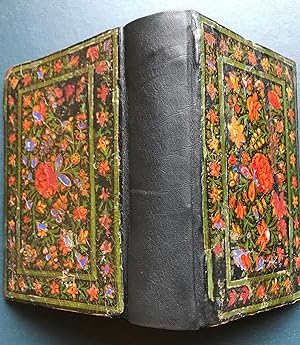
Add to basketHardcover. Condition: Good. Small 8vo. Arabic manuscript on smoothed paper. Ottoman Empire, mid-19th century. 16.8 x 10 cm. With 3 double-page illuminated 'unwan, written in Naskhi script, in gold and opaque colors and some jus marks in gold and colors at the margins. Sura headings in blue before gold. Each page with internal text frame in blue, black, and gold, verse dividers in the form of numerous golden dots. 371 unnumbered leaves. Written area: 11.8 x 5.7 cm. 15 lines per page. Modern leather binding using the covers of a Qajar lacquer binding from the early 19th century with floral motifs (covers with damage and missing parts), occasional ink a little bit blurred, otherwise in very good condition, fitted in a modern cloth box, no date, no signature. The double illuminated pages within certain Suras in blue and gold palette is characteristic of the production of Kashmir. #34917.
-
Kitab Intikhab al-Iqtidab al-Majmu' 'ala Tariq al-Mas'ala wa Radd al-Jawab / Medical Treaty.
Language: Arabic
Publication Date: 1852
Manuscript / Paper Collectible
US$ 1,382.81
US$ 46.99 shipping
Ships from United Kingdom to U.S.A.Quantity: 1 available
Add to basketHardcover. Condition: Fair. (25 x 18 cm), [3 blanks], [85 pp], [4 blanks], Arabic text, 18 lines per page, text inscribed in black and red ink, worn contemporary full leather, weak spine, water staining to margins, dated 21 November 1852. Abu Nasr Sa'id bin Abi Al-Kheir bin Issa Al-Masihi, probably of Syrian origin, was a remarkable and most imminent scholar. In this work, he uses the method of questions and answers to list the different groups of medicines as well as ailments and diseases. At the end he mentions that the reason behind writing this manuscript is to be an introduction for the beginner and a reminder for those who finish medicinal studies. #34461.
-
US$ 4,839.83
US$ 46.99 shipping
Ships from United Kingdom to U.S.A.Quantity: 1 available
Add to basketHardcover. Condition: Good. Arabic manuscript on smoothed paper, wide margins, Naskhi style with very small text frames, written space 11 x 6 cm, the colophon calls the date and the clerk, El-Seyyid Mustafa el Hulûsî, a student of the Mustafa el Muhâlis, double-sided, 'Unwan in gold and opaque colours, three lines of text in gold and colours, and some colour decorations in margins. Suras headlines in white on gold base with colour frame. Each page with a double text frame in red, black and gold. Coloured and golden small circular signs, The illumination is somewhat rough, gold colour was used instead of gold, occasional damp staining in margins, last leave lists the Islamic months. Ottoman Empire 1247 (d. I. 1831/32).#34913.
-
Tahrir Qawa'id al-Risala al-Shamsiyya.
Language: Arabic
Publication Date: 1865
Manuscript / Paper Collectible
US$ 2,765.62
US$ 46.99 shipping
Ships from United Kingdom to U.S.A.Quantity: 1 available
Add to basketHardcover. Condition: Very Good. [220], Arabic text neatly hand written, 18 lines to the page, tables, some key words written in red, contemporary full stamped calf, lightly rubbed, light damp stains to margins of few pages, otherwise a very good copy, inscribed 30 March, 1865. Najam al-Din al-Qazwini al-Khatibi (d.1276) was an Islamic philosopher and logician. His most important work is this work on logic. It was commonly used as the first major text on logic in madrasas, until the twentieth century and is "perhaps the most studied logical textbook of all time". Al-Katibi's logic was largely inspired by the formal Avicennian system of temporal modal logic, but is more elaborate and departs from it in several ways. While Avicenna considered ten modalities and examined six of them, al-Katibi considered many more modalized propositions and examined thirteen which he believed were "customary to investigate". #29241.
-
US$ 4,148.43
US$ 46.99 shipping
Ships from United Kingdom to U.S.A.Quantity: 1 available
Add to basketFull-Leather. Condition: Good. (165 x 120 mm), [304 leaves], 15 lines to a page, Naskhi script, contemporary decorated leather, light to moderate wear, 2 richly coloured and gilt-decorated opening pages, gilt borders and illuminations throughout, approximately 30 gilt and colour shoulder devices, mostly marginal dampstaining throughout, many leaves dust smudged, a few leaves sprung, copied by Ibrahim Naf''i, one of the students of Hajji Wali al-Din Khalusi Anushahri, (c1850). #34967.
-
US$ 5,531.24
US$ 46.99 shipping
Ships from United Kingdom to U.S.A.Quantity: 1 available
Add to basketHardcover. Condition: Good. 303 pp., frontispiece decorated with plant motifs, beautiful Layout with wide margins, titles of the Suras have white gouache on a golden headband, full calf binding with flap, professionally repaired, gilt decorated covers with a gilt "mandorle" in the middle, part of last page transferred to opposite leaf without any loss, copied by Hafiz Ahmed Raghib efendi, Year 1254 of the Hegira [1838].#34886.
![Seller image for [Islamic Devotional Manuscript with Qur'anic Verses, Attributes of Allah, and Other Prayers] for sale by James Cummins Bookseller, ABAA](https://pictures.abebooks.com/inventory/md/md32180726399.jpg)

![Seller image for [Vocabularium Italico-Arabicum]. Arabic-Italian dictionary. for sale by Antiquariaat FORUM BV](https://pictures.abebooks.com/inventory/md/md31843464867.jpg)


![Seller image for Talkhis al-fawâ?id wa taqrîb al-mütabâ?id [Commentary on al-Shatibi] for sale by James Cummins Bookseller, ABAA](https://pictures.abebooks.com/inventory/md/md32180726398.jpg)
![Seller image for Kitab Al-Waqi'at fi'l-Fatawi [Kitab Al-Waghi'at Fi Al-Fatwi]. for sale by Antiquariaat FORUM BV](https://pictures.abebooks.com/inventory/md/md30833681173.jpg)


![Seller image for Kitab al-Taharah. [Book of Purification]. for sale by FOLIOS LIMITED](https://pictures.abebooks.com/inventory/md/md31883906388.jpg)