

Order Total (1 Item Items):
Shipping Destination:

Attributed After (19 results)
Skip to main search results
Search filters
Product Type
- All Product Types
- Books (5)
- Magazines & Periodicals (No further results match this refinement)
- Comics (No further results match this refinement)
- Sheet Music (No further results match this refinement)
- Art, Prints & Posters (14)
- Photographs (No further results match this refinement)
- Maps (No further results match this refinement)
- Manuscripts & Paper Collectibles (No further results match this refinement)
Condition Learn more
- New (No further results match this refinement)
- As New, Fine or Near Fine (No further results match this refinement)
- Very Good or Good (11)
- Fair or Poor (No further results match this refinement)
- As Described (8)
Binding
- All Bindings
- Hardcover (No further results match this refinement)
- Softcover (No further results match this refinement)
Collectible Attributes
- First Edition (No further results match this refinement)
- Signed (No further results match this refinement)
- Dust Jacket (1)
- Seller-Supplied Images (17)
- Not Print on Demand (19)
Language (2)
Free Shipping
- Free Shipping to U.S.A. (No further results match this refinement)
Seller Location
Seller Rating
-

"Herodias" - Herodias with the head of John the Baptist / Mythologie mythology
Language: German
Published by ca. 1820., 1820
Seller: Antiquariat Steffen Völkel GmbH, Seubersdorf, Germany
Seller rating 5 out of 5 stars

Art / Print / Poster
Bild-Maße: ca. 19,5 x 14 cm. -- Original Kupferstich. Mit Sammlerstempel auf der Rückseite. -- gut erhalten. || Original engraving. With collector's stamp on verso. -- in good condition. // Wir, das Antiquariat Steffen Völkel, kaufen und verkaufen alte Bücher, Handschriften, Zeichnungen, Autographen, Grafiken und Fotografien. Wir sind stets am Ankauf von kompletten Bibliotheken, Sammlungen und Nachlässen interessiert. Sprache: Deutsch Gewicht in Gramm: 10.
-

"Theatre Royal / April ____ a Comedy / with the Mock Doctor / For the Benefit of the / Author of the Farce". Within image "W. Hogarth ft";
Published by London: Craddock and Barnard., 1837
Seller: Wittenborn Art Books, San Francisco, CA, U.S.A.
Seller rating 5 out of 5 stars
Art / Print / Poster
Condition: Good. Print: 12 x 15 cm. Plate: 16 x 16 cm. Spot in lower marigin.Theatre ticket design for The Mock Doctor, a benefit at the 'Theatre Royal', designed by William Hogarth. Text under the image reads: 'Theatre Royal, April, a comedy with the Mock Doctor for the Benefit of the Author of the Farce'. Presumably the author referred to is Henry Fielding who wrote the English translation of Moliere's play. The plates were bought by the publisher Baldwin, Cradock and Joy at the Boydell sale in 1818. The Works of William Hogarth as published by Baldwin, Cradock and Joy in 1822 with the original plates restored by James Heath, engraver to His Majesty. The Heath edition was the last to print directly from Hogarth's original engraved plates.
-

The Author's Benefit Pasquin. At ye Theatre in ye Haymarket.
Published by London: Craddock and Barnard., 1837
Seller: Wittenborn Art Books, San Francisco, CA, U.S.A.
Seller rating 5 out of 5 stars
Art / Print / Poster
Condition: Good. Print: 11.2 x 13 cm. Plate: 16 x 16 cm. Spot in lower marign.Theatre ticket: a stage scene with seven performers, a dog and a cat, and in the background two tightrope walkers accompanied by an ape; within a frame, a satyr on either side; a forgery purporting to be an admission ticket for a performance of Fielding's Pasquin at the Haymarket Theatre in April 1736 The plates were bought by the publisher Baldwin, Cradock and Joy at the Boydell sale in 1818. The Works of William Hogarth as published by Baldwin, Cradock and Joy in 1822 with the original plates restored by James Heath, engraver to His Majesty. The Heath edition was the last to print directly from Hogarth's original engraved plates.
-

THEATRE ROYAL / COVENT GARDEN. For the Benefit of Mr. Walker. Stage scene.
Published by London: Craddock and Barnard., 1837
Seller: Wittenborn Art Books, San Francisco, CA, U.S.A.
Seller rating 5 out of 5 stars
Art / Print / Poster
Condition: Good. Print: 9 x 11 cm. Plate: 11 x 12cm. Subject:Related to John Gay (British, Barnstaple, Devon 1685-1732) spot in upper margin. The plates were bought by the publisher Baldwin, Cradock and Joy at the Boydell sale in 1818. The Works of William Hogarth as published by Baldwin, Cradock and Joy in 1822 with the original plates restored by James Heath, engraver to His Majesty. The Heath edition was the last to print directly from Hogarth's original engraved plates.
-
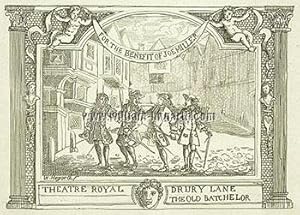
For the Benefit of Joe Miller. Theatre Royal. Drury Lane. The Old Batchelor.
Published by London: Craddock and Barnard., 1837
Seller: Wittenborn Art Books, San Francisco, CA, U.S.A.
Seller rating 5 out of 5 stars
Art / Print / Poster
Condition: Good. Print: 14 x 18 cm. Plate: 19 x 16.5 cm. Paper: 25 x 22 cm. Oblong.above, a man with a sword to either side and an inscription plaque with weapons below. The plates were bought by the publisher Baldwin, Cradock and Joy at the Boydell sale in 1818. The Works of William Hogarth as published by Baldwin, Cradock and Joy in 1822 with the original plates restored by James Heath, engraver to His Majesty. The Heath edition was the last to print directly from Hogarth's original engraved plates.
-

'James Figg | Master of ye Noble Science of Defence | on ye right hand in Oxford Road | near Adam & Eve court teaches Gentle- | men ye use of y[e] small backsword & |Quarterstaff at home & abroad'.
Published by London: Craddock and Barnard., 1837
Seller: Wittenborn Art Books, San Francisco, CA, U.S.A.
Seller rating 5 out of 5 stars
Art / Print / Poster
Condition: Good. Print: 16.5 x 12 cm. Plate: 19 x 16.5 cm. Paper: 25 x 22 cm. Spot in right margin.Forgery purporting to be a trade-card for James Figg, prize fighter and instructor in sword and quarter-staff; portrait of Figg standing full-length, one hand on his hip, the other on the hilt of his sword, with another man to left of him holding a quarter-staff, in a raised fighting ring with spectators; in a decorative border with crossed swords above, a man with a sword to either side and an inscription plaque with weapons below. The plates were bought by the publisher Baldwin, Cradock and Joy at the Boydell sale in 1818. The Works of William Hogarth as published by Baldwin, Cradock and Joy in 1822 with the original plates restored by James Heath, engraver to His Majesty. The Heath edition was the last to print directly from Hogarth's original engraved plates.
-
Antique Print-DOMITIA-LONGINA-ROMAN-EMPIRE-PORTRAIT-Mariette-Sadeler-c.1700
Published by c.1700, 1700
Seller: Pictura Prints, Art & Books, Overasselt, Netherlands
Seller rating 5 out of 5 stars
Art / Print / Poster
After Aegidius Sadeler (attributed) (illustrator). 'DOMITIA LONGINA DOMITIANI VXOR. / XII / DOMITIA ESPOUSA DOMITIAN ERERE DE TITUS, AU TEMPS DE SON SECOND CONSULAT ET EURENT UN FILS DE LEUR / MARIAGE. MAIS ESTANT PARUENU A L'EMPIRE, IL LA REPUDIA ENCORE QUIL L'EUT HONOREE DU NOM D'AUGUSTA. / TOUTEFOIS EXCESSIUEMENT EPRIS DE SON AMOUR IL LA RAPELLA, BIEN QUE LA FILLE DE TITUS SON FRERE LUY / FUT PRESENTEE POUR FEMME, IL NE POUUOIT VIURE SANS DOMITIA, ET NE LAISSA PAS D'AYMER CETTE NIEPCE / COMME SA CONCUBINE, IL FUT ENFIN CAUSE DE SA MORT, CAR IL FIT AUORTER SON FRUIT. SUET AND DOMIT. INSCRIPTIONS AND TEXTUAL ELEMENTS: MARIETTE EXCUDIT. 'Portrait of Domitia Longina, in elaborate Roman dress and hairstyle, facing right. Richly ornamented jewelry and drapery. Includes a narrative in French describing her marriage and tragic death.Made by Anonymous, published by Pierre Mariette after After Aegidius Sadeler (attributed).Medium: Engraving on hand laid (verge) paper.Sheet size: 23.3 x 33.7 cm (9.17 x 13.27 inch). Image size: 19 x 27.6 cm. (7.48 x 10.87 inch).DOMITIA LONGINA, DOMITIAN, ROMAN EMPRESS, PIERRE MARIETTE, SADELER, ANTIQUE PORTRAIT, JULIO-CLAUDIAN WOMEN | PCO-E22-21BACKGROUND INFORMATIONPart of a Roman empresses portrait series; print published by Pierre Mariette (c.1700), a Parisian printseller and publisher of classical and historical subjects.Biography engraver: Anonymous engraver.Biography artist: Aegidius Sadeler (c. 15701629), Flemish engraver of the late Renaissance, known for court portraiture and historical engravings. Condition: very good, given age. Full margins, light toning, faint fold in top margin, strong clean impression. General age-related toning and/or occasional minor defects from handling. Please study scan carefully.
-

Portrait of Ferry Carondelet with his Secretaries.
Published by Paris: Recueil Crozat., 1729
Seller: Wittenborn Art Books, San Francisco, CA, U.S.A.
Seller rating 5 out of 5 stars
Art / Print / Poster
Condition: Good. Etching and engraving. 34 x 25 cm. (sheet). Plate number 35, from "Recueil d'Estampes d'après les plus beaux Tableaux et d'après les plus beaux Desseins qui sont en France dans le Cabinet du Roy, dans celui de Monseigneur le Duc d'Orleans, & dans d'autres Cabinets, Tome Premier." [Cabinet Crozat, Volume 1].Very Good. Sheet trimmed to or within the platemark. Areas of red, pink, and blue paint? in upper quadrant of image.
-

Couple in the Woods. Original drawing.
Published by 19th Century.
Seller: Wittenborn Art Books, San Francisco, CA, U.S.A.
Seller rating 5 out of 5 stars
Art / Print / Poster
Condition: Good. Drawing in sanguine. 11.2 x 7.4cm. Mounted on a support sheet.Provenance:Né en 1906 à Lezay (Deux-Sèvres), Jacques Cathy a exercé d'abord la profession de caricaturiste à l'hebdomadaire « Le Rire ». Il a rejoint vers 1927 l'équipe du Cabaret « La Vache Enragée » conduite par Roger Toziny. Jacques Cathy poursuit sa carrière de chansonnier après le décès de Toziny en 1939 et après la guerre il conduit parallèlement une carrière d'acteur dans le cinéma. Jacques Cathy était le 3ème Maire de La Commune Libre de Montmartre à partir de l'élection en 1949.,Final provenance: Les Collections Aristophil - 164 bis avenue Charles-de-Gaulle, 92200 Neuilly-sur-Seine.
-

Christ of Caprarola. Original Engraving, After Carraci.
Published by c1665-1690., 1665
Seller: Dark Parks Books & Collectibles, Fallon, NV, U.S.A.
Seller rating 5 out of 5 stars
Extremely rare. Pagination: Single leaf. Engraving. Fine impression, beautiful original engraving, with large margins and fine, detailed lines. Contemporary ink notes on verso, no affect at all. Loose, without matting. Body of Christ lying on the ground, his head resting on the Vrigin, supported by another Mary; with St. John holding Christ?s left hand and displaying its wound to St. Mary Magdalene. Stunning and very rare. Suitable for framing. Lairesse (1641-1711), born in Liege, second son of painter Renier. Known for a facial deformity (some will state syphilis), Rembrandt?s portrait of Gerard at age 25, is a famous one. He was influenced by Rembrandt, and later French neo-classical. In 1690, he lost his sight and concentrated on art theory. A draughtsman, theatrical designer, writer, and theoretician, he is best known as the celebrated Dutch painter in the years to follow Rembrandt?s death.Lairesse shows more detail and finer lines than Carracci in this beautiful scene, which is in reverse of Carracci?s original. We attribute this work to Lairesse by the original auction purchase of this print over 20 years ago. Though, we find no other copies of this print in any institutions, reference citations, or for sale at time of description. It appears to be extremely rare.
-

Standing Classical man in gown. Original drawing.
Published by 16th or 17th Century.
Seller: Wittenborn Art Books, San Francisco, CA, U.S.A.
Seller rating 5 out of 5 stars
Art / Print / Poster
Condition: Good. Drawing in sanguine. 16 x 9cm. Artist's name in pencil verso. Provenance:Né en 1906 à Lezay (Deux-Sèvres), Jacques Cathy a exercé d'abord la profession de caricaturiste à l'hebdomadaire « Le Rire ». Il a rejoint vers 1927 l'équipe du Cabaret « La Vache Enragée » conduite par Roger Toziny. Jacques Cathy poursuit sa carrière de chansonnier après le décès de Toziny en 1939 et après la guerre il conduit parallèlement une carrière d'acteur dans le cinéma. Jacques Cathy était le 3ème Maire de La Commune Libre de Montmartre à partir de l'élection en 1949.,Final provenance: Les Collections Aristophil - 164 bis avenue Charles-de-Gaulle, 92200 Neuilly-sur-Seine.
-

Two Men in top hats with stylish woman in a flowing wrap. Original watercolor and gouache.
Published by Mid-late 19th Century.
Seller: Wittenborn Art Books, San Francisco, CA, U.S.A.
Seller rating 5 out of 5 stars
Art / Print / Poster
Condition: Good. Watercolor and gouache. 31 x 22cm. Annotated with artist's name verso and collection number. .Compare to Morgan Library, Dept. of Drawings and Prints. Record ID:109832.Notes:The artist's fame stems from his sketches of Parisian society, for which Baudelaire dubbed him "the Painter of Modern Life" in the pages of Le Figaro (1863). Widely traveled and a regular contributor to the growing corpus of illustrated journals such as Illustrated London News and Punch, he worked swiftly and captured the sense of movement synonymous with modern urban life.This group of figures appears to be gathered in the foyer of a theater or cabaret, judging from the row of gas lamps along the upper margin. The women wear small bonnets, one a cape, the other a jacket, over voluminous crinolines, a stiff underskirt introduced in 1855 and unfashionable by 1867. They speak to two men in top hats, while a third seems indifferent to their presence; other similarly attired men mill about and walk through the background.Provenance:Né en 1906 à Lezay (Deux-Sèvres), Jacques Cathy a exercé d'abord la profession de caricaturiste à l'hebdomadaire « Le Rire ». Il a rejoint vers 1927 l'équipe du Cabaret « La Vache Enragée » conduite par Roger Toziny. Jacques Cathy poursuit sa carrière de chansonnier après le décès de Toziny en 1939 et après la guerre il conduit parallèlement une carrière d'acteur dans le cinéma. Jacques Cathy était le 3ème Maire de La Commune Libre de Montmartre à partir de l'élection en 1949.,Final provenance: Les Collections Aristophil - 164 bis avenue Charles-de-Gaulle, 92200 Neuilly-sur-Seine.
-

Seated Man holding a jug. Original sanguine drawing.
Published by Holland: 17th Century
Seller: Wittenborn Art Books, San Francisco, CA, U.S.A.
Seller rating 5 out of 5 stars
Art / Print / Poster
Condition: Good. Sanguine drawing on old laid paper. 12.5 x 9.7cm. Tipped on a support sheet. Provenance:Né en 1906 à Lezay (Deux-Sèvres), Jacques Cathy a exercé d'abord la profession de caricaturiste à l'hebdomadaire « Le Rire ». Il a rejoint vers 1927 l'équipe du Cabaret « La Vache Enragée » conduite par Roger Toziny. Jacques Cathy poursuit sa carrière de chansonnier après le décès de Toziny en 1939 et après la guerre il conduit parallèlement une carrière d'acteur dans le cinéma. Jacques Cathy était le 3ème Maire de La Commune Libre de Montmartre à partir de l'élection en 1949.,Final provenance: Les Collections Aristophil - 164 bis avenue Charles-de-Gaulle, 92200 Neuilly-sur-Seine.
-
Study for the sculpture "L'Afrique," Château de Versailles. Original sanguine drawing.
Published by Versailles: circa 1675-1682., 1682
Seller: Wittenborn Art Books, San Francisco, CA, U.S.A.
Seller rating 5 out of 5 stars
Art / Print / Poster
Condition: Good. Sanguine drawing with old manuscript text on attached sheet. 16.5 x 12.5cm. 17th Century watermarked paper : chalice on an urn."L'Afrique: StatueMR 1792;inv. 1850.9446;.:Inventaire de 1707 : « Une statue, en pied, de marbre blanc, représentant l'Afrique sous la figure d'une femme, la teste couverte d'une trompe d'éléphant, ayant une draperie pendante au millieu du sein, laquelle passe autour des deux bras et couvre une partie du bas de la figure, qui a le bras droit levé, tenant un bout de bâton dans sa main, et la gauche, baissée, dont elle relève sa draperie. Au bas est un lion couché, qui laiche le pied gauche de laditte statue, qui a sept pieds un pouce de hauteur. Faite par Cornu en 1682. Le bras droit est raporté au-dessus du coude ». .Historique: Paiements mentionnés par les sources comptables à Georges Sibrayque, pour une figure pour le parterre d'Eau, d'avril 1675 à octobre 1682 (travail explicitement mentionné en cours d'avril 1675 à août 1680).Parfait paiement à Jean Cornu, le 6 juin 1694, pour deux figures dont l'une « commencée par Sibraique [?] représentant l'Afrique ».Modèle en plâtre, représenté sur la gravure d'Israël Silvestre datée de 1682, disposé au bosquet de la Renommée avant décembre 1680, date d'approbation du guide de Combes, et vraisemblablement retiré en 1683 afin d'être remplacé par la version en marbre."Provenance:Né en 1906 à Lezay (Deux-Sèvres), Jacques Cathy a exercé d'abord la profession de caricaturiste à l'hebdomadaire « Le Rire ». Il a rejoint vers 1927 l'équipe du Cabaret « La Vache Enragée » conduite par Roger Toziny. Jacques Cathy poursuit sa carrière de chansonnier après le décès de Toziny en 1939 et après la guerre il conduit parallèlement une carrière d'acteur dans le cinéma. Jacques Cathy était le 3ème Maire de La Commune Libre de Montmartre à partir de l'élection en 1949.Final provenance: Les Collections Aristophil - 164 bis avenue Charles-de-Gaulle, 92200 Neuilly-sur-Seine.
-
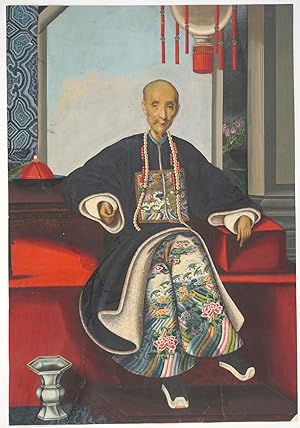
Houqua. A Chinese Merchant. A Chinese trade painting, portrait
Published by Canton?, 1830
Seller: Antipodean Books, Maps & Prints, ABAA, Garrison, NY, U.S.A.
Association Member: ABAA ANZAAB ESA ILAB
Seller rating 3 out of 5 stars

Painting. Condition: Good + overall. An early gouache portrait of Houqua, considered the richest man in the world in the 1830s. 'This gouache portrait of Howqua, exists in several versions and sizes, from full-length to head and shoulders . some in oils and others in gouache. They seem to have had their origin in a group of portraits executed by Chinnery, the portrait of Howqua, was probably shipped to England on January 31st 1830. Following and adapting Chinnery's prototypes, Lamqua must have done a brisk business in such portraits. In particular, the distinctive features of Howqua domed forehead, hollow cheeks, wispy beard gained an almost iconic status, the acceptable face, as it were, of the China trade.' (P. Conner, 'Lamqua Western and Chinese Painter', Arts of Asia, March-April 1899, p.54). This portrait has elements of several images of Houqua. The basic structure is based on the portrait held at the Metropolitan Museum of Art in the style of George Chinnery. In that portrait, Houqua sits on a red banquette, looking straight at the painter, his legs crossed, wearing a dark blue robe with white cuffs, a central elaborate panel of embroidery at his chest and wide pants decorated with diagonal strips of blue, green and red. He also wears two or three strings of beads, his red domed hat to the left, a wooden doorway framework and an open space behind with a sky and a Chinese red-tasseled lantern hanging above him to the right. There is also a silver colored metal object at the left of his foot and a wooden footstool. In this portrait, the face is of an older Houqua, appearing similar to the Tinqua "Portrait of Houqua" portrait on ivory also at the Metropolitan. This image varies from that format, most strikingly on the intricate dragon coat pattern which we have not been able to trace in any other variant of this portrait. Another variation is the harbor background found in many examples, which has been blocked by a wall extending from the pillar on the right. Howqua, the representative of the thirteen factories among the Guangzhou merchants. The subject of this portrait is probably Wu Bingjian (1769-1843), the richest man on earth during the Jiaqing and Daoguang periods, or possibly his fifth son, Wu Shaorong (1833-1856). Howqua Wu Bingjian, had risen to become the most senior of the hong merchants in Canton, one of a select few permitted to trade in silk and porcelain with foreigners. The word hong (?) refers to both a type of building and a Chinese merchant intermediary within the Canton system of trade. Howqua's personal wealth was estimated to be around US $26 million by 1834. He contributed a third of the US $3 million that China's Qing dynasty was required to pay in reparations to the British after the 1842 Treaty of Nanking that ended the First Opium War. He had close ties with powerful contemporaries such as James Matheson, William Jardine, Samuel Russell and Abiel Abbot Low. Gouache portrait on paper, 20 1/4 x 14". There are a number of expertly repaired cracks that are barely visible as well as a matching Chinese pattern strip of paper applied to the vacant top left corner. This portrait was most recently featured on the cover of March 2026 issue of Antiques Weekly newspaper.
-

Design for a corner of a ceiling painting.
Language: German
Published by c. 1780., 1780
Seller: Antiquariat Steffen Völkel GmbH, Seubersdorf, Germany
Seller rating 5 out of 5 stars
Art / Print / Poster
Stencil, pen, brown ink, grey and yellow wash; mounted; 246 x 163mm Giovanni Antonio Torricelli was a Swiss quadraturist. He almost always worked in collaboration with his brother Giuseppe Antonio (1710-1808), who was a figurist painter. Both are reported to have studied in Bologna and then to have worked in the principal cities of Italy before they went abroad. The attribution is vague as drawings by Torricelli are scarcely known. Literature: cf.: Mary L. Myers Architectural and Ornament drawings: Juvarra, Vanvitelli, The Bibiena family, & other Italian draughtsmen. New York, 1975. (ill. 59; pp. 42-43); Anastasia Gilardi, Torricelli, Giovanni Antonio e Giuseppe Antonio (Fratelli) in: SIKART Lexikon zur Kunst in der Schweiz (online) // Wir, das Antiquariat Steffen Völkel, kaufen und verkaufen alte Bücher, Handschriften, Zeichnungen, Autographen, Grafiken und Fotografien. Wir sind stets am Ankauf von kompletten Bibliotheken, Sammlungen und Nachlässen interessiert. Sprache: Deutsch Gewicht in Gramm: 550.
-
![Seller image for [Original etching/ets] 't'Wegh Voeren van Prins Willem van Furstenberg'; capture of Wilhelm von Fürstenberg, 1674. for sale by Antiquariaat Arine van der Steur / ILAB](https://pictures.abebooks.com/inventory/md/md30408860177.jpg)
[Original etching/ets] 't'Wegh Voeren van Prins Willem van Furstenberg'; capture of Wilhelm von Fürstenberg, 1674.
Seller: Antiquariaat Arine van der Steur / ILAB, Den Haag, Netherlands
Seller rating 4 out of 5 stars

Night scene of the capture of Wilhelm von Fürstenberg, bishop of Strasbourg, on 16 February 1674. In Cologne he is taken away by coach. Inscription on banner above: 't'Wegh Voeren van Prins Willem van Furstenberg'. Etching on laid paper; small margins; platemark: 257 x 345 mm; total: 283 x 358 mm; watermark: foolscap watermark; centerfold reinforced with paper on verso; some darkening and smudges in the margins, else in good condition. Muller 2526: 'fine engraving'. After an engraving attributed to Romeyn de Hooghe by Muller (Muller 2525).
-
[Tavern scene with five farmers singing and making music].
Publication Date: 1635
Seller: ASHER Rare Books, T Goy Houten, Netherlands
Seller rating 5 out of 5 stars
US$ 4,158.42
US$ 28.84 shipping
Ships from Netherlands to U.S.A.Quantity: 1 available
Add to basketOne of the pastiches of a well-known painting by the Flemish artist Adriaen Brouwer (1605-1638). Between 1626 and 1629, he was a pupil of the famous Dutch painter Frans Hals (1580-1666) in Amsterdam and Haarlem, before returning to Antwerp in 1631. Together with his friend David Teniers the Younger, Brouwer was one of the representatives of the popular genre painters working in the style of Pieter Brueghel the Elder (d. 1569). The subjects of his paintings include many tavern scenes with farmers, musicians, and singing people. His influence on other 17th-century painters like Adriaen and Isaac van Ostade and David Teniers is apparent. Many of his often small panel paintings were copied or imitated by other painters at the time. The model for our painting is unmistakably Adriaen Brouwer's work in the Alte Pinakothek in Munich (Inv. 629) belonging to a series of the five senses, representing hearing. A farmer with a red cap and greenish jacket plays the violin in the foreground, a jar between his spread legs; another farmer in the background, beer mug in his left hand, is approaching a singing trio - one is reading the text of the song from a slip of paper.A number of good (our painting) and less good copies and pastiches of this painting are known, which are attributed to different artists, including Hendrik Martensz Sorg, Cornelis Saftleven, Jan Jansz. van Buesem, and Jan Miense Molenaer.Our painting recently has been attributed - apart from to Adriaen Brouwer himself - to Jan Jansz. van Buesem (ca. 1600-ca. 1649), a pupil of Pieter Quast (1606-1647). Van Buesem is known for his genre works examples of which are included in a recent oeuvre catalogue (Schouws, nos.12-13, 16-17, 20, 31 (our copy not included)). On the back of our panel is a clipping pasted with a short description of the painting (no. 6468) containing an attribution to Jan Buesem by Dr Walther Bernt, München, from 1974 who adds: "Unten rechts monogrammiert: Jm."(sic!). These initials, however appear on the bench at the left and may well refer, however, to Jan (Miense) Molenaar who certainly was acquainted with the work of Adriaen Brouwer.Jan Miense Molenaer (1610-1668) was a Dutch Golden Age genre painter whose style was a precursor to Jan Steen (1626-1679). He shared a studio with his wife Judith Leyster, one of the few female painters of the 17th century, and both may well have been pupils of Frans Hals in Haarlem. Later he developed a style more akin to Adriaen van Ostade, with works depicting music players mostly in a setting of a tavern with drinking farmers, such as his "Music Makers" (Museum of Fine Arts, Budapest), or "Family Making Music" (Frans Hals Museum, Haarlem).It is all the more likely that Jan Miense Molenaar was the painter of our panel because of his initials on the bench (JM), and because of an old label mentioning his name, also pasted to the back of the panel (partly erased).Apart from some minor damages in the lower part, this 17th-century painting is in very good condition.l Lichtert (ed.), Adriaen Brouwer (2018), p. 82; Schouws, Jan Jansz. Beusem, het leven en werk van een Amsterdams 17de-eeuwse kleine meester (Master scriptie, University of Amsterdam, 2019), esp. pp. 23-30; Weller, Jan Miense Molenaar, painter of the Dutch Golden Age (NY, 2002). Painting, oil on oak panel with bevelled edges. In a richly modelled gilt frame. Painting: 25.2 x 20.7 cm.; grame 39.5 x 34.5 x 5 cm.
-
US$ 1,127.23
US$ 36.68 shipping
Ships from Netherlands to U.S.A.Quantity: 1 available
Add to basketScene with a quack trying to sell his wares to several bystanders, a sick man lying on the ground next to him. A small market, houses and a church tower in the background. The group of figures is loosely inspired by the etching 'the quack' (1648) by Adriaen van Ostade (1610-1685). l Pen and brown ink and watercolours on velin, 252 x 252 mm. Within brown ink border. Top edge pasted on mount, small tear in upper left corner and left edge, otherwise in very good condition.




![Seller image for [Tavern scene with five farmers singing and making music]. for sale by ASHER Rare Books](https://pictures.abebooks.com/inventory/md/md32168513001.jpg)