Order Total (1 Item Items):
Shipping Destination:

Beato, Signed (14 results)
Author:
beato
Refine with Advanced Search
Skip to main search results
Search filters
Product Type
- All Product Types
- Books (10)
- Magazines & Periodicals (No further results match this refinement)
- Comics (No further results match this refinement)
- Sheet Music (No further results match this refinement)
- Art, Prints & Posters (No further results match this refinement)
- Photographs (4)
- Maps (No further results match this refinement)
- Manuscripts & Paper Collectibles (No further results match this refinement)
Condition Learn more
- New (No further results match this refinement)
- As New, Fine or Near Fine (1)
- Very Good or Good (4)
- Fair or Poor (1)
- As Described (8)
Binding
Collectible Attributes
- First Edition (1)
- Signed (14)
- Dust Jacket (No further results match this refinement)
- Seller-Supplied Images (13)
- Not Print on Demand (14)
Language (3)
Free Shipping
Seller Location
Seller Rating
-
US$ 16.61
US$ 23.89 shipping
Ships from Czech Republic to U.S.A.Quantity: 1 available
Add to basketSoftcover. Condition: Fair. Autoren- / zusammenhängende Unterschrift; Abnutzung / Risse - deutlich.
-

Encuadernación de tapa blanda. Condition: Bien. S.A.E.T.A. Sociedad Anónima Española de Traductores y Autores, 1950 aprox. DEDICATORIA Y FIRMA AUTOGRAFA DEL AUTOR. Numerosos problemas con sus soluciones. Libros de estudio y textos para la universidad y escuelas superiores. Ingeniería. 463 páginas. 24 x 17. Tapa blanda de editorial ilustrada. Sin subrayados ni anotaciones. Buen estado general de conservación. Libro.
-
Rischio e mutamento ambientale globale. Percorsi di sociologia dell'ambiente
Language: Italian
Published by Franco Angeli, Milano, 1993
ISBN 10: 882047770X ISBN 13: 9788820477707
Signed
brossura. Condition: Good. 0. In 8', br. ed., pp. 302; dedica aut. dell'A. al frontespizio; lievi segni d'uso alla cop., restante in buono stato. ***Books dated over 70 years old are not exportable, please do not order.***. Book.
-
PANEGIRICO DEL BEATO RAIMUNDO LULIO, P. CONRADO MUIÑOS SAENZ 1895
Published by Tipografía de Bartolomé Rotger., 1895
Seller: Libreria Anticuaria Marc & Antiques, Sabadell, B, Spain
Seller rating 5 out of 5 stars

First Edition Signed
Encuadernación de tapa blanda. Condition: Excelente. 1ª Edición. Palma. Tipografía de Bartolomé Rotger. 1895. 21X15. 40p. Rustica. Agustiniana. Dedicatoria de Conrado Muiños a Dionisia de España, 3/1896. Curioso ejemplar. Ref 9.5 Biblioteca FGJ. Dedicatoria autógrafa del autor.
-
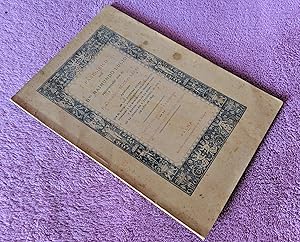
Égypte & Syria. [A Collection of 60 Photographic Prints on Syria, Egypt, and the Middle East].
Published by c., 1880
Seller: Robert Frew Ltd. ABA ILAB, London, United Kingdom
Association Member: ABA ILAB PBFA
Seller rating 5 out of 5 stars
Signed
US$ 4,078.80
US$ 13.20 shipping
Ships from United Kingdom to U.S.A.Quantity: 1 available
Add to basketA collection of 59 original album prints (c.21 x 28 cm.) in black & white except for one in colour, most titled and signed in the negative, each laid onto thicker card (27 x 35 cm.), the ensemble housed in a contemporary portfolio of blue pebbled cloth with red morocco title-label to upper cover ("Syrie-Égypte"), marbled endpapers, and original green ties. Additional manuscript captions in French to some prints. Some occasional light fading, one print with scattered spotting to card only, generally a wonderfully preserved collection of photographs handsomely presented in a contemporary portfolio. An impressive collection of albumen prints of the Middle East by Bonfils, Beato, and Langaki. The majority are of Egypt and include a selection of ancient Egyptian monuments and scenes from contemporary life. In addition there are photographs of Syria and Lebanon. The photos depict a wide variety of subjects, including exterior and interior views of Mosques, portraits, antiquities, views, etc. etc.
-
Nine photographs of Egypt.
Published by Egypt, [1880s]., 1880
Seller: Antiquariat INLIBRIS Gilhofer Nfg. GmbH, Vienna, A, Austria
Association Member: ILAB PADA VDA VDAO
Seller rating 5 out of 5 stars
Signed
9 albumen prints (approx. 340 x 260 mm), each mounted on backing cardboard (ca. 400 x 330 mm). Three edges gilt. A fine set of nine albumen images of Egyptian sights and views, including Karnak, ships on the Nile, the Aswan cataract, the Temple of Edfu, murals at the Sanctuary at Karnak, camel drivers on the Sinai, etc. Pascal Sébah (1823-86), a leading photographer of the Middle East, was renowned for his well-judged compositions and for the excellent print quality achieved by his technician A. Laroche. His studio, founded in 1857, was continued under his brother Cosimo and his son Jean. A single image in this series is not by Sebah: a view of the island of Philae (near the First Cataract of the Nile) is signed "A. Beato" in a shaded portion of the image, identifiying this as the work of Antonio (Antoine) Beato (after 1832-1906), a British and Italian photographer noted for his genre works, portraits, views of the architecture and landscapes of Egypt and the other locations in the Mediterranean region. - Slight fading; well preserved.
-
HIGIENE BARATA.
Published by Tip. de Calatrava, 1915
Seller: Marta Micaela Librera Anticuaria, Puebla de Guzmán, H, Spain
Seller rating 5 out of 5 stars
Signed
Condition: Bueno. HIGIENE BARATA. Salamanca, 1915. 21x14'5, 157p, 1h, cubiertas algo ajadas. Dedicatoria autógrafa del autor. Dedicatoria autógrafa del autor.
-
![Seller image for Untitled [scene from Luxor]. for sale by Rodger Friedman Rare Book Studio, ABAA](https://pictures.abebooks.com/inventory/md/md31577919180.jpg)
Untitled [scene from Luxor].
Published by ca 1880, 1880
Seller: Rodger Friedman Rare Book Studio, ABAA, Tuxedo, NY, U.S.A.
Seller rating 5 out of 5 stars
Signed
Condition: Good. Large albumen-silver photograph on paper, 367 x 267 mm. Signed in plate. Lightly toned to sepia. Unmounted, a bit crinkled at the edges. Depicts a fellah in traditional dress and three camels before the columns at Luxor.
-
![Seller image for [Colonnade of the Temple of Edfu]. for sale by Shapero Rare Books](https://pictures.abebooks.com/inventory/md/md10234500440.jpg)
[Colonnade of the Temple of Edfu].
Published by Circa -1880, 1870
Seller: Shapero Rare Books, London, United Kingdom
Association Member: ABA ILAB PBFA
Seller rating 5 out of 5 stars
Photograph Signed
US$ 543.84
US$ 19.80 shipping
Ships from United Kingdom to U.S.A.Quantity: 1 available
Add to basketAlbumen print; very good tonal range and in good condition, closed tear to left hand edge and 2 small closed tears to lower edge repaired; titled and numbered 547 on reverse in pencil; signed in negative 'A. Beato'. Beato photographs two Egyptians in front of the columns of the western side of the colonnade, from the courtyard in front of the hypostyle hall, giving sense of the monumental scale of the architecture. Built during the Ptolemaic Kingdom with sites including Dendera and Philae, the Temple at Edfu was preserved nearly intact due to being nearly completely buried by 12 meters of desert sand and Nile silt. The work to uncover the temple was started by the French Egyptologist Auguste Mariette in 1860, and it remains a major visitor site in Egypt. Antonio Beato (1832-1906) was one of Egypt's most prolific photographers. Unlike his brother Felice Beato who travelled widely, Antonio remained in Egypt for most of his professional life.
-
![Seller image for [Entrance to the Temple of Khonsu at Karnak]. for sale by Shapero Rare Books](https://pictures.abebooks.com/inventory/md/md10234500343.jpg)
[Entrance to the Temple of Khonsu at Karnak].
Published by Circa -1880, 1870
Seller: Shapero Rare Books, London, United Kingdom
Association Member: ABA ILAB PBFA
Seller rating 5 out of 5 stars
Photograph Signed
US$ 679.80
US$ 19.80 shipping
Ships from United Kingdom to U.S.A.Quantity: 1 available
Add to basketAlbumen print; excellent condition and good tonal range, titled in French and numbered on reverse in pencil, signed in the negative 'A. Beato'. Built during the New Kingdom by Ramesses III on the site of an earlier temple, the Temple of Khonsu, is located within the Precinct of Amun-Re at Karnak. Ptolemy III built the pylon (gateway) seen in this albumen print at the end of an avenue of rams-head sphinxes which run to the Temple of Luxor. Antonio Beato (1832-1906) was one of Egypt's most prolific photographers. Unlike his brother Felice Beato who travelled widely, Antonio remained in Egypt for most of his professional life.
-
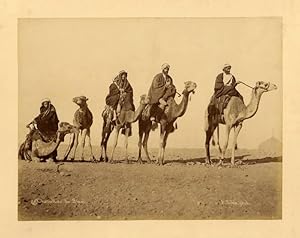
Album containing 146 albumen prints of Egypt from the 1870ies. - [MAGNIFICENT ALBUM WITH EARLY PHOTOGRAPS OF EGYPT INCLUDING SOME OF THE VERY EARLIEST OF THE SUEZ CANAL ]
Seller: Herman H. J. Lynge & Søn ILAB-ABF, Copenhagen, Denmark
Seller rating 4 out of 5 stars

Signed
Egypt, ca. 1870ies. Folio-oblong (365 x 280 mm). 146 albumen prints mounted verso and recto on 73 ff. Bound in contemporary half cloth. With traces of paper-label to inner margin of front board. Label of the stationery shop "Maison Martinet, Albert Hautecoeur, bd des Capucines, 12, Paris" pasted on to upper outer corner of pasted down front end-paper. Paper creased and some leaves symetrically perforated, not affecting photos. Two photos with tears and a few photos partly detached from paper. Some photos are slightly discoloured and toned but are in general in good condition. Extraordinary collection containing 146 albumen prints depicting landscapes and animated scenes of Egypt including some of the very earliest photographs of the newly opened Suez Canal. The photographs also document a period in Egyptian history, where the country began to gain independence and autonomy from Ottoman rule" Constantinople had granted Egypt the status of an autonomous vassal state or Khedivate in 1867, and completion of the Suez Canal gave Britain a faster route to India which in turn made Egypt increasingly reliant on Britain for both military and economic aid. Most photos are signed by the greatest local photographers of the time: the Zangaki brothers, Bonfils, Arnoux, Beato, Fiorillo, Béchard and Sébah. Active in the second half of the 19th century, these photographers of diverse origins such as French, Italian, British, Ottoman and Greek all established a studio or a branch in Egypt, in Alexandria, Port Said and Cairo. The Suez Canal was one of the most ambitious engineering projects of the 19th century. It was designed to create a waterway between the Mediterranean Sea and the Red Sea, linking Europe and Asia and providing a faster and more efficient route for shipping goods between the two continents. Construction of the canal began in 1859 and took over ten years to complete. Hippolyte Arnoux is best known for his remarkable photographs of the Suez Canal in Egypt. Arnoux's photographs of the Suez Canal were groundbreaking in their time and remain an important documentation of the construction of one of the world's most significant engineering endeavors. He was hired by the French government to document the construction of the canal, and he spent several years in Egypt taking photographs of it. He used a large-format camera, which allowed him to capture incredible detail and clarity in his images. Arnoux's photographs of the Suez Canal were not only important documents of the construction of the canal, but they also played an important role in the popular imagination of the time. They helped to promote the idea of progress and modernity, as well as the importance of colonialism and European expansion in the world. Zangaki's portrait photography also received much acclaim. His portraits were known for their ability to capture the essence of his subjects, conveying their personality, character, and emotions, and his portraiture work also demonstrated his mastery of lighting, composition, and posing.Zangaki's landscape photography is another notable aspect of his work. He and his brother captured breathtaking images of Egypt's natural landscapes, such as the Nile River, the desert, and the countryside. Their images were notable for their use of contrast, shadows, and light, creating a unique atmosphere that evoked the beauty and mystery of Egypt's landscapes. Their work contributed significantly to the early days of Egyptology, as it allowed European scholars and archaeologists that were not in a position to travel to examine the monuments and artifacts. The present collection forms a fine testament to one the most interesting periods in modern Egyptian history and to the cradle of Egyptian photography.
-
Vues d'Egypte. Photograph album.
Published by Cairo, ca. 1865., 1865
Seller: Antiquariat INLIBRIS Gilhofer Nfg. GmbH, Vienna, A, Austria
Association Member: ILAB PADA VDA VDAO
Seller rating 5 out of 5 stars
Signed
Oblong folio (510 x 385 mm). 25 albumen prints (ca. 260 x 370 mm), loosely mounted on grey leaves, each captioned in French. Green half morocco. Early, uncommonly well-preserved album of photographs showing the monuments of Egypt. Having arrived in Egypt as early as 1859, Antonio Beato (1835-1906) was among the first commercial photographers to make their way to the Middle East in order to capitalise on the increasing demand for souvenir photographs. Beato's images of Egypt were distinctly different from those of other photographers working in the region (cf. Hannavy). - Binding a little rubbed. Most of the photos signed in the negative, showing fresh and crisp contrast. - Hannavy, J. (ed), Encyclopedia of Nineteenth-Century Photography (Routledge, 2013), pp. 127f.
-
![Seller image for [Colonnade of the Temple of Edfu]. for sale by Shapero Rare Books](https://pictures.abebooks.com/inventory/md/md10234499891.jpg)
[Colonnade of the Temple of Edfu].
Published by Circa -1880, 1870
Seller: Shapero Rare Books, London, United Kingdom
Association Member: ABA ILAB PBFA
Seller rating 5 out of 5 stars
Photograph Signed
US$ 815.76
US$ 19.80 shipping
Ships from United Kingdom to U.S.A.Quantity: 1 available
Add to basketAlbumen print, good tonal range and in very good condition, signed in negative 'A. Beato', titled in French and numbered on reverse in pencil. Beato photographs two Egyptians in front of the columns of the western side of the colonnade, from the courtyard in front of the hypostyle hall, giving sense of the monumental scale of the architecture. Built during the Ptolemaic Kingdom with sites including Dendera and Philae, the Temple at Edfu was preserved nearly intact due to being nearly completely buried by 12 meters of desert sand and Nile silt. The work to uncover the temple was started by the French Egyptologist Auguste Mariette in 1860, and it remains a major visitor site in Egypt. Antonio Beato (1832-1906) was one of Egypt's most prolific photographers. Unlike his brother Felice Beato who travelled widely, Antonio remained in Egypt for most of his professional life.
-

Lot of Two Original large albumen Photographs of Egypt by Beato, -1880s
Publication Date: 1885
Seller: Max Rambod Inc, Woodland Hills, CA, U.S.A.
Association Member: ABAA ILAB PADA
Seller rating 5 out of 5 stars
Photograph Signed
2 photographs of Ramesis Statue,and Large Monument,.Printed Circa 1880s , on 2 large albumen prints. 8-1/2"x10" mounted on recto and verso of one 10"x10" board. First image is signed on photograph in ink "A. Beato." Second image appears to have been signed in negative "A. Beato" Cockling to mount, some surface scratching on both photographs. Upper corner of mount bent, not affecting any image. Because of the existence of a number of photographs signed "Felice Antonio Beato" and "Felice A. Beato", it was long assumed that there was one photographer who somehow managed to photograph at the same time in places as distant as Egypt and Japan. But in 1983 it was shown by Italo Zannier (Bennett 1996, 38) that "Felice Antonio Beato" represented two brothers, Felice Beato and Antonio Beato, who sometimes worked together, sharing a signature. The confusion arising from the signatures continues to cause problems in identifying which of the two photographers was the creator of a given image. Antonio Beato went to Cairo in 1860 where he spent two years before moving to Luxor where he opened a photographic studio in 1862 and began producing tourist images of the people and architectural sites of the area. In the late 1860s, Beato was in partnership with Hippolyte Arnoux. Signed.


![Seller image for Égypte & Syria. [A Collection of 60 Photographic Prints on Syria, Egypt, and the Middle East]. for sale by Robert Frew Ltd. ABA ILAB](https://pictures.abebooks.com/inventory/md/md32012825588.jpg)

![Seller image for Album containing 146 albumen prints of Egypt from the 1870ies. - [MAGNIFICENT ALBUM WITH EARLY PHOTOGRAPS OF EGYPT INCLUDING SOME OF THE VERY EARLIEST OF THE SUEZ CANAL ] for sale by Herman H. J. Lynge & Søn ILAB-ABF](https://pictures.abebooks.com/inventory/md/md31447341300.jpg)