Order Total (1 Item Items):
Shipping Destination:

Bernard Abbe E (23 results)
Skip to main search results
Search filters
Product Type
- All Product Types
- Books (23)
- Magazines & Periodicals (No further results match this refinement)
- Comics (No further results match this refinement)
- Sheet Music (No further results match this refinement)
- Art, Prints & Posters (No further results match this refinement)
- Photographs (No further results match this refinement)
- Maps (No further results match this refinement)
- Manuscripts & Paper Collectibles (No further results match this refinement)
Condition Learn more
- New (No further results match this refinement)
- As New, Fine or Near Fine (7)
- Very Good or Good (3)
- Fair or Poor (2)
- As Described (11)
Binding
Collectible Attributes
- First Edition (4)
- Signed (No further results match this refinement)
- Dust Jacket (No further results match this refinement)
- Seller-Supplied Images (12)
- Not Print on Demand (23)
Language (2)
Free Shipping
Seller Location
Seller Rating
-

PHILIPPE HOWARD. Drame en trois actes et en vers.
Published by Au petit séminaire de Notre-dame de Sainte-Garde à Saint-Didier (vaucluse), s.d. (, 1891
Seller: Librairie ancienne du Vivarais, Saint Etienne de Boulogne, France
Seller rating 5 out of 5 stars

in-12 de 106 pages non coupées ; Reliure: br.
-
SAINT LEON ET ATTILA. Drame en trois actes et en vers.
Published by Au petit séminaire de Sainte-Garde à Saint-Didier (Vaucluse),, 1887
Seller: Librairie ancienne du Vivarais, Saint Etienne de Boulogne, France
Seller rating 5 out of 5 stars
in-8 de 106 pages non coupées ; Reliure: br.
-
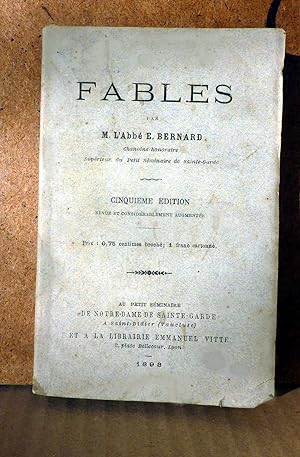
Fables.
Published by Petit Séminaire de Ste Garde et Librairie Vitte 1893 St Didier (Vaucluse), Paris, 1893
1 vol In16 broché de 100 pages. Décorations typographiques. 5° édition revue et considérablement augmentée. Bon état.
-

paperback. Marcel Petit 1988. in-8. 120 pages. Marcel Petit 1988. in-8. 120 pages. Nb de volume : 1. Reprint d'un classique provençal en langue provençale non traduite . Reprint d'un classique provençal en langue provençale non traduite . Couverture à rabats en très bon état, rousseurs internes . Glaude, Pastouralo coumico en tres ate en en vèrs, Ame la musico di nouvé E. L'Ase de Tounin.
-
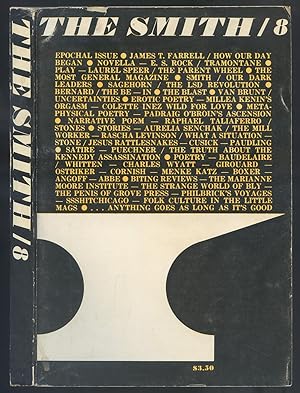
The Smith / 8: Triple Issue (Vol. 3, Issues 1, 2, & 3, February 1968)
Published by The Smith, New York, 1968
Seller: Between the Covers-Rare Books, Inc. ABAA, Gloucester City, NJ, U.S.A.
Association Member: ABAA ESA ILAB IOBA
Seller rating 5 out of 5 stars
First Edition
Softcover. Condition: Very Good. First edition. Illustrated wrappers. Cover design by Stephen Dowskin. 192pp. Covers slightly rubbed with modest edgewear, very good. Includes "How Our Day Began" by James T. Farrell; additional contributions by E.S. Rock, Laurel Speer, Sidney Bernard, Ed Stone, James E. Paulding, Sam Cornish, H.L. Van Brunt, Alicia Ostriker, George Abbe, James Hoggard and more.
-
Saint-Léon et Attila, drame en trois actes et en vers
Published by Au Petit Séminaire de Notre-Dame de Saint-Garde, Vaucluse ; Librairie Vitte et Perrussel, Lyon, 1887
Seller: LIVRES ANCIENS ET CONTEMPORAINS, HASPARREN, France
Seller rating 5 out of 5 stars
Couverture souple. Condition: Moyen. 0 Couverture d'usage ; intérieur en (très) bon état ; DX2-C125. Livre.
-

DIEU ET LES HOMMES.
Language: French
Published by ROBERT LAFFONT . 993., 1993
ISBN 10: 2221076184 ISBN 13: 9782221076187
Couverture souple. Condition: bon. R160047904: 1993. In-8. Broché. Bon état, Couv. convenable, Dos satisfaisant, Intérieur frais. 231 pages. 1ère de couverture illustrée en couleurs. . . . Classification Dewey : 200-RELIGION.
-
SAINT-LO, imp. Jacqueline - 1946 - 56 ème volume - in-8 - broché - 147 pages - mouillures importantes Livres.
-

Couverture souple. Condition: Bon. In-12 broché (160x100 mm) de 275 pages. Le poème de Job (D'après le texte biblique). Ex-libris à l'étiquette de Ernest DE CROZET.
-
Gloires Monastiques ou les Fondateurs et les Fondatrices d'Ordres, d'Institutions et de Congrégations catholiques, au point de vue historique, religieux et social.
Language: French
Published by Périsse Frères, Auguste Hénault, 1851
First Edition
rigide. Condition: Assez bon. 1 vol. in-4 reliure demi-basane marron, Périsse Frères, Paris, Auguste Hénault, Toulouse, 1851, XVI-343 pp. avec 7 lithographies hors texte Etat très satisfaisant (rel. frottée, 5 pl. brunies, ancien cachet d'institution religieuse, étiquette de cote en garde) pour cet intéressant ouvrage. Langue: Français.
-

MARTYRE DE SAINT GERMAIN, DRAME EN 3 ACTES ET EN VERS
Published by Au Petit Séminaire de Notre-Dame de Sainte-Garde, Saint-Didier, 1887
Couverture souple. Condition: bon. RO40146702: 1887. In-12. Broché. Etat d'usage, Couv. légèrement passée, Dos frotté, Intérieur acceptable. 108 pages. Etiquette de code sur le dos. Tampons et annotations de bibliothèque sur le 1er plat et en page de titre. . . . Classification Dewey : 792-Théâtre.
-
ANGERS, Germain & G. Grassin - 1892 -In-8 - broché - Pagination 121 à 407 - rousseurs - mouillures sur 2 è fascicules Livres.
-

L AUREOLE DE LA VIERGE - DEVOTION A MARIE PENDANT LE MOIS DE MAI
Published by PERISSE FRERES/ BON ET PRIVAT, 1841
Couverture rigide. Condition: bon. RO30145006: 1841. In-12. Relié. Etat d'usage, Coins frottés, Dos frotté, Intérieur frais. 482 pages - coiffes frottes - nombreux accrocs sur les plats - contreplats jaspes - lettrines et culs-de-lampe , dos a 4 nerfs , titre dore au dos. . . . Classification Dewey : 232.91-Vierge Marie.
-
MONTBRISON, Imprimerie Éleuthère Brassart - 1929 - R.30x23 - Reliure originale, cartonnage de percaline bleue ou noire chagrinée, titrée or sur un dos rond; (4), 12 et (460) pages; figures en noir. (Collection Chartes du Forez). Bon exemplaire. Français Livres.
-
1. Notre-Dame de Paris. Par Louis Despras [Arthaud]. 2. Notre-Dame de Paris - Huit Siècles d'Histoire. Par Bernard Mahieu. 3. Notre-Dame de Paris - Monument et Vie. Par l'Abbé Louis Le Rouzic. Lot de 3 livres.
Published by B. Arthaud, Éditeur à Grenoble. 1939. + Nouvelles Editions Latines. Sans Date. + Editions SPES à Paris., 1939
Couverture souple. Condition: Bon. Édition illustrée. Un livre et deux brochures sur Notre-Dame de Paris, voir détail plus loin. 122 + 32 + 90 Pages. ********** Détail : 1. Notre-Dame de Paris. Par Louis Despras. B. Arthaud, Éditeur à Grenoble. 1939. Broché, couverture illustrée en couleurs par Paul Leroy et imprimée en bleu, in-8, 19,5x14 cm, 122 pages, 33 photos de Sougez, 1 plan, bon état (texte manuscrit sur la page de faux-titre). ********** 2. Notre-Dame de Paris - Huit Siècles d'Histoire. Par Bernard Mahieu, Conservateur Aux Archives Nationales. Nouvelles Éditions Latines. Sans Date. Brochure agrafée sous couverture illustrée & imprimée en noir, in-8, 19x14 cm environ, 32 pages couverture comprise, gravures en noir dans le texte, bon état. ********** 3. Notre-Dame de Paris - Monument et Vie. Par l'Abbé Louis Le Rouzic, Directeur de la Maîtrise de Notre-Dame de Paris. Éditions SPES à Paris. 1939. Brochure cous couverture blanche imprimée en noir & rouge (insolée), in-12, 16,5x12,5 cm environ, 90 pages, préface de Marcel Aubert, Membre de l'Institut, état correct. ***** Le lot de 3 livres.
-

L'AUREOLE DE LA VIERGE, DEVOTION A MARIE PENDANT LE MOIS DE MAI
Published by Périsse Frères, Paris - Bon et Privat, Toulouse, 1841
Couverture rigide. Condition: bon. RO40170656: 1841. In-12. Relié demi-cuir. Etat d'usage, Couv. convenable, Dos très frotté, Quelques rousseurs. 482 pages. Titre et filets dorés sur le dos. Etiquette de code sur le dos. Tampons de bibliothèque en page de titre. Coiffe en pied abîmée. . . . Classification Dewey : 232.91-Vierge Marie.
-
Condition: Assez bon. BRAUN ET CIE (illustrator).
-

Le Fraxinet - Drame en trois actes et en vers
Published by Au petit séminaire de Notre Dame de sainte Garde, 1895
Condition: Fair. Etat correct. Couverture salie. Intérieur avec peu de rousseurs. Saint Didier (vaucluse). in-12. 1895. broché. 104 pages. Illustrations en couleurs de Pierre Rousseau. Fair.
-
MONTBRISON, Imprimerie Éleuthère Brassart - 1929 - R.30x23 - Reliure originale, cartonnage de percaline bleue ou noire chagrinée, titrée or sur un dos rond; (4), 12 et (516) pages; figures en noir. (Collection Chartes du Forez). Bon exemplaire. Français Livres.
-
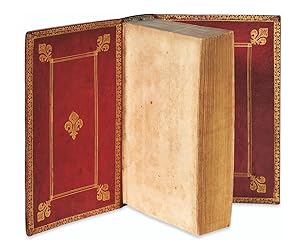
Sermons de S. Bernard, abbé de Clairvaux, sur diverses sortes de sujets. Nouvellement traduits en François, par le R. P. Dom Antoine de S. Gabriel, Fueillent
Published by Jacques de Laize-de-Bresche, 1681
Seller: Librairie Métamorphoses, Paris, France
Association Member: ILAB
Seller rating 5 out of 5 stars
First Edition
Couverture souple. Condition: Très bon. Edition originale. In-8 (182 × 120 mm) de [4]-830-[16] pages, la dernière étant blanche ; maroquin rouge janséniste, dos à nerfs, titre or, doublure bord à bord du même maroquin encadrée d'une dentelle entourant un cadre formé de trois filets portant, aux coins et au centre, cinq grandes fleurs de lys ornées et azurées ; roulette sur les coupes et sur les coiffes, tranches dorées (reliure de l'époque). Édition originale de cette traduction. Elle est l'uvre d'Antoine Desprez, dit Antoine de Saint-Gabriel, moine feuillant, supé- rieur du monastère de Saint-Bernard de Paris et provincial de Bourgogne au XVIIe siècle, traducteur des uvres complètes de saint Bernard (14 volumes parus de 1667 à 1684). Exemplaire réglé, revêtu d'une élégante reliure de l'époque en maroquin rouge. Elle a été probablement exécutée pour un membre ou un proche de la famille royale. Les fers qui ornent la doublure sont caractéristiques des ateliers de reliure qui travaillaient pour la Cour sous les règnes de Louis XIII et de Louis XIV, et attestés comme tels dès le milieu du xviie siècle (voir par exemple Pierre Berès, cat. 86, Livres & manuscrits signifi- catifs et choisis, 1995, no 25). Provenance : « Chaussac » (?), signature sur le feuillet de faux-titre, ainsi qu'une mention plus longue mais caviardée sur la page de titre. Petit manque dans la marge inférieure des feuillets Ee3 et Ee4, papier très légèrement bruni.
-
Lettres d'un françois (français). (Tome III seul)
Seller: Fronhofer Schlösschen Galerie, Burgsinn, Germany
Seller rating 5 out of 5 stars
La Haye, Jean Neaulme, 1745, in-12 de (4)-II-380-(2) pp. d'errata, reliure de l'époque de plein veau fauve granité, dos à nerfs orné de fers dorés, Pièce de titre et de tomaison de maroquin rouge, bel exemplaire. Tome III seul, sur les 3 que comprend l'ouvrage.
-
DE L'ETAT RELIGIEUX
Seller: Librairie Philosophique J. Vrin, Paris, France
Seller rating 4 out of 5 stars

RELIGION[BONNEFOY DE BOUYON (Abbé), BERNARD (Abbé)].De l'État religieux.P., 1784, in-16, rel. demi-veau, dos orné, frotté, pièce de titre, pet. mque au dos, 1 mors fendu, charnières fragiles, tranches jaunes, signet. Barbier, II, 302. 300 gr.
-
Histoire naturelle, générale et particulière, avec la description du Cabinet du Roy
Published by De l'Imprimerie Royale [later Imprimerie des Bâtimens du Roi; Hôtel de Thou; Plassan], Paris, 1804
Seller: SOPHIA RARE BOOKS, Koebenhavn V, Denmark
Seller rating 4 out of 5 stars
First Edition
First edition. The Founding Treatise of Secular Science. First edition of the first work to present natural history as a continuous secular narrative-from planetary formation through geology and mineralogy to the quadrupeds, birds, fishes, and cetaceans, and at last to the human races-and the work in which, across fifty-five years and four political regimes, the biblical chronology that had organised European natural science since antiquity ceased to be the only frame within which educated readers could discuss the age of the earth. Buffon was appointed Intendant du Jardin du Roi in 1739 at thirty-two, and spent nearly half a century converting the royal cabinet of natural-history specimens into a compendium that, at its close under Lacépède's hand in 1804, comprised forty-four quarto volumes, more than twelve hundred engraved plates, and a style so supple that Buffon's elegies on individual species remained set texts in French lycées into the twentieth century. Uniformly bound in contemporary French mottled calf and preserving all forty-four text volumes together with the separately-issued and frequently-absent atlas to the Minéraux, the present copy is of a completeness and coherence uncommon in a publication whose fifty-five-year issue spanned four successive Parisian imprints. His prose made deep time habitable. Within thirty years of the final volume Lyell was writing the Principles of Geology; within sixty, Darwin the Origin. Ernst Mayr called Buffon "the father of all thought in natural history" at his time; the DSB records that he "established the intellectual framework within which most naturalists up to Darwin worked." The publishing history is itself a monument. The first three volumes appeared together in the autumn of 1749 from the Imprimerie Royale, sold out in six weeks, were reprinted three times within the same interval, and provoked the Sorbonne's faculty of theology into delivering Buffon a list of propositions judged heretical-to which Buffon submitted a carefully calibrated retraction while continuing to print the offending volumes unchanged. The initial prospectus of 1748 had promised fifteen volumes in three divisions; by the time Buffon died in 1788 thirty-five were in print, a thirty-sixth was on the press, and the plan of covering the vegetable kingdom had quietly been abandoned. The seventh and final Supplément appeared posthumously in 1789 through Lacépède's editorship; the fifth volume of the Minéraux, containing the Traité de l'aimant, had issued a year earlier from the Imprimerie des Bâtimens du Roi and was accompanied by a separately-issued atlas of folding maps and tables. Lacépède then continued the animal-kingdom programme with the Quadrupèdes ovipares et Serpens (1788-89), the Poissons (1798-An XII) and the Cétacées (1804). The combined output of four imprints across three generations of Parisian printers-the Imprimerie Royale, the Imprimerie des Bâtimens du Roi, the Hôtel de Thou under Panckoucke and Plassan, and Plassan imprimeur-libraire-makes the uniformly-bound contemporary set one of the more elusive bibliographical objects of the French Enlightenment. Volume I opens the series with the Premier Discours: De la manière d'étudier et de traiter l'histoire naturelle, a forty-page frontal assault on Linnaean classification that argues, from a position of mathematical and empirical rigour rare in the literature of the period, that species as Linnaeus conceived them were artificial abstractions imposed on the continuous variability of individuals, and that a taxonomy built on stamen-counts and pistil-counts had no purchase on nature. The attack was political as well as philosophical. Linnaeus's Systema Naturae (Leiden, 1735) had already been adopted as the common grammar of European zoology; Buffon's Discours, delivered from within the most prestigious press in France, asserted that the Swede's method was a convenience of memory mistaken for a description of the world. The volume continues with the Second Discours: Histoire et théorie de la Terre, dated by Buffon himself "à Montbard le 3 octobre 1744," which proposes a cosmogony in which the planets were struck from the sun by the oblique impact of a comet and have been cooling ever since, and with the Preuves de la théorie de la Terre, in which Buffon develops his theory across seventeen articles and provides two engraved terrestrial maps drawn under his supervision by Robert de Vaugondy fils. These arguments, delivered within a volume bearing the royal arms of France on its title-page vignette, constituted the most public challenge to Mosaic cosmogony yet mounted in eighteenth-century France. The geological argument reached its mature form a generation later in the fifth Supplément, the Époques de la Nature (1778), published when Buffon was seventy-one. Here he proposed seven epochs of the earth's history, estimated their combined duration at roughly 75,000 years, and in unpublished manuscript notes pushed his private estimate to three million-an order of magnitude consistent with the timescales that Lyell would later extract from stratigraphy and that Darwin would require for natural selection to operate. The significance of the Époques is not only the number. It is the rhetorical form of the argument: Buffon marshals fossil molluscs at Alpine altitudes, the decay of volcanic emissions, the rate at which heated iron spheres cool in Buffon's own forge at Montbard, and the distribution of living species across climate zones, and weaves these into a cumulative inductive case in which each line of evidence corroborates the others. The technique is no longer antiquarian but probabilistic-Buffon had, after all, published a French translation of Newton's Method of Fluxions in 1740, and would publish original work on the probability that a needle tossed on a ruled floor should cross a line, the problem that bears his name in modern geometric probability. When the Époques reached Edinburgh and Cambridge in the 1780s, it ann.