Order Total (1 Item Items):
Shipping Destination:

Bethlen Count Stephen (3 results)
Skip to main search results
Search filters
Product Type
- All Product Types
- Books (3)
- Magazines & Periodicals (No further results match this refinement)
- Comics (No further results match this refinement)
- Sheet Music (No further results match this refinement)
- Art, Prints & Posters (No further results match this refinement)
- Photographs (No further results match this refinement)
- Maps (No further results match this refinement)
- Manuscripts & Paper Collectibles (No further results match this refinement)
Condition Learn more
- New (No further results match this refinement)
- As New, Fine or Near Fine (No further results match this refinement)
- Very Good or Good (2)
- Fair or Poor (No further results match this refinement)
- As Described (1)
Binding
- All Bindings
- Hardcover (3)
- Softcover (No further results match this refinement)
Collectible Attributes
- First Edition (1)
- Signed (No further results match this refinement)
- Dust Jacket (No further results match this refinement)
- Seller-Supplied Images (1)
- Not Print on Demand (3)
Language (1)
Price
- Any Price
- Under US$ 25 (No further results match this refinement)
- US$ 25 to US$ 50
- Over US$ 50
Free Shipping
- Free Shipping to U.S.A. (No further results match this refinement)
Seller Location
Seller Rating
-

The Treaty Of Trianon And European Peace: Four Lectures Delivered In London In November 1933
Published by Arno Press/ New York Times, 1971
ISBN 10: 0405027370 ISBN 13: 9780405027376
Hardcover. Condition: Very Good. Dust Jacket Condition: No Dustjacket. Later Edition. ISBN 0405027370. Hardback. 1971 reprint of 1934 original. No dustjacket; bound in tan boards with black lettering and black/red design. Slight wear to corners and edges; minor dustsoiling to top edge; otherwise tight, sound and unmarked in Very Good condition. No Signature.
-
The Treaty of Trianon & European Peace.
Publication Date: 1971
Seller: Anthony C. Hall, Bookseller ABA ILAB, Isleworth, MIDDX, United Kingdom
Association Member: ABA ILAB PBFA
Seller rating 4 out of 5 stars

US$ 27.80
US$ 40.49 shipping
Ships from United Kingdom to U.S.A.Quantity: 1 available
Add to basketHardback. 187pp (1934) reprinted Arno Press, NY 1971. Very good copy.
-
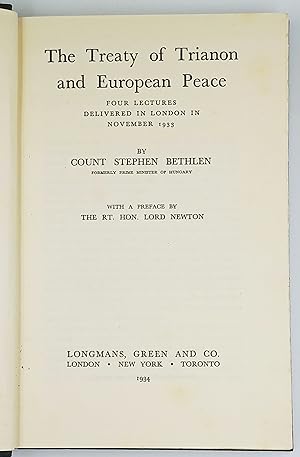
The Treaty of Trianon and European Peace
Published by London - New York - Toronto, Longmans Green and Co., 1934
Seller: Abauj Antique Bookshop, Kistokaj, H, Hungary
Seller rating 5 out of 5 stars

First Edition
Hardcover. Condition: Very Good. 1st Edition. Stephen Bethlen, Count: The Treaty of Trianon and European Peace - Four lectures delivered in London in november 1933 - With a preface by The Rt. Hon. Lord Newton. London - New York - Toronto, 1934. Longmans Green and Co. XIII. 187 p. with map graphs. First edition. Publisher's full cloth binding. - -- - Count Stephen Bethlen, 1874 - 1947?, Hungarian premier (1921 - 31). A Transylvanian, he entered the Hungarian parliament in 1901, and in 1919 he was a delegate to the Paris Peace Conference. Called to the premiership by Admiral Horthy, he prevented (1921), despite his monarchist leanings, the return of King Charles (Austrian Emperor Charles I) to avoid military intervention by the Little Entente. The chief aim of his foreign policy was the revision of the post-World-War-I Treaty of Trianon (see Trianon, Treaty of); a treaty of friendship (1927) with Italy advanced this cause. - -- - The Treaty of Trianon often referred to as the Peace Dictate of Trianon or Dictate of Trianon in Hungary, was prepared at the Paris Peace Conference and was signed in the Grand Trianon château in Versailles on 4 June 1920. It formally ended World War I between most of the Allies of World War I[a] and the Kingdom of Hungary. French diplomats played the major role in designing the treaty, with a view to establishing a French-led coalition of the newly formed states. The treaty regulated the status of the Kingdom of Hungary and defined its borders generally within the ceasefire lines established in November December 1918 and left Hungary as a landlocked state that included 93,073 square kilometres (35,936 sq mi), 28% of the 325,411 square kilometres (125,642 sq mi) that had constituted the pre-war Kingdom of Hungary (the Hungarian half of the Austro-Hungarian monarchy). The truncated kingdom had a population of 7.6 million, 36% compared to the pre-war kingdom's population of 20.9 million. Though the areas that were allocated to neighbouring countries had a majority of non-Hungarians, in them lived 3.3 million Hungarians 31% of the Hungarians who then became minorities. The treaty limited Hungary's army to 35,000 officers and men, and the Austro-Hungarian Navy ceased to exist. These decisions and their consequences have been the cause of deep resentment in Hungary ever since.