

Order Total (1 Item Items):
Shipping Destination:

Biot Arago (21 results)
Skip to main search results
Search filters
Product Type
- All Product Types
- Books (21)
- Magazines & Periodicals (No further results match this refinement)
- Comics (No further results match this refinement)
- Sheet Music (No further results match this refinement)
- Art, Prints & Posters (No further results match this refinement)
- Photographs (No further results match this refinement)
- Maps (No further results match this refinement)
- Manuscripts & Paper Collectibles (No further results match this refinement)
Condition Learn more
- New (9)
- As New, Fine or Near Fine (3)
- Very Good or Good (4)
- Fair or Poor (No further results match this refinement)
- As Described (5)
Binding
Collectible Attributes
- First Edition (9)
- Signed (No further results match this refinement)
- Dust Jacket (No further results match this refinement)
- Seller-Supplied Images (9)
- Not Print on Demand (12)
Language (3)
Price
- Any Price
- Under US$ 25 (No further results match this refinement)
- US$ 25 to US$ 50
- Over US$ 50
Free Shipping
Seller Location
Seller Rating
-

Annalen der Physik. Jahrgang 1807, viertes Stück I-V und drittes Stück I
Language: German
Publication Date: 1807
Hardcover. Condition: Very Good. Slightly shelf-worn w joints starting to crack. Traces of bookworm in front hinge. Clean and tight. I: Ueber die Verwandtschaften der Körper zum Lichte; und insbesondere über das Brechungsvermögen der verschiedenen Gasarten. Von Biot, Arrago. II: Ergänzungen zu dem im vorigen Hefte der Annalen befindlichen Auszuge aus der Abhandlung der Herren Biot und Arago über die Verwandtschaften der Körper zum Lichte und das Brechungsvermögen der Gasarten. Von Gilbert. III: Von der Messung der Höhemn vermittelst des Barometers. Von De La Place. IV: Wägung der Gasarten, des Quecksilbers und des Wassers; und Bestimmung des Coefficienten für Höhenmessungen durch das Barometer. Von Biot und Arago. V: Noch einige Bemerkungen über das Messen der Höhen mit dem Barometer und über die Formel des Hrn. De La Place. Von Gilbert. I: Darstellung der Theorie des Hrn. De La Place von der Wirkung der Haarrörschen, und verwandten Erscheinungen. Von Biot. 346-410 + 36-114 + 152-218 + 233-254 pp + 4 plates (2 fold-out). 8vo. 233 pp.
-
Annales de Chimie et de Physique. Année 1816 - Volume II - Tome Deuxième [ Tome 2 ] : Suite de l'Essai d'une Classification naturelle pour les Corps simples (Ampère) ; Note sur la dilatation des liquides (Gay-Lussac) ; Relation de la Découverte d'une masse de fer natif dans le Brésil par M. Mornay (Wollaston) ; Sur les Eruptions volcaniques de l'île de Java et les îles voisines ; Sur la propriété dont jouissent quelques diamants de couper le verre ; Relation d'un lac de soude dans l'Amérique du Sud (Palacio Faxar), etc.
Language: French
Published by Chez Crochard, 1816
First Edition
rigide. Condition: Satisfaisant. 1 vol. in-8 cartonnage marbré de l'époque, Chez Crochard, Paris, 1816, 440 pp. Contient notamment : Suite de l'Essai d'une Classification naturelle pour les Corps simples (Ampère) ; Note sur la dilatation des liquides (Gay-Lussac) ; Relation de la Découverte d'une masse de fer natif dans le Brésil par M. Mornay (Wollaston) ; Sur les Eruptions volcaniques de l'île de Java et les îles voisines ; Sur la propriété dont jouissent quelques diamants de couper le verre ; Relation d'un lac de soude dans l'Amérique du Sud (Palacio Faxar), etc. Etat satisfaisant (sans gardes, mq. la coiffe de queue, qq. petites piqûres de vers en dos) Langue: Français.
-
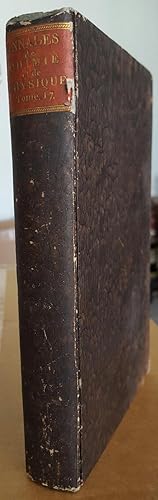
rigide. Condition: Assez bon. 1 vol. in-8 cartonnage marbré de l'époque, Chez Crochard, Paris, 1821, 448 pp. avec un tableau dépliant et une planche dépliante. Contient notamment : Rapport fait à l'Académie des Sciences par M. Arago, le lundi 4 juin 1821, sur un Mémoire de M. Fresnel relatif aux couleurs des lames cristallisées douées de la double réfraction - Notes sur le calcul des teintes que la polarisation développe dans les lames cristallines (Fresnel) ; IIe Note (Fresnel) ; Remarques de M. Biot sur un Rapport lu, le 4 juin 1821, à l'Académie des Sciences, par Mm. Arago et Ampère ; Examen des remarques de M. Biot (Ampère) ; Sur la manière d'analyser les mines de nickel, et sur une nouvelle combinaison du nickel avec l'arsenic et le soufre (Berzelius) ; Note sur le sulfate de Quinine (Robiquet) ; Analyse comparée des excrémens d'un rossignol du coeur d'un boeuf dont il a été nourri (Braconnot) ; Sur la pierre météorique qui est tombée dans le département de l'Ardèche, le 15 juin 1821 ; etc. Rare exemplaire du tome 17 des "Annales de Chimie et de Physique". Etat très satisfaisant (cartonnage lég. frotté avec petit accroc en coiffe sup. et notamment à un mors en coiffe sup.) Langue: Français.
-

Couverture rigide. Condition: Bon. Edition originale. ---- EDITION ORIGINALE ---- Réunion en deux volumes, par la Société Française de physique, des mémoires publiés sur l'électrodynamique par AMPERE, OERSTED, ARAGO, BIOT, DAVY, FARADAY, G. et A. DE LA RIVE, FRESNEL, BARLOW, SAVARY, WEBER, ETC ---- P., Gauthier-Villars, 2 volumes in 8 reliés en demi-chagrin vert et en demi-chagrin rouge (reliures de l'époque), 7pp., 412pp. ; (2), 403pp. ---- "Ces mémoires sont rangés par ordre de date. Le premier volume commence par le mémoire d'OERSTED, publié le 21 Juillet 1820, et va jusqu'à la fin de 1823. Il renferme également les mémoires d'AMPERE, d'ARAGO, de BIOT, de DAVY, de FARADAY, etc. Ceux d'AMPERE tiennent naturellement la plus grande place. Les mémoires d'AMPERE postérieures à 1823 occupent également une grande partie du volume. On trouvera, à très peu près, dans ces deux volumes tout ce qui a été publié sur l'électrodynamique par l'illustre physicien. On trouvera également quelques morceaux restés inédits ou publiés seulement par extraits ainsi que DEUX NOTES INEDITES DE FRESNEL relatives au magnétisme.". (Avertissement) ---- OERSTED : Expérience relative à l'effet du conflit électrique sur l'aiguille aimantée -- AMPERE : De l'action exercée sur un courant électrique par un autre courant, le globe terrestre ou un aimant ; Mémoire sur l'expression mathématique des attractions et des répulsions électriques ; Analyse des mémoires lus à l'Académie les 11 et 26 Décembre 1820 et les 8 et 15 Janvier 1821 ; Extrait d'une lettre d'Ampère à M. Le Professeur De La Rive sur des expériences électromagnétiques ; Expériences relatives aux nouveaux phénomènes électrodynamique obtenus au mois de Décembre 1821 ; Réponse à la lettre de M. Van Beck, sur une nouvelle expérience électromagnétique ; Exposé sommaire des nouvelles expériences électromagnétiques faites par différents physiciens, depuis le mois de Mars 1821 ; Second mémoire sur la détermination de la formule qui représente l'action mutuelle de deux portions infiniment petites de conducteurs voltaïques ; Mémoire sur la théorie mathématique des phénomènes électro-dynamiques, uniquement déduite de l'expérience, dans lequel se trouvent réunis les mémoires que M. Ampère a communiqués à l'Académie royale des Sciences, dans les séances des 4 et 26 Décembre 1820, 10 Juin 1822, 22 Décembre 1823, 12 Septembre et 28 Novembre 1825. -- ARAGO : Expériences relatives à l'aimantation du fer et de l'acier par l'action du courant voltaïque - Davy : Sur les phénomènes magnétiques produits par l'électricité ; Nouvelles recherches sur les phénomènes magnétiques produits par l'électricité . Sur un nouveau phénomène électromagnétique -- FRESNEL : Note sur des essais ayant pour but de décomposer l'eau avec un aimant ; Comparaison de la supposition des courants autour de l'axe avec celle des courants autour de chaque molécule ; Deuxième note sur l'hypothèse des courants particulaires -- BIOT & SAVARY : Sur l'aimantation imprimée aux métaux par l'électricité en mouvement -- G. DE LA RIVE : Notice sur quelques expériences électromagnétiques -- FARADAY : mémoire sur les mouvements électromagnétiques et la théorie du magnétisme ; notes d'Ampère sur le mémoire de Faraday -- BARLOW : Sur une expérience électromagnétique curieuse - G. DE LA RIVE : Lettre à M. Arago sur de nouvelles expériences relatives aux actions des courants galvaniques - A. De La Rive : Mémoire sur l'action qu'exerce le globe terrestre sur une portion de circuit voltaïque -- SAVARY, WEBER - ETC**4807/M2.
-
Collection de mémoires relatifs à la physique publiés par la Société Française de physique : Tome I : Mémoires de COULOMB - Tome II & III Mémoires sur l'électrodynamique par OERSTED - AMPERE - ARAGO - BIOT - DAVY - FARADAY - G. & A. DE LA RIVE - FRESNEL --- 3 VOLUMES (COMPLETE SET)
Published by P., Gauthier-Villars, 1884/1887;, 1887
First Edition
Couverture rigide. Condition: Très bon. Edition originale. ---- EDITION ORIGINALE ---- RARE ---- P., Gauthier-Villars, 1884/1887; 3 VOLUMES in 8 reliés en demi-toile grise, étiquettes de titre bordeaux, dos ornés d'un fleuron doré (reliures de l'époque), T.1 : 16pp., 414pp., T.2 : 7pp., 412pp., T.3 : (2), 403pp. ---- Réunion en 3 volumes par la Société française de physique de MEMOIRES RELATIFS A L'ELECTRICITE ET AU MAGNETISME PARUS AUX XVIIIe et XIXe SIECLES. Le premier volume contient tous les mémoires de COULOMB. Les deuxième et troisième volumes renferment les mémoires sur L'ELECTRODYNAMIQUE par OERSTED, AMPERE, ARAGO, DAVY, FRESNEL, BIOT et SAVART, FRESNEL, G. DE LA RIVE, FARADAY, BARLOW, A. DE LA RIVE, SAVARY, WEBER**4805/M1.
-
Mémoires de physique et de Chimie - 1807/1817 -- EDITION ORIGINALE -- BEL EXEMPLAIRE -- 3 VOLUMES (COMPLETE SET)
Published by P., Bernard, 1807/1817, 1807
First Edition
Couverture rigide. Condition: Très bon. Edition originale. ---- EDITION ORIGINALE ---- RARE ---- BEL EXEMPLAIRE provenant de la bibliothèque de la Société de Jésus dont le fonds scientifique fut vendu à l'hôtel Drouot en 1984 ---- P., Bernard, 1807/1817, 3 VOLUMES in 8 reliés en pleine basane racinée, dos ornés de fers et filets dorés, étiquettes de titres et de tomaisons rouge, tranches jaspées (reliures de l'époque), (cachets de la bibliothèque de la société de Jésus dans la marge des pages de titres dont le fonds scientifique fut vendu à l'hotel Drouot en 1984), T.1 : (2), 4pp., 382pp., 1 TABLEAU DEPLIANT, 1 PLANCHE DEPLIANTE, T.2 : 3 feuillets non chiffrés, pp. 6/498, 1 TABLEAU DEPLIANT, 2 PLANCHES, T.3 : 6pp., (1), 618pp., 1 TABLEAU DEPLIANT ---- EN FRANCAIS DANS LE TEXTE N° 215 : "En 1807, BERTHOLLET fonde avec LAPLACE la Société d'Arcueil qui se réunit régulièrement pour discuter des grands problèmes scientifiques de l'époque. LA SOCIETE D'ARCUEIL a regroupé les savants les plus éminents de cette première moitié du XIXe siècle et, malgré sa durée très courte, CELLE-CI DOIT ETRE RETENUE COMME LE HAUT LIEU DE LA SCIENCE DE CETTE EPOQUE. Une simple liste des savants membres de la Société d'Arcueil suffit à témoigner de son importance : BERTHOLLET, LAPLACE, Alexandre de HUMBOLDT, J.B. BIOT, THENARD, GAY-LUSSAC, Pyrame de CANDOLLE, COLLET-DESCOLTILS, Amédée Barthélémy BERTHOLLET (le fils), Etienne-Louis MALUS, François ARAGO, J.E. BERARD, CHAPTAL, Pierre-Louis DULNG, Siméon-Denis POISSON. La collaboration d'un tel groupe de savant fut très fructueuse et donna lieu à un grand nombre de travaux en commun. A THENARD et GAY-LUSSAC, nous devons la préparation du sodium et du potassium en grande quantité par des moyens chimies ; à HUMBOLDT et GAY-LUSSAC des études sur le magnétisme terrestre. En 1808, GAY-LUSSAC donne sa loi sur la combinaison des gaz en volume, selon laquelle les gaz se combinent entre eux avec des rapports volumétriqaues simples. Une grande partie du premier volume est consacrée aux travaux de THENARD sur les éthers et sur la bile. MALUS découvre la polarisation de la lumière par réflexion. HUMBOLDT étudie la géographie des plantes. BIOT publie un mémoire sur la vitesse du son. DULONG découvre le chlorure d'azote" ---- NORMAN N° 1971**76390/7639/ARB3.
-
_ 'Note sur le calcul des teintes que la polarisation développe dans les lames cristallisées'. Pp. 101-112, 167-192, 312-316 in: Annales de Chimie et Physique, vol. 17 (Dix-Septieme). BIOT: 'Remarques de Biot sur un rapport lu, le 4 juin 1821, à l Académie des Sciences, par MM. Arago et Ampère' (pp. 225-258). ARAGO: 'Examen des Remarques de M. Biot' (258-272); ARAGO & AMPÈRE: 'Rapport fait l'Academie des Sciences le lundi 4 juin 1821 sur un memoire de M. Fresnel, relatif aux couleurs des lames cristallisées douées de la double réfraction' (80-101).
Published by Paris: Crochard, 1821., 1821
Seller: Ted Kottler, Bookseller, Redondo Beach, CA, U.S.A.
Seller rating 4 out of 5 stars

First Edition
Hardcover. Condition: Very Good. No Jacket. 1st Edition. First Edition of a 'major controversy . . . one that marks the first public encounter between a selectionist and a wave theorist' (Buchwald, 1989, p. 214) -- Fresnel and Biot -- that also involved their contemporaries Arago and Ampère. 'The nasty confrontation between Arago and Biot that Fresnel so vividly described marks an epoch in the history of the wave theory' (Buchwald, p. 238). Entire volume offered. 448 pp; plates (2 folding). Contemporary boards. Edges slightly worn, else Very Good. Fresnel's 'Calcul des teintes' paper, as it is referred to by Jed Z. Buchwald in his The Rise of the Wave Theory of Light: Optical Theory and Experiment in the Early Nineteenth Century (1989; the bibliographic entry for the paper is 1821c), was reprinted in Vol. I, pp. 609-653 of Fresnel's Oeuvres (1827). In this paper Fresnel 'detailed his new hypothesis that light is always asymmetric' (Buchwald, p. 390). Biot's paper is reprinted in Fresnel's Oeuvres (pp. 569-590), as is Arago's (591-600); the trio forms much of the basis for Buchwald's discussion of the complex problems -- and Fresnel's eventual solution -- of diffraction, polarization, etc., on pp. 212-62. On pp. 227-8, Buchwald quotes a passage from Fresnel 1821c, 611-12, then follows: 'However, with this hypothesis alone one cannot explain any better than before why Fresnel's and Arago's rules [for the interference of polarized light] work. Moreoever, as it stands one would be at a loss to explain why the asymmetry sometimes rotates and sometimes does not -- whereas before one could at least understand that a wave might have both a longitudinal and a transverse component. Accordingly Fresnel did not introduce this new hypothesis without also suggesting a unifying physical interpretation for it: namely, that the asymmetry in question occurs entirely in the plane of the wave, so that light waves are always completely transverse. Fresnel carefully emphasized this idea in the spring of 1821, and it is worth quoting from him at some length because it is the only evidence we have from near the period when he developed his new understanding [my emphasis].' Buchwald then quotes from Fresnel 1821c, 635-36, and follows, "Implicit in this physical hypothesis is a new, and difficult, understanding of the function of the principle of interference, one that permits it to be used in a very general manner" (p. 229). Buchwald begins chapter 9, 'A Case of Mutual Misunderstanding', by quoting the letter from Fresnel to his brother Léonor that 'so vividly described' the Arago-Biot confrontation, then adds, 'Scarcely two years after Fresnel had won the prize for his diffraction memoir, the Academy ordered printed, over Biot's explicit and public objections, Fresnel's account of chromatic polarization. The members did not accept the report, but apparently only because Arago had insisted that they do so (and he in any case had the report printed in the Annales almost immediately [Arago and Fresnel 1821] [pp. 80-101 in the volume offered here; pp. 553-68 in Fresnel, Oeuvres]. This was a stunning personal victory for Arago and a stinging public defeat for Biot. Years before, Biot had snatched the field away from Arago; now, by proxy at least, Arago took it back. . . . The events that culminated in this bitter confrontation are somewhat tangled, in part because Fresnel's memoir was not printed until the Oeuvres. Instead, Arago printed Fresnel's 'Calcul des teintes' in three parts in the Annales. However, at the end of his report Arago remarks that the first memoir discussed in it was submitted to the Academy on 7 October 1816, and it was followed by 'a supplement' on 19 January 1818. There were in addition several notes that Fresnel gave to Arago and Ampère (almost certainly just shortly before the report was written)' (Buchwald, p. 238; the remainder of the chapter, pp. 239-51, discusses Arago's and Biot's polemical reports).
-

Ueber die Verwandtschaften der Körper zum Lichte; und insbesondere über das Brechungsvermögen der verschiedenen Gasarten. Frei bearbeitet von Gilbert. SS. (345)-392. In: Annalen der Physik. Hrsg. L. W. Gilbert. Band 25.
Language: German
Published by Leipzig Barth, 1807
Seller: Antiquariat Gerhard Gruber, Heilbronn, Germany
Seller rating 4 out of 5 stars
First Edition
(20 x 12 cm). (8) 468 S. Mit 4 Kupfertafeln. Pappband der Zeit. Erste deutsche Ausgabe dieser bedeutenden Arbeit. - "Arago und Biot bestimmen den Brechungsexponenten von Gasen, indem sie die Ablenkung messen, die ein Lichtstrahl durch ein mit dem Gase gefülltes Hohlprisma erfährt, und leiten das Gesetz ab, daß die brechenden Kräfte der Gase ihren Dichtigkeiten proportional sind, und daß für Gasgemische die brechende Kraft gleich der Summe der brechenden Kräfte der Bestandteile ist" (Darmstaedter). - Stempel auf Titel. Stellenweise etwas stockfleckig und gebräunt. Die letzten Blätter mit schwachem schmalen Fleckenrand im oberen weißen Rand, sonst gut erhalten. - DSB 2, 133; Darmstaedter 292. - Der Band enthält weiter Arbeiten von Vauquelin, A. von Humboldt, von Rumford, L. von Buch etc.
-
Rapport fait à l'Academie des Sciences, le lundi 23 Avril 1821, sur le Voyage autour du Monde de la Corvette l'Uranie, commandée par M. de Freycinet.
Seller: Herman H. J. Lynge & Søn ILAB-ABF, Copenhagen, Denmark
Seller rating 4 out of 5 stars
First Edition
(Paris, Crochard, 1821). No wrappers, as extracted. In: "Annales de Chimie et de Physique, Par MM. Gay-Lussac et Arago.", tome 16, Cahier 4. Pp. 389-427. First printing of the official raport on captain Freycinet's voyage. He sailed from Toulon on 17 September 1817 in L'Uranie with his wife Rose who secreted herself aboard, and who wrote a separate account of the voyage. After refreshing at the Cape of Good Hope and Mauritius he landed at Shark Bay on 12 September 1818 where he set up an observatory, thoroughly surveyed the inlets and the coastal districts and removed the plate left by Willem de Vlamingh, which he had found and re-erected in 1801. He then sailed north to Timor. His accounts and description of the landscape and life and customs of that and other islands in the East Indies captivated the attention of people in Europe much more than his Australian reports, and a widespread interest developed in the expedition. Leaving Timor on 27 November he sailed via the Moluccas, the Carolines, the Marianas, and the Sandwich Islands and reached Port Jackson on 19 November 1819, the scientists on board adding constantly to their store of information on hydrography, botany, cartography and anthropology. After spending Christmas ashore, they sailed on 26 December and, falling in with the westerlies, set a course for Cape Horn.On 13 February 1820 L'Uranie was wrecked on the Falkland Islands" the scientific records and notes were saved before the vessel foundered, but 2500 of the 4175 plant specimens were lost. Freycinet returned to France in November 1820 and died on 18 August 1842.
-
Rapport fait à l'Academie des Sciences, le lundi 23 Avril 1821, sur le Voyage autour du Monde de la Corvette l'Uranie, commandée par M. de Freycinet.
Seller: Herman H. J. Lynge & Søn ILAB-ABF, Copenhagen, Denmark
Seller rating 4 out of 5 stars
First Edition
(Paris, Crochard, 1821). No wrappers. In: "Annales de Chimie et de Physique, Par MM. Gay-Lussac et Arago.", tome 16, Cahier 4. Pp. 337-445. (The entire issue offered). Rapport: pp. 389-427. First printing of the official raport on captain Freycinet's voyage. He sailed from Toulon on 17 September 1817 in L'Uranie with his wife Rose who secreted herself aboard, and who wrote a separate account of the voyage. After refreshing at the Cape of Good Hope and Mauritius he landed at Shark Bay on 12 September 1818 where he set up an observatory, thoroughly surveyed the inlets and the coastal districts and removed the plate left by Willem de Vlamingh, which he had found and re-erected in 1801. He then sailed north to Timor. His accounts and description of the landscape and life and customs of that and other islands in the East Indies captivated the attention of people in Europe much more than his Australian reports, and a widespread interest developed in the expedition. Leaving Timor on 27 November he sailed via the Moluccas, the Carolines, the Marianas, and the Sandwich Islands and reached Port Jackson on 19 November 1819, the scientists on board adding constantly to their store of information on hydrography, botany, cartography and anthropology. After spending Christmas ashore, they sailed on 26 December and, falling in with the westerlies, set a course for Cape Horn.On 13 February 1820 L'Uranie was wrecked on the Falkland Islands" the scientific records and notes were saved before the vessel foundered, but 2500 of the 4175 plant specimens were lost. Freycinet returned to France in November 1820 and died on 18 August 1842.
-
Mémoire sur la Diffraction de la lumière, où l'on examine particululièrement le phénomène des franges colorées que présentent les ombres des corps éclairés par un point lumineux. - Extrait d'une Lettre de M. Fresnel à M. Arago, sur l'influence de .
Seller: Herman H. J. Lynge & Søn ILAB-ABF, Copenhagen, Denmark
Seller rating 4 out of 5 stars
Paris, Crochard, 1816-25. Bound in 2 fine recent hmorocco. In: "Annales de Chimie et de Physique, Redigées par MM. Gay-Lussac et Arago", Tome I, IV, IX, X, XI, XV, XVII, XX, XXI, XXIII, XXVIII and XXIX. Some memoirs with scattered brownspots. All but volume 15 with the orig. titlepages to the volumes. Vol. XV having instead of the titlepage, a sample of the orig. printed wrappers, December issue 1820. Bound at end of volume 2. The memoir, no. 25a below is inserted at the end of volume 2. Some of the memoirs having textillustrations. Some versos of titlepages with stamps. First appearances of this groundbreaking series of papers and memoirs in which Fresnel established the scientific basis for the wave theory of light and gave the theoretical framework for explaining, in the context of his theory of the transversal nature of lightwaves, the phenomena of double refraction, refraction, dispersion, polarization, interference, diffraction patterns, diffraction fringes as light spreads around objects, etc. He developed mathematically the hypothesis of the wave nature of light and he demonstrates its conformity with experience. His study of light was a dynamic interplay between theory and observation, between mathematics and experiment. - The offered series also comprises the contributions from Arago and the rapports from The French Academy's committees by Ampère, Biot and Fourier - see below nos. 6,11,14,15,a.nd 18."From the point of view of method, his investigations extended from the manual operations of the laboratory to the most abstract mathematical analyses. Few physicists since Newton had been so versatile."(Silliman in "Historical Studies in the Physical Sciences", vol. 4, p. 155.)."The wave-thory at this time was still encumbered with difficulties. Diffraction was not satisfactorily explained" for polarization no explanation of any kind was forthcoming the Huygenian construction appeared to require two different luminiferous media within double refracting bodies and the universality of that construction had been impugned by Brewster's discovery of biaxial crystals. The upholders of the emission theory, emboldened by the success of Laplace's theory of double refraction, thought the time ripe for their final triunph and as a step to this, in March 1817 they proposed Diffration as the subject of the Academy's prize for 1818. Their expectation was disappointed" and the successful memoir afforded the first of a series of reverses of which, in the short space of seven years, the corpuscular theory was completely owerthrown. The author was Augustin Fresnel."(Whittaker "A History of the Theories of Aether & Electricity", vol. 1, p.107 ff.)."This concept of transverse waves met with the greatest hostility from the scientists of the day, who could not imagine an extremely fluid and rarified ether which at the same time possessed the mechanical properties of a rigid body. Even Arago admitted that he could not follow the exuberant engineer in his ideas. ButFresnel was convinced that at last he had the key to many mysteries, and with his model of waves he gave a full clarification of the phenomena of polarization. With insuperable precision he explained a long series of extremely complicated experiments, such as those of chromatic polarization that Arago himself had discovered by chance in 1811, and which the followers of Newton could not explain in spite of all their efforts. Following this line Fresnel reached the synthesis which is his masterpiece.we must recall the final interpretation that he gave of the famous phenomenon of partial reflection by transparent surfaces, that simple phenomenon which until then had puzzled Grimaldi, Newton, and Huygens, and which in Malus's experiments had unexpectedly acquired a special importencee as it had been compared to the great mystery of double refraction."(Ronchi "The Nature of Light", p. 255 ff.).Comprising:1. Mémoire sur la Diffraction de la lumière, où l'on examine particululièrement le phénomène des franges colorées que présentent les ombres des corps éclairés par un point lumineux. "Ann.Chim.P." Tome 1. 1816. With titlepage to vol. 1. Pp. 239-281 and 1 folded engraved plate.2. Extrait d'une Lettre de M. Fresnel à M. Arago, sur l'influence de la chaleur dans les couleurs développées par la polarisation.Tome 4. 1817. With titlepage to vol. 4. Pp. 298-300.3. Lettre de M. Fresnel à M. Arago, sur l'influence du mouvement terrestres dans quelques phénomènes terrestres dans quelques phénoménes d'optique. Tome 9. 1818. With titlepage to vol. 18. Pp. 57-70.4. Note additionelle à la Lettre de M. Fresnel à M. Arago, insérée dans le dernier Cahier des Annales. Tome 9. 1818. Pp. 286-287.5. FRESNEL & ARAGO. Sur l'Action que le rayons de lumiére polarisés exercent les uns sur les autres. Tome 10. 1819. With titlepage to vol. 10. Pp. 288-305. - Also with "Extrait d'un ouvrage du P. Grimaldi intitulé: Traité physico-mathérmatique de la lumiere des couleurs et de l'iris". Pp. 306-312.6. ARAGO. Rapport par M. Arago à l'Academie des Sciences, au nom de la Commission qui avait été chargée d'examiner les Mémoires envoyés au concours pour le prix de la diffraction. Tome 11. 1819. With titlepage to vol. 11. Pp. 5-30.7. Mémoire sur la Diffraction de la Lumiere. (Extrait). (This importent Price-Memoir was only printed in full in 1826). Tome 11. 1819. Pp. 246-296.8. Suite Du Mémoire sur la Diffraction de la Lumière. Tome 11. 1819. Pp. 337-378. + Note sur des Essais ayant pour but de décomposer l'eau avec un aimant. Pp. 219-222.9. Note sur des Essais ayant pour but de décomposer l'eau avec un aimant. Tome 15. 1820. Pp. 219-222. No titlepage to vol. 15.10. Résume d'un Mémoire sur la Reflexion de la lumière. Tome 15. 1820. Pp. 379-386. Tome 15 is here represented with the last issue of the year (Decembre 1820, pp. 337-448) and instead of the titlepage having the orig. printed wrappers (bound at end of the second volume).11. ARAGO & AMPÈRE. Rapport fait à l'Academie des Sciences.
-
Leather Bound. Condition: New. Presenting an Exquisite Leather-Bound Edition, expertly crafted with Original Natural Leather that gracefully adorns the spine and corners. The allure continues with Golden Leaf Printing that adds a touch of elegance, while Hand Embossing on the rounded spine lends an artistic flair. This masterpiece has been meticulously reprinted in 2025, utilizing the invaluable guidance of the original edition published many years ago in 1806. The contents of this book are presented in classic black and white. Its durability is ensured through a meticulous sewing binding technique, enhancing its longevity. Imprinted on top-tier quality paper. A team of professionals has expertly processed each page, delicately preserving its content without alteration. Due to the vintage nature of these books, every page has been manually restored for legibility. However, in certain instances, occasional blurriness, missing segments, or faint black spots might persist. We sincerely hope for your understanding of the challenges we faced with these books. Recognizing their significance for readers seeking insight into our historical treasure, we've diligently restored and reissued them. Our intention is to offer this valuable resource once again. We eagerly await your feedback, hoping that you'll find it appealing and will generously share your thoughts and recommendations. Pages:- 102, Print on Demand. If it is a multi-volume set, then it is only a single volume. We are specialised in Customisation of books, if you wish to opt different color leather binding, you may contact us. This service is chargeable. Product Disclaimer: Kindly be informed that, owing to the inherent nature of leather as a natural material, minor discolorations or textural variations may be perceptible. Explore the FOLIO EDITION (12x19 Inches): Available Upon Request. 102 102.
-
Leather Bound. Condition: New. Language: French. Language: French. Presenting an Exquisite Leather-Bound Edition, expertly crafted with Original Natural Leather that gracefully adorns the spine and corners. The allure continues with Golden Leaf Printing that adds a touch of elegance, while Hand Embossing on the rounded spine lends an artistic flair. This masterpiece has been meticulously reprinted in 2025, utilizing the invaluable guidance of the original edition published many years ago in 1806. The contents of this book are presented in classic black and white. Its durability is ensured through a meticulous sewing binding technique, enhancing its longevity. Imprinted on top-tier quality paper. A team of professionals has expertly processed each page, delicately preserving its content without alteration. Due to the vintage nature of these books, every page has been manually restored for legibility. However, in certain instances, occasional blurriness, missing segments, or faint black spots might persist. We sincerely hope for your understanding of the challenges we faced with these books. Recognizing their significance for readers seeking insight into our historical treasure, we've diligently restored and reissued them. Our intention is to offer this valuable resource once again. We eagerly await your feedback, hoping that you'll find it appealing and will generously share your thoughts and recommendations. Lang: - French, Pages:- 106, Print on Demand. If it is a multi-volume set, then it is only a single volume. We are specialised in Customisation of books, if you wish to opt different color leather binding, you may contact us. This service is chargeable. Product Disclaimer: Kindly be informed that, owing to the inherent nature of leather as a natural material, minor discolorations or textural variations may be perceptible. Explore the FOLIO EDITION (12x19 Inches): Available Upon Request. 106 106.
-

Condition: New. Print on Demand.
-
849.BIOT ET ARAGO 1821 RECUEIL DOBSERVATIONS GEODESIQUES, ASTRONOMIQUES ET PHYSIQUES. 588PP. ILLUSTRATED PLUS FOLD OUT PLATES. MARBLE AND LEATHER. GOOD CONDITION. (GNH-BASE-45).
-
Condition: New. PRINT ON DEMAND.
-
Condition: New. Print on Demand.
-

Condition: New. Print on Demand.
-
Condition: New. Print on Demand.
-
Condition: New. PRINT ON DEMAND.
-
Leather Bound. Condition: New. Language: francais. Language: francais. Presenting an Exquisite Leather-Bound Edition, expertly crafted with Original Natural Leather that gracefully adorns the spine and corners. The allure continues with Golden Leaf Printing that adds a touch of elegance, while Hand Embossing on the rounded spine lends an artistic flair. This masterpiece has been meticulously reprinted in 2024, utilizing the invaluable guidance of the original edition published many years ago in 1821. The contents of this book are presented in classic black and white. Its durability is ensured through a meticulous sewing binding technique, enhancing its longevity. Imprinted on top-tier quality paper. A team of professionals has expertly processed each page, delicately preserving its content without alteration. Due to the vintage nature of these books, every page has been manually restored for legibility. However, in certain instances, occasional blurriness, missing segments, or faint black spots might persist. We sincerely hope for your understanding of the challenges we faced with these books. Recognizing their significance for readers seeking insight into our historical treasure, we've diligently restored and reissued them. Our intention is to offer this valuable resource once again. We eagerly await your feedback, hoping that you'll find it appealing and will generously share your thoughts and recommendations. Lang: - francais, Pages: - 638, Print on Demand. If it is a multi-volume set, then it is only a single volume. We are specialised in Customisation of books, if you wish to opt different color leather binding, you may contact us. This service is chargeable. Product Disclaimer: Kindly be informed that, owing to the inherent nature of leather as a natural material, minor discolorations or textural variations may be perceptible. Explore the FOLIO EDITION (12x19 Inches): Available Upon Request. 638 638.

![Seller image for Annales de Chimie et de Physique. Année 1816 - Volume II - Tome Deuxième [ Tome 2 ] : Suite de l'Essai d'une Classification naturelle pour les Corps simples (Ampère) ; Note sur la dilatation des liquides (Gay-Lussac) ; Relation de la Découverte d'une masse de fer natif dans le Brésil par M. Mornay (Wollaston) ; Sur les Eruptions volcaniques de l'île de Java et les îles voisines ; Sur la propriété dont jouissent quelques diamants de couper le verre ; Relation d'un lac de soude dans l'Amérique du Sud (Palacio Faxar), etc. for sale by Librairie du Cardinal](https://pictures.abebooks.com/inventory/md/md8861037067.jpg)
![Seller image for Annales de Chimie et de Physique. 1821 - Volume 2 : Tome Dix-Septième [ Tome 17 - Tome XVII ] : Rapport fait à l'Académie des Sciences par M. Arago, le lundi 4 juin 1821, sur un Mémoire de M. Fresnel relatif aux couleurs des lames cristallisées douées de la double réfraction - Notes sur le calcul des teintes que la polarisation développe dans les lames cristallines (Fresnel) ; IIe Note (Fresnel) ; Remarques de M. Biot sur un Rapport lu, le 4 juin 1821, à l'Académie des Sciences, par Mm. Arago et Ampère ; Examen des remarques de M. Biot (Ampère) ; Sur la manière d'analyser les mines de nickel, et sur une nouvelle combinaison du nickel avec l'arsenic et le soufre (Berzelius) ; Note sur le sulfate de Quinine (Robiquet) ; Analyse comparée des excrémens d'un rossignol du coeur d'un boeuf dont il a été nourri (Braconnot) ; Sur la pierre météorique qui est tombée dans le département de l'Ardèche, le 15 juin 1821 ; etc. for sale by Librairie du Cardinal](https://pictures.abebooks.com/inventory/md/md8861037082.jpg)


![Seller image for Mémoire sur les affinités des corps pour la lumière, et particulièrement sur les forces réfringentes des différens gaz, par MM. Biot et Arago, lu à la classe des sciences mathématiques et physiques de l'Institut national de France, le 24 mars 1806 1806 [Leather Bound] for sale by Gyan Books Pvt. Ltd.](https://pictures.abebooks.com/inventory/md/md31962419124.jpg)
![Seller image for Mémoire sur les affinités des corps pour la lumière : et particulièrement sur les forces réfringentes des différens gaz 1806 [Leather Bound] for sale by Gyan Books Pvt. Ltd.](https://pictures.abebooks.com/inventory/md/md31423707721.jpg)

![Seller image for Recueil d'observations geodesiques, astronomiques et physiques, executees par ordre du Bureau des longitudes de France en Espagne, en France, en Angleterre et en Ecosse, pour determiner la variation de la pesanteur et des degres terrestres sur le prolong 1821 [Leather Bound] for sale by Gyan Books Pvt. Ltd.](https://pictures.abebooks.com/inventory/md/md30266782053.jpg)