Order Total (1 Item Items):
Shipping Destination:

Black Panthers (37 results)
Skip to main search results
Search filters
Product Type
- All Product Types
- Books (20)
- Magazines & Periodicals (14)
- Comics (No further results match this refinement)
- Sheet Music (No further results match this refinement)
- Art, Prints & Posters (1)
- Photographs (No further results match this refinement)
- Maps (No further results match this refinement)
- Manuscripts & Paper Collectibles (2)
Condition Learn more
- New (4)
- As New, Fine or Near Fine (3)
- Very Good or Good (3)
- Fair or Poor (No further results match this refinement)
- As Described (27)
Binding
Collectible Attributes
- First Edition (4)
- Signed (2)
- Dust Jacket (No further results match this refinement)
- Seller-Supplied Images (30)
- Not Print on Demand (36)
Language (2)
Free Shipping
Seller Location
Seller Rating
-
hardcover. Condition: Very Good. Connecting readers with great books since 1972! Used books may not include companion materials, and may have some shelf wear or limited writing. We ship orders daily and Customer Service is our top priority!
-
Paperback. Condition: Very Good. Connecting readers with great books since 1972! Used books may not include companion materials, and may have some shelf wear or limited writing. We ship orders daily and Customer Service is our top priority!
-

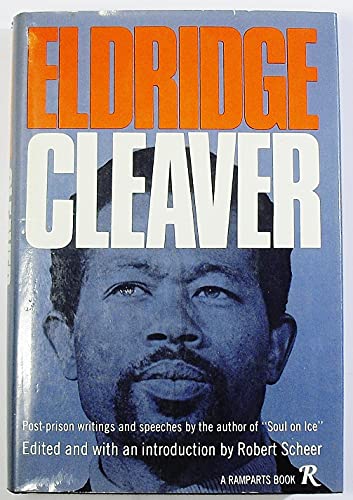
Eldridge Cleaver: post-prison writings and speeches [Hardcover] [Black Panthers] Cleaver, Eldridge. (Scheer, Robert, editor)
Language: English
Published by RAMPARTS PRESS INC, 1969
hardcover. Condition: Good. 1969 used hardcover copy some wear/tears to dust jacket, tanning to pages with age, spine intact, price tag unclipped.
-

Black Panther Inspiration: Rehabilitating Black Prisoners
ISBN 10: 171918464X ISBN 13: 9781719184649
Condition: As New. Unread book in perfect condition.
-
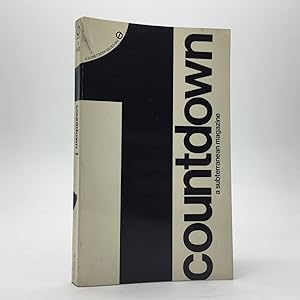
COUNTDOWN 1, A SUBTERRANEAN MAGAZINE
Published by Signet, New American Library, 1970
Seller: Any Amount of Books, London, United Kingdom
Association Member: ABA ILAB PBFA
Seller rating 5 out of 5 stars

First Edition
US$ 22.04
US$ 24.74 shipping
Ships from United Kingdom to U.S.A.Quantity: 1 available
Add to basketSoft cover. 8vo. Unpaginated. Black and white covers. Black page edge. Illustrated throughout in black and white. First printing February 1970. good plus, with a crease along spine and a 2cm tear to corner of front cover at the hinge.
-

Good Times: vol. 4, #10, March 12, 1971
Published by Good Times Commune, San Francisco, 1971
Seller: Bolerium Books Inc., San Francisco, CA, U.S.A.
Seller rating 5 out of 5 stars
Magazine / Periodical First Edition
Newspaper. 20p., folded tabloid underground newspaper, news, opinion, reports, actions, psychedelia, ads, illustrations, photos, very good on newsprint. Originally San Francisco Express Times. Cover features John Baldwin cartoon montage of Nixon, Laird, helicopters, Vietnamese, etc. Inside: report on International Women's Day rally in S.F., much discussion of internal struggles in Black Panther Party (Newton vs. Cleaver, etc.), report on bust at Wheeler Ranch, UFW-Teamster conflict, rundown of vitamins and minerals, letter from Soledad prisoner, and back cover poem by Erica Huggins.
-

Black Panther Inspiration: Rehabilitating Black Prisoners
ISBN 10: 171918464X ISBN 13: 9781719184649
Seller: GreatBookPricesUK, Woodford Green, United Kingdom
Seller rating 5 out of 5 stars
US$ 24.66
US$ 20.06 shipping
Ships from United Kingdom to U.S.A.Quantity: Over 20 available
Add to basketCondition: As New. Unread book in perfect condition.
-

Black Panther Inspiration: Rehabilitating Black Prisoners
ISBN 10: 171918464X ISBN 13: 9781719184649
Seller: GreatBookPricesUK, Woodford Green, United Kingdom
Seller rating 5 out of 5 stars
US$ 24.94
US$ 20.06 shipping
Ships from United Kingdom to U.S.A.Quantity: Over 20 available
Add to basketCondition: New.
-

Black Panther Inspiration: Rehabilitating Black Prisoners
ISBN 10: 171918464X ISBN 13: 9781719184649
Condition: New.
-

Broadside: October 1966 Black Panther Party Platform and Program - What We Want, What We Believe
Published by S.i. 1969-1970], [N.p., 1969
Seller: Lorne Bair Rare Books, ABAA, Winchester, VA, U.S.A.
Association Member: ABAA ILAB IOBA
Seller rating 5 out of 5 stars
Broadside, with text and photograph of Huey P. Newton crudely photocopied on white 8.5" x 14" stock. Some handling a few stray ink marks to left margin, with foxing along the edges; Very Good. Contemporary photocopy, presumably for community circulation, of the Black Panther Party's Ten Point Platform and Program, reproduced from the August 23, 1969 issue of The Black Panther. 83812.
-

Free all Political Prisoners (pinback button)
Published by [Robert Rush] [196-?], [Berkeley]
Seller: Bolerium Books Inc., San Francisco, CA, U.S.A.
Seller rating 5 out of 5 stars
Manuscript / Paper Collectible
1.75 inch diameter pin, very good, with depiction of a pig with rectally puckered lips dressed as a judge; union bug on edge. Manufactured by Robert Rush for the Sacramento branch of the Black Panther Party (according to Rush himself).
-
Hardcover. Condition: new. New Copy. Customer Service Guaranteed.
-
Flyer: Demand an End to Political Attacks on teh Movement! Defend the Black Panther Party! Free Huey! Free the New York Panthers!
Published by Peace and Freedom Party [1969], New York, 1969
Seller: Lorne Bair Rare Books, ABAA, Winchester, VA, U.S.A.
Association Member: ABAA ILAB IOBA
Seller rating 5 out of 5 stars
Double-sided mimeographed flyer, text printed in black on light yellow stock, measuring 8.5" x 11". Three old horizontal folds smoothed out, with light wear and subtle toning to extremities; Very Good+. Informative flyer drawing attention to the major issues on the Peace and Freedom Party platform: the political attacks on the Chicago 8, members of the Black Panther Party, and "a new level of repression that combines attacks on black and white activists; on students, poor, and working people." Draws attention to the plight of Bobby Seale, Huey P. Newton, and Eldridge Cleaver, and calls for an end to the Vietnam War. Concludes with a solicitation for membership, information, and financial contributions. 83806.
-
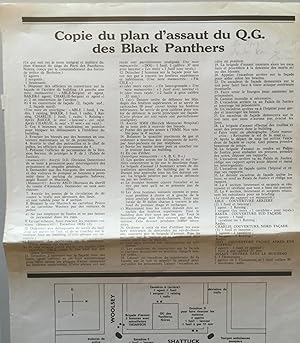
Copie du plan d' assaut du Q. G. des Black Panthers. (Aus: L' Idiot international. N° 4. Mars 1970
Published by Paris - Londres, L' Idiot international) Mars 1970, 1970
41 x 27.5 cm, eine Seite gefaltet, ein Plan, Rückseite: L' Idiot international, N° 4, Mars 1970.
-

PRESS PHOTO OF PAUL COATES
Publication Date: 1992
Seller: johnson rare books & archives, ABAA, Covina, CA, U.S.A.
Association Member: ABAA ESA ILAB
Seller rating 5 out of 5 stars
Black-and-white glossy press photograph (10" x 8") by Lloyd Fox. Near fine with caption and date stamps on the verso. "People profile of Paul Coates in his home at 3700 Campfield Rd. off of Liberty Rd. He runs Black Classic Press and once headed the state's Black Panther organization." William Paul Coates (b.1946) founded Black Classic Press in Baltimore to publish obscure and important books by and about people of African descent. He is the father of author and journalist Ta-Nehisi Coates.
-

Are These Cats Red? The Black Panthers. An exposé of a Communist front which is engaging in guerrilla warfare against high schools and universities
Published by Conservative Society of America, Pineville, LA, 1969
Seller: Lorne Bair Rare Books, ABAA, Winchester, VA, U.S.A.
Association Member: ABAA ILAB IOBA
Seller rating 5 out of 5 stars
First Edition
First Edition. Single sheet, printed both sides, folded to make an eight-panel brochure. Near Fine. Radical right-wing tract issued by Courtney's "Conservative Society of America," whose initials C.S.A. were not coincidentally shared by the Confederate States of America during the American Civil War. The CSA was nomiinally organized to fight communism in American politics, but Courtney was also a staunch segregationist, a perspective that clearly informs the current polemic, which warns: ".After the Black Panthers have taken control of the community schools and police, and have threatened - or killed - the responsible negroes into submission, they will claim to be the official NEgro leaders.If the Panthers gain community control, they will have military bases from which they can launch their attack on the rest of the United States ." Scarce.
-

Fundraising Letter for Black Panther Party Members' Legal Defense
Published by New York City, 1970
Seller: Auger Down Books, ABAA/ILAB, Marlboro, VT, U.S.A.
Association Member: ABAA ESA ILAB
Seller rating 5 out of 5 stars
Manuscript / Paper Collectible
Condition: Fine. In March of 1969, eight members of the Black Panther Party (BPP) were arrested in Chicago, accused of conspiracy to incite a riot. In April, twenty-one BPP members were arrested in New York City and charged with a conspiracy to murder NYPD officers and bomb several buildings, including two police stations and the Bronx Botanical Gardens. The following year, BPP co-founder and former "Chicago Eight" co-defendant Bobby Seale was charged with ordering the 1969 murder of suspected FBI informant Alex Rackley. Offered here is a letter signed in facsimile by African-American activists and actors Ossie Davis and Dick Gregory seeking to raise funds for the Panthers' legal defense in these trials. The trials became a favored cause for the American New Left cultural figures from comic actress Peggy Cass and film director Robert Downey Sr. to author Norman Mailer and feminist icon Gloria Steinem appear as "sponsors" of the Committee to Defend the Panthers, which itself was formed by musician and composer Leonard Bernstein. Donations raised by the Committee would go to paying for "legal research, travel to interview and transport witnesses, court transcripts and other trial-related essentials." The letter warns: "Today the Panthers tomorrow it could be any of us. Our country cannot must not tolerate government vendettas against ANY group. Unless the tide of repression is turned, and fast, we had all better run for our lives. [] Unless these men and women can be assured of a fair trial, with a JURY OF THEIR PEERS, no man or woman in the United States can be sure of justice in court." In 1971, all members of the Panther 21 were acquitted;in 1972, all criminal convictions against the Chicago Seven were reversed, and Bobby Seale was released from prison with his charges dropped. Single letter measuring 8 x 10.5 inches, one single-sided sheet.
-

The Black Panthers.
Published by New York. Universal Publishing and Distributing Corporation, 1969
Seller: Librairie Les Autodidactes - Aichelbaum, Paris, France
Association Member: ILAB
Seller rating 5 out of 5 stars
First Edition
. In-4 agrafé. Editor : P. Sachs, text by J. Alvin Kugelmass. Ouvrage de propagande du Black Panthers Party. Textes en anglais. Très importante iconographie. E.O.
-
Early Issue of The Black Panther Newspaper, 1969 Covering Community Outreach, Police Brutality, and U.S. Imperialism
Publication Date: 1969
Seller: Max Rambod Inc, Woodland Hills, CA, U.S.A.
Association Member: ABAA ILAB PADA
Seller rating 5 out of 5 stars
Magazine / Periodical
[Black Panther Party][Black Radicalism] Newton, Huey P., ed. The Black Panther, October 25, 1969 issue, documenting how the Black Panther Party used its newspaper as an instrument of political coordination linking community healthcare, prisoner defense, youth programs, labor outreach, and international analysis across multiple chapters. Rather than treating these efforts as separate causes, the issue shows them functioning through a common communications structure: the Bobby Hutton Free Health Clinic in Kansas City, free breakfast work in San Francisco, defense organizing around the New Haven Panther 14 and Martin Sostre, local reporting on police violence and repression, and political commentary on Haiti under François Duvalier. The cover sets that framework clearly through the juxtaposition of Eldridge Cleaver and Kim Il Sung, with anti-imperialist text that places local organizing, state repression, and global struggle in one ideological field. The Black Panther: Black Community News Service. Vol. III, No. 37. Saturday, October 25, 1969. Newspaper issue in tabloid format. Front page with large photographic cover portrait, Party identification banner, price of 25 cents, and quotations from Eldridge Cleaver and Kim Il Sung. Interior coverage includes "Statement from Chairman Bobby Seale," "Check It Out!," "Black Youth Shot Down in Santa Rosa Streets," "Continuous Repression Against the Vanguard Party," "Ambush," "Bobby Hutton Free Health Clinic," "Defense of the New Haven Panther 14," "Statement from New Haven Area Captain Doug Miranda," "Civil Servants, Public Officials Speak Out," "Feeding Hungry Children vs. Men of the Cloth," "Brownsville Liberation School," "Papa Doc and the Truth About Haiti Today," and "Karenga and the Truth About 'Us'." What emerges from the issue is the newspaper's role in carrying reports between local chapters and readers, publicizing Party institutions, naming police violence and court cases, and tying neighborhood programs to a broader Black internationalist politics. By late 1969 the paper had become one of the Party's primary mechanisms for circulating chapter activity, fundraising urgency, ideological education, and defense campaigns, and this issue shows that process in operation across health, food distribution, schools, labor conflict, prisons, and foreign affairs. Losses at the center fold of the front cover, chipping along the creases, and general wear expected of circulated newsprint of this age; inner pages good, overall good condition. A strong issue for the way it concentrates the Party's practical community programs and prisoner defense work alongside sustained attention to Haiti and international anti-imperialist politics.
-
New York Black Radical Periodical "Liberator", February 1970 Issue on the Young Lords, Black Panthers, and Life in Harlem
Publication Date: 1970
Seller: Max Rambod Inc, Woodland Hills, CA, U.S.A.
Association Member: ABAA ILAB PADA
Seller rating 5 out of 5 stars
Magazine / Periodical Signed
[Black Activism][Black Panthers] Watts, Daniel H. Liberator Vol. 10, No. 2, a February 1970 Black radical magazine covering the Young Lords, Addison Gayle Jr., and Selwyn R. Cudjoe, at a time of intensified Black and Puerto Rican political organizing in New York. The cover announces "The Young Lords," "Dreams of a Native Son," and "Beyond the Panthers". Articles include Watts's editorial "Let It Crawl," Henry Gerard Chery's "Recipe for a Riot," Akbar Balagon Ahmed's "Harlem Farewell," and Clayton Riley's theatre review. Issued just after the Young Lords' occupation of the First Spanish United Methodist Church in East Harlem, the magazine records neighborhood campaigns around garbage, food programs, police confrontation, Black political education, and the continuing political presence of Malcolm X through Gayle's essay and its full-page portrait captioned "El Hajj Malik El Shabazz / May 1925 - February 1965." Liberator. Vol. 10, No. 2. New York: Liberator, February 1970. About 23 pages. Radical monthly magazine edited by Daniel H. Watts. The issue opens with Watts's editorial "Let It Crawl," followed by Gayle's "Dreams of a Native Son". Rich Balghur's Young Lords feature begins on page 11 and includes group portraits and documentary captions including "The breakfast program," "Supporters from the community bringing food and clothing," and "The bust," while the accompanying text identifies the organization as founded in 1969 and recounts its garbage campaign, church occupation, eviction by New York police, children's breakfast programs, and health work. Additional contents include Ahmed's "Harlem Farewell," illustrated with a Harlem streetscape; Cudjoe's "Beyond the Panthers," opening beside protest placards reading "FREE THE BLACK PANTHERS"; Chery's "Recipe for a Riot," paired with a Harlem rat protest photograph; Othello Mahone's review of Julius Lester's Revolutionary Notes; Clayton Riley's theatre review; and letters including "Black University" from The Black Students, Nashville, Tennessee. Cover price 40 cents. The issue belongs to Liberator's final major decade as an independent Black-owned monthly, and page 19 states that history explicitly in Watts's signed appeal noting publication of writers including LeRoi Jones, Nathan Hare, Eldridge Cleaver, Addison Gayle, Clayton Riley, Douglas Turner Ward, Toni Cade, and Malcolm X. That same page records a subscription increase from $3.00 to $4.00 and a single-copy increase from 35 cents to 40 cents because of rising postal, manufacturing, and labor costs, fixing the number within the material economics of Black independent publishing in 1970. 23 pages; tanning throughout; some staining and pin hole on back wrapper; otherwise very good condition. A strong issue for Black Power print culture, African American periodical history, and Young Lords organizing in New York. Signed.
-

Street Sheets
Published by n.p. New York, NY, 1970
Seller: Specific Object / David Platzker, New York, NY, U.S.A.
Seller rating 5 out of 5 stars
[8] pp.; 8 vol. : 1 vol. : 18.7 x 12.6 cm. ; 1 vol. : 30.5 x 13 cm. ; 1 vol. : 28 x 21.5 cm. ; 1 vol. : 33 x 21.5 cm. ; 4 vol. : 35.4 x 21.5 cm.; loose leaves; color; edition size unknown; unsigned and unnumbered; offset-printed Compilation of seven posters / flyers arranged within folded Street Sheets cover. Posters / flyers consist of "Food Manual #1" with instructions for lentil soup, "Political Prisoners of Lower East Side," lyrics and score to "I'm Tired of Bastards Fuckin Over Me," poster for New York trial of Black Panther / 21 Trial, a breakfast program for all children at a firehouse, poster with text "There is Some Shit We Will Not Breathe," and quotes from Susan Sherman from the Federal Courthouse in Foley Square. Good / Very Good. All posters folded once towards bottom of the sheet, handling marks, and light edge wear.
-
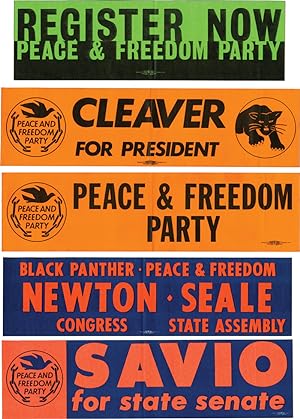
Five original Black Panther / Peace and Freedom Party oversize bumper stickers
Published by Berkley Graphics Arts, Berkeley, 1968
Seller: Royal Books, Inc., ABAA, Baltimore, MD, U.S.A.
Seller rating 5 out of 5 stars
Collection of five vintage bumper stickers from the 1968 political campaigns run via a collaboration between the Black Panthers and the Peace and Freedom Party. Each of the stickers were made for various Peace and Freedom Party political campaigns, including: Mario Savio for California state senator, Black Panther founders Huey Newton and Bobby Seale, and Eldridge Cleaver for president, and two stickers simply advertising the Peace and Freedom Party itself. In 1968 the Black Panthers would move away from direct actions (including their legendary confrontations with the Berkeley police department) and briefly into the political sphere, when they joined forces with the PFP, a left-wing anti-war party advocating Black liberation, women's liberation, and LGBTQ rights. The campaigns were largely seen as political statements, as Cleaver was a convicted felon and technically ineligible for the presidency due to his being under the age of 35 by the time of inauguration, and as Newton and Seale were on trial at the time, repeatedly being denied their civil liberties. All items rare, each with original peel-off paper backing, and each between 4 x 13.5 an 4 x 15 inches. Near Fine and unused, with light soil on two of the stickers and rubber stamp for the "Lancaster County Peace & Freedom Movement Organizing Committee" on the verso of one sticker. A few of these rear peel-off panels have come loose due to dryness, but most are intact, and the bumper stickers themselves are unaffected.
-
FREE THE PANTHER 21! FREE ALL POLITICAL PRISONERS; April 4, Mass March, Assemble 12 noon, Central Park Mall - 72nd ST. Speakers include Afeni Shakur, Dave Dillard, William Kunstler, Abbie Hoffman
Published by Committee to Defend the Panther 21, (NY), 1970
Seller: Second Life Books, Inc., Lanesborough, MA, U.S.A.
Association Member: ABAA ILAB SNEAB
Seller rating 4 out of 5 stars

Broadside, 11 x 8-1/2 inches. Printed in black on yellow paper, bold text printed above the strident figure of a political prisoner.
-
1968 Berkeley Barricade Revolutionary Broadsheet on Free Huey Demonstrations
Seller: Max Rambod Inc, Woodland Hills, CA, U.S.A.
Association Member: ABAA ILAB PADA
Seller rating 5 out of 5 stars
Art / Print / Poster
[Black Panthers.] Barricade. Vol. 1, No. 2. Berkeley: July 12, Year of the Barricades [1968]. Broadsheet printed both sides. 19.75" x 14" inches. The unnamed editors describe themselves as "people who have been on the streets and turned off by meetings that have tried to misdirect our struggle. We are an independent, non-profit, non-sectarian, nonorganization." Cover story is on Free Huey demonstrations, noting upcoming events in DeFremery Park and elsewhere. States that "The Panthers thought The Barricade was outa sight and hope all Barricade readers will come to DeFremery Park." Creased from folding into quarters, red pen underlining scattered through the text, overall very good condition.
-
Free Angela Davis, "Liberte Pour Angela!" 1972
Publication Date: 1972
Seller: Max Rambod Inc, Woodland Hills, CA, U.S.A.
Association Member: ABAA ILAB PADA
Seller rating 5 out of 5 stars
Magazine / Periodical
Black Panter: French newspapers call to Free Angela Davis. February 1972. "Liberte pour Angela!" Bulletin de l'APN. Published by official Soviet news agency in France, L'Agence de Presse Novosti. In French. 4 pages. 17 x 12 inches. Image of Angela Davis with raised fist on front cover. 2 illustrated portraits of Angela Davis on page 4. In 1971 the CIA estimated that five percent of Soviet propaganda efforts were directed towards the Angela Davis campaign. Soviet press used Angela Davis to highlight the civil rights issues and racial problems in the United States, posing it as a negative societal result of Capitalism. Price listed as "1 kopeck." At the time this article was written, Davis was imprisoned and facing federal charges after appearing on the FBI's list of most wanted fugitives. In 1970, guns belonging to Davis were used in an armed takeover of a courtroom in Marin County, California, in which four people were killed. Charged with three capital felonies, Davis was held in jail for over a year before being acquitted of all charges in 1972. In the months following her ruling as not guilty, Davis went on a speaking tour of many Communist countries which offerd her support. She visited the Soviet Union at the invitation of the Central Committee where she received an honorary doctorate from Moscow State University; in 1979, she again returned to the USSR to receive the Lenin Peace Prize. Includes statements of support from prominent Soviet figures such as Valentina Tereshkova (first woman in space). In very good condition.
-
Brothers, Film Based on Angela Davis and the Black Panthers Promotional Archive, 1977
Publication Date: 1977
Seller: Max Rambod Inc, Woodland Hills, CA, U.S.A.
Association Member: ABAA ILAB PADA
Seller rating 5 out of 5 stars
[Black Panthers] [Counterculture] [Prison and Incarceration] Brothers film archive. Warner Brothers, 1977. Archive consists of six items, including 5 original black and white press photographs and one lobby card for the film Brothers, a fictionalized account of the historical events and friendship between Angela Davis and prison inmate George Jackson. Photos measure 8" x 10" and lobby card measures 11" x 14". Starring Vonetta Mcgee and Bernie Casey. The film starring Bernie Casey and distributed by Warner Bros. depicts the brutal prison conditions for African Americans and George Jackson of Soledad Brothers thinly disguised relationship with Black Panther Member Angela Davis. The film was shot in North Dakota state prison using inmates as extras. The card features a bright red borders and captions on the front listing the cast members. Photos capture Bernie Casey as George Jackson in prison. Minor edge wear and creasing to corners. This archive is powerful and in excellent condition. Soledad Brother George Jackson's writings about prison conditions for African Americans created awareness and spread important information about the severity of treatment.
-
The Black Panther Newspaper, 1972 Issue Covering Angela Davis, Rent Control, Public Health, and Soledad Prison
Publication Date: 1972
Seller: Max Rambod Inc, Woodland Hills, CA, U.S.A.
Association Member: ABAA ILAB PADA
Seller rating 5 out of 5 stars
Magazine / Periodical
[Black Panther Party][Black Radicalism] Newton, Huey P., ed. The Black Panther, April 22, 1972 issue documenting the Black Panther Party's media outreach connecting tenant organizing, community health, international anti-apartheid protest, prison defense, and reader mobilization within a single operational print network. The front page headline, "No Eviction, Free Repairs if You Were Your Own Landlord," paired with the placard "Berkeley Residents Demand Community Control of Rents," frames housing not as a private grievance but as a governing question, while interior headlines including "20,000 Blacks Vote to Control Hospital," "South Africa Is a State in the Union," "Black People and the Republican Convention, 1972," "Soledad Prison Killed Its Own to Get Comrade Hugo," and "Pig Fantasies Used to Convict Angela" show the paper coordinating local campaigns, prison cases, and international politics through one Party organ. What the issue shows happening is the translation of Party line into institutional action: rent control is described through charter provisions and public vote, hospital struggle through a Black community referendum, and prison cases through ongoing defense against what the paper calls "racist frame up" prosecutions. Newton, Huey P., ed. The Black Panther. San Francisco, California: The Black Panther Party, Saturday, April 22, 1972. Vol. VIII, No. 9. Large format newspaper issue. The cover carries the secondary line "Progressive Americans, Led by Panthers, Return From China See Inside Supplement." Inside, the housing feature states that Berkeley's proposed rent control charter amendment would create "A five member Rent Control Commission elected at large in Berkeley for 4 year terms," require that "No evictions will be allowed in Berkeley unless first approved by the Rent Control Commission," and insist that "All hearings of the Rent Control Commission on rent increases, decreases and evictions must be open to the public." The Winston Salem hospital article opens under "20,000 Blacks Vote to Control Hospital" and states that "20,000 in all" came out "to get proper medical care." Other photographed contents include Bobby Seale's anti apartheid article, with the captioned declaration that "The masses of Black people in the world.can be united around concrete survival."; the essay "Revolution and the White 'Left' in America"; the political analysis "Black People and the Republican Convention, 1972"; the Hugo Pinell defense article under "Soledad Prison Killed Its Own to Get Comrade Hugo"; the Angela Davis piece "Pig Fantasies Used to Convict Angela," stating "The State's 'case' is built completely on lies"; and a large subscription form headed "Subscribe to Survive." This issue is especially strong on the Party's use of print to present readers political analysis and active participation. Housing, health care, prison defense, anti imperialism, and electoral strategy are addressed as connected fronts of struggle, each with articles calling for collective action. Folded as issued with toning, creasing, edge wear, and small marginal chips and tears consistent with survival of large format newsprint; overall good condition. A strong single issue for showing how The Black Panther turned weekly journalism into a working instrument of community, political education, and mobilization.
-
Intersectional Activism in The Black Panther Newspaper, 1971 Issue on Racial Violence, Electoral Intimidation, and Black GIs in Fort Hood
Publication Date: 1971
Seller: Max Rambod Inc, Woodland Hills, CA, U.S.A.
Association Member: ABAA ILAB PADA
Seller rating 5 out of 5 stars
Magazine / Periodical
[Black Panther Party][Black Radicalism] Newton, Huey P. The Black Panther, November 29, 1971 issue, a vital organ of the Black Panther Party for political communication across prison defense campaigns, anti-police brutality reporting, Black military dissent, community mobilization, and international political education. The cover story on Norma Gist, a Black mother jailed after defending her children from racist violence in Idabel, Oklahoma, is paired with interior coverage of Frank Nubin, Black GI organizing at Fort Hood, the imprisonment of Hugo Pinell, racist electoral intimidation in Houston, and a rear-page "Survival Week" broadside for Chicago events featuring Bobby Seale, Bob Rush, and Charles Koen. Rather than functioning only as a news weekly, this issue shows the Party press coordinating solidarity across local cases, prison activism, military resistance, electoral struggle, and survival-program organizing while also linking domestic Black liberation politics to global realignment through the front-page notice on the People's Republic of China entering the United Nations. The Black Panther. Vol. VII, No. 14. San Francisco, CA: The Black Panther Party, Monday, November 29, 1971. Supplement present. Front page printed in black and blue with large headline, "If You Love Them, You'll Defend Them," over an image of Norma Gist and her children behind prison bars; masthead reads "The Black Panther Intercommunal News Service," priced at 25 cents, with copyright credited to Huey P. Newton. Visible interior contents include "A Potentially Dangerous Man" on Brother Frank Nubin; "We Won't Have a Ni**er City Council Man" on violence directed at Ovide Duncantell in Houston; "Black GIs Battle on the Home Front," concerning Fort Hood hearings on racism in military justice and promotion; and the two-page article "The Black Panther Party and Hugo Pinell," accompanied by San Quentin imagery and text on prison repression and collective resistance. The final illustrated page is a Chicago "Survival Week" announcement calling for a student strike for survival and a December 4 rally, with named speakers Bobby Seale, Bob Rush, and Charles Koen, plus notice of food distribution through the People's Free Medical Center. By late 1971, Black Panther newspapers had become one of the Party's central mechanisms for binding dispersed campaigns into a readable political structure, converting local incidents into shared movement knowledge and directing readers toward defense work, rallies, and survival programs. This issue makes that process visible in unusually concentrated form: state violence against Black families, military racism, prison radicalization, and community organizing appear not as separate stories but as linked fronts in the same political field, while the China supplement places that field within the Party's wider internationalist frame. Closed tears and chipping to front page and folds; handling wear and toning consistent, inner pages complete. Overall good condition. A strong single issue for tracing how Black Panther print culture carried information, discipline, and mobilization across multiple sites of struggle in late 1971.
-
1969 Issue of the Black Panther Party Newspaper, Reporting on the Killing of Fred Hampton and Mark Clark by the Chicago Police and FBI
Publication Date: 1969
Seller: Max Rambod Inc, Woodland Hills, CA, U.S.A.
Association Member: ABAA ILAB PADA
Seller rating 5 out of 5 stars
Magazine / Periodical
[Black Panther Party][Black Radicalism] Newton, Huey P. The Black Panther, Vol. IV, no. 4, issued December 27, 1969, a vital organ of the Party disseminating coverage of police violence, legal defense, political education, prison solidarity, and community survival work in the immediate aftermath of the killings of Fred Hampton and Mark Clark. Rather than isolating those killings as a single event, the issue contextualizes their deaths among wider U.S. racial repression, providing investigative reporting along with chapter listings, speeches, and local programming, demonstrating how the organization moved information across local branches and a national readership. The result is a concentrated record of Black Panther Party print strategy at the end of 1969, when the paper served both as a news organ and as an instrument of coordination. The Black Panther. Vol. IV, No. 4. San Francisco, CA: The Black Panther Party, December 27, 1969. Folio newsprint issue. Masthead reads "Black Community News Service," priced at 25 cents and marked "Published Weekly." The cover carries a large photograph beneath quotations from political prisoners in Denver, with interior contents announced as "No Justice in Amerikka," "Statement to the P.R.G. of S.V. from Eldridge Cleaver," and "David Hilliard Speaks on B.S.U.'s." Interior pages shown here include "L.A. Pigs Condemn Peoples' Office," "Bill Green on the Condemning of L.A. Panther Office," "Political Prisoner Speaks to GIs," "Breakfast for School Children Programs," a substantial "List of Chapters and Branches of the Black Panther Party," "Speech by Charles Garry at Benefit in his behalf Dec. 19, 1969," "Seize the Time," "What is There to Investigate," "Lived a Revolutionary Died a Revolutionary" on Mark Clark, "Black Representatives Investigate Government Conspiracy," "Huey's Appeal" Part 16, "Pig, An International Language," Eldridge Cleaver's statement at the Embassy of the P.R.G. of South Vietnam, and David Hilliard's "Farewell and Criticism of Earl." The issue directly addresses the killings of Hampton and Clark and the Party's insistence that those deaths be understood as the direct result of state surveillance and persecution in response organized Black political resistance. Cleaver's statement extends that political frame outward into an international anti imperial context. Published only weeks after Hampton and Clark were executed by the Chicago Police in a raid coordinated wit the FBI, this issue preserves the Party's response of mourning, investigation, and mobilization while continuing to publicize its community outreach breakfast programs, campus activity, chapter structure, and legal advocacy. Overall good to very good, with minor marginal losses not affecting text, moderate toning, small chips and short edge tears, and handling wear consistent with circulated newsprint of this age. The combination of Hampton and Clark coverage, Cleaver's statement, and the printed national branch list makes this issue a precise record of how the Black Panther Party used its newspaper to connect local violence, national organization, and international politics within a single weekly publication.
-
Black Panther Party 1977 Newspaper Reporting on California Prison Aid, Fred Hampton Murder Trial, and Elaine Brown's Leadership
Publication Date: 1969
Seller: Max Rambod Inc, Woodland Hills, CA, U.S.A.
Association Member: ABAA ILAB PADA
Seller rating 5 out of 5 stars
Magazine / Periodical
[Black Panther Party][Black Radicalism] Newton, Huey P. Black Panther Party newspaper, January 1977 issue covering prison organizing, Oakland municipal politics, and the continuing afterlife of Cointelpro. Front-page headline "Free Commissary Program Gives 500 Packages To Prison Inmates" and carries Elaine Brown's long interview on "People's Power" in Oakland. The issue ties California prison support to the Party's Free Legal Aid and Educational Program and Oakland Community Learning Center, naming Joan Kelley and Lulla Hudson and listing intended recipients at San Quentin, Vacaville, Folsom, Soledad, Chino, Corona, Tracy, and Frontera. The Black Panther. Vol. XVI, No. 8. Oakland, California: The Black Panther Party, January 1, 1977. Published weekly by the Black Panther Party. Cover price 25 cents. Front page coverage states that the Free Prison Commissary Program would send "500 packages containing clothing, food and other needed items to men and women incarcerated in California prisons this holiday season". Interior pages include the editorial "P.S. Free Huey," a New Year message linking Huey P. Newton's imprisonment to the June 16 Soweto uprising; Elaine Brown's "Whatever Happened To The Black Panther Party?" with the line "people know that what I stand for is their survival"; a continuation of the Party's federal lawsuit over police attacks; "Elaine Brown Interviewed On 'People's Power' In Oakland," where Brown states that "control of the design and maintain the status quo, could not continue"; "21 Past, Present U.S. Officials Named In $100 Million B.P.P. Lawsuit"; "T.V. Cop Shows Blasted"; "Supreme Court Rulings Attack Women's Rights"; "Deal Worked Out To Block A Black Mayor For Chicago"; "Richmond Coalition Walks Out On City Council, Set To Start Petition Drive"; and "U.S. Cities Targets Of Army Germ Warfare Tests." Letters to the editor include "Azanian Militant Requests Literature" and "San Bruno Inmates Demand Removal Of Racist Guard," extending the issue's emphasis on international struggle and prison grievance. Issued during Elaine Brown's leadership of the Party, the newspaper turns repeatedly to the linked problems of incarceration, municipal power, media attack, and federal repression. Oakland remains central throughout, as well as coverage of San Quentin, Washington, Richmond, Chicago, San Francisco, and Patterson, showing the breadth of Party journalism in early 1977 and addressing prison support, electoral conflict, legal defense, and national Black political debate. Light edge wear and toning, minor creasing, and small chips at extremities; overall very good condition. A strong issue centered on California prison aid, Fred Hampton trial coverage, and Elaine Brown's Oakland political program at the opening of 1977.