Order Total (1 Item Items):
Shipping Destination:

Book Hours (180 results)
Skip to main search results
Search filters
Product Type
- All Product Types
- Books (74)
- Magazines & Periodicals (1)
- Comics (No further results match this refinement)
- Sheet Music (No further results match this refinement)
- Art, Prints & Posters (73)
- Photographs (No further results match this refinement)
- Maps (No further results match this refinement)
- Manuscripts & Paper Collectibles (32)
Condition Learn more
- New (3)
- As New, Fine or Near Fine (15)
- Very Good or Good (21)
- Fair or Poor (No further results match this refinement)
- As Described (141)
Binding
Collectible Attributes
- First Edition (4)
- Signed (4)
- Dust Jacket (No further results match this refinement)
- Seller-Supplied Images (168)
- Not Print on Demand (177)
Language (3)
Free Shipping
Seller Location
Seller Rating
-
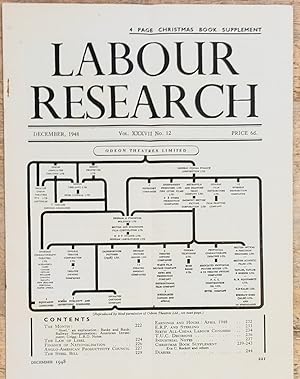
Labour Research December 1948 / THE STEEL BILL / Odeon Theatres Limited / Railway Reorganisation / The Law Of Libel / Finanve of Nationalisation / Anglo-American Productivity Council / Earnings And Hours / E.R.P.and Sterling / T.U.C. Decisions / Eva C Reckitt "Christmas Book Supplement"
Published by The Labour Research Department, 2 Soho Square, London, 1948
Magazine / Periodical
US$ 13.80
US$ 14.74 shipping
Ships from United Kingdom to U.S.A.Quantity: 1 available
Add to basketSoft cover. Condition: Very Good. 20 pages. THE STEEL BILL / Odeon Theatres Limited / Railway Reorganisation / The Law Of Libel / Finanve of Nationalisation / Anglo-American Productivity Council / Earnings And Hours / E.R.P.and Sterling / T.U.C. Decisions / Eva C Reckitt "Christmas Book Supplement" (SL#94).
-

US$ 20.12
Free Shipping
Ships from United Kingdom to U.S.A.Quantity: Over 20 available
Add to basketPaperback. Condition: New. Print on Demand. This enriching collection of tales and fables charms with timeless lessons and captivating adventures. Composed by a renowned author, this book has delighted young readers for generations. With tales like "The Little Basket-Maker," children will learn the virtues of kindness and perseverance. "The Poor Old Man" emphasizes respect for the elderly, while "The Apple Flowers" and "The Birds' Nest" promote appreciation for nature and its wonders. Each story imparts valuable life lessons in a relatable and engaging way, fostering a love of reading and enriching young minds. This enchanting book will resonate with children and parents alike, offering a rich tapestry of wisdom and imagination that will stay with them long after the last page is turned. This book is a reproduction of an important historical work, digitally reconstructed using state-of-the-art technology to preserve the original format. In rare cases, an imperfection in the original, such as a blemish or missing page, may be replicated in the book. print-on-demand item.
-

Social Life in Britain from the Conquest to the Reformation
Published by CUP, Cambridge, 1918
Seller: Appleford Bookroom, Abingdon, OXON, United Kingdom
Seller rating 5 out of 5 stars

First Edition
US$ 24.84
US$ 38.78 shipping
Ships from United Kingdom to U.S.A.Quantity: 1 available
Add to basketBuckram. Condition: Very Good Internally. No Jacket. Book of Hours Frontis. (illustrator). First Edition. 8vo, dark buckram, xvi+540 pp. Case a bit bumped,& slight wear at top of spine, but internally a fine copy. Binding sound. This is a definitive book by a great Cambridge Medieval history professor. Book covers land & people, birth & nurture, authors, scribes, reading, church folk, knights, war, manor house & cottage, town life, rich & poor, houses, dress, meals, sorts, pastimes, travel, women's life, art, architecture, etc. pretty well everything for social history. ex-St Asaph Cathedral Library. Size: 8vo. Association Copy. Exlib with Usual Marks.
-
Condition: Fine. The book is in fine condition.
-
The Book of Hours of the Emperor: Maximilian the First D?rer
Published by Abaris Books, New York, 1974
Seller: 32.1 Rare Books + Ephemera, IOBA, ESA, Princeton, NJ, U.S.A.
Association Member: IOBA
Seller rating 4 out of 5 stars

Hardcover. 4to., 344 pp. Quarter-rexine and imitation vellum boards, silver arms on front board. The volume provides a facsimile constituted from a reproduction of the 62 folios in the Staatsbibliothek, Munich, and the 57 folios preserved at the Bibliothe`que municipale, Besanon, with the lacking signatures substituted from the undecorated copy of the Prayer Book at the Oesterreichische Nationalbibliothek, Vienna. Edited and with a detailed commentary by Walter L. Strauss. In Latin, with marginal translations and notes in English. Fine in Fine publisher's slipcase.
-
A single leaf from a decorated manuscript.
Published by Northern France, c. 1500]., 1500
Seller: Justin Croft Antiquarian Books Ltd ABA, Faversham, United Kingdom
Seller rating 5 out of 5 stars
US$ 275.97
US$ 20.09 shipping
Ships from United Kingdom to U.S.A.Quantity: 1 available
Add to basketThis attractive fragment includes the opening of the prayer to the Virgin 'O intemerata' (O Immaculate), commonly included (with the 'Oscecro te') in a medieval Book of Hours. Folio Society, Collectors Corner (n.d, ?1960) £2. Single leaf, vellum (178 × 112 mm), 22 lines (both recto and verso), Latin text in a good lettre bâtarde, four-line initial 'O' on a ground of red and blue with white scrolls. Preserved in modern morocco backed boards (stained).
-
HEURES DE LA SAINTE BIBLE
Published by Societe D'Editions Catholiques, Paris, 1892
Seller: Tom W. Ayling, Wallingford, United Kingdom
Seller rating 4 out of 5 stars
First Edition
US$ 344.96
US$ 36.36 shipping
Ships from United Kingdom to U.S.A.Quantity: 1 available
Add to basketFirst edition. Octavo. Finely bound in contemporary purple morocco, lettered in blind to the spine, with large silver initials to the upper cover. Silk moire endpapers. Deep turn-ins elaborately decorated gilt. Beautifully illustrated with decorative borders to each page, and full page plates. A fine copy.
-
Illuminated Manuscript Leaf on Vellum.
Published by Unknown scribe & illuminator, 1490
Seller: Sequitur Books, Boonsboro, MD, U.S.A.
Association Member: IOBA
Seller rating 5 out of 5 stars
Manuscript / Paper Collectible
Condition: Very Good. Gorgeous original, hand-drawn leaf on parchment probably from a book of hours. 6 x 4 inches, attractively framed and matted. Dimensions in glass-fronted frame: 13 1/4 x 19 inches. No date, presumed to be circa late 15th - early 16th cent. 16 lines with painted border in gold and blue; 4 illuminated initials, the largest covering 4-lines. Manuscripts & Paper Collectibles.
-
Livre de prieres.
Published by Paris: Charles Matheu, 1858., 1858
Seller: Michael R. Thompson Books, A.B.A.A., Los Angeles, CA, U.S.A.
Seller rating 1 out of 5 stars

Octavo. .[12], 149, [13] pp. Chromolithographed throughout in colors and gold, with full-page illustrations and elaborate decorative borders. The borders display varied motifs: some are Byzantine, some are Carolingian, some are reminiscent of fifteenth-century Books of Hours, and others seem very nineteenth-century. Dedicated to Cardinal Franois-Nicholas-Madeleine Morlot, Archbishop of Paris (1795-1862). [ @ith:] Livre de prieres illustr a l'aide des ornements des manuscrits classs dans l'ordre chronologique et selon les styles divers qui sont succd depuis huitime sicle jusqu'au seizieme. Tome II: Notice historique et texte explicatif par Fernand Denis et B. Ch. Mathieu. Paris: Chez l'auteur, 1862. Octavo. 250 pp. Text within typographic border. Otherwise unillustrated. Uniformly bound in quarter green morocco over green cloth boards. Spines a bit faded and a bit scuffed and rubbed. Spines gilt, covers stamped in blind with large cross in the middle of each cover. Very good condition.
-
In Dutch.
Published by The Netherlands, c.1475., 1475
Seller: Bernard Quaritch Ltd ABA ILAB, London, United Kingdom
Association Member: ABA ILAB PBFA
Seller rating 5 out of 5 stars
US$ 2,069.76
US$ 42.87 shipping
Ships from United Kingdom to U.S.A.Quantity: 1 available
Add to basketA complete vellum leaf (c.140 x 96 mm, text area c.115 x 80 mm), single columns of 20 lines written in brown ink in a good gothic script; recto with one ten-line initial 'H' (Here) in blue and red infilled with green branches, pink leaves and flowers, leafy pink penwork borders extending therefrom into the upper and inner margins, a gilt-framed border to lower and outer margins enclosing a long scroll bearing text entwined around a green branch on a blue and red ground, one three-line initial 'K' (Komet) in red with pink foliate infill; small initials in alternating red and blue, smaller capitals touched in red, rubrics; trimmed at head just touching the top of a flourish from the initial 'H', the blue ground to lower border mostly rubbed away, small smudge to one initial to verso; overall very well preserved.A very attractive leaf from a small Dutch Book of Hours with the opening of the Hours of the Virgin, with an initial 'H' of beautiful execution and with a trompe-l'oeil border.The delicate foliate and floral design in the body of the 'H', in shades of green and pink, is extremely well done, the curling green branches being echoed in the attractive border, in which a long white scroll bearing a prayer ('O almechtige gudertijrne verlozer .') winds its way around a branch in an appealing trompe-l'oeil design. In the parent manuscript, this leaf would likely have followed a miniature of the Annunciati on. Language: Latin.
-
Miniature illuminated manuscript on vellum with 12 full-page and 4 small miniatures by the Parisian atelier of Maître François.
Published by Paris 1480-1490, 1480
Seller: Antiquariaat de Roo, Zwijndrecht, Netherlands
Seller rating 4 out of 5 stars
US$ 81,191.69
US$ 26.28 shipping
Ships from Netherlands to U.S.A.Quantity: 1 available
Add to basketA tiny and complete Parisian Book of Hours with a plethora of intricate illuminations. 91 x 65mm (3.6 x 2.6in). 190 leaves on vellum, additional 4 paper leaves after (plus 3 paper endleaves at front and back) Complete, collation: 1-238, 246. Modern foliation in pencil at bottom right corners.14 lines, justified 54 x 38mm (2.1 x 1.5in), ruled in red ink, written in small dark brown lettre bâtarde, rubrics in red, penwork initials in blue with red infill or in burnished gold with dark blue infill, and flourishing extending into the margins throughout, line fillers in blue and gold. Calendar in dark brown and red. 4 small miniatures measuring four lines depicting three of the evangelists and their symbols, and the Virgin, touched in gold, some in arched frames, within three-sided panel border decorations of acanthus leaves, wildflowers, and strawberries, some in gold grounds and with black hairline penwork. 12 large miniatures in arched compartments within full borders in the same style, with additional figures of birds, insects, monsters, and a half-naked man, each including a large initial measuring 3-5 lines, blue on red with gold and white penwork, one on liquid gold grounds illuminated with berries. Some occasional light thumbing and cockling, a few smudges, and minor losses of pigment to some of the miniatures, but overall clean and vibrant. Bound in a beautiful 17th-century French red morocco binding with two triple gilt ruled frames to both boards and arabesque stamps at each corner, spine divided into five compartments, all with gilt arabesque decoration, raised bands, gilt roll tooling to board edges, brass clasp and catch in fine condition, minor cracking to one joint and some signs of wear to spine and corners, all edges gilt, marbled endpapers, bookplate to front endpaper, and additional gathering of four leaves inserted at the end, with manuscript prayer in an 18th century hand, in French and Latin. Text: Calendar ff.1-14v; blanks ff.15-16; Gospels ff.17-24v; Joys of the Virgin ff.25-28v; prayers to be said at different times of day and during mass ff.29-40v; Hours of the Virgin, use of Paris, ff.41-100v: matins f.41, lauds f.54, prime f.67, terce f.73v, sext f.78v, none f.83, vespers f.87v; compline f.95; Hours of the Cross, ff.101-108v; Hours of the Holy Spirit ff.109-114v; Seven Penitential Psalms and Litany ff.115-136v; Office of the Dead, use of Paris, ff.137-190v; additional gathering with prayer to the Virgin and the Holy Wound in French and Latin. Illumination: Twelve full-page and four small illuminations by the Parisian atelier of Maître François (fl.1460-80), tentatively identified with François Barbier père, active in Paris between 1455-72. An oeuvre of around fifty manuscripts has been reconstructed for the master through comparison to his only documented work from 1475 (La Cité de Dieu in Paris, Bib. Sainte-Geneviève, ms. 246). Painted in vibrant colours and with unusual marginalia decoration, including lozenge and square divisions within borders, which are also populated with a variety of birds, monsters, and the figure of a half-naked, drunk man. The use of gold thin strokes to highlight is liberally employed throughout the miniatures, the light tones present in the landscapes, and the porcelain-like complexions of the female figures point towards master François' method. Variants in overall style can be observed in different miniatures within this book of hours, pointing towards a variation in the personal style of different scribes. The subjects of the large miniatures are as follows: St John on Patmos, sitting down writing with an eagle at his side f.17; Annunciation, with the Virgin facing Gabriel, the Holy Spirit flying through an open window f.41; the Nativity, Christ lying on the floor surrounded by the Virgin and Joseph in a barn f.67, Annunciation to the Shepherds, three shepherds gazing up from their flock to an angel holding a banderole 'Gloria in excelsis Deo' f.73v, Adoration of the Magi, two figures of the kings in addition to the family, one looking at the Star of Bethlehem f.78v, Presentation in the Temple, with the Virgin's figure kneeling f.83; the Massacre of the Innocents f.87v; Flight into Egypt, background figures of wheat farmers and an army f.95; Crucifixion, the figure of the fainting Virgin being held by St John and Mary Magdalene, a Roman soldier holding a lance and shield and a richly dressed figure wearing a medieval cardinal's attire, f.101; Pentecost, the Virgin and the Holy Spirit central to the composition f.109; Bathsheba bathing, King David observing in the background f.115; Death with a spear approaching a nobleman who turns away f.137. The four smaller miniatures depict Luke the Evangelist f.18v, Matthew the Apostle f.20v, Mark the Evangelist f.22v, and the Virgin with Saint Anne f.54. Provenance: 1. Produced in Paris, as indicated by the Calendar, illumination and liturgical use, during the last quarter of the 15th century. 2. An erased c.17th century inscription on f.4, partially legible under black light: 'Monsieur La [.]?'. 3. Jacques-Philippe Ledru (1754-1832), French physician, mayor of Fontenay-aux-Roses, Grand Master of the Parisian masonic lodge the Chevaliers de la Croix, and son of Nicolas-Philippe Ledru, conjurer and illusionist under Louis XV and Louis XVI: his engraved ex-libris 'EX LIBRIS JACOBI PHILIPPI LE DRU MEDICUS' inside upper cover. A charming, pocket-sized Parisian Hours from the end of the 15th century.
-
Ces presentes heures a lusaige de Rome furet acheuez Lan Mil. CCCC. iiii. xx. xviii. le xxii. iour de Aoust .
Published by Philippe Pigouche, for Simon Vostre 22 Aug. 1498, 1498
Seller: Yushodo Co., Ltd., Fuefuki-shi, Yamanashi Pref., Japan
Association Member: ILAB
Seller rating 5 out of 5 stars
Hardcover. Condition: Good. 4to. ca. 20.5 x 14 cm. 72 ff. (a-i8), with 24 metal-cut engravings, printed on vellum. Approximately 33 lines per page, all page enclosed in elaborate borders, with metal-cuts depicting numerous scenes, some are from bible and the other such as hunting etc. Capitals illuminated in gilt on red & blue ground, the end of the line also. Later binding full brown morocco, embossed floral motives and gilt lettered "HORAE B. MARIAE" and "VIRGINIS". Spine with 6 raised bands, each panels embossed and gilt decorated, a.e.g. In slip case. [ISTC ih00394000; Goff H394; Hain 8846; HC 8855; Copinger 3098; Polain 1928; Schäfer (Arnim) 165; Proctor 8196; BMC VIII 119; GW 13314].
-
[Incipit, A2r:] Alst my gaet niet nae mij[n] syn / Soe wil ic my liden en[de] swyghe stil .
Published by [Diocese of Utrecht, the County of Holland],, 1488
Seller: Antiquariaat FORUM BV, Houten, Netherlands
Seller rating 5 out of 5 stars
US$ 164,736.77
US$ 28.56 shipping
Ships from Netherlands to U.S.A.Quantity: 1 available
Add to basketAn extensively and beautifully decorated Dutch-language book of hours, written on good quality vellum and dated 1488, and illuminated by the Master of the Brussels Hours of the Bezborodko Group, being one of the stylistic groups of the famous Masters of the Dark Eyes. The present book of hours was hitherto unrecorded as manuscript of these famous illuminators of medieval manuscripts and it appears to be the earliest example of a manuscript decorated by the Master of the Brussels Hours of the Bezborodko Group.With regards to the text, the present manuscript can be considered as a quite common book of hours, as it contain texts often present in these books (the Hours of the Virgin, the Long Hours of the Cross, the Hours of the Holy Spirit, the Hours of Eternal Wisdom, the Office of the Dead and the Seven Penitential Psalms, including a litany) and some other suffrages and prayers. However, with regards to the decoration program, the present manuscript is notorious, as it was a yet unrecorded example of a manuscript illuminated by one of the Masters of the Dark Eyes, more specific the Master of the Brussels Hours of the Bezborodko Group. Many thanks to dr. Klara Broekhuijsen for conforming this and for providing us the material to study this manuscript in relation to other manuscripts of the Bezborodko Group.The Masters of the Dark Eyes are considered to be the "most important and most prolific illuminators working in the County of Holland" (Broekhuijsen, Masters and miniatures) and were named after their most prominent feature: the heavy shadows around the eyes of their figures. They were responsible for the illumination of many works of which an unusually large number of over seventy manuscripts are left and they are known for the lavishness and extent of their decoration programmes. On stylistic grounds, the Masters of the Dark Eyes are divided into seven groups, all flourishing between ca. 1490-1510, of which one is called the Bezborodko Group, "the best among the Masters of the Dark Eyes in terms of quality" (Broekhuijsen, Masters and miniatures). Features of the Bezborodko Group are a refined use of colour, their specific border decoration (acanthus leaves in various colours, flowers and fabulous beasts with gold or black dots among them, leaving the bare vellum visible) and moreover their use of engravings and woodcuts as models for the compositions of their miniatures.In the Bezborodko Group we distinguish two painters: the Master of the Bezborodko Hours and the Master of the Brussels Hours. The decoration program of this book of hours is an outstanding example of the work of the Master of the Brussels Hours. Differences between both Bezborodko Masters come out in the first place in their use of colour. The Master of the Brussels Hours has a preference for more dark reds and blues in the draperies of figures and in the border decoration instead of the softer colours (pink, yellow, pale blue) of the Master of the Bezborodko Hours. The border decoration in this manuscript show especially many vivid red and blue and especially the draperies of the figures in the miniatures are almost all painted in a dark deep blue. Another feature of the way they shape their figures in the miniatures. The figures as painted by the Master of the Brussels Hours are somewhat taller, slender and more elegant with finer faces, more pointed chins (especially for women) and sharper contours in contrast to the figures of the Master of the Bezborodko Hours, which have more thickset, compact forms with rounder faces. In the present manuscript the figures all have pointed chins. When we compare the compositions in the present book of hours with those in other manuscripts illuminated by the Master of the Brussels Hours, we find almost one-to-one matches in the decoration program.The present manuscript is the earliest dated example of a book of hours illuminated by the Master of the Brussels Hours, being signed 1488. Five other manuscripts of the Bezborodko Group are dated (two date from 1489, one from 1490, two from 1491). It is quite hard to say precisely where the manuscript must have been made, as it is for almost every manuscript illuminated by the Masters of the Dark Eyes, but we can assume that the present book of hours is illuminated in the former County of Holland. The present manuscript was long time unrecorded as a manuscript illuminated by one of the Masters of the Dark Eyes because it circulated for years in private collections. We know that the manuscript was formerly part of the library of the Old Catholic Clergy of Sts. Gummarus and Pancratius in Enkhuizen (based upon the 19th-century inscription on the verso of the front endpaper). In May 1909 the manuscript was at auction (Frederik Muller, nr. 814) and again a year later, on 16-17 June 1910 (nr. 1736), where it was bought by the jurist W.H. Köhler, living in Maarssen. The manuscript was sold again on auction at Van Huffelen on 7 February 1946, where it was bought by W.A. Hofman. From then on, the present manuscript remained family property, obtained by the current owner by inheritance.Binding slightly worn and professionally restored around the spine. Fastenings (2) and 1 anchor plate lost. Some marginal dust-soiling of the leaves, some marginal spots and stains, a few very minor marginal tears (never affecting the miniatures or text), two small wormholes in the last quire (not affecting the text) and some more worming on the last endpaper, endpapers browned and chipped, a few marginal creases, some miniatures, initials and border decoration show signs of wear, but overall the book of hours, being a beautiful and curious example of book illumination by one of the Masters of the Dark Eyes, is still in good condition.l The description made by Willem de Vreese of the present manuscript can be found in the Bibliotheca Neerlandica Manuscripta, 856. For the Masters of the Dark Eyes and the Brezborodko group: Klara H. Broekhuijsen, The Masters of the Da.
-
BOOK OF HOURS, Latin and French, Use of Rome
Published by Paris Germain Hardouyn. (Colophon: "ont este imprimees a Paris pour Germain Hardouyn demorant entre les deux portes du Palais a lenseigne de Saincte Marguerite." [1518], 1518
Seller: Buddenbrooks, Inc., Newburyport, MA, U.S.A.
Association Member: ABAA ILAB SNEAB
Seller rating 5 out of 5 stars
First of the edition. Printed on vellum and beautifully illuminated with forty hand-painted miniatures. There are sixteen large and twenty four small miniatures (i.e. metalcuts) painted in blue, red, brown, green, yellow, white and gold, and numerous one- and two-line initials in gold and blue, pictorial metal-cut borders throughout (partly illuminated). With full page miniatures: Skeleton, Maria with the infant Jesus, Jesus on Mount of Olives, Flight to Egypt, The Three Magi, Nativity, Crucification, etc. 8vo (17.8 x 11/0 cm), handsomely bound in eighteenth century full marbled, polished calf, the edges gilt, the spine with raised bands gilt decorated. 112 leaves, printed on vellum in a Gothic typeface (twenty-four lines per page). Almanach / Calendar for the years 1518 -1525. Signatures: A - O8 (14 quires) = 112 leaves (complete). A handsome and well preserved copy, complete. A FINE PRINTED BOOK OF HOURS FROM THE EARLY 16TH CENTURY, PARIS. In the late fifteenth and early sixteenth century, printed books of hours like the present copy were produced in greater numbers than manuscript horae, in part in order to meet the demands of a bourgeoning middle class audience that could afford such items. RARE. Not in Brunet, Bohatta, Lacombe, Mortimer French, Adams.
-
Officium Beate Marie Virginis secundum Romana[m] Curiam
Published by Barcelona, 1490
Manuscript / Paper Collectible First Edition Signed
Hardcover. Condition: Near fine. First Edition. [Barcelona, ca. 1490.] Octavo (6" x 4 5/16", 153mm x 110mm). [Full collation and list of miniatures available.] With 9 full-page miniatures gilt (all blank recto; one of which is before color; see below) and a great many gilt initials large and small. Graded calendar foll. 1r-6v, with feast days in red. Litany of saints foll. 110v-112v. Rebound in red morocco extra-gilt pointillé by Townsend & Son, Sheffield (signed at the verso of the first free end-paper), likely Victorian in date. On the spine, three raised bands. In the second panel, "MISSAL/SPANISH/M.S." gilt. Three sets of triple gilt strokes to the head- and tail-pieces. Gilt strokes to the edges of the boards, continuing to the inside dentelle. Marble end-papers. All edges of the text-block gilt. Burgundy silk marking-ribbon. Presented in an olive morocco pull-off case. Sporadic soiling to the vellum (heavy on a few leaves), with indications of damp to the lower fore-corner (noticeable on a few leaves). The ink on a handful of leaves is worn, but largely dark and legible. Miniatures and folios are untrimmed and retain a healthy border. Small worm-hole in the margins foll. 131r -132r. Small water-stain to fol. 136. Without border illustration foll. 157r-215r, and the Miniature of David at Prayer is before color. Foliated in graphite at the lower fore-corner of the verso of each leaf. Acquisition note in ink to the recto of the fourth binder's blank: "Missal of Spanish execution. Written probably at Urgell, in Catalonia. See the Catalan phrases 'Dimecres Sant' & 'Lo Divendres Sant' pages 176 & 190 + 204. / Bought in Barcelona. Oct 1862/ [signed] Wm. F[. . .]" Books of hours (horae) were the most widely-produced books from the XIVc-XVIIc, and as a result they range widely in structure and illustration. Illumination or decoration is minimal in many examples and is often restricted to decorated capital letters at the start of psalms and other prayers, but books such as this, made for wealthy patrons, are extremely lavish, with full-page miniatures and intricate border illumination. Along with delicate floral motifs, there are numerous animal illustrations, featuring rabbits, snails, ladybugs, dragons, and birds, all features of the popular medieval bestiary. An unusual feature of the present horae is the prevalence of flies and bees, whose depiction is virtually unseen in manuscript illustration before the XVIc. Many of these small beasts symbolize humility; bees, for example, were characterized as the "smallest of birds," and were praised over the centuries for their loyalty, considered to be worthy of emulation by human beings. The book appears to have been written for the personal use of someone named Christopher, whose name appears in red in the prayers of fol. 77r ("Et michi famulo tuo Chrisofor") and on fol. 83v ("famulum tuum Christofore"). An earlier cataloguer notes that Ferdinand and Isabella gave a royal welcome (and perhaps a book?) to Christopher Columbus in 1493, returned from his first voyage, though there is no other evidence to support this connection. The miniatures are distinctly Flemish in style, likely from Bruges or Ghent, commissioned or purchased for the purpose of this horae. The uncolored miniature of David at prayer offers a rare and fascinating insight to the sketch process of illuminators; it is unusual to find an incomplete illumination, especially within an otherwise completed volume. The text was written in Catalonia (possibly Urgell), with several notations in Catalan, apparently in the same hand. Also indicative of Catalan origin, and indeed of specifically Barcelona use, the calendar includes the feasts of Eulalia of Barcelona 12 February and 13 October; and of St. Pacianus, the first bishop of Barcelona, 9 March. This horae offers a fascinating fusion of Flemish and Spanish manuscript production, a testament to the internationalism of Renaissance Europe. atalogued by Sophie Fyfe and JL Rosenberg (D.Phil, Oxon.).
-
[Liber horarum - Use of Rouen].
Published by Rouen, Normandy, ca. 1480., 1480
Seller: Antiquariat INLIBRIS Gilhofer Nfg. GmbH, Vienna, A, Austria
Association Member: ILAB PADA VDA VDAO
Seller rating 5 out of 5 stars
Manuscript / Paper Collectible
Small 4to. Latin and French illuminated manuscript on vellum, 160 ff. Ruled in red ink for 14 lines per page (16 in the calendar). Gothic textura, major feasts in calendar in burnished gold, others alternately red or blue. Text pages illuminated with panel borders of flowers and plants on gold, and blue and gold stylised acanthus on a plain ground. Calendar has 24 small square miniatures set into panel borders; major text divisions marked by 12 large miniatures; 2 historiated initials; hundreds of smaller initials and line-fillers throughout. 18th century French red calf over pasteboards, gilt cover borders, spine gilt titled, marbled endpapers, all edges gilt. A Rouen Book of Hours of outstanding quality and in slightly larger than usual format, commissioned by a female patron who is portrayed in the last miniature awaiting the arrival of the Messiah. - The style of illumination is typical of that practised in Rouen during the late 15th century. Characteristic features include the profuse use of gold highlights on draperies and hillsides, often cross-hatched; cross-hatching of grassy areas in landscapes; a palette predominantly based on pink, blue, brown and green, and the use of grey for the modelling of facial features, men having rather swarthy flesh, and women very pale skin; the rather peremptory manner of painting hands; the grey-blue acanthus on flat gold backgrounds for borders. Also the liturgical use points to Rouen as the place of production: the sparse calendar includes St Romanus (23 October) in gold, as well as St Evodius (8 October) and Mellonus (22 October), all three were bishops of Rouen; Romanus and Mellonus also appear in the Litany. Prayers are written for the use of a female supplicant, and a conventional portrait of the original owner appears in the final miniature. - Contents: calendar, in French (f. 1r); Gospel extracts (f. 13r); prayers "Obsecro te" and "O intemerata", using feminine forms (ff. 20v); Hours of the Virgin (f. 31r), Lauds followed by suffrages to the Holy Spirit, Nicholas, and Katherine; Seven Penitential Psalms (f. 83r) followed by (f. 98r) a Litany of saints (Clement, Fabian, and Sebastian, at the bottom of f. 100r, are mistakenly repeated at the top of the verso); Hours of the Cross (f. 105) and of the Spirit (f. 109r); Office of the Dead (f. 113r); "Les quinze joies nostre dame" (f. 151r) and "Les sept requestes" of the Lord (f. 157r), both in French. - Illumination: the calendar (ff. 1r-12v) has occupations of the months on rectos, and zodiac signs on versos. January: feasting; Aquarius. February: warming at a hearth; Pisces. March: pollarding; Aries. April: half-length man in a garden; Taurus. May: man and woman on horseback, hawking; Gemini: a naked man and woman embracing. June: scything; Cancer. July: reaping; Leo. August: threshing; Virgo. September: treading grapes; Libra. October: sowing seed; Scorpio. November: knocking acorns from trees to feed pigs; Sagittarius. December: killing a pig; Capricorn. - The major texts are each introduced by a large miniature, including the individual Hours of the Virgin, except Vespers and Compline which have historiated initials: - 1. (f. 13r) The Four Evangelists, in a four-part miniature characteristic of Rouen. - 2. (f. 31r) The Annunciation, surrounded by a border composed of nine smaller compartments: three with angels, the other six with scenes from the life of the Virgin: Gabriel appearing to Joachim; Meeting at the Golden Gate; Nativity of the Virgin; Presentation of the Virgin; Virgin at the Loom; and Marriage of the Virgin to Joseph. - 3. (f. 44v) The Visitation. - 4. (f. 59r) The Nativity. - 5. (f. 65v) The Annunciation to the Shepherds. - 6. (f. 69v) The Adoration of the Magi. - 7. (f. 73r) The Presentation in the Temple; the infant has his arms outspread, visually prefiguring his Crucifixion. - 8. (f. 76v) The Flight into Egypt (historiated initial). - 9. (f. 78r) The Coronation of the Virgin (historiated initial). - 10. (f. 83.
-
Illuminated manuscript HORAE A WILDLY ECCENTRIC AND PERSONAL BOOK OF HOURS
Published by Amiens, 1490
Seller: Konstantinopel ANTIQUARIAN BOOKSELLERS., ENSCHEDE, Netherlands
Seller rating 5 out of 5 stars
Manuscript / Paper Collectible
US$ 464,793.03
US$ 16.57 shipping
Ships from Netherlands to U.S.A.Quantity: 1 available
Add to basketHardcover. Condition: As New. BOOK OF HOURS, use of Amiens, in Latin and French. Around 1490. With 24 small Calendar miniatures, four small miniatures, 17 full-page miniatures in full borders. A remarkable Book of Hours since every page is fully illuminated and in a burlesque way populated with grotesques or drolleries. Dragons, dwarfs, knights, troubadours, archers, ladies, musicians, shitting apes, courtship scenes, satyrs, ladies, mermaids, dancing shepherds, cats pursuing mice, squirrels, bears, dragons and hybrid beasts and chimeras. The borders on every page of this Book of Hours and the miniatures are a vivid evocation of the full range of secular and spiritual life of the Dukes of Burgundy. The miniatures were entrusted to illuminators probably based in Paris, although the first two miniatures with their clear outlines and surface pattern may indicate someone trained in Rouen, ff.7v and 13v. The following seven miniatures are by an illuminator close to the Master of the Chronique Scandaleuse, named from BnF MS Clairambault 486, and perhaps influenced by the Master of Martainville 183, named from a Book of Hours in the Bibliothèque municipale in Rouen; both were active in Paris. A weaker practitioner of a similar style provided the next four full-page miniatures and the small miniatures. FURTHER INFORMATION UPON REQUEST.
-
Use of Angers, In Latin, illuminated manuscript on vellum. Bruges, c. 1440-1450
Published by c.1440, 1440
Seller: Maggs Bros. Ltd ABA, ILAB, PBFA, London, United Kingdom
Association Member: ABA ILAB PBFA
Seller rating 5 out of 5 stars
Manuscript / Paper Collectible
US$ 62,092.76
US$ 36.17 shipping
Ships from United Kingdom to U.S.A.Quantity: 1 available
Add to basketTwelve full-page arch-topped miniatures with full borders of acanthus-leaves and other foliage and flowers, facing 5-line initials in blue and pink with white penwork on burnished gold grounds, and with similar full border decoration, book trimmed to edge of border decoration, and so borders often smudged on outer edges from thumbing, else in good and fresh condition; capitals touched in yellow, rubrics in red, numerous 1-line initials in alternate liquid gold and blue with penwork to contrast, numerous 2-line initials in liquid gold on blue and pink grounds touched with white penwork. 131 leaves (one blank), 125mm x 84mm, perhaps once with a calendar at the front, else complete, collation: i9 (a singleton), ii10 (2 singletons), iii11 (3 singletons), iv-vii9 (a singleton in each gathering), viii8, ix9 (a singleton), x8, xi2, xii9 (a singleton), xiii-xv8, xvi5 (of 6, last cancelled), with all full-page miniatures on added sheets, erratic modern pencil foliation (followed here) omits leaves between '10' and '20', between '70' and '90' and between '100' and '120', written space 85mm x 45mm, single column, 18 lines in brown ink in a small Gothic bookhand. 18th French red morocco gilt, blue paper endleaves, gilt edges, elaborate calligraphic initials 'TKL' on cut-out laid onto front pastedown. A beautifully preserved Book of Hours, written and illuminated in Bruges for a patron in the vicinity of Angers in the mid-fifteenth century. Books of Hours prepared for the Use of Angers are rare. Leroquais lists only one in the Bibliothèque nationale de France (BnF. ms. lat. nouv. acq., 395), and the Fitzwilliam Museum, which holds the largest collection of Books of Hours in Britain, also records only one in its holdings (MS. 335; see M.R. James, Descriptive Catalogue of the MSS in the Fitzwilliam Museum, 1895 and Wormald & Giles, Descriptive Catalogue, 1982). The text here comprises the Hours of the Virgin interspersed with the Hours of the Cross and the Holy Spirit, with Matins (fol. 2r), Lauds, (fol. 11r), Prime (fol. 25r), Terce (fol. 31r), Sext (fol. 37r), None (fol. 44r), Vespers (fol. 50r), Compline (fol. 59r); suffrages of the saints (fol. 64r); the Seven Penitential Psalms (fol. 74r); a Litany with SS. Donatus and Amelberga (fol. 83v); and the Office of the Dead (fol. 93r). The interspersed Hours of the Virgin, Cross and Holy Spirit are characteristic of manuscripts from the Loire valley. The miniatures, set in elegantly tall and thin arch-topped frames (each approximately 95mm. by 48mm.), are fine examples of the work of Bruges artists in the mid-fifteenth century. The soft-pink, almond-shaped faces echo the work of the Masters of the Beady Eyes whose style dominated manuscript illumination in Bruges in the first decades of the fifteenth century, and on occasion (as in the eyes of the angels either side of Christ in the miniature on fol. 73v) the facial features are completely within that tradition. Yet the appearance of rows of small, round, lollipop-like trees in the background of many of the miniatures here, owes much to the work of the artist William Vrelant (active 1454-81), and places the artist here more towards the middle of the century. The subjects of the miniatures are: 1. Folio 1r, the Annunciation to the Virgin, in which the Virgin stands at her prie deu reading, while a kneeling angel appears behind her holding a banderole enclosing "Ave gracia plena dominus tecum" as God appears in the upper left-hand corner, all within a Gothic interior with a curtained closet containing a bottle, a small pouch and a blue book. Some rubbing to border, else in excellent condition. 2. Folio 11v, the Visitation, with the Virgin and St. Elizabeth set in a grassy landscape before trees, buildings and a colourfully depicted medieval town. Some rubbing to border, else in excellent condition. 3. Folio 20v, the Crucifixion, with John the Evangelist and the Virgin Mary to the left and richly dressed Jews and soldiers (one with a liq.
-
Heures de Nostre Dame, ? l'usage de Romme: en latin, & en fran?ois, nouvellement imprim?es
Published by Nicolas Du Chemin, Paris, 1570
Seller: Heritage Book Shop, ABAA, Beverly Hills, CA, U.S.A.
Seller rating 5 out of 5 stars
BOOK OF HOURS (illustrator). l'usage de Romme en latin, & en fran?ois, nouvellement imprim?es. Paris: Nicolas Du Chemin, 1570]. Rare early printed Book of Hours. Two parts in one octavo volume (7 x 4 1/4 inches; 177 x 110 mm). [43], 114, [98] pp. Bound without first title-page. Printed in red and black, with engraved allegorical borders throughout. Numerous woodcut miniatures throughout the text. Section two with separate section title, with engraved vignette. Final page with engraved printer's device of griffin. We could only find two copies at libraries, one of which was also missing its title-page. Aside from this copy we could only find one other copy at auction. Contemporary calf, rebacked with original spine laid down. Boards and spine elaborately stamped in gilt and blind. With arabesque central devices. Professional repairs to bottom margin of leaves 91-109, 114generally only affecting the blank bottom margin, and occasionally touching the engraved border. Section two with some worming, also just along blank bottom margin, occasionally repaired. Leaf 98 with closed tear repaired, no loss of text. Final leaf with colophon and printer's imprint with some repairs, but with minimal loss. Nicolas du Chemin was a French printer, primarily of music. He was active in Paris between about 1549 and his death in 1576. "Described as a bookseller in a document dated November 1540, Du Chemin issued his first printed book in 1541. In 1543 he moved his shop to the rue St-Jacques-de-Latran under the sign of the silver Griffin, the address from which he issued music as well as many books on medicine, grammar, arithmetic, law and Latin literature to the end of his career." (Oxford Music Online). "During the early 1540's, Du Chemin established himself in Paris as a printer of religious, medical, philosophical and historical texts. Among his publications, for instance, we know of an edition of the Latin Psalter with commentaries by the Italian theologian Marcantonio Flamino (M. Antonii Flamini in Librum Psalmorum brevis explanatio; 1546), Fran?ois Chappuys? treatise on cures for the plague (Sommaire de certains et vrays remedes contre la peste; 1545), Polydore Vergil's Latin history of the world (Polydore Vergil Historiographe, a French translation of his De inventoribus rerum libri tres; 1546), and many other works, too. 1 Du Chemin continued this line of work even as he ventured into music printing." (2009, Digital Duchemin Project ? Richard Freedman). "Nicolas Du Chemin, followed by Guillaume Le B?, would attain renown as pioneering engravers, type-founders, and printers, if only because they were among the first in France to design and manufacture their own types and printing equipment." (Copyright history dot org). Bohatta 1282; Not in Lacombe. HBS 68799. $4,500.
-
Heures [Hours] de nostre dame a l'usage de Paris
Published by [Par Jacques Kerver], Paris, 1561
Seller: Heritage Book Shop, ABAA, Beverly Hills, CA, U.S.A.
Seller rating 5 out of 5 stars
BOOK OF HOURS (illustrator). Heures [hours] de nostre dame a l'usage de Paris. Paris: Par Jacques Kerver, 1561]. Printed on vellum. Octavo (6 7/8 x 4 1/4 inches; 175 x 110 mm). With Calendar. With eight large oval illuminated miniatures in the calendar, forty-one full page miniatures, some with borders, and some without for a total of forty-nine large miniatures. And with thirty smaller miniatures in the text of saints and other holy figures. With 171 of 184 leaves. Text leaves after calendar are numbered XV- CLCCCI, and the 14 previous leaves not numbered. Of these 14 preliminary and calendar leaves, present copy is lacking A1-A5, (Title-page, next page and the months January-April). Also lacking B6 (the calendar facing the miniature for December). Text pages lacking leaves D2, I7, K7, V1, and Z6-8. Text ruled in red. Numerous illuminated one and two-line initial heightend in gold with alternating red and blue backgrounds. Miniatures are beautifully hand-colored and heightened in gold. Some of the large miniatures have architectural borders. We could find no copy of this at auction. Title, date and publisher based on Lacombe 453-454. Early French red morocco. Rebacked with spine laid down. Boards triple-ruled in gilt. Spine elaborately stamped in gilt. Board edges gilt. Gilt dentelles. All edges gilt. Marbled pastedown endpapers. Front free endpaper with a small oval illumination on vellum of flaming heart, invisibly tipped in (not part of the miniature count). Front pastedown with small leather bookplate of famous book collector W.A. Foyle, Beeleigh Abbey. Back pastedown with bookseller sticker of W. & G. Foyle LTD. Overall a beautiful example of a French printed book of hours with more illuminated miniatures than usually seen. Printer Jacques Kerver was the son of well known printer Thielman Kerver who left his business to his wife and then son Jacques. "Thielman Kerver was a highly successful Parisian publisher, whose business continued for generations within his family. In the early 16th century, he published several Books of Hours that conceptually followed the segmented border format used in the manuscript shown nearby. For him, the advantage lay in making small metal printing plates that could be recombined and reused. The plates were attached to wooden blocks to make them the same height as the type for the text. The pictorial metalcuts are so densely overpainted that it is hard to see that the images are printed. Kerver inked his types in both red and black in emulation of manuscript text. The main type font, however, is very different from French manuscripts of a few years earlier and signals a shift in orientation from medieval monasticism to renaissance humanism." (Minneapolis Institute of Art). "Miniatures were a large part of the appeal of the Book of Hours, the bestselling book in the Middle Ages. It should not come as a surprise, therefore, that some of the earliest printed Books of Hours are illustrated with woodcuts and metalcuts that were overpainted in imitation of miniatures. These hybrid books demonstrate how the new technologies of printing were used to complement-rather than rival or replace- traditional methods of artistic production. Books of Hours (or Horae, from the Latin for "hours") get the name from the Hours of the Virgin: a set of devotional texts, usually in Latin, that in monastic practice are recited at the eight canonical hours of the day. Typically, each of the canonical hours has an image of a significant event in the life of the Virgin Mary: Annunciation (matins), Visitation [visit to Elizabeth] (lauds), Nativity [birth of Jesus] (prime), Annunciation to the shepherds (terce), Adoration of the Magi (sext), Presentation [purification in the temple] (none), Flight into Egypt (vespers), and the Coronation [Mary's coronation in heaven by Jesus] (compline). A number of other texts contained in the Horae (including a calendar, gospel readings, Office for the Dead, and prayers to saints), as well as the page borders, often incorporated images. At the turn of the sixteenth century, Parisian printers greatly expanded the market for Horae. Because of the costly materials and, especially, the skilled labor of scribes and illuminators, manuscript Books of Hours were too expensive for most people. Luxury editions?written on large, fine sheets of vellum and illuminated by established artists?were the reserve of royalty and the wealthiest religious institutions. With the advent of the printing press, Books of Hours became accessible to the members of the professional, merchant, and artisan classes." (The Mass-Produced Original: Printed Books of Hours. Maureen Ward). Bohatta 354. Brunet. Lacombe 453-454. HBS 68705. $29,500.
-
Book of Hours illuminated in Ghent
Published by Ghent, 1470
Seller: Heritage Book Shop, ABAA, Beverly Hills, CA, U.S.A.
Seller rating 5 out of 5 stars
BOOK OF HOURS (illustrator). ANONYMOUS GHENT ARTIST. Book of Hours.[In Latin]. [Ghent, c.1470s-1480s]. Illuminated manuscript on vellum. Illuminated in Ghent in the 1470s-1480s, bearing the stylistic features of works painted by the great illuminators active in the city such as the Vienna Master Mary of Burgundy. According to Christie's apparently textually complete but likely lacking one or two full-page miniatures. (6 3/4 x 4 1/2 inches; 170 x 115 mm). [1], 110, [1] leaves. With modern pencil foliation. Text in 15 lines. With numerous rubrics in red, and one-line initials heightened in gold, blue and red. Many two-line initials in gold, on pink and blue grounds throughout. One four-line illuminated initial with partial border of acanthus and hairline tendrils with gold leaves, 7 six-line initials in gold leading to partial borders, 6 full-page, seven-line initials on gold grounds. Initials and text bordered in gild within full borders also featuring fruits, flowers, birds, animals and grotesques. Four of these facing four full-page miniatures within full borders. 10 additional small miniatures with partial borders. Seventeenth-century full calf, rebacked preserving original spine. With paper pastedowns. Boards and spine ruled in gilt. Boards with some wear. Some occasional marginal staining or small holes. Marginal corners of leaves 63, 66, 78 and 106 with some repair, not affecting manuscript. A minor amount of light rubbing to borders and miniatures. Overall a beautiful example of illumination and miniatures. With colors extremely bright and gold exceptionally brilliant. Housed in a custom morocco clamshell. [From Christie's: "Provenance: (1) The liturgical use is generic, for Rome, while the style of decoration and the calendar suggest an origin in Ghent: the latter features Sts Amalberga (10 July; in red) and Macarius (9 May; the elevation of his relics in Ghent). (2) An early owner was presumably responsible for the pilgrim stamps added to f.1, traces of which still remain. (3) Sotheby?s, 10 July 1968, lot 300. (3) Christie?s, 16 July 1969, lot 144. (4) Christie?s Paris, 29 November 2011, lot 121. Content: Calendar ff.1-6; Hours of the Cross ff.7-9 (presumably lacking opening miniature); Hours of the Holy Spirit ff.11-13v (presumably lacking opening miniature); Mass of the Virgin ff.14-19v; Gospel extracts ff.20-25; Memorials, opening with St John the Baptist ff.25v-27v; Obsecro te ff.28-31v; O intemerata ff.31v-34; Office of the Virgin, use of Rome ff.35; Penitential Psalms and Litany ff.80-94v; Short Office of the Dead ff.96-110. Illumination: The rather sparse borders of blue and gold acanthus sprays and flowers on plain vellum with birds or grotesques at mid-height were popularised in Ghent in the 1470s: they are very close to the borders painted in the Ordonnance du premier ?cuyer copied in by Nicholas Spierinc for Charles the Bold in 1469 (Vienna, ?NB, Cod. s. n. 2616), which reappear in the Hours of Engelbert of Nassau (Oxford, Bodleian Library, Ms Douce 219?220) illuminated in Ghent on the 1470s by the Master of Mary of Burgundy. The miniatures, with their realistic scaling of the figures to their settings, must originate in the rich pattern pool fed by compositions from the great illuminators active in Ghent from the 1470s onwards such as the Master of Mary of Burgundy and Lieven van Lathem. The Funeral Mass miniature (f.95v), for example, is a simplified version of a composition that appears in two Books of Hours painted in Ghent in the 1470s or 1480s: one held in Oxford (Bodleian Library, Gough Liturg. 15, f.94) and another in the Biblioth?que de l'Arsenal (ms 638, f.75). The subjects of the four full-page miniature are as follows: Pentecost f.10v; Virgin and Child f.34v; David in Prayer f.79v; Funeral Mass f.95v. The subjects of the small miniatures are as follows: St John f.20, St Luke f.21; St Matthew f.22v; St Mark f.24; St John the Baptist f.25v; St Andrew f.26; St Laurence f.26v; St Barbara f.27; St Katharine f.27v; Deposition f.28. Portions of description taken from Christie's London. HBS 68622. $67,500.
-
Heures Nouvelles Tir?es de la Sainte Ecriture: ?crites et grav?es par L. Senault
Published by Chez L?Auteur, Paris, 1695
Seller: Heritage Book Shop, ABAA, Beverly Hills, CA, U.S.A.
Seller rating 5 out of 5 stars
First Edition
BOOK OF HOURS; SENAULT, L. (illustrator). First Edition. First Edition of this Engraved Work [BOOK OF HOURS]. SENAULT, L., [illustrator]. Heures Nouvelles Tir?es de la Sainte Ecriture. ?crites et grav?es par L. Senault. Paris: Chez L Auteur 1695. First edition, second state (without dedication leaf to the Dauphine, Marie Anne Christine Victoire de Baviere, who died in 1690, and the breasts of the "impudiques sirenes" on p. 210 are not exposed). The prayer for the Dauphine is on p. 69. Octavo. [2], 1-46, 48-223, 223-260, [4, blank] pp. Engraved throughout, the text in a double rule border, with numerous lovely engraved vignettes, head- and tailpieces, initials by Senault. Early full green morocco. Boards tooled in gilt and with gilt central device. Spine elaborately stamped in gilt. With red morocco spine label, lettered in gilt. All edges gilt. Marbled endpapers. With some rubbing to board edges and corners. Previous owner's old ink signature on front free endpaper, date 1823. Internally very clean. Housed in a felt-lined, green cloth clamshell with morocco spine label. Overall a very nice copy. "Louis Senault followed Pierre Moreau in producing two writing books (one dated 1688) and then concentrating on successive editions of a devotional work printed from the same plates. But while Moreau finished by producing printed books with some of the characteristics of handwriting, Senault endeavoured to preserve in his engraved books the full flavour of a contemporary manuscript. After the death of his daughter, Elizabeth Senault, he produced some equally attractive smaller engraved Heures Nouvelles dedicated to the Grand Dauphin" (Printing and the Mind of Man, British Museum Section). HBS 68550. $1,800.
-
[Liber horarum - Use of Rouen].
Published by Rouen, Maître de l'échevinage (workshop), ca. 1480 (last quarter of the 15th century CE)., 1480
Seller: Antiquariat INLIBRIS Gilhofer Nfg. GmbH, Vienna, A, Austria
Association Member: ILAB PADA VDA VDAO
Seller rating 5 out of 5 stars
Manuscript / Paper Collectible
8vo (190 x 133 mm). Latin manuscript (lettre batarde) on vellum. 2 columns, 25 lines. 70 (instead of 74) ff., with 2 ff. of flyleaves at beginning and end each. Floral borders in colours and gilt; ornamental initials; 10 (instead of 14?) illuminated pages. 16th century calf with gilt double cover rules and central oval stamps (upper cover: crucifixion; lower cover: annunciation). Splendidly illuminated Northern French Book of Hours on vellum. The nearly full-page miniatures (ca. 110 x 80 mm) show extended landscapes as well as interiors, comprising: fol. 14r, Annunciation (at the beginning of the matin of the Office of Mary); fol. 20r, Visitation (Lauds); fol. 26r, Crucifixion (Hours of the Cross); fol. 27r, Pentecost (Hours of the Holy Spirit); fol. 31r, Adoration (Sext), fol. 33r, Presentation at the Temple (None); fol. 35r, Flight into Egypt (Vespers); fol. 38, Coronation of Mary (Compline); fol. 41v, King David in prayer (Penitential Psalms); fol. 50v, Job (Office of the Dead). Wants 4 leaves: before fol. 7 (Gospel lections), before fols. 28 & 30 (Prime and Terce in the Office of Mary), and before fol. 65 (beginning of a prayer to the Blessed Virgin). The finely gilt accents on the figures' clothing are typical of the French book illumination of the period. The borders (on all sides of the first calendar page and surrounding the miniatures, otherwise only to the outside of the text) show characteristically elongated, light brown and blue tendril leaves as well as blossoms and fruits (mainly strawberries and oblong red blossoms) within light brown compartments. The various prayers and lections have small coloured initials; final paragraph lines are completed with red and blue bars bearing gilt decoration. - The localisation of this Book of Hours is conclusively demonstrated by the original note on fol. 13r: "Hore beate Marie virginis secundum usum Rothomagansem" (i.e., Rouen in Normandy). Liturgically of high importance is the calendar (fols. 1r-6v), written in French: the entries are alternately in red and blue, feasts are emphasized in gilt. Names include St Martialis, bishop of Limoges, celebrated in Rouen on 3 July and also prominently mentioned in the litany; St Romanus, bishop of Rouen (23 October); and other bishops of Rouen, such as Ansbertus (9 February), Hugo (9 April), Mellonus (22 October), and numerous saints typical for the region, some of which reappear in the litany (fols. 47v-50r). - The localisation is supported by the art-historical evidence: the tendril forms were developed in Rouen around 1460 by the "maître de l'échevinage", and his highly productive workshop continued the tradition until the 16th century. The compositions and their arched top borders further support this attribution. The date is suggested by the lack of bars in the borders, such as are typical of workshop's ornamentation as late as in the third quarter of the 15th century, and on the other hand by the unadulterated Gothic character of the illumination, which in Rouen tends to give way to Renaissance motifs even in the late 15th century. - Provenance: 16th century old French entries on fol. 70v, concerning the birth of several children of the book's owner. The first entry mentions a fourth son, Pierre, born on 13 May 1563; by 1570 he is followed by four more children who were apparently entered immediately after their birth. While the family's name is not stated, it might be identified from the names of the godparents. An added prayer entered on fol. 13v appears nearly contemporary with these notes. - Occasional very insignificant paint smudges and offsetting to opposite pages with a few very minor stains. Altogether in fine state of preservation.
-
Use of Rouen, in Latin, illuminated manuscript on vellum
Published by Northern France, (Rouen), 1500
Seller: Sokol Books Ltd. ABA ILAB, London, United Kingdom
Seller rating 5 out of 5 stars
Manuscript / Paper Collectible
US$ 172,479.89
US$ 56.27 shipping
Ships from United Kingdom to U.S.A.Quantity: 1 available
Add to basketHardcover. Condition: Very Good. 180 by 116mm., 85 leaves (plus one eighteenth- or early nineteenth-century vellum endleaf with new frontispiece and 4 paper endleaves at each end), complete, collation: i6, ii-vii8, viii6, ix10, x6, xi9 (last a cancelled blank), with eighteenth- or early nineteenth-century pen foliation 1-87, including new frontispiece, followed here, single column, 23 lines in a professional letter batârde, capitals touched in yellow, dark red rubrics, one-line initials in liquid gold on burgundy or blue grounds, with line-fillers in same, larger initials in scrolling white acanthus leaf sprays enclosing foliage sprays and on gold grounds, each text leaf with decorative border panels of gold and coloured acanthus leaves and other foliage and fruit, Calendar in gold, blue and red ink opening with similar white acanthus initials, each leaf accompanied by vignettes with the occupations and zodiac symbols set within full decorated borders, one leaf with a similar vignette of the Annunciation to the Virgin (opening Matins in the Hours of the Virgin) set within a full decorated border enclosing a brown roaring quadruped in the bas-de-pas, thirteen three-quarter page arch-topped miniatures (see below), with full borders of acanthus leaves and other foliage set on shapes of dull gold or blank vellum, one full-page miniature of the tree of Jesse set on striking black background (see below), slightly trimmed at edges damaging only modern foliation, occasional small chips to paint and gold, small smudges to base of Tree of Jesse miniature, and very small spots, else in excellent condition, in late seventeenth or early eighteenth century red morocco over pasteboards, gilt-tooled with curled ropework frame around edge of each board, profusely gilt-tooled with floral compartments on spine, marbled endleaves, some slight bumps to edges. The volume comprises: a Calendar (fol. 2r); the Passion Readings (fol. 7r); the Obsecro te (fol. 12r) and the O intemerata (fol. 14r); the Hours of the Virgin (fol. 16v), opening Hore intemerate virginis marie secundum usum rothom[agum] , interspersed with the Hours of the Cross and Holy Spirit, with Matins (fol. 16v), Lauds (fol. 23r), Prime (fol. 32r), Terce (fol. 36r), Sext (fol. 39r), None (fol. 41v), Vespers (fol. 44r) and Compline (fol. 46v); the Penitential Psalms (fol. 50r), followed by a Litany; the Ofiice of the Dead (fol. 62r); followed by the Doulce dame (fol. 80v), the Doulx dieu (fol. 84r) in French, and Suffrages to the Saints. The rich palette of reds, gold and even black (used as a background for the Tree of Jesse miniature, as well as dark shading underneath the branches of trees) as well as the distinctive border decoration is redolent of Rouen work of the last decades of the fifteenth century, most notably miniatures often attributed to Robert Boyvin (c. 1470-after 1536), who worked for Cardinal Georges d Amboise (archbishop of Rouen from 1493 until his death on 25 May 1510) as well as many other clients (see I. Delaunay, Le manuscrit enluminé à Rouen au temps du cardinal Georges d Amboise: l uvre de Robert Boyvin et de Jean Serpin in Annales de Normandie 45e année, 3, 1995, pp. 211-244). Of particular note here are the striking image of the Tree of Jesse and the uncommon image of the meeting of three living and three dead. The large miniatures are: 1. fol. 8r, St. John on Patmos seated before his attribute the eagle, writing on a scroll; 2. fol. 16r, The tree of Jesse, with Jesse as a bearded sleeping fifure reclining at the foot of the leaf, with a twisted tree emerging from his chest and branching off with half-length portraits of the various kings in gold and coloured robes emerging from the buds at the end of some of its branches, the highest stalk containing the Virgin and Child, all on black ground and within architectural columns and architrave containing Adam, Eve and the Serpent in the centre; 3. fol. 23r, the Vistation of the Virgin to St. Anne before a medieval walled city;
-
Use of Rome, in Latin. Hore divine virginis Marie secundum usum Romanum
Published by Paris, Germain Hardouyn, 1533 (Kalender: 1520-32), 1533
Seller: Sokol Books Ltd. ABA ILAB, London, United Kingdom
Seller rating 5 out of 5 stars
US$ 53,468.77
US$ 56.27 shipping
Ships from United Kingdom to U.S.A.Quantity: 1 available
Add to basketHardcover. Condition: Fine. [A PRINCE-BISHOP'S COPY] PRINTED ON VELLUM 8vo. 96 unnumbered leaves, A-L8, a8. 31 lines. Roman Letter. Six full page and fifteen large half page metalcuts, all freely illuminated in gold and colours by a contemporary hand with gold painted architectural borders ruled in red, to each large cut, twelve small freely painted metalcuts in text. Metalcut skeleton with four small cuts all freely painted on verso of title, borders to each page ruled in red and black, painted with gold, with large freely painted floral and vine outer borders on liquid gold grounds, entirely rubricated with liquid-gold initials and line-filler on alternate red and blue grounds. A1r, title with Hardouin device, A1v Skeleton with four small cuts and with text in French, A2r table, A2v almanac for 1520-1532, A3-A5r calendar, A6r-A8r Gospel sequence (two full page cuts), A8v-B4r Passion according to St. John, B4v-F4r Hours of the Virgin (nine large cuts), F4v-G3r, Seven Penitential Psalms (two large cuts, King David and Bathsheba), G3r-I1r Office of the Dead (two large cuts, one of Job on his dungheap), I1v-I4v Hours of the Cross and of the Holy Ghost (three large cuts of Crucifixion etc), I5r- K1v Office of the Immaculate Conception and Beata Maria (one large cut, one text cut), K2r-L8v, Suffrages, prayers to the saints (one large cut, and eleven text cuts), a1r-a8v 'hore ad laudem divi Hieronymi' by Giovanni Andrea Bishop of Aleria in Latin and in French. Inscription on pastedown "16+28 Benefac Dne bonis et rectis corde Georgius Friderius Arcbicps Mogts" (the gift of Georg Friedrich von Grieffenklau zu Vollards, Archbishop-Elector of Mainz dated 1628). A fine copy, with the painting and gold absolutely fresh and clean, in stunning early C17th velvet over wooden boards, 8 large grotesque gilt metal cornerpieces of a medusa head with scallop below, two finely worked gilt metal clasps with a portrait of a warrior within oval, four gilt metal catches with a pair of griffins with open scallop beneath, arms at centre within ornate grotesque border of winged figures out of cornucopia (shield missing from upper cover). velvet worn on spine and edges, all edges gilt. Extremely rare, finely printed and beautifully illuminated book of hours, finely printed on good quality vellum with the cuts beautifully illuminated in gold and colour in a ;rectangular format. The illuminator has not simply coloured the cuts beneath but has freely painted over them or extended the painting of the figures beyond the original borders. Books of hours were used by individuals at home rather than in church. A calendar was attached to the front so that memorial days of the saints could be identified. They were typically structured around the hourly prayers observed in monasteries and Catholics would recite the appropriate liturgy eight times a day. These books served as symbols of status and and were often luxurious items, gifts given on important occasions."An important point to notice in connection with the illustrations of French 'Books of Hours' at this time is that they are nearly all inspired by German artists and nearly all copied from illuminated MSS." Joseph Cundall. 'A Brief History of Wood engraving.' The Hardouin's workshop dominated the market of printed books of hours, in Paris between 1510 and 1550. Gillet Hardouin worked primarily as a printer, between 1500 and 1542, and German Hardouin was registered in the Guild of Illuminators. They were the only editors capable of both printing and illumination without commissioning other professionals. They often used fine, densely ornamented metal cut borders, however they had gone out of fashion by the time this vol was produced, which gives this volume a much cleaner and clearer style. Here borders have been added but have been freely painted in the margins over gilt grounds. The quality of their work is remarkable. It seems that they produced books of hours in various formats.
-
Use of Rome, in Latin, illuminated manuscript on vellum
Published by Low Countries, (probably Bruges), 1460
Seller: Sokol Books Ltd. ABA ILAB, London, United Kingdom
Seller rating 5 out of 5 stars
Manuscript / Paper Collectible
US$ 89,689.54
US$ 56.27 shipping
Ships from United Kingdom to U.S.A.Quantity: 1 available
Add to basketHardcover. Condition: Very Good. 178 by 120mm., 123 leaves (plus 1 paper and 2 vellum endleaves at front and back), uncollatable but with probably only two single leaves wanting (those once with the miniatures opening Lauds and Terce in the Hours of the Virgin), some miniatures bound in on singletons, single column, 20 lines in an angular late gothic bookhand, red rubrics, small initials in liquid gold on spiky blue or pink grounds heightened with white penwork, larger initials in burnished gold on pink and blue grounds, often with sprays of tri-lobed flowers touched in pink or blue, or pink or blue enclosing foliate sprays and on brightly burnished gold grounds, seven historiated initials (in the Suffrages for the Saints), nine full-page rectangular miniatures with full borders of acanthus leaves, single line foliage and flowers set on blank vellum with numerous bezants, some small scuffs and spots, but overall in good condition, bound in eighteenth-century calf over pasteboards, gilt-tooled with two concentric frames (the inner with floral sprays at corners) on each board, spine similarly tooled with floral compartments, gilt-edge and gauffered, joints cracked, but sound, preserved in slipcase. The volume comprises: a Calendar (fol. 1r); the Hours of the Cross (fol. 7r); the Hours of the Holy Spirit (fol. 13r); a mass for the Virgin (fol. 16v), followed by the Passion Readings, the Obsecro te (fol. 23v) and O intemerata (fol. 25v); Suffrages to the Saints (fol. 27v); the Hours of the Virgin (fol. 52r), followed by variations for the Church year; the Seven Penitential Psalms (fol. 83r) followed by a Litany; the Office of the Dead (fol. 96r) and prayers. The large miniatures are: 1. The Crucifixion; 2. Pentecost with the Virgin seated with her back to us gazing to heaven out of an archway, surrounded by followers; 3. The Annunciation to the Virgin, in which she kneels in her bower before her prie-deu with a closed book in a green binding; 4. The Nativity, with the Virgin and Joseph either side of an angel adoring the Child in a grassy area before the stable; 5. The Adoration of the Magi; 6. The Presentation in the Temple; 7. The Massacre of the Innocents; 8. The Flight into Egypt; 9. King David kneeling at a window and beholding God in the heavens; 9. A Funeral, with priests and hooded mourners. Provenance:1. Produced for a patron from the Low Countries, most probably from Brussels: with SS. Medard (bishop of Noyon, 8 June), Hubert (bishop of Liège, 3 November) in Calendar, and Armand (father of Belgian monasticism) in the Litany, and crucially Gudula (an extremely rare female saint, born in seventh-century Flemish Brabant, who died and was buried at Hamme in that region, and whose relics were later removed to the church of St. Salvator in Moorsel, and again in the late tenth century to the chapel of Saint Gaugericus at Brussels, where they remained until 1579 when the church was attacked and pillaged by Protestants and the relics dispersed) in Calendar and Litany (the feast in Calendar in early July, perhaps in error for 8 January).2. Nineteenth-century printed sale ticket in French (lot or no. '34') on front pastedown.3. Sale description enclosed, issued by The Halle Bros. Co. (perhaps the defunct Cleveland, Ohio, department store, who focussed on luxury goods and personal service) in first-half of the twentieth century.
-
Near Miniature Book of Hours, Use of Rome, in Latin and French, illuminated manuscript on vellum
Published by Northern France, (Paris), 1490-1510, 1490
Seller: Sokol Books Ltd. ABA ILAB, London, United Kingdom
Seller rating 5 out of 5 stars
Manuscript / Paper Collectible
US$ 117,286.33
US$ 56.27 shipping
Ships from United Kingdom to U.S.A.Quantity: 1 available
Add to basketHardcover. Condition: Good. 209 leaves (plus 2 endleaves at front and back, ruled for main text, those at back loose in volume), wanting a few single leaves throughout (including two miniatures) and with some text leaves misbound at end, collation: i13 (first a cancelled blank, last blank), ii-viii8, ix7 (last leaf, once with miniature, cut away), x-xii8, xii4, xiv-xv8, xvi7 (last leaf, once with miniature, cut away), xvii-xxii8, xxiii2, xxiv-xxv8, xvi6, xxvii2, xxviii6 (including pastedown) with a final blank bifolium tucked into the volume (gatherings xxvi onwards misbound and in part from elsewhere in same volume: see below), single column, 16 lines of a professional French lettre batârde with long ascenders and descenders stretching up and down from uppermost and lowermost line, rubrics in pale blue, initials in liquid gold on red and black grounds, line-fillers formed of tiny panels or woody stems in same, each text leaf with a decorative foliate panel, Calendar in red, blue and gold ink with decorative border panels enclosing roundels with miniatures of the occupations and zodiac symbols, six small square miniatures in Passion Readings and of Virgin and Christ, six three-quarter page miniatures set within wide decorated borders of liquid gold and coloured foliage enclosing snails, drollery animals and humans with animal legs (two of whom wear armour while one shoots an arrow into the other s bottom), warring wildmen with clubs and bucklers, another hairy wildman who rides a polar bear, an angel, knights mounted on imaginary creatures, all on panels of brown, blue or dull-gold in various shapes, four three-quarter page miniature set within elaborate architectural frames, and enclosing another scene in their bas-de-page, slight cockling in places and a few leaves with tears to edges, some scuffing to paint in places with losses to edges of decorated borders, trimmed to edges of these borders, but overall in good and presentable condition, 115 by 78mm., bound in black morocco (circa 1600) tooled with outer frame of gilt dots on boards and floral rollstamps over thongs, separated from top three thongs at front. The volume comprises: a Calendar (fol. 1r); Gospel Readings (fol. 14r); the Hours of the Virgin (fol. 22r); Seven Penitential Psalms (fol. 105r), followed by a Litany; the Hours of the Cross (wanting opening, fol. 128r); the Hours of the Holy Spirit (fol. 131v); the Office of the Dead (fol. 136r); the Suffrages to the Saints (fol. 178r), followed by prayers. To this has been added the prayer to St. Hubert (fol. 199r), followed by blanks (fols. 200-203, once the original end of the book). The volume now finishes with a single leaf with a prayer to the Virgin most probably from the original text block, and added prayers once among the additions at the end of the volume. Illumination: The miniatures here are the work of a notably close follower of the Master of the Chronique Scandeleuse, who flourished in Paris between 1490 and 1510, working for elite patrons there, and the quality and richness of the illumination suggests the direct influence of the master himself. Here are his distinctive ivory-skinned women, figures with half-closed eyes and ruby red lips, as well as his love for gilded architectural frames. The wealth of imagery in the border is impressive, with riotous wildmen fighting and being shot in the bottom with an arrow, men-at-arms with shaggy legs hunting, and perhaps strangest and rarest of all, a white bear on fol. 88v. While elephants, whales and similar are of staggering rarity in medieval manuscripts, no other example of a white bear is known to the present cataloguer. In the medieval world white bears (whether polar bears or albino versions of mainland European breeds) were of astronomical rarity, and where they occur in our records it is always in connection with royal or near-royal status (King Cnut the Great was supposed in the late medieval Ramsey Abbey Chronicle to have given them twelve white bearskins to set before their.
-
Use of Autun
Published by France, perhaps Autun, 1480
Seller: Sokol Books Ltd. ABA ILAB, London, United Kingdom
Seller rating 5 out of 5 stars
Manuscript / Paper Collectible
US$ 26,906.86
US$ 56.27 shipping
Ships from United Kingdom to U.S.A.Quantity: 1 available
Add to basketHardcover. Condition: Near Fine. 130mm x 88mm, 208 leaves, some catchwords but collation impractical, wanting 2 leaves after fol. 24, another after fols. 85 and 152 and one at end, single column of 15 lines of lettre bâtarde, red rubrics, one- and 2-line initials in blue and liquid gold with contrasting penwork, larger initials in dark blue on burgundy grounds enclosing liquid gold scrollwork, some leaves with decorated borders of coloured and acanthus leaves and more realistic foliage on liquid gold or blank vellum shapes, 5-line historiated initial opening the Office of the Dead, with a young woman (perhaps the original owner) being struck down by Death, here as a spear wielding skeleton, some slight cockling and small spots and stains, else excellent condition; contemporary binding of brown calf over wooden boards, blind-stamped in rectangles filled with fleur-de-lys, a monkey, a bird, and a foliate scroll, small scuffs and ink stains, rebacked and restored. Provenance: Written and illuminated c. 1480, most probably for a patron in Autun: Calendar with local saints, Nazarus and Celsus (28 July, with octave, to whom the original cathedral of Autun was dedicated), St Lazare (1 September, with "Hic fit de sancto Lazaro" on 2 and 3 September), the revelatio of St Lazare (20 October, with octave), Proculus (4 November), the adventus reliquiarum of Nazarius and Celsus (6 November), Amator (26 November), and the dedication of the church of St Lazare (20 December), with these and further local saints in the Litany (SS. Martial, Trophine, and Saturnine). Text: The volume comprises: a Calendar (fol. 1r); the Obsecro te (fol. 13r) and O intemerata (fol. 17v); the Gospel extracts (fol. 21r); the Hours of the Virgin (fol. 25r); the Seven Penitential Psalms (fol. 86r) with a Litany; the Office of the Dead (fol. 106r); seasonal variants for the hours (fol. 153r, wanting last leaf).
-
Use of Rome, in Latin, illuminated manuscript on vellum
Published by Flanders, 3rd quarter of the 15th-century, c. 1465-1475, 1465
Seller: Sokol Books Ltd. ABA ILAB, London, United Kingdom
Seller rating 5 out of 5 stars
Manuscript / Paper Collectible
US$ 131,084.72
US$ 56.27 shipping
Ships from United Kingdom to U.S.A.Quantity: 1 available
Add to basketHardcover. Condition: Good. Small 8vo., 96 x 68 mm, height 4 inch. 223 leaves on parchment, including 13 added leaves (fols 1, 10, 24, 48, 64, 71, 78, 85, 92, 103, 112, 124, 151), without the calendar, two leaves after fol. 17, the first added to the original collation, and some additions to the text at end; collation: I8+1, II8+2 (viii and leaf added after vii excised at the end), III6, IV8+1, V8, VI8+1, VII8, VIII8+1, IX-X8, XI8+2, XII8, XIII-XV8+1, XVI-XVII8, XVIII6, XIX8+1, XX-XXV8, XXVI8+2, XXVII4, XXVIII4-2 (iii-iv excised), traces of catchwords in lower margin of last verso of quires (see fols 49v, 94v, 102v, 145v, 167v, 175v and 183v). Justification 50 x 33 mm, ruled in purple for single vertical bounding lines and 16 horizontal lines for 15 written lines below top ruled line. Regular Gothic bookhand (Textualis Rotunda Formata) in brown and red, possibly by an Italian scribe. Rubrics in red; versal initials (1-line high) in blue or gold with red or black penwork decoration throughout; psalm and prayers initials (2-line high) in burnished gold-leaf set against a square ground of blue and red with white tracery throughout; 13 large illuminated book-initials and full decorated borders on fols 2r, 11r, 25r, 49r, 65r, 72r, 79r, 86r, 93r, 104r, 113r, 125r and 152r: initials (5-line high) in blue or red with white tracery decoration set against burnished gold-leaf grounds infilled with ivy-leaves decoration in blue, red, purple and green highlighted with white tracery, borders decorated with acanthus and other leaves, strawberries and flowers in gold, blue, red, pink and green, gold bar framing text on left, right and lower border, reserved white ground of the borders on fols 2r and 25r with added shell-gold; 13 full-page miniatures in the style of the Mildmay Master, with double-bar and arch-topped frames in burnished gold and purple set within full decorated borders on fols 1v, 10v, 24v, 48v, 64v, 71v, 78v, 85v, 92v, 103v, 112v, 124v, 151v: borders decorated as above, with reserved white ground of borders on fols 1v and 24v with added shell-gold, miniatures illustrating the Crucifixion, Pentecost, Annunciation, Visitation, Nativity, Annunciation to the Shepherds, Adoration of the Magi, Presentation in the Temple, Massacre of the Innocents, Flight to Egypt, Coronation of the Virgin, King David in prayer and Raising of Lazarus. Good quality parchment, well preserved, margins slightly trimmed, little sign of thumbing in lower right corners. Sewn on three spine bands of double-split alum-tawed skin and with bookblock edges gilt and gauffered, late fifteenth or early sixteenth century; in brown morocco with blind-fillet decoration on thin wooden boards, re-cased probably in 16th century, newer parchment flyleaf and conjoint pastedown at the beginning and the end. In modern brown cloth box. Some worming on boards and flyleaves only. This charming Book of Hours was produced in Bruges. These books were the result of the work of a number of different artisans and artists working separately on the different phases of production the copying of the text, the decoration of minor initials and line fillers, and the illumination of initials, borders and miniatures. The devotional texts were usually copied on dedicated single or multiple quires according to their length, with the beginnings of the canonical hours copied on rectos; they were then assembled in volumes whose textual sequences corresponded to the requirements of the individual customers, with dedicated miniatures inserted to face the beginning of the canonical hours and other illumination and decoration added to the clients' taste and means. All the illuminated miniatures of the present manuscript are on the verso of added singletons whose parchment is often heavier and thicker than the soft and beautiful parchment of the quires, which shows hardly any visible difference between the flesh and the hair side. It is therefore unusual to find manuscripts made by the same scribe.
-
Use of Autun, in Latin and French, illuminated manuscript on vellum
Published by France (probably Besançon), 1430
Seller: Sokol Books Ltd. ABA ILAB, London, United Kingdom
Seller rating 5 out of 5 stars
Manuscript / Paper Collectible
US$ 51,743.97
US$ 56.27 shipping
Ships from United Kingdom to U.S.A.Quantity: 1 available
Add to basketHardcover. Condition: Good. 8vo, 165 by 105mm,152 leaves (plus original singleton at front, and original endleaf formed from final leaf of last gathering), wanting a leaf from end of Compline, the Office of the Dead, and the opening leaf of the Hours of the Cross. Catchwords, collation: i-iii6, iv-x8, xi7 (wants last), xii-xviii8, xix3 (wants at least one), xx8, xxi2, single column of 13 lines per page in late gothic bookhand, rubrics in red, line fillers in red and blue designs, capitals touched in pale yellow wash, small initials in red or dark blue (some with contrasting penwork), larger initials in same colours with elaborate scrolling penwork, initials opening major text breaks in blue or faded pink with white penwork, on burnished gold grounds and enclosing coloured twists of foliage. SEVEN THREE-QUARTER PAGE ARCH-TOPPED MINIATURES edged with thin gold frames, with full borders of single-line foliage with gold and coloured foliage and flowerbuds enclosing sprays of coloured acanthus leaves, some spaces left for miniatures in suffrages, a few near-contemporary additions in Latin and French. Small spots and marks, a little flaking from a few miniatures or decorated borders, on fine vellum with wide and clean margins. In contemporary panel-stamped dark brown leather with flower-heads and fleur-de-lys set within frames of chevrons and foliage, some small scuffs, bumps and a few wormholes, loss at head of spine, eighteenth-century paper label "heures" on spine, leaves from later fifteenth-century Book of Hours reused as pastedowns, overall solid and in good condition. Provenance: Most probably written and illuminated in Besançon for a male patron: the liturgical usage is either Autun or Besançon, while the Calendar is firmly the latter, with the local saint, Pierre de Bellevaux (also known as St. Peter of Tarentaise, 8 May), founder of the Cistercian abbey of Bellevaux where his relics were kept throughout the Middle Ages, as well as saint-bishops of Besançon: Claudius (early sixth century; 5 June) and Antidus the martyr (d. c. 407; 17 June). That said, St. Symphorianus, patron of Autun, appears in the Litany and so there may be some liturgical crossover between these two regions in the commission of this volume for an individual patron. The prayer, Obsecro te, appears on fol. 94 in the male form. C16 ms inscription on fly "Orants. Oudot La Verne". La Verne is a village about 30 km from Besançon. "Oudot" was a popular medieval Christian name in the region and later also a surname. Oudot La Verne, a merchant tanner, married in 1582 and a little later Alexandre Oudot was curé of Verne. Almost certainly lost or disposed of following the suppression of religious life during the Revolution. Re-emerged recently in France Text: Principally Latin with some French. The volume comprises: a Calendar (fol. 1r); Readings from the Gospels (fol. 14r); the Hours of the Virgin, with Matins (fol. 20r), Lauds (fol. 34r), Prime (fol. 48r), Terce (fol. 55r), Sext (fol. 60r), Nones (fol. 64r), Vespers (fol. 68r), and Compline (fol. 76r); Hours of the Cross (fol. 83r); Hours of the Holy Spirit (fol. 87v); the Obsecro te and O intemerata (fol. 91v), followed by the Sept joies de la Vierge, Dulcissime domine and the Sept joies again in Latin; Penitential Psalms (fol. 103v) followed by a Litany; the Office of the Dead (fol. 127v); and Suffrages to the Saints (fol. 144r). Illumination: The miniatures here with their distinctively stout bodied figures and split eyes identify this as the work of a Besançon artist working in the second quarter of the fifteenth century (cf. F. Avril and Reynaux, Les manuscrits à peintures en France, 1440-1520, 1993, no. 109). Our artist has been attributed to the painter of another Book of Hours, Use of Autun, now BnF., NAL. 3118, a follower of the artist of BnF., lat. 1186 (Book of Hours, Use of Langres) and New York, Morgan Library, M. 293 (Book of Hours, Use of Besançon).


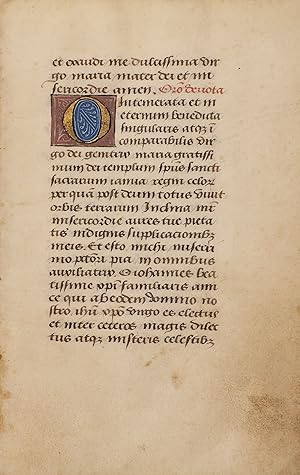

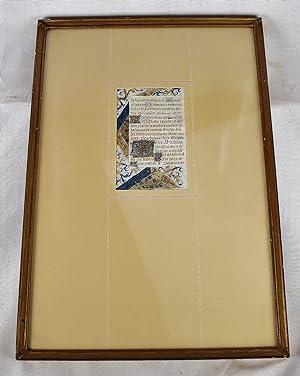


![Seller image for [Incipit, A2r:] Alst my gaet niet nae mij[n] syn / Soe wil ic my liden en[de] swyghe stil . for sale by Antiquariaat FORUM BV](https://pictures.abebooks.com/inventory/md/md32014502005.jpg)
![Seller image for Officium Beate Marie Virginis secundum Romana[m] Curiam for sale by Arader Books](https://pictures.abebooks.com/inventory/md/md31925431137.jpg)
![Seller image for [Liber horarum - Use of Rouen]. for sale by Antiquariat INLIBRIS Gilhofer Nfg. GmbH](https://pictures.abebooks.com/inventory/md/md31786852342.jpg)
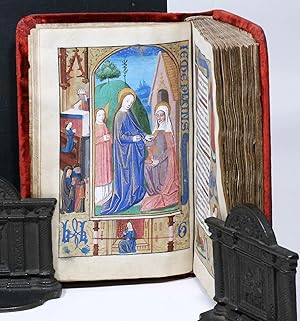

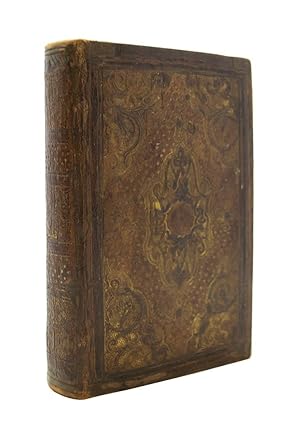
![Seller image for Heures [Hours] de nostre dame a l'usage de Paris for sale by Heritage Book Shop, ABAA](https://pictures.abebooks.com/inventory/md/md31202735730.jpg)
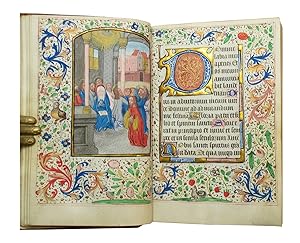
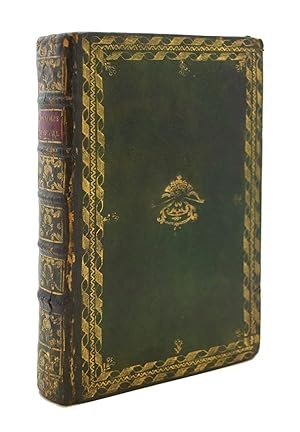
![Seller image for [Liber horarum - Use of Rouen]. for sale by Antiquariat INLIBRIS Gilhofer Nfg. GmbH](https://pictures.abebooks.com/inventory/md/md30797118902.jpg)