
Brigitte Pitarakis Edited By (3 results)
Language: English
Published by Istanbul Arastirmalari Enstitüsü, Istanbul 2018
- Softcover
Seller: Khalkedon Rare Books ABA, ILAB, IOBA, ESA, Istanbul, TurkeyKhalkedon Rare Books ABA, ILAB, IOBA, ESA
Contact seller5-star sellerCondition: New
US$ 55.00
US$ 20.44 shippingShips from Turkey to U.S.A.Quantity: 1 available
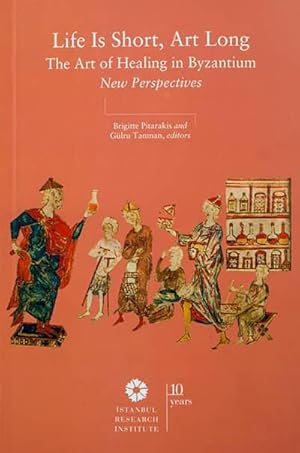
Soft cover. Condition: New. Paperback. Roy. 8vo. (24 x 17 cm). In English. 265 p., color ills. Life is short, art long: The art of healing in Byzantium. New perspectives. Providing new approaches to Byzantine views on health and medicine, this 13-chapter volume builds interdisciplinary bridges between a variety of subjects, rang…ing from religious beliefs and supernatural forces to oral health and dietary habits. Other topics include perceptions of the eternal afterlife, health centers in Constantinople and Anatolia, medical literature, access to exotic materials used in pharmaceuticals, traditions related to the god Asklepios, and hospital architecture designed to promote healing. The themes covered are based on the proceedings of the symposium held 14 March 2015, Medicine Day in Turkey, as part of the exhibition Life is Short, Art Long: the Art of Healing in Byzantium at the Pera Museum. All chapters are in English.

Language: English
Published by Istanbul: Istanbul Research Institute, 2022., Istanbul: 2022
- Softcover
Seller: BOSPHORUS BOOKS, Istanbul, TurkeyBOSPHORUS BOOKS
Contact seller4-star sellerCondition: New
US$ 52.63
US$ 39.74 shippingShips from Turkey to U.S.A.Quantity: 1 available
Soft cover. Condition: New. DELOUIS, OLIVIER - BRIGITTE PITARAKIS (Edited by) Discovering Byzantium in Istanbul: Scholars, institutions, and challenges, 1800- 1955. Istanbul: Istanbul Research Institute, 2022. Large 8vo., 399 p., b/w and color ills. Paperback. New ISBN: 9786057120533 CATALOG: Byzance KEYWORDS: Byzantium Istanbul… - Constantinople At a time when classical antiquity continued to be the main attraction, drawing Western scholars to the Eastern Mediterranean, Byzantine history and archaeology emerged as a new field of competitive scientific exploration in the former Byzantine capital. Some of the major themes and issues addressed at Discovering Byzantium in Istanbul are scholars' motivations and incentives for studying the Byzantine Empire, the means by which they accessed the monuments and material wealth of Constantinople, what they were allowed to see and under what circumstances and conditions, and the networks they established among themselves and with authorities from governmental and cultural institutions. The activities of newly founded foreign institutes and museums are also examined, along with scientific competition at the international level, including the reactions of Turkish scholars. The period covered by Discovering Byzantium in Istanbul begins with the emergence of major archaeological expeditions in the Eastern Mediterranean and is rich in major historical events and findings that brought the Ottoman Empire and the modern Turkish Republic to the fore. It ends with the International Congress of Byzantine Studies convening its tenth conference, for the first time meeting in Istanbul.
Kariye from Theodore Metochites to Thomas Whittemore: One monument, two monumental personalities.= Kariye: Bir anit, iki anitsal kisilik. Theodoros Metokhites'ten Thomas Whittemore'a. [Exhibition catalogue]. Texts by Holger A. Klein, Robert G. Ousterhout, Natalia Teteriatnikov, Dimiter Angelov, Jeffrey M. Featherstone.
Edited by HOLGER A. KLEIN, ROBERT G. OUSTERHOUT, BRIGITTE PITARAKIS.
Language: Turkish
Published by Suna ve Inan Kiraç Vakfi Pera Müzesi, Istanbul 2010
- Softcover
Seller: Khalkedon Rare Books ABA, ILAB, IOBA, ESA, Istanbul, TurkeyKhalkedon Rare Books ABA, ILAB, IOBA, ESA
Contact seller5-star sellerCondition: New
US$ 30.00
US$ 20.44 shippingShips from Turkey to U.S.A.Quantity: 1 available
Soft cover. Condition: New. 2nd Edition. Paperback. 4to. (29 x 24 cm). In English and Turkish. 212 p., color and b/w ills. Kariye from Theodore Metochites to Thomas Whittemore: One monument, two monumental personalities.= Kariye: Bir anit, iki anitsal kisilik. Theodoros Metokhites'ten Thomas Whittemore'a. [Exhibition catalogue].… Texts by Holger A. Klein, Robert G. Ousterhout, Natalia Teteriatnikov, Dimiter Angelov, Jeffrey M. Featherstone. Displayed at Pera Museum, Kariye, from Theodoros Metokhites to Thomas Whittemore; One Monument, Two Monumental Personalities is comprised largely of objects and documents on loan from abroad, the exhibition narrates the story of Kraiye, one of the globally renowned monuments of Istanbul, as well as the extraordinary tales of two of its 'builders', who lived six centuries apart. At one end stands fellow townsman Theodoros Metokhites, Byzantine thinker, poet and politician, who shaped Kariye at the turn of the 14th century and adorned it with priceless mosaics and frescoes. On the other end is American renaissance man and archaeologist Thomas Whittemore, who passionately and meticulously restored this structure to its former grandeur in the 1940s, consequently bestowing it to the world of culture and art as a museum. In between lies the unconventional story of a structure shaped by the footprints of these remarkable men. The former church of the monastery of Christ of the Chora, better known today as the Kariye Camisi or Kariye Museum, is one of the most impressive Byzantine monuments to survive in the modern city of İstanbul. Founded probably as early as the sixth century, rebuilt by members of the imperial family in the late eleventh and early twelfth centuries, and splendidly restored by the Byzantine humanist, poet, and prime minister Theodore Metochites between 1316 and 1321, the church of the Chora Monastery is today considered one of the most outstanding examples of Late Byzantine art and architecture to survive. While the building itself was already known as the 'Mosaic Mosque' during the nineteenth century, the fame of the church's rich and complex interior decoration rests by and large on an extensive restoration campaign initiated by the American scholar and philanthropist Thomas Whittemore, founder and director of the Byzantine Institute of America from 1930 to his death in 1950. It was the aim of this exhibition, to explore the history of the "Kariye" through its representation over the centuries, and to pay homage to the two men who were responsible for its restoration and conservation in the fourteenth and twentieth centuries respectively: Theodore Metochites and Thomas Whittemore. The exhibition furthermore aimed to celebrate the work of those who have helped to preserve the architecture of the Kariye and its extraordinary cycle of mosaics and frescoes during the 1940s and 1950s.


