Order Total (1 Item Items):
Shipping Destination:

British Mandate (11 results)
Skip to main search results
Search filters
Product Type
- All Product Types
- Books (8)
- Magazines & Periodicals (1)
- Comics (No further results match this refinement)
- Sheet Music (No further results match this refinement)
- Art, Prints & Posters (2)
- Photographs (No further results match this refinement)
- Maps (No further results match this refinement)
- Manuscripts & Paper Collectibles (No further results match this refinement)
Condition Learn more
- New (No further results match this refinement)
- As New, Fine or Near Fine (No further results match this refinement)
- Very Good or Good (4)
- Fair or Poor (1)
- As Described (6)
Binding
Collectible Attributes
- First Edition (1)
- Signed (1)
- Dust Jacket (No further results match this refinement)
- Seller-Supplied Images (8)
- Not Print on Demand (11)
Language (1)
Price
- Any Price
- Under US$ 25 (No further results match this refinement)
- US$ 25 to US$ 50 (No further results match this refinement)
- Over US$ 50
Free Shipping
- Free Shipping to U.S.A. (No further results match this refinement)
Seller Location
Seller Rating
-
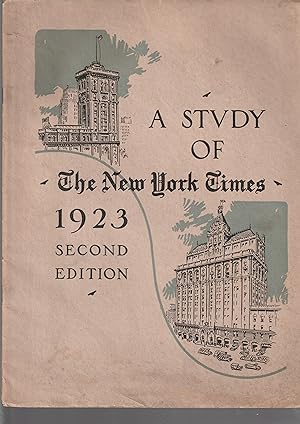
A Study of the New York Times 1923
Published by The Sweeney and James Company, Cleveland, Ohio, U.S.A., 1923
Paperback. Condition: Fair. No Jacket. 24 pages. 284 x 220 mm. Very light water stains. Light soiling to covers. One double leaf detached.
-
SINAI AND PALESTINE In Connection with their History
Published by John Murray, 1905
Seller: Arches Bookhouse, Portland, OR, U.S.A.
Seller rating 5 out of 5 stars

Hardcover. Condition: VERY GOOD. 560pp. + plates and maps. Stated 'Cheap Edition', but still a sound and sturdy production. Sewn binding in blue cloth with gilt stamped spine lettering. Some light rubbing to the tips and faint toning to the spine, light foxing and damp splotches to edges, very clean and sharp otherwise. With owner's inscription to the free and pastedown front endpaper, namely Saul P.N. Benjamin / Jerusalem, Palestine, Sept. 23, 1944.
-

REPORT BY HIS MAJESTY'S GOVERNMENT IN THE UNITED KINGDOM.ON THE ADMINISTRATION OF PALESTINE AND TRANS-JORDAN FOR THE YEAR 1932.
Published by HMSO, London, 1933
Seller: M.POLLAK ANTIQUARIAT Est.1899, ABA, ILAB, Tel-Aviv, Israel
Seller rating 5 out of 5 stars
Original Wrappers. Condition: Good. XII+267pp. Outside minimal marginal wear ,otherwise a very good and clean copy -.
-
THE CYPRUS BLUE BOOK 1931. All Statistics and Returns, Except Where Otherwise Stated, are in Respect of the Calendar Year Ended on 31st December 1931.
Published by Government Printing Office, Nicosia, 1932
Seller: M.POLLAK ANTIQUARIAT Est.1899, ABA, ILAB, Tel-Aviv, Israel
Seller rating 5 out of 5 stars
First Edition
Original Wrappers. Condition: Very Good. First Edition. 432pp . Occasional spotting . Spine expertly repaired and lightly browned , otherwise a good copy. Rare.-.
-
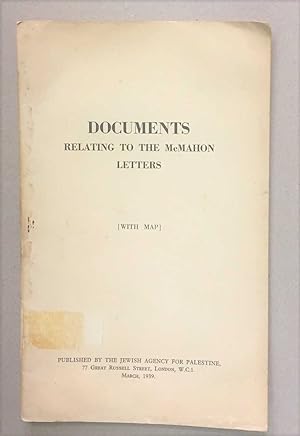
DOCUMENTS RELATING TO THE MCMAHON LETTERS (WITH MAP)
Published by Massada Press, 1939
Seller: M.POLLAK ANTIQUARIAT Est.1899, ABA, ILAB, Tel-Aviv, Israel
Seller rating 5 out of 5 stars
Soft cover. Condition: Very Good. 20pp . THE JEWISH RESPONSE (of the JEWISH AGENCY FOR PALESTINE) to the British Government's publication of the " McMahon Letters " published earlier the same month (March 16th, 1939). The McMahon Letters include the correspondence between Sir Henry McMahon (His Majesty's High Commissioner in Egypt) and Hussein Sharif of Mecca between 1915 and 1916 and represent a series of letters that were exchanged during World War I in which the British government agreed to recognize Arab independence after the war in exchange for Hussein's launching the Arab Revolt against the Ottoman Empire. These alleged promises to the Arab side given before the later BALFOUR DECLARATION OF 1917 were therefore considered by the supporters of the JEWISH CAUSE as being without legal validity. THIS VERY RARE PUBLICATION includes among its documents a STATEMENT BY MCMAHON, that the area in which Arab independence was promised DID NOT INCLUDE PALESTINE. - With a folding coloured map of the ARAB TERRITORIES AND PALESTINE. Lower part of the booklet with 2cm wide strip of water stain (NOT AFFECTING THE MAP) , outside cover with some markings on spine and remains of label removed. Second impression of 1939. A VERY GOOD COPY. VERY RARE AND IMPORTANT PUBLICATION.
-
Memorandum Submitted to The Palestine Royal Commission on Behalf of The Jewish Agency for Palestine.
Published by London Jewish Agency for Palestine November, 1936
Seller: Shapero Rare Books, London, United Kingdom
Association Member: ABA ILAB PBFA
Seller rating 5 out of 5 stars
US$ 689.77
US$ 20.09 shipping
Ships from United Kingdom to U.S.A.Quantity: 1 available
Add to basket16mo (24.5 x 15.4 cm); original printed wrappers, faded with some staining; corners chipped, spine rubbed with marginal tears, pages clean; [2], 3-323, [1] pp. Memorandum submitted to the Peel Commission by the Jewish Agency for Palestine, with Introductory Note by Dr. Chaim Weizmann, future First President of The State of Israel. The Jewish Agency for Palestine was founded by Weizmann in 1929 in order to manage effectively the Jewish population affairs in Palestine and to unite them all in the mission of building a national home for all the Jews at the Land of Israel. On November 25, 1936, Weizmann addressed the Peel Comission in a two and a half hours long speech. He described the hardships of the Jewish population in Europe, sawing the east to the Rhein river the world divided to places where the Jews can't live and places where Jew's aren't allowed to enter. He talked about the lack of Homeland for the Jewish people and about their longing to the Land of Israel, their original Homeland, which they have never forgot and never gave up on. He demanded the millions of persecuted Jews of Europe to be given a refuge. Years later, Lord Peel wrote that Weizmann's address to the commission was the one that left the deepest impression. The full text of Weizmann's statement to the commission was published, titled The Jewish People and Palestine. A copy of its second edition can be found in our stock, under no. 106334.
-
Palestine. Report of The High Commissioner of the Administration of Palestine, 1920-1925.
Published by London The Colonial Office, 1925
Seller: Shapero Rare Books, London, United Kingdom
Association Member: ABA ILAB PBFA
Seller rating 5 out of 5 stars
US$ 793.24
US$ 20.09 shipping
Ships from United Kingdom to U.S.A.Quantity: 1 available
Add to basket16mo (24.5 x 15.4 cm); original printed paper wrappers with some browning to edges; front cover leaf detached, small marginal folds and tears to wrappers. [3], 4-59 pp. Report to the Secretary of State for the Colonies by Herbert Samuel, The High Commissioner of Palestine at the time. The report covers issues such as: public security, justice, finance, public health, education, as well as immigration and population of Palestine, and many more. Herbert Samuel was appointed to the position of High Commissioner on the 1st of July 1920, before the Council of the League of Nations approved a British mandate for Palestine; he served in this role until June 30, 1925. Samuel was the first Jew to govern the historic Land of Israel in 2000 years; he officially recognised Hebrew as one of the three official languages of the land, and his appointment was warmly welcomed by the Zionist movement.
-
Report of the Commission on the Disturbances of August, 1929.
Published by London H. M. Stationery Office March, 1930
Seller: Shapero Rare Books, London, United Kingdom
Association Member: ABA ILAB PBFA
Seller rating 5 out of 5 stars
US$ 1,310.57
US$ 20.09 shipping
Ships from United Kingdom to U.S.A.Quantity: 1 available
Add to basket8vo (24.5 x 15.5 cm); 4 folding maps (one in colour), original printed wrappers, spine held together with tape, old pencil inscriptions, small marginal tears and browning; previous owner's signature to title page; stamps of the Jerusalem Consulate of the Republic of Czechoslovakia throughout the book; 202, [4] pp. Officially known as the 'Report of the Commission on the Palestine Disturbances of August 1929' was the result of the British commission of inquiry, led by Sir Walter Shaw. The commission was came to investigate the violent rioting which took place in Palestine in late August 1929 (aka the Buraq Uprising) over the long-standing dispute between Muslims and Jews over access to the Western Wall in Jerusalem. Appendix V, pp. 196-199, contains the 'Statement of British Policy in Palestine issued by Mr. Churchill in June, 1922'.
-
Two Proclamation Posters.
Published by Jerusalem The Greek Monastery Press for the High Commissioner, 1929
Seller: Shapero Rare Books, London, United Kingdom
Association Member: ABA ILAB PBFA
Seller rating 5 out of 5 stars
Art / Print / Poster
US$ 2,690.11
US$ 20.09 shipping
Ships from United Kingdom to U.S.A.Quantity: 1 available
Add to basketTwo original posters, printed in black ink (43 x 34 cm); text in Hebrew and English; light staining, small marginal tears and folding marks. The British Mandatory authorities' first response to the 1929 riots, featuring a sweeping accusation against the Arabs for initiating the violence (an accusation they retracted just hours later). In his statement, High Commissioner John Robert Chancellor (1870 â" 1952) places direct blame on the Arabs for the outbreak of the 1929 riots: 'I have returned from the United Kingdom to find to my distress the country in a state of disorder and a prey to unlawful violence. I have learned with horror of the atrocious acts committed by bodies of ruthless and bloodthirsty evil-doers, of savage murders perpetrated upon defenceless members of the Jewish population regardless of age or sex, accompanied, as at Hebron, by acts of unspeakable savagery, of the burning of farms and houses in town and country and of the looting and destruction of property. These crimes have brought upon their authors the execration of all civilised peoples throughout the world.' At the same time, the Mandatory authorities immediately suspended all Arab newspapers, holding them responsible for incitement to violence and public disorder. This unusually sharp public statement, directed squarely at the Arab population, provoked fury among Arab leaders toward High Commissioner Chancellor. Within hours, under mounting pressure, Chancellor wrote to the British government, urging it to reconsider â" or even withdraw entirely â" its commitment to Zionism. In his private correspondence, he referred to the Balfour Declaration as a 'colossal blunder'. A few days later he issued a second statement in which he retracted his earlier firm words and announced that an investigation would be conducted into the conduct of both sides. This led to the setting up of the Shaw Commission of Enquiry, led by Sir Walter Shaw. If you are interested in the Shaw Commission of Enquiry report, please see stock no.116330.
-

Proclamation by the officer administering the government.
Published by Jerusalem November 15, 1945
Seller: Shapero Rare Books, London, United Kingdom
Association Member: ABA ILAB PBFA
Seller rating 5 out of 5 stars
Art / Print / Poster Signed
US$ 3,448.86
US$ 20.09 shipping
Ships from United Kingdom to U.S.A.Quantity: 1 available
Add to basketPrinted poster, 62.5 x 70 cm; creases, a few stains and small marginal tears; text in Hebrew, English and Arabic. A large poster, which was likely hung on the streets of Mandate Palestine, reminding civilians to mind their own business, to behave lawfully and to not carry or store any weapons. Signed by Robert Scott, Acting Chief Secretary. The poster illustrates the British reaction to the latest armed offensives and violent protests against British rule, that characterised the final period of the British Mandate in Palestine.
-
Original Hebrew Newspaper Reporting on the End of British Mandate in Palestine, 1948
Publication Date: 1948
Seller: Max Rambod Inc, Woodland Hills, CA, U.S.A.
Association Member: ABAA ILAB PADA
Seller rating 5 out of 5 stars
Magazine / Periodical
Davar Labour Daily, Tel Aviv. 1 July 1948. Hebrew-language newspaper. Complete issue of 4 large pages, measuring 17 × 23 inches, twice folded. This historically consequential issue of Davar documents the immediate aftermath of the end of the British Mandate in Palestine and the consolidation of Israeli sovereignty during the opening phase of the 1948 Arab-Israeli War. The prominent front-page headlines announce the formal conclusion of British rule-reporting that "the last British soldiers left yesterday"-and describe the entry of the Jewish Navy into the Port of Haifa, a moment of immense symbolic and strategic importance. Published only weeks after the May 14, 1948 declaration of the State of Israel, this issue captures a rare contemporaneous Israeli labor-Zionist perspective on decolonization, state formation, and the transfer of military and political authority. As the official newspaper of the Mapai-aligned labor movement, Davar functioned not merely as a news outlet but as a central ideological voice shaping early Israeli civic identity, workers' culture, and political legitimacy. This issue represents a primary-source artifact of Israeli independence, naval organization, and the dismantling of British imperial presence in the eastern Mediterranean. The reporting situates Haifa-a critical port city and former locus of British power-as a stage for the transition from mandate to statehood, underscoring the intertwined histories of labor Zionism, military mobilization, and postwar geopolitical realignment. Complete, large-format issues from this precise transitional window are increasingly scarce, particularly with legible headlines directly addressing the withdrawal of British forces and the assertion of Jewish naval control. Condition: Very good overall. Minor cuts confined to the central fold, consistent with age and original handling. Paper remains sound and complete. Overall grade: Very Good.