

Order Total (1 Item Items):
Shipping Destination:

Cabeo Niccolò (6 results)
Skip to main search results
Search filters
Product Type
- All Product Types
- Books (6)
- Magazines & Periodicals (No further results match this refinement)
- Comics (No further results match this refinement)
- Sheet Music (No further results match this refinement)
- Art, Prints & Posters (No further results match this refinement)
- Photographs (No further results match this refinement)
- Maps (No further results match this refinement)
- Manuscripts & Paper Collectibles (No further results match this refinement)
Condition Learn more
- New (3)
- As New, Fine or Near Fine (No further results match this refinement)
- Very Good or Good (No further results match this refinement)
- Fair or Poor (No further results match this refinement)
- As Described (3)
Binding
- All Bindings
- Hardcover (5)
- Softcover (No further results match this refinement)
Collectible Attributes
- First Edition (3)
- Signed (No further results match this refinement)
- Dust Jacket (No further results match this refinement)
- Seller-Supplied Images (6)
- Not Print on Demand (3)
Language (2)
Price
- Any Price
- Under US$ 25 (No further results match this refinement)
- US$ 25 to US$ 50
- Over US$ 50
Free Shipping
Seller Location
Seller Rating
-
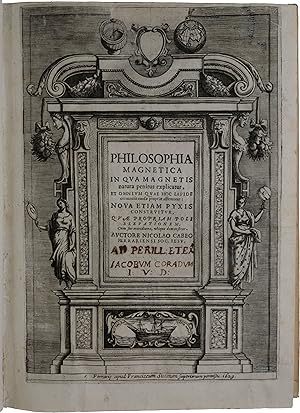
Philosophia Magnetica, In Qua Magnetis Natura Penitus Explicatur. Et Omnium Quae Hoc Lapide cernuntur, causae propriae afferuntur. . .
Published by Johann Kinckius, Francesco Succi, 1629., Cologne and Ferrara:, 1629
Seller: Jeff Weber Rare Books, Neuchatel, NEUCH, Switzerland
Seller rating 4 out of 5 stars

First Edition
US$ 7,500.00
US$ 29.15 shipping
Ships from Switzerland to U.S.A.Quantity: 1 available
Add to basketFolio. [20], 412, [12] pp. Printer's mark of first title with the added fine engraved architectural title-page with scientific apparatus, 149 wood-engravings including world map (p. 93); first title and dedication pages browned as usual. Added t.p. engraved has "praxis" changed to "pyxis" and imprint reads: Ferrarie apud Franciscum Succium. Contemporary full vellum, gilt spine title, edges colored. The first [typographic] title and dedication pages were added to this Cologne edition (see below). Aside from the two German leaves, the rest of the text is clean, crisp and very fine. FIRST EDITION, COLOGNE ISSUE, OF THE FIRST WORK TO DISCUSS ELECTRICAL REPULSION, "PERHAPS THE MOST SIGNIFICANT DISCOVERY OF THE CENTURY FOLLOWING GILBERT." :: WOLF. THE FIRST WORK TO DISCUSS ELECTRICAL REPULSION. "On p. 194 of this famous work of the great Italian Jesuit will be found the first recognition of electrical repulsion. Gilbert's discoveries and theories are freely discussed, the latter often adversely. Sympathetic telegraphy disproved (page 301); magnetic field mapped out by iron filings; also diagrams of the magnetic (lover's) telegraph. Cabeo opposed the views of Copernicus on astronomy, as well as those of Gilbert on terrestrial magnetism. Copies of this first edition are much sought after." :: Wheeler Gift. "An important work on the loadstone. . . A curious chapter. . .institutes a comparison between electrical and magnetical attraction. . .The PHILOSOPHIA MAGNETICA is the second Latin book published on electricity." :: Mottelay. The Cologne issue adds a new typographic title-page and resets the dedication leaf (conjugate leaf) beginning "Ludovico XIII" [see Wellcome description]. The Papal arms which were at the top of the engraved title-page are replaced with the Jesuit emblem and the last line of the title beginning with "multa quoque dicuntur." has been added. It seems fairly obvious that Succi printed two variants of the book, one intended for the German trade; the paper of the book is distinctly a superior Italian printing on fine paper except for the added leaves which are on the typically browned paper of seventeenth century German books. Probably Kinkius printed these two leaves and sent them to Italy to be added to his issue of the book. This copy is in a typical Italian binding of the time which implies, in this cataloger's mind, that Succi supplied the books with the changes in a finished form to his German counterpart. REFERENCES: Bakken 7; Bibl. Dt. Mus. Libri rari 060; Ferguson I, p. 136; Neville I, p. 232; Riccardi I, 205; Ronalds 92; Sotheran, 659; Wheeler Gift 97; De Backer-Sommervogel II, 483, 1; Thorndike VII, 267ff.; Wellcome I, 1171a. Full title: Philosophia Magnetica, In Qua Magnetis Natura Penitus Explicatur. Et Omnium Quae Hoc Lapide cernuntur, causae propriae afferuntur: Nova Etiam Praxis Construitur. quae propriam Poli elevationem, cum meridiano, ubique demonstrat, Multa Quoque Dicuntur De electricis & aliis attractionibus, & eorum casis FULL TITLE: Philosophia Magnetica, In Qua Magnetis Natura Penitus Explicatur. Et Omnium Quae Hoc Lapide cernuntur, causae propriae afferuntur: Nova Etiam Praxis Construitur. quae propriam Poli elevationem, cum meridiano, ubique demonstrat . . . [PLEASE CONTACT DIRECT FOR FURTHER INFORMATION].
-

Philosophia magnetica in qua magnetis natura penitus explicatur, et omnium quae hoc lapide cernuntur causae propriae afferuntur.
Language: Latin
Published by Ferrara Succius, 1629
Seller: Antiquariat Gerhard Gruber, Heilbronn, Germany
Seller rating 5 out of 5 stars

First Edition
(31,5 x 22,5 cm). (16) 412 (12) S. Mit breiter gestochener Titelbordüre, 4 großen Textkupfern und zahlreichen Textholzschnitten. Lederband der Zeit mit reicher Rückenvergoldung. Erster Druck der ersten Ausgabe mit dem Wappen von Ludwig XIII. oberhalb des Titels und dem Widmungsblatt "Rex christianissime". Im gleichen Jahr erschien eine Titelauflage mit Kölner Impressum und mindestens 3 Varianten. - "The first Italian book on magnetism and electricity, and only the second to be published on these subjects, the 'De Magnete' (London, 1600) by William Gilbert being the first. The important discovery of electrical repulsion is here first announced (p. 194), and this phenomenon was later systematically investigated by Otto von Guericke in his 'Experimenta Nova' (Amsterdam, 1672). Electrical repulsion 'seems to have been noticed incidentally by Cabeus, who. describes how filings attracted by excited amber sometimes recoiled to a distance of several inches after making contact' (Wolf, I, 303). Cabeo (1585-1650) taught mathematics and theology in Parma for many years and later settled in Genoa, where he taught mathematics. This work, of some chemical interest, describes many experiments on the posibility of telegraphic communication by means of magnetized needles and gives the first picture of the sympathetic telegraph, which fancifully anticipates the actual telegraph." (Neville). - Das Textkupfer auf S. 93 zeigt eine kleine ovale Weltkarte, die auf S. 220 mit Gradeinteilung wiederholt wird. - Mit Exlibris der Royal Meteorological Society sowie mit handschriftlichem Besitzvermerk des britischen Astronomen Bernard Ephraim Julius Pagel (1930-2007) auf montiertem Papierstreifen. - Titel leicht fleckig, mit etwas flauem Druckvermerk und handschriftlicher Jahreszahlenergänzung. Die S. 5/6 und S. 7/8 verbunden. Vorderes fliegendes Vorsatzblatt mit altem Papier erneuert. Einband etwas berieben und bestoßen, Ecken und Rücken restauriert, sonst sauberes und gut erhaltenes Exemplar. - DSB 3, 3; Ferguson I, 136; Neville I, 232; Wheeler-Gift 97 (Copies of this first edition. are much sought after"); Ekelöf 103; Mottelay 109; Riccardi I/1, 205.
-
Philosophia magnetica, in qua magnetis natura penitus explicatur, et omnium quae hoc lapide cernuntur, causae propriae afferuntur. Nova etiam pycis constrtuitur, quae propiam poli elevationem, sum suo meridiano, ubique demonstrat
Published by Francesco Suzzi, Ferrara, 1629
Seller: SOPHIA RARE BOOKS, Koebenhavn V, Denmark
Seller rating 4 out of 5 stars
First Edition
First edition. UNIQUE PRE-PUBLICATION PRESENTATION COPY. First edition, a unique pre-publication presentation copy by Cabeo to his teacher Jacobo Corrado, of the first extensive study of magnetism since William Gilbert's De Magnete (1600). Corrado's name is handwritten on the title page, which is in an unfinished state, the coat-of-arms at the head having been left un-engraved; in addition, there is an eleven-line manuscript dedication on the second leaf, which is blank but usually contains the Privilege of the Emperor Charles V. In the dedication Cabeo thanks his teacher and praises him for his vast knowledge. "His first book, the Philosophia magnetica, discussed not only Gilbert's but also Cabeo's own experimental investigations of terrestrial magnetism as well as magnetized iron and 'lodestone' (the mineral magnetite). The central focus of his work, like Gilbert's before him, was therefore the study of the magnetic behaviors of compass needles. Where Gilbert, however, argued that the Earth itself is a giant magnet, whose poles reproduce the poles of an ordinary magnet and with which it interacts, Cabeo maintained instead that magnetic properties are inherent to certain sorts of matter; they did not subsist in their relationships to the great magnet, the Earth. Indeed, Cabeo denied that the Earth itself is a great magnet, even though it contains matter lending it magnetic effects. He also, again following Gilbert, discussed magnetic attraction between rubbed objects (typically, pieces of amber resin) and light objects such as bits of straw or paper; the attractive virtues of such electrified bodies appeared to be sufficiently similar to those of magnets that it seemed appropriate to investigate them together. In accounting for the production of electrical attraction by certain kinds of matter when they are rubbed, Cabeo-always, as a natural philosopher, on the lookout for causal explanations of phenomena, not simply their descriptions-suggested that the rubbing stimulates the emission of tiny particles, as an effluvium, from the rubbed body's pores, which, in its interaction with the surrounding air, tends to move light objects toward it as a result of the rarified air's subsequent behavior. In the Philosophia magnetica, Cabeo considered the methodological and epistemological issues relating to his experimental investigations. He stressed that his work sought the causes behind natural effects (this being the usual goal of Aristotelian-style natural philosophy) but that he would proceed by borrowing the approach of the mathematicians because it was so clear and demonstrative. He also stressed the extent to which his discussions were based upon experimental work, his experiments having been repeated numerous times, with multiple witnesses on hand to guarantee the truth of his reports. The necessity of saying such things stemmed from the unusual nature of the phenomena Cabeo described; neither magnetic nor electrical effects were generally familiar from everyday experience, and arguments based on unusual and contrived experimental behaviors therefore needed special justification to be accepted" (DSB). No presentation copy on ABPC/RBH. Cabeo (1586-1650) entered the Jesuit order as a novice in 1602. "Cabeo's academic training occurred primarily at Parma, following the usual Jesuit curriculum of the period, and included the study of logic, natural philosophy (centered on the works of Aristotle), metaphysics, and theology; he clearly also studied some mathematics. Following the completion of his studies around 1616, Cabeo taught theology, philosophy, and metaphysics at Parma until 1621; he subsequently spent several years living at the Jesuit college back in Ferrara, his birthplace, and taught some theology there in the late 1620s. At the end of his life he returned to teaching, now at the Jesuit college in Genoa. In the meanwhile, he served the ducal courts in Mantua and in Modena, made use of his mathematical expertise in work on civil engineering projects, and was an itinerant preacher. He remained throughout his life engaged in issues of mathematics and natural philosophy, debating issues of mechanics, free fall, and motion with such contemporaries and familiars as Giovanni Battista Baliani, Benedetto Castelli, and Giovanni Battista Riccioli, as well as publishing his two major treatises. His interests covered a wide range of contemporary natural philosophy, however, beyond those questions of motion associated with his older contemporary Galileo" (ibid.). Although he was not in general a supporter of Galileo's theories, he observed the experiments of Baliani on falling objects and agreed with Galileo that different objects fall the same distance in the same time regardless of their composition (Galilei, Opere, XVIII, 99 ff.). "Cabeo was a Jesuit, and like many Jesuits, he was interested in magnetism, because magnetism seemed to demonstrate the existence of occult properties, the hidden propensities of things to cause effects in other objects without an obvious means of action. Since a lodestone, or natural magnet, could magnetize a piece of iron, and then cause the iron object to move toward the lodestone, and itself to move toward the iron, this seemed to be a wonderful manifestation of occult properties. And the Jesuits were fascinated by occult effects . Cabeo seems to have admired Gilbert's work, but he disagreed with Gilbert on a number of points, especially when Gilbert was critical of the Aristotelian approach to natural philosophy that had been adopted by most of the Jesuits. And he definitely did not agree, as Gilbert had concluded, that the earth's magnetism caused it to rotate on its axis" (/niccolo-cabeo/). "In his discussion of terrestrial magnetism, Cabeo conceded that the whole Earth participated in magnetic virtue, but he objected strenuously to Gilbert's assertion that the Earth was a big magnet. Gilbert had contended that at its core, the Earth was composed of a homogeneous and pure ma.
-
![Seller image for Philosophia magnetica 1629 [LeatherBound] for sale by True World of Books](https://pictures.abebooks.com/inventory/md/md31616572055.jpg)
Philosophia magnetica 1629 [LeatherBound]
Publication Date: 2025
LeatherBound. Condition: New. BOOKS ARE EXEMPT FROM IMPORT DUTIES AND TARIFFS; NO EXTRA CHARGES APPLY. LeatherBound edition. Condition: New. Reprinted from 1629 edition. Leather Binding on Spine and Corners with Golden leaf printing on spine. Bound in genuine leather with Satin ribbon page markers and Spine with raised gilt bands. A perfect gift for your loved ones. Pages: 449 NO changes have been made to the original text. This is NOT a retyped or an ocr'd reprint. Illustrations, Index, if any, are included in black and white. Each page is checked manually before printing. As this print on demand book is reprinted from a very old book, there could be some missing or flawed pages, but we always try to make the book as complete as possible. Fold-outs, if any, are not part of the book. If the original book was published in multiple volumes then this reprint is of only one volume, not the whole set. Sewing binding for longer life, where the book block is actually sewn (smythe sewn/section sewn) with thread before binding which results in a more durable type of binding. Pages: 449.
-
Leather Bound. Condition: New. Language: Latin. Language: Latin. Presenting an Exquisite Leather-Bound Edition, expertly crafted with Original Natural Leather that gracefully adorns the spine and corners. The allure continues with Golden Leaf Printing that adds a touch of elegance, while Hand Embossing on the rounded spine lends an artistic flair. This masterpiece has been meticulously reprinted in 2025, utilizing the invaluable guidance of the original edition published many years ago in 1629. The contents of this book are presented in classic black and white. Its durability is ensured through a meticulous sewing binding technique, enhancing its longevity. Imprinted on top-tier quality paper. A team of professionals has expertly processed each page, delicately preserving its content without alteration. Due to the vintage nature of these books, every page has been manually restored for legibility. However, in certain instances, occasional blurriness, missing segments, or faint black spots might persist. We sincerely hope for your understanding of the challenges we faced with these books. Recognizing their significance for readers seeking insight into our historical treasure, we've diligently restored and reissued them. Our intention is to offer this valuable resource once again. We eagerly await your feedback, hoping that you'll find it appealing and will generously share your thoughts and recommendations. Lang: - Latin, Pages:- 450, Print on Demand. If it is a multi-volume set, then it is only a single volume. We are specialised in Customisation of books, if you wish to opt different color leather binding, you may contact us. This service is chargeable. Product Disclaimer: Kindly be informed that, owing to the inherent nature of leather as a natural material, minor discolorations or textural variations may be perceptible. Explore the FOLIO EDITION (12x19 Inches): Available Upon Request. 450 450.
-
Philosophia Magnetica: In Qva Magnetis natura penitus explicatur . 1629 [Leather Bound]
Publication Date: 2025
Leather Bound. Condition: New. Language: Latin. Language: Latin. Presenting an Exquisite Leather-Bound Edition, expertly crafted with Original Natural Leather that gracefully adorns the spine and corners. The allure continues with Golden Leaf Printing that adds a touch of elegance, while Hand Embossing on the rounded spine lends an artistic flair. This masterpiece has been meticulously reprinted in 2025, utilizing the invaluable guidance of the original edition published many years ago in 1629. The contents of this book are presented in classic black and white. Its durability is ensured through a meticulous sewing binding technique, enhancing its longevity. Imprinted on top-tier quality paper. A team of professionals has expertly processed each page, delicately preserving its content without alteration. Due to the vintage nature of these books, every page has been manually restored for legibility. However, in certain instances, occasional blurriness, missing segments, or faint black spots might persist. We sincerely hope for your understanding of the challenges we faced with these books. Recognizing their significance for readers seeking insight into our historical treasure, we've diligently restored and reissued them. Our intention is to offer this valuable resource once again. We eagerly await your feedback, hoping that you'll find it appealing and will generously share your thoughts and recommendations. Lang: - Latin, Pages:- 460, Print on Demand. If it is a multi-volume set, then it is only a single volume. We are specialised in Customisation of books, if you wish to opt different color leather binding, you may contact us. This service is chargeable. Product Disclaimer: Kindly be informed that, owing to the inherent nature of leather as a natural material, minor discolorations or textural variations may be perceptible. Explore the FOLIO EDITION (12x19 Inches): Available Upon Request. 460 460.


![Seller image for Philosophia Magnetica: In Qva Magnetis Natvra Penitvs Explicatvr, Et Omnivm Qvæ Hoc Lapide cernuntur, causæ propriæ afferuntur: Nova Etiam Praxis Constrvitvr, qvæ propriam Poli eleuationem, cum suo meridiano, vbique demonstrat, Mvlta Qvoqve Dicvntvr De electricis, & alijs attractionibus & eorum causis. Additis Figvris Variis, Tam Aeneis, quàm ligno incisis 1629 [Leather Bound] for sale by Gyan Books Pvt. Ltd.](https://pictures.abebooks.com/inventory/md/md31600308092.jpg)
![Seller image for Philosophia Magnetica: In Qva Magnetis natura penitus explicatur . 1629 [Leather Bound] for sale by Gyan Books Pvt. Ltd.](https://pictures.abebooks.com/inventory/md/md31600302632.jpg)