Order Total (1 Item Items):
Shipping Destination:

Calepinus (58 results)
Author:
calepinus
Refine with Advanced Search
Skip to main search results
Search filters
Product Type
- All Product Types
- Books (58)
- Magazines & Periodicals (No further results match this refinement)
- Comics (No further results match this refinement)
- Sheet Music (No further results match this refinement)
- Art, Prints & Posters (No further results match this refinement)
- Photographs (No further results match this refinement)
- Maps (No further results match this refinement)
- Manuscripts & Paper Collectibles (No further results match this refinement)
Condition Learn more
- New (17)
- As New, Fine or Near Fine (1)
- Very Good or Good (7)
- Fair or Poor (No further results match this refinement)
- As Described (33)
Binding
Collectible Attributes
- First Edition (2)
- Signed (No further results match this refinement)
- Dust Jacket (1)
- Seller-Supplied Images (45)
- Not Print on Demand (41)
Language (4)
Free Shipping
Seller Location
Seller Rating
-
SEPTEM LINGUARUM , HOC EST LEXICON LATINUM, Variarum Linguarum interpretatione adjecta, ad usum seminarii patauini pluries emendatum , et auctum ; Nunc vero post Patauinam supremam Editionem [.] Opera et studio Johannis Baptistae Gallicciolli; Editio novissima. Tomus primus A -- L. Tomus secondus M -- Z
Language: French
Published by VENETIIS, MDCCLXXVIII (1778), EX TYPOGRAPHIA JOHANNIS GATTI, 1778
Couverture rigide. Condition: Bon. Deux tomes en un fort volume in folio (380 x 240 x 70 mm), [5] ff. 446 pp. - 458 pp. 80 pp. ( VERA BARBARA ). Titre en rouge et noir. Vignette au titre. Reliure en basane brune, dos à nerfs orné, tranches et gouttière mouchetées de rouge. (reliure époque). (plats frottés avec la présence d'épidermures, coiffe supérieure en partie manquante, accroc sur une coupe, petites galeries de ver, la plupart marginales ou en coin, sur une trentaine de feuillets au tome I et sur une cinquantaine de feuillet au tome II). Texte sur deux colonnes. Lettrines ornées, culs-de-lampe. Ambrosio CALEPINO, dit Ambrosius CALEPINUS, est un savant et religieux italien de la confrérie des augustins. Il consacre toute son énergie, jusqu'à sa mort à l'âge avancé de 76 ans, à la rédaction de son célèbre dictionnaire. Pour ce faire il rassemble un vaste lexique, développe les définitions et adopte le plan alphabétique déjà popularisé par le Catholicon qui, depuis plusieurs siècles, constituait la référence du genre. Décédé en 1511, CALEPINO ne verra pas son ?uvre continuer à s'étoffer. Les éditions se succéderont à un rythme très soutenu, au point qu'on en dénombrera près de 200 au total, toutes versions confondues. Le dictionnaire passe à cinq langues en 1545, à sept en 1551 puis à dix en 1588. Plusieurs écrivains et philologues continuent à réviser et amender l'ouvrage, et ce jusqu'au XVIIIe siècle. La version en sept langages de 1718, rédigée par Jacopo FACCIOLATI, c'est le cas pour notre exemplaire à la date de 1778, rencontrera en son temps un très vif succès. Ex-libris.
-

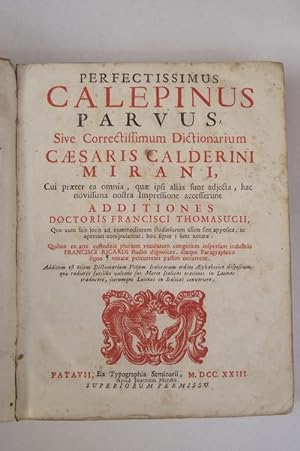
Perfectissimus Calepinus Parvus sive correctissimum Dictionarium Caesaris Calderini Mirani. Additiones Doct. Francisci Thomasucii.
Published by Ex Typ. Remondini,, Bassani,, 1748
Seller: Studio Bibliografico Benacense, Riva del garda, TN, Italy
Seller rating 5 out of 5 stars

Cm. 22, pp. (8) 448; 122. Frontespizio in rosso e nero. Leg. d'inizio '800 in mezza pelle. Metà del dorso mancante, peraltro ben conservato.
-
Septem linguarum Calepinus. Hoc est lexicon latinum, variarum linguarum interpretatione adjecta in usum Seminarii Patavini
Published by Patavii. Joannem Manfr?., 1758
Hardcover. Condition: Good. Dust Jacket Condition: No dust jacket. Good. No dust jacket. null Leather spine head chipped, corner wear, half-title page clipped, library markings, full leather, marble endpapers. Oversize book.
-
Septem linguarum Calepinus hoc est lexicon latinum vcariarum linguarum interpretatione adjecta in usum Seminari Patavini.
Published by Padova, Typ. Seminarii, 1752., Patavii, 1752
Seller: Libreria Antiquaria Gonnelli, Firenze, FI, Italy
Seller rating 4 out of 5 stars

Condition: Buono (Good). 0. 2 volumi in-folio. Tracce d'uso ed alcuni restauri ai margg. infer. di alcune carte. Legatura in pergamena coeva, dorso rifatto. Book.
-
Perfectissimus Calepinus Parvus sive correctissimum Dictionarium Caesaris Calderini Mirani. Additiones Doct. Francisci Thomasucii.
Published by Ex Typ. Seminarii,, Patavii,, 1723
Seller: Studio Bibliografico Benacense, Riva del garda, TN, Italy
Seller rating 5 out of 5 stars
Cm. 23, pp. (8) 448; 113 (1). Frontespizio in rosso e nero. Leg. coeva in mezza pergamena con titoli in oro su tassello al dorso. Qualche segno d'uso, ma esemplare genuino e ben conservato.
-

Septem linguarum? hoc est Lexicon Latinum, Variarum linguarum interpretatione adjecta. Editio postrema de qua vide Praefationem.
Published by ex Typ. Seminarii, Patavii, 1718
Seller: Studio Bibliografico Benacense, Riva del garda, TN, Italy
Seller rating 5 out of 5 stars
hardcover. Condition: Buono (Good). Cm. 33, pp. (12) 1128 (116). Frontespizio in rosso e nero con grande incisione xilografica centrale. Legatura coeva in mezza pergamena e piatti in cartonato rigido. Titoli in oro su tassello al dorso. Un rinforzo alla parte alta del dorso e qualche segno d'uso, ma complessivamente esemplare genuino e ben conservato. L'aggiunta finale titola: Addenda et mutanda. . Book.
-
Septem linguarum Calepinus hoc est lexicon latinum vcariarum linguarum interpretatione adjecta in usum Seminari Patavini.
Published by Patavii, Typ. Seminarii, 1752., Patavii, 1752
Seller: Libreria Antiquaria Gonnelli, Firenze, FI, Italy
Seller rating 5 out of 5 stars
Condition: Buono (Good). 0. 2 volumi in-folio. Tracce d'uso ed alcuni restauri ai margg. infer. di alcune carte. Legatura in mezza pergamena coeva. Book.
-
SEPTEM LINGUARUM CALEPINUS. HOC EST LEXICON LATINUM, VARIARUM LINGUARUM INTERPRETATIONE ADJECTA IN USUM SEMINARII PATAVINI (VOLUMEN SECUNDUM only) a Book Ready for the Bindery. Interior Good and Tight, FEPs and Covers Separated but Still Present.
Published by Patavii, Typis Seminarii. Apud Joannem Manfre. Superiorum Permissu, Privilegio, 1741
Seller: Reed Books The Museum of Fond Memories, Birmingham, AL, U.S.A.
Seller rating 2 out of 5 stars

Leatherbound. Condition: Worn Condition. Dust Jacket Condition: No Dust Jacket as Issued. MUCH OF SPINE COVER IS MISSING. This book is complete and ready for restoration or rebinding. Size: 15 1/4 x 10 1/4 x 1 3/4 Inches.
-
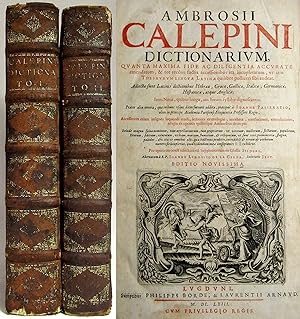
Ambrosii Calepini Dictionarium, quanta maxima fide ac diligentia accurate emendatum, & tot recens factis accessionibus ita locupletatum, ut iam Thesaurum Linguae Latinae, adjectae sunt Latinis dictionibus hebraeae, graecae, gallicae, italicae, germanicae, hispanicae, atque anglicae
Published by Lugduni: Philippi Borde & Laurentii Arnaud, 1663
Hardcover. Condition: Good. Antique 1663 complete 2 volume folio set. The books are overall in good condition with some signs of wear and age. The leather covers have some scuffing and wear with some corner wear and edge wear. There are small sections of cracking towards the top of the 2nd volume's outer leather joints and some cracking to the interior hinges of both volumes; however, the bindings of the books are still good and sound. Both volumes have a nice engraved title page and the first volume also has an additional half title. There are some crease lines/ wrinkles to the 2nd volume's title page. A couple of the pastedowns have some small handwritten numbers to the top margin in fountain pen. The interiors are toned from age but are fairly clean with some scattered light foxing, soiling, and grubbiness. A few pages have some worming. Most of the worming is pretty minor; there are just about 10 leaves or so in the "S" section where it is a bit heavier. Page 545/546 in the 1st volume has a fair amount of chipping to the bottom margin, however no text is affected. Along with that there is likely the very occasional page with some kind of other minor imperfection such as a small tear or chip, mild stain, minor marking, creased page corner, etc. The books are large volumes which measure approximately 15 3/8 inches by 9 1/2 inches. The text is collated and complete. There are some printing errors in a few of the page numbers; however, the content is correct. Volume 1 is 959 pages and volume 2 is 855. ************This is an oversize 2 volume set which will require additional shipping charges if being shipped outside of the United States or for domestic expedited shipping************.
-
Ambrosii Calepini dictionarium, quanta maxima fide ac diligentia accurate emendatum & tot recèns factis accessionibus ita locupletatum, ut iam thesaurum linguae latinae quilibet polliceri sibi audeat .
Published by Lugduni, Petri Prost, Philippi Borde, Laurentii Arnaud, 1647., 1647
Seller: Antiquariaat Garcia, Mechelen, Belgium
Association Member: ILAB
Seller rating 5 out of 5 stars
2 parts in 1 vol in-folio ( 39 x 24,5 x 13). 959 pp , 855 pp. Full leather binding with re-inforced spine. Decent copy of this considerably enlarged " octolingue dictionarium ". The eight languages being latin, greek, hebrew, french, italian, german, spanish and english.
-
Septem linguarum& hoc est Lexicon Latinum, variarum linguarum interpretatione adjecta in usum Seminarii Patavini. Editio octava emendatior, et auctior.
Published by Manfre',, Patavii,, 1758
Seller: Studio Bibliografico Benacense, Riva del garda, TN, Italy
Seller rating 5 out of 5 stars
Due volumi in-folio (cm. 39), pp. (8) 464; (2) 481 (1) 24, 86 (2). Frontespizi con grandi fregi incisi, di cui il primo in rosso e nero. Legatura coeva in cart. alla rustica con nervi passanti. Esemplare marginoso (in barbe) fresco e ben conservato.
-
Dictionarium. Post omnes alias editiones, ea denuo vocabulorum ex omnibus omnium authorum, tam priscorum, quam recentiorum, qui de hac re scripsere, libris excerptorum, accessione auctum, eaque cura ac iudicio recognitum, ut nihil praeterea reliquum sit quod desideres. Nam et vulgarem vocabulorum interpretationem addidimus, ut his etiam qui praeceptore carent, sit satisfactum. Quae accessere hoc signo notantur.
Published by Al segno del Nettuno, Venetiis, 1548
Seller: Studio Bibliografico Benacense, Riva del garda, TN, Italy
Seller rating 5 out of 5 stars
hardcover. Condition: Buono (Good). Cm. 29, cc. 623. Marchio tipografico al frontespizio e belle iniziali ornate. Legatura ottocentesca in mezza pelle e cart. rigido con titoli su tassello al dorso ed al piatto. Esemplare genuino ma con macchiette sparse e qualche abile rinforzo alle prime ed ultime carte. Manca l'ultima carta, sicuramente bianca (cfr. Iccu). Edizione non comune. Book.
-
Septem linguarum Calepinus. Hoc est lexicon latinum, variarum linguarum interpretatione adjecta in usum Seminarii Patavini.
Published by Joannem Manfrè., 1752
Rilegato. Condition: buono. 2 voll., in fol., p. perg., pp. 464 (1° vol.) + 481 + 24 di Verba Barbara + 86 di Index (2° vol.). Front. figurati. Testata. Capilettera. Tagli marmorizzati.
-
Dictionarium Octolingue quanta maxima fide ac diligentia accurate emendatum [.] adjectae sunt Latinis dictionibus Hebraecae, Graecae, Gallicae, Italicae, Germanicae, Hispanicae, atque Anglicae, etc.
Published by Lugduni [Lyon], Sumptib. Philippi Borde & Laurentii Arnaud 1663, 1663
Seller: Antiquariaat Pieter Judo (De Lezenaar), Hasselt, Belgium
Association Member: ILAB
Seller rating 5 out of 5 stars
First Edition
Complete in 2 volumes, iv,959 + 855 pp., large woodcut mark on title with Borde's device ('Semina fortunae geminat cum tempore virtus'), "Editio novissima", folio (39x25cm.), text printed in two columns, text in Latin, title in red and black, in two uniform cart. hardcover bindings (ca. 19th century, spines in leather, some use at ends, corners bumped and some slightly damaged), foxing throughout though text is always well readable, vague stain in margin of first pages of vol.1, small stamp on first blanco endpaper and on title page, nervertheless a good copy, [Monumental Latin dictionary with equivalents in 7 languages. The first edition was published in 1502, and since then it has been expanded and revised continuously. This edition is based on the revised edition by the French humanist Jean Passerat (1534-1602)], weight: 6.6kg., T107174.
-
Linguarum novem [] Dictionarium.
Published by Leiden, A. Commelinus, 1654
Seller: Sokol Books Ltd. ABA ILAB, London, United Kingdom
Seller rating 5 out of 5 stars
First Edition
US$ 3,454.56
US$ 56.35 shipping
Ships from United Kingdom to U.S.A.Quantity: 1 available
Add to basketHardcover. Condition: Very Good. 1st Edition. [POLYGLOT DICTIONARY] FIRST EDITION thus. Small 4to. 2 parts in 1, separate t-p to each, pp. (viii) 628. Roman and Italic letter, little Gothic, Greek, Hebrew and Greek, double column. First engraved t-p with Fame as angel playing trumpet with small map of Europe and North Africa (plate inverted), second t-p in red and black with woodcut printer's device, woodcut initials and ornaments. First t-p very slightly dusty, intermittent faint marginal water stain to couple of gatherings, a handful of pages a bit browned, very small ink splash to fore-edge of couple of gatherings, tear to blank fore-edge of first 3O2 and lower outer corner (blank) of 4T1, tiny ink burn to first 4F3 touching one letter, little worm hole to fore-edge of first 4H4-second I4. A very good copy in contemporary German calf, traces of ties, tripled blind ruled to a panel design, outer border with rolls of palmettes in blind, raised bands, spine triple blind ruled, title gilt to spine, extremities worn, spine and joints bit cracked. Modern bookplate to front pastedown, early ex-libris of D.(?) Massel to first t-p. Finely bound, very good copy of the first edition of this scarce, abridged version, in no less than nine languages, of the most influential early modern polyglot dictionary. This is variant A, with the imprint 'in Bibliopolo' (Jones, 'German Lexicography', 261). Ambrogio Calepino (1440-1510) was an Italian lexicographer renowned for his Latin dictionary of 1502; known as 'il Calepino', it was reprinted dozens of times in the course of the C16. Despite the changed 'intellectual climate' beginning from the second half of the C16, 'with vernacular languages throughout Europe conspiring to defeat the humanists' project and make classical Latin an irredeemably foreign language to all, Calepino's dictionary became the main translation dictionary in use' (Moss, 'Renaissance Truth', 24), especially thanks to the subsequent enlargements by sundry European scholars, which turned it into a polyglot dictionary featuring up to 13 languages.3 This 1654 Leiden edition included additions by Jean Passerat (1534-1602), the successor of Ramus to the professorship of Latin at the Collège de France, and was edited by Cornelis Schrevel (1608-64), professor at Leiden and author of a Latin-Greek lexicon. Extremely successful thanks to its portable format, it features definitions in Latin, Greek, Hebrew, French, Italian, German, Spanish, English and Flemish. The preface remarks indeed that 'the weight of the original work, and the crowding of the numerous examples, had become very confusing, and made reading tedious'. In layout, format and content, Schrevel's edition made it a more useable instrument for private study. A solid reference work in a handsome binding. Pettegree & Wasby, Netherlandish Books, 6393; Sommervogel 186:7; Graesse I, 15. W.J. Jones, German Lexicography in the European Context (Berlin, 2000); A. Moss, Renaissance Truth and the Latin Language Turn (Oxford, 2003).
-
Ambrosii Calepini Bergomatis Ordinis Eremitani Observatium professoris devotissimi vocabularis thesaurus copiosissimus: ex Nicolai Perotti Cornucopie.
Published by Alessando Paganino, Toscolano, 1522
Seller: Sanctuary Books, A.B.A.A., New York, NY, U.S.A.
Seller rating 5 out of 5 stars
Paperback. Condition: Very Good. 4to (220 x 148mm). 381pp., (mispaginated as common, 2C misbound). Title within woodcut interlace border. Two woodcut initials for dedication and letter 'A' with scrolling vinework. Double columns of Italic type. Later blue wrappers, ms. title to spine, cancelled period inscription on front wrap; (title browned and brittle at upper hinge and margin, lightly dampstained throughout mostly at front and rear, edges lightly worn.) Early ownership inscription to title. 1522 edition of Calepinus' Latin dictionary, first appearing in Reggio in 1502, nine years before his death. The first edition was faulty in its deficiency of good words and abundance of unauthorized ones, in its errors of citations and confused meanings. It was reprinted many times during the 16th century; the Aldine press alone produced no fewer than 18 editions from 1542 to 1592. Later editions were considerably enlarged and by the mid 1580s the Latin original had added equivalents in eleven other languages. Calepinus, an Italian monk and philologist, devoted himself to letters and his name became almost synonymous with Latin lexicons during this 16th century. His polyglot dictionary was a helpful source for Latin phrases and figures of speech in philosophy and theology. Calepinus' dictionary remains one of the most popular humanist dictionaries of the period; tracing words back to their Greek and Latin roots as well as noting the specific passages in the primary source material. This work, as noted in the title, incorporated the contents of the Cornucopia of Nicholas Perotti (1458). Notably, Calepinus includes proper names in his descriptions and details the histories and legends associated with them. Calepinus' dictionary was also more orthodox than its predecessors in its alphabetical arrangement and additions of more quotations from Christian works. It is noteworthy that the 1752 edition was used in the seminary of Patavia and was intended for theological studies. Well-preserved, important dictionary, chock-full of encyclopedic material for the Renaissance student.
-
Ambrosii Calepini Bergomatis Ordinis Eremitani Observatium professoris devotissimi vocabularis thesaurus copiosissimus: ex Nicolai Perotti Cornucopie.
Published by Alessando Paganino, Toscolano, 1522
Seller: Sanctuary Books, A.B.A.A., New York, NY, U.S.A.
Seller rating 5 out of 5 stars
Hardcover. Condition: Very Good. 4to, 216x144 mm, early limp vellum with spine title in ink. Title within woodcut interlace border. Two woodcut initials for dedication and letter 'A' with scrolling vinework. Double columns of upright italic type. 380 [i. e., 379] (of 380) leaves, with dictionary text complete; lacks the last leaf with note from the author to Egidio da Viterbo and colophon. Front joint partly cracked, front cover warped, recased, endpapers renewed; margins trimmed affecting some headlines, marginal dampstaining and soiling through much of volume, early underscoring and marginalia, scattered repairs, worming in blank lower margin of opening leaves, title reinforced in margins. 19th-century bookplate and signature of Arthur P. Chadbourne. 1522 edition of Calepinus' Latin dictionary, first appearing in Reggio in 1502, nine years before his death. The first edition was faulty in its deficiency of good words and abundance of unauthorized ones, in its errors of citations and confused meanings. It was reprinted many times during the 16th century; the Aldine press alone produced no fewer than 18 editions from 1542 to 1592. Later editions were considerably enlarged and by the mid 1580s the Latin original had added equivalents in eleven other languages. Calepinus, an Italian monk and philologist, devoted himself to letters and his name became almost synonymous with Latin lexicons during this 16th century. His polyglot dictionary was a helpful source for Latin phrases and figures of speech in philosophy and theology. Calepinus' dictionary remains one of the most popular humanist dictionaries of the period; tracing words back to their Greek and Latin roots as well as noting the specific passages in the primary source material. This work, as noted in the title, incorporated the contents of the Cornucopia of Nicholas Perotti (1458). Notably, Calepinus includes proper names in his descriptions and details the histories and legends associated with them. Calepinus' dictionary was also more orthodox than its predecessors in its alphabetical arrangement and additions of more quotations from Christian works. It is noteworthy that the 1752 edition was used in the seminary of Patavia and was intended for theological studies. Well-preserved, important dictionary, chock-full of encyclopedic material for the Renaissance student.
-
Ambrosii Calepini Dictionarium in quo restituendo atque exornando haec praestitimus. additamenta Pauli Manutii.
Published by apud Paulum Manutium, Aldi f., Venetiis, 1563
Seller: Libreria Ex Libris ALAI-ILAB/LILA member, Roma, RM, Italy
Seller rating 5 out of 5 stars
Ottime legature 700 in piena pergamena con titolo su tassello in pelle al ds. Tagli azzurri. Minime mancanze al tassello del primo vol. Frontis. ingiallito con mancanze marginali anticamente riparate, scritta a china prima pars e firme di appartenenza. Restauri marginali e alone all angolo inferiore delle prime dieci carte. Qualche rara macchiolina. Nel complesso, buon esemplare. Rarissima edizione. Renouard, p. 189. Non in EDIT16, non in Adams, né in Br. Libr. Folio (cm. 31), legato in 2 Voll., 911(1) pp.nn., 1 c. bianca. Ancora aldina al frontis. Testo su due colonne.
-
Dictionum latinarum et graecarum i(n)terpretes perspicacissimius omniuque Cornucopiae vocabolarum itertor sagacisimmus ita ut in unum coegerit volumen
Published by Alessandro Paganino, 1513
Seller: LIBRERIA ANTIQUARIA PIEMONTESE, TORINO, TO, Italy
Seller rating 4 out of 5 stars
Rilegato. Condition: molto buono. In f° (30,3 x 20). Cc. 326. Frontespizio xilografico a bordura, grande marca tipografica in fine. Testo su due colonne. Fioriture e gorette marginali. Primo e ultimo fascicolo abilmente lavati. Buon esemplare in legatura seicentesca tutta pelle rustica, riparazione al dorso con titolo su tassello manoscritto recentemente, fermagli metallici perduti. Edizione molto rara e tra le più antiche disponibili, oltre che di notevole fascino tipografico grazie al caratteristico impianto compositivo del Paganino. La dedica dell'A. (1440-1510) è al Senato di Bergamo, sua città di origine. Il libro prende spunto dai precedenti studi di Lorenzo Valla e Nicolò Perotti, qui citati accanto agli autori classici latini, mirando a riportare la lingua alla latinità classica e fu tra i maggiori successi editoriali di ogni tempo nella storia italiana. Beautiful xylographic title-page from Paganino's press. Text on two columns. Some small light waterstains and foxing. First and last quire accurately washed, a well preserved copy in Seventeenth Century calf binding, lacks original clasps, a small restoration at spine (title on spine with modern manuscript label). Of the very earliest and rarest edition of this fundamental work on Italian grammar, reprinted and enlarged until the end of Eighteenth Century. NUOVO, n. 7. SANDER, n. 1535. ESSLING, n. 1658. PANZER, VIII-416. Cat. Libri, n. 1412.
-
Septem linguarum Calepinus. Hoc est lexicon latinum, variarum linguarum interpretatione adjecta in usum Seminarii Patavini.
Published by Joannem Manfrè., Patavii., 1726
2 voll., in 4°, p. perg., pp. 578 (1° vol.) + 594 + 30 di Verba Barbara + 110 di Index (2° vol.). Front. figurati. Testata. Capilettera. Gore. Mende ai piatti . Diverse pp. presentano una corrosione di parte del marg. est. , che, tuttavia non interessa il t.
-
Septem linguarum Calepinus; hoc est lexicon latinum; variarum linguarum interpretatione adjecta in usum seminarii Patavioni. Editio altera emendatior. 2 Bände in 1.
Published by Passau, MManfre, 1726
Seller: Antiquariat Andreas Moser, Inh. W.Klügel, Wien, Austria
Seller rating 5 out of 5 stars
6 Bll., 578 SS.; 1 Bl., 594 SS.; 30 SS., 110 SS. Folio. Etwas späterer Hpgmt.bd. mit Rsch. Etwas locker im Bund, durchgehend etwas stock- oder braunfleckig, am oberen Rand leicht wasserfleckig, Rücken am hinteren Gelenk mit kleiner Fehlstelle, Ecken etwas bestoßen.
-
Septem linguarum Calepinus: hoc est lexicon latinum, variarum linguarum interpretatione adjecta in usum Seminarii Patavini
Published by Typographia Seminarii, Apud Joannem Manfrè, Patavii, 1726
Seller: Rulon-Miller Books (ABAA / ILAB), St. Paul, MN, U.S.A.
Association Member: ABAA ILAB RMABA
Seller rating 5 out of 5 stars
Editio altera emendatior, 2 volumes, folio, pp. [12], 578; 594, 30, 110; a6 A-2N8 [*] [?2] A-2Q8 a-o4; lacking [?] (Vol. II half title page) and o4 (blank); woodcut printer's devices, initials, and head- and tail-pieces; 19th-century three-quarter vellum over marbled paper-covered boards, brown morocco gilt spine label (Vol. II only); binding quite chipped and worn, joints cracked, crude tape repair to Vol. II spine, boards near loose; blank library bookplates mounted to front pastedowns; pages inconsistently browned and foxed, else textblock mostly good and sound. Labarre 202.
-
F. Ambrosii Calepini Bergomensis.Dictionarium septem linguarum, Hebraicæ, Græcæ, Latinæ, Italicæ, Germanicæ, Hispanicæ, & Gallicæ
Published by Apud Ioannem Guerilium, Venetiis, 1618
Seller: Rulon-Miller Books (ABAA / ILAB), St. Paul, MN, U.S.A.
Association Member: ABAA ILAB RMABA
Seller rating 5 out of 5 stars
Cui hac nostra sexta editione, folio, [2], 476, 18, 18, 56 ll.; [pi-pi2] A-3M8 3N-3O6 ?-3?6 A-C6 A-G8; engraved title page printed in red and black, woodcut initials and head- and tail-pieces; text in double column; 20th-century cream paper-covered boards, manuscript paper spine label; first and last few leaves quite ragged along edges with some small loss of text to F2 and F4 of the fourth section; marginal worming affecting text from E8-H6 of first section; occasional heavy browning and dampstaining, else a good, sound copy. This famous and durable polyglot dictionary was first published as a Latin lexicon in Reggio in 1502, and was gradually augmented by a series of editors to include up to ten languages, including English. "During the whole period of the Renaissance scarcely an important dictionary was published which did not reflect directly or indirectly the influence of Calepine" (Starnes). Labarre 181.
-
SEPTEM LINGUARUM. Hoc est Lexicon Latinum, Variarum Linguarum interpretatione adjecta in usum Seminarii Patavini. Editio decima.
Published by Typis Seminarii Apud Joannem Manfre. Patavii, 1778, 1778
Seller: FARRÉ Libreria Anticuaria, Barcelona, B, Spain
Seller rating 5 out of 5 stars
-1779. 37,5 cm. 2 tomos: 474-494-24-86 pág. a dos y a tres columnas. Encuadernados en pergamino. Diccionarios.
-

Dictionarium, quanta maxima fide ac diligentia fieri potuit accurate emendatum, multiusque partibus cumulatum. Adiectae sunt latinis dictionibus Hebraeae, Gracae, Gallicae, Italicae, Germanicae & Hispanicae.
Published by Lugduni,, 1580
Seller: Llibreria Antiquària Delstres, Canet de Mar, B, Spain
Seller rating 4 out of 5 stars
Espectacular volumen por su tamaño y grosor. La tipografía de esta obra es muy pequeña y por lo tanto son miles de palabras las que figuran en este diccionario; además de la tipografia romana, está la griega, y hebraica; las palabras en italiano y español, están en itálica. 2 hojas, 1374 paginas. Texto a dos columnas. Gran viñeta de leon rampante dentro de orla manierista grabado en madera. Pergamino moderno con título rotulado en el lomo. Portada reforzada. 37x22 cm.
-
F. Ambrosii Calepini Bergomensis ord. eremit. s. Augustini dictionarium septem linguarum . additamenta quoque Pauli Manutii suo quæque loco inserta . vocabolariumque italicolatinum maximopere est amplificatum
Published by typis Stephani Curtij, Venetiis, 1689
Seller: Rulon-Miller Books (ABAA / ILAB), St. Paul, MN, U.S.A.
Association Member: ABAA ILAB RMABA
Seller rating 5 out of 5 stars
Folio, 2 parts in 1, pp. [6], 988; 156; lacking the advertisement leaf [*4]; first title page printed in red and black, both with printer's woodcut device, text in both double and triple column, woodcut initials and ornaments; later maroon calf-backed marbled boards, gilt lettering and decoration on spine; title page backed, with paper repairs in the fore-margin and corners (barely touching any letterpress), paper repair in the lower corners of the first 15 leaves, last 4 leaves with neat repair in the fore-margins (again not touching any letterpress); all else good and sound. This famous and durable polyglot dictionary was first published as a Latin lexicon in Reggio in 1502, and was gradually augmented by a series of editors to include up to ten languages, including English. "During the whole period of the Renaissance scarcely an important dictionary was published which did not reflect directly or indirectly the influence of Calepine" (Starnes). Labarre 198.
-
Septem linguarum Calepinus. Hoc est lexicon latinum, variarum linguarum interpretatione adjecta in usum Seminarii patavini
Published by Typis Seminarii.Apud Joannem Manfrè, Patavii, 1741
Seller: Rulon-Miller Books (ABAA / ILAB), St. Paul, MN, U.S.A.
Association Member: ABAA ILAB RMABA
Seller rating 5 out of 5 stars
Editio quinta emendatior, & auctior, 2 volumes, folio; Vol. I: a6 A-2X6 2Y2; Vol. II: A-2I6 2K12 2L-3H6 3I8; full contemporary calf, elaborately gilt-tooled spine in 7 compartments, 2 tan gilt spine labels, all edges red; boards rubbed with minor loss of leather to Vol. I upper cover, lacking Vol. I half title page, else textblocks fine. Labarre 205; Vancil, p. 44.
-
Septem linguarum Calepinus. Hoc est lexicon latinum, variarum linguarum interpretatione adjecta in usum Seminarii patavini
Published by Ex Typographia Seminarii, Apud Joannem Manfrè, Patavii, 1736
Seller: Rulon-Miller Books (ABAA / ILAB), St. Paul, MN, U.S.A.
Association Member: ABAA ILAB RMABA
Seller rating 5 out of 5 stars
Editio quarta emendator, 2 volumes, folio, pp. [12], 554; [2], 570, 30, 110; Vol. I: a6 A-2L8 2M8; Vol. II: [?]1 A-2O8 2P4 a-g8; woodcut printer's marks and initials, Vol. I title page printed in red and black, text primarily in double column; full contemporary vellum (some minor soiling), manuscript spine title; edges scuffed and rubbed; 1744 ownership signature on title pages; pages unevenly browned, else textblocks very good and sound. Labarre 204.
-
Septem linguarum Calepinus. Hoc est lexicon latinum, variarum linguarum interpretatione adjecta in usum Seminarii patavini
Published by Typis Seminarii.Apud Joannem Manfrè, Patavii, 1752
Seller: Rulon-Miller Books (ABAA / ILAB), St. Paul, MN, U.S.A.
Association Member: ABAA ILAB RMABA
Seller rating 5 out of 5 stars
Editio septima emendatior, & auctior, 2 volumes in one, folio, pp. [8], 464, [2], 481, [1], 24, 86; [?]4 A-2P6 2Q4 [*]2 A-2R6 a-h6 i8; f missigned F; woodcut printer's mark and initials, title page printed in red and black, text primarily in double column; full contemporary calf, elaborately gilt-tooled spine in 7 compartments, all edges marbled, marbled endpapers; minor scuffing to binding; half title page starting to loosen, small stain affecting a couple of words to Vol. I leaf D, minor loss to Vol. II leaf I6, else textblock very good and sound. "The first edition (1502) in Latin only, was issued at Reggio. Subsequent editions were issued regularly in various towns. According to Brunet, at least 16 editions were issued by Aldus between 1542 and 1583. The "Calepine," as it came to be called, was gradually augmented to include various languages: Hebrew, Greek, French, Italian, German, Spanish and English. It continued to be printed throughout the 16th and 17th [and 18th centuries]. During the whole period of the Renaissance scarcely an important dictionary was published which did not reflect directly or indirectly the influence of Calepine . at once a dictionary abounding in grammatical and etymological information and an encyclopedia especially instructive about men and matters of antiquity" (Starnes, Renaissance Dictionaries, 51-2). Labarre 207.
-
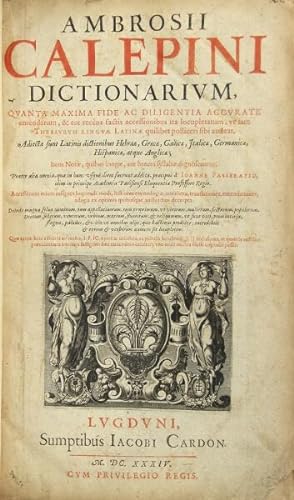
Ambrosii Calepini dictionarium, quanta maxima fide ac diligentia accurate emendatum, & tot recèns factis accessionibus ita locupletatum, utiam thesaurum linguæ latinæ quilibet polliceri sibi audeat. Adiecta sunt Latinis dicitionibus Hebrææ, Græcæ, Gallicæ, Italicæ, Germanicæ, Hispanicæ, atque Anglicæ
Published by Iacobi Cardon, Lugduni, 1634
Seller: Rulon-Miller Books (ABAA / ILAB), St. Paul, MN, U.S.A.
Association Member: ABAA ILAB RMABA
Seller rating 5 out of 5 stars
Folio, 2 volumes in 1, pp. [12], 902, [2], 815; both title pages printed in red and black, and both with printer's woodcut device, copper-engraved head-piece on dedication page, woodcut initials and ornaments; full contemporary parchment (some soiling), blind-stamped lozenges, later manuscript spine title; supplied endpapers, large loss to bottom quarter of half title page not affecting text repaired; a very good, sound copy of a large and impressive volume. This famous and durable work was first published as a Latin lexicon in Reggio in 1502, and was gradually augmented by a series of editors to include up to ten languages, including English. "During the whole period of the Renaissance scarcely an important dictionary was published which did not reflect directly or indirectly the influence of Calepine" (Starnes). The first edition to contain English equivalents was that of Lugduni 1585, Alston II, 94; Labarre 187.
![Seller image for SEPTEM LINGUARUM , HOC EST LEXICON LATINUM, Variarum Linguarum interpretatione adjecta, ad usum seminarii patauini pluries emendatum , et auctum ; Nunc vero post Patauinam supremam Editionem [.] Opera et studio Johannis Baptistae Gallicciolli; Editio novissima. Tomus primus A -- L. Tomus secondus M -- Z for sale by Aparté](https://pictures.abebooks.com/inventory/md/md32364312234.jpg)






![Seller image for Linguarum novem [] Dictionarium. for sale by Sokol Books Ltd. ABA ILAB](https://pictures.abebooks.com/inventory/md/md30727656935.jpg)