
Order Total (1 Item Items):
Shipping Destination:

Cuneiform (25 results)
Author:
cuneiform
Refine with Advanced Search
Skip to main search results
Search filters
Product Type
- All Product Types
- Books (18)
- Magazines & Periodicals (1)
- Comics (No further results match this refinement)
- Sheet Music (No further results match this refinement)
- Art, Prints & Posters (No further results match this refinement)
- Photographs (No further results match this refinement)
- Maps (No further results match this refinement)
- Manuscripts & Paper Collectibles (6)
Condition Learn more
- New (3)
- As New, Fine or Near Fine (1)
- Very Good or Good (1)
- Fair or Poor (No further results match this refinement)
- As Described (20)
Binding
Collectible Attributes
- First Edition (3)
- Signed (1)
- Dust Jacket (No further results match this refinement)
- Seller-Supplied Images (14)
- Not Print on Demand (23)
Language (2)
Free Shipping
Seller Location
Seller Rating
-

Condition: New. Brand New! Not Overstocks or Low Quality Book Club Editions! Direct From the Publisher! We're not a giant, faceless warehouse organization! We're a small town bookstore that loves books and loves it's customers! Buy from Lakeside Books!
-

Soft cover. Condition: Near Fine. First Edition. Very slight edgewear. Signed By All 9 "live poets".
-

British Museum Society Bulletin November 1985 Number 50 / Carol Andrews "How democracy came to the afterlife" / Christopher Walker "From cuneiform to computer" / Brian Anderson "Fantasy and Grimm reality" / Fine Czech prints / / Antony Griffiths "A doubly exciting swap" / Malcolm McLeod "Magic and the modern artist"
Published by The British Museum, 1985
Magazine / Periodical
US$ 14.09
US$ 15.04 shipping
Ships from United Kingdom to U.S.A.Quantity: 1 available
Add to basketSoft cover. Condition: Very Good. 40 pages. Illustrated. Carol Andrews "How democracy came to the afterlife" / Christopher Walker "From cuneiform to computer" / Brian Anderson "Fantasy and Grimm reality" / Fine Czech prints / / Antony Griffiths "A doubly exciting swap" / Malcolm McLeod "Magic and the modern artist" (BT#37).
-

Publication Announcement by the Cuneiform Press
Published by Cuneiform Press, Buffalo, NY, 2002
Seller: Oak Knoll Books, ABAA, ILAB, NEW CASTLE, DE, U.S.A.
Seller rating 5 out of 5 stars

Cuneiform Press (illustrator). broadside (11 by 8 inches). Announcement of publication of Patrick F. Durgin, Color Music. Designed by Eric Troolin. Folded.
-
Cuneiform Texts from Babylonian Tablets in the British Museum. Part XX I.
Published by Trustees of the British Museum. Reprint., 1966
Seller: Asia Bookroom ANZAAB/ILAB, Canberra, ACT, Australia
Association Member: ANZAAB ILAB
Seller rating 5 out of 5 stars
50 plates, ex library with neat cancelled stamps endpapers, tall quarto, very good and clean.
-
Cuneiform Texts from Babylonian Tablets in the British Museum. Part XI I.
Published by Trustees of the British Museum. Reprint., 1962
Seller: Asia Bookroom ANZAAB/ILAB, Canberra, ACT, Australia
Association Member: ANZAAB ILAB
Seller rating 5 out of 5 stars
50 plates, ex library with neat cancelled stamps endpapers, tall quarto, very good and clean.
-
Cuneiform Texts from Babylonian Tablets in the British Museum. Part XIV.
Published by Trustees of the British Museum. Reprint., 1964
Seller: Asia Bookroom ANZAAB/ILAB, Canberra, ACT, Australia
Association Member: ANZAAB ILAB
Seller rating 5 out of 5 stars
50 plates, ex library with neat cancelled stamps endpapers, tall quarto, very good and clean.
-
Cuneiform Texts from Babylonian Tablets in the British Museum. Part XXIII.
Published by Trustees of the British Museum. Reprint., 1967
Seller: Asia Bookroom ANZAAB/ILAB, Canberra, ACT, Australia
Association Member: ANZAAB ILAB
Seller rating 5 out of 5 stars
50 plates, tall quarto, very good and clean.
-

Texts from Babylonian Tablets in the British Museum. Part XXIV.
Published by Trustees of the British Museum. Reprint., 1967
Seller: Asia Bookroom ANZAAB/ILAB, Canberra, ACT, Australia
Association Member: ANZAAB ILAB
Seller rating 5 out of 5 stars
22pp + 50 full page plates, tall quarto, library stamp front free endpaper, very good clean copy.
-

Texts From BabylonianTablets in the British Museum. Part XI.
Published by Trustees of the British Museum. Reprint., 1962
Seller: Asia Bookroom ANZAAB/ILAB, Canberra, ACT, Australia
Association Member: ANZAAB ILAB
Seller rating 5 out of 5 stars
50 full page plates, ex library with neat cancelled stamps endpapers, tall quarto, very good clean copy.
-
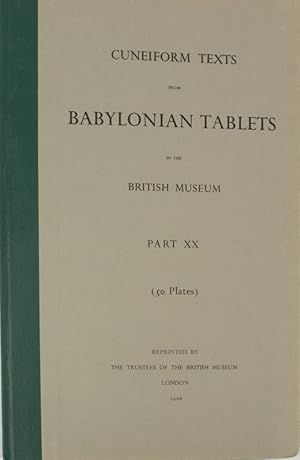
Cuneiform Texts from Babylonian Tablets in the British Museum. Part XX.
Published by Trustees of the British Museum. Reprint., 1966
Seller: Asia Bookroom ANZAAB/ILAB, Canberra, ACT, Australia
Association Member: ANZAAB ILAB
Seller rating 5 out of 5 stars
50 plates, ex library with neat cancelled stamps endpapers, tall quarto, very good and clean.
-
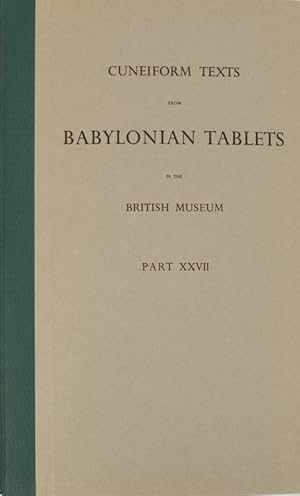
Cuneiform Texts from Babylonian Tablets in the British Museum. Part XXVI I
Published by Trustees of the British Museum. Reprint., 1968
Seller: Asia Bookroom ANZAAB/ILAB, Canberra, ACT, Australia
Association Member: ANZAAB ILAB
Seller rating 5 out of 5 stars
50 plates, ex library with neat cancelled stamps endpapers, tall quarto, very good and clean.
-
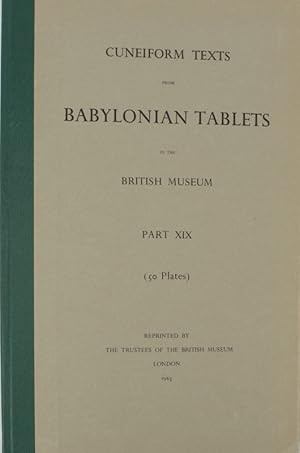
Cuneiform Texts from Babylonian Tablets in the British Museum. Part XIX.
Published by Trustees of the British Museum. Reprint., 1965
Seller: Asia Bookroom ANZAAB/ILAB, Canberra, ACT, Australia
Association Member: ANZAAB ILAB
Seller rating 5 out of 5 stars
50 plates, ex library with neat cancelled stamps endpapers, tall quarto, very good and clean.
-
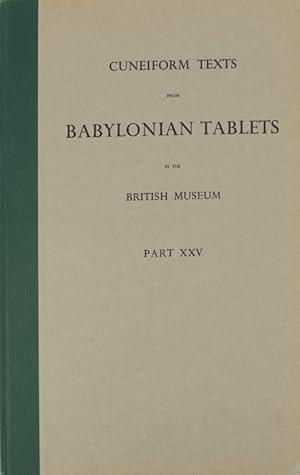
Cuneiform Texts from Babylonian Tablets in the British Museum. Part XXV.
Published by Trustees of the British Museum. Reprint., 1967
Seller: Asia Bookroom ANZAAB/ILAB, Canberra, ACT, Australia
Association Member: ANZAAB ILAB
Seller rating 5 out of 5 stars
50 plates, ex library with neat cancelled stamps endpapers, tall quarto, very good and clean.
-
Babylonian Tablets, & C., in the British Museum. 2 Bände
Seller: Celler Versandantiquariat, Eicklingen, Germany
Association Member: GIAQ
Seller rating 5 out of 5 stars
British Museum, London, 1910/14. Part XIII u. XXXIV mit insg. 10 S. u. 100 Taf., Pbd., Quart (NaT.):---Nachgebunden unter Einbezug der Orig. Einbände 750 Gramm.
-
Undersögelse om de persepolitanske Inscriptioner. (1.-) 2. Afhandling.
Seller: Herman H. J. Lynge & Søn ILAB-ABF, Copenhagen, Denmark
Seller rating 4 out of 5 stars

First Edition
(København, Seidelin,1801). 4to. Uncut. No wrappers as issued in "Det Kongelige danske Videnskabernes Selskabs Skrifter". Titlepage, pp. 253-292 + Titlepage, pp. 291-349 a. 1 folded engraved plate. First printing of 2 importent memoirs, as Münter here gives an importent contribution to the deciphering of cuneiform texts.
-
Undersögelse om de persepolitanske Inscriptioner. (1.-) 2. Afhandling.
Seller: Herman H. J. Lynge & Søn ILAB-ABF, Copenhagen, Denmark
Seller rating 4 out of 5 stars
First Edition
(København, Seidelin,1801). 4to. Uncut. No wrappers as issued in "Det Kongelige danske Videnskabernes Selskabs Skrifter". Titlepage, pp. 253-292 + Titlepage, pp. 291-349 a. 1 folded engraved plate. First printing of 2 importent memoirs, as Münter here gives an importent contribution to the deciphering of cuneiform texts.
-
Cuneiform tablet with seal impression of a fight between a man and a beast.
Published by Umma [Tel Jokha, Iraq], 2040 BCE., 2040
Seller: Antiquariat INLIBRIS Gilhofer Nfg. GmbH, Vienna, A, Austria
Association Member: ILAB VDA VDAO
Seller rating 5 out of 5 stars
Manuscript / Paper Collectible
Clay tablet (47 x 40 mm). Sumerian Cuneiform, Ur III period. A Sumerian clay tablet bearing cuneiform characters and figures from a seal, including one of a man fighting a large animal, probably a visual invocation of a mythological scene. It is dated to the seventh year of King Amar-Suen, the son of the great king Shulgi of the Ur III dynasty. - In thin, clearly formed cuneiform characters, the tablet records arrears under the Bala system of taxation and bears the impression of two seals: one side depicts a man fighting with a large quadruped standing on its hind legs, while the other shows six smaller human figures who appear to be helping in the battle. The differential in size suggests that the man fighting with the beast is a king, a legendary hero, or both. Other seals from the time of Amar-Suen depict a man grappling with a bull in what appears to be a visual invocation of the fight of Gilgamesh and the Bull of Heaven (such as one preserved in the British Museum), which suggests that this motif is represented here as well. - Tales of the legendary king Gilgamesh (or Bilgames, as he was known in Sumerian) began to be written down in the Ur III period, and the Sumerian poems from this era ultimately provided the material for the consolidated Epic of Gilgamesh, compiled in Akkadian during the Old Babylonian period five centuries later. - In a Sumerian poem and in Tablet VI of the Epic, Gilgamesh fights the Bull of Heaven which had been sent by the Goddess Inanna (in Sumerian, or in Akkadian: Ishtar), which results in the death of his friend and companion, Enkidu. Written and visual references to tales of Gilgamesh, such as most likely the seal impression on this tablet, precede the fuller written accounts, demonstrating that they circulated orally at first. - The Ur III dynasty followed on from the demise of the Akkadian Empire which conquered Sumer under Sargon the Great. The period witnessed a renaissance of Sumerian culture, and the consolidation of the various Sumerian city-states of Mesopotamia under the kings of Ur. Major reforms took place under Shulgi (r. 2094-2046 BCE), particularly to the systems of taxation, administration and scribal practice. During his nearly half-century reign, Shulgi issued the world's first surviving body of laws, the so-called Code of Ur-Nammu, and took the divine title, declaring himself a god. Amar-Suen (r. 2046-2038) was his son, about whom little is known aside from the fact that he undertook a renovation of the temple of the god Enki. - Bala taxation, referenced here, was another innovation of Shulgi and consisted of demands for goods and labour from every person in a given province. A different province was selected every month, to allow for a constant supply of goods and labour for the royal coffers without placing unsustainable burdens on any one region. - This tablet was formerly the property of Edgar J. Banks, an American antiquarian, who collected hundreds of examples of cuneiform tablets during his tenure as U.S. consul in the Ottoman Empire during the early years of the twentieth century. Banks has been suggested as one of the historical figures that helped inspire the fictional character of Indiana Jones. It was later owned by John Harvey Kellogg, of Corn Flakes fame. - A beautiful example of Neo-Sumerian culture, both testifying to administrative sophistication and hinting at a flourishing oral tradition. - Surfaces worn, some loss to detail of the figures but contours still clearly recognisable. Some discoloration and very minor chips and cracks to surface, but the neatly written cuneiform characters are clear and visible. - 1) Edgar J. Banks (1866-1945). 2) John Harvey Kellogg (1852-1943) and his descendants. - Cf. CDLI Seals 007552 (British Museum 103321).
-
Cuneiform contract for sale of land for a silver mine.
Published by Larsa, Sumer, 1808 BCE., 1808
Seller: Antiquariat INLIBRIS Gilhofer Nfg. GmbH, Vienna, A, Austria
Association Member: ILAB VDA VDAO
Seller rating 5 out of 5 stars
Manuscript / Paper Collectible
Clay tablet (46 x 67 mm) in Sumerian Cuneiform. 3 sides. Contract for a sale of land, previously an orchard, to be used as a silver mine. The transaction took place in the Sumerian kingdom of Larsa, the dominant of Mesopotamia at the time. It is dated to the reign of Rim-Sîn I, the area's final king before its conquest by Hammurabi of Babylon. - The land is described as an orchard planted with palm, pomegranate and apple trees. The seller, Awiyatum, swears that neither he nor his descendants will make any claim on it in future to the purchaser, Abum-il(um), who intends it for a silver mine. Six witnesses attest to the sale, and the date is given as being in the first month of the 14th year of the reign of King Rim-Sîn I of Larsa (1822-1763 BCE), thus c. 1808 BCE. - The reference to Rim-Sîn not only allows us to date this transaction precisely but also to locate it in the Kingdom of Larsa, the most powerful of the Sumerian city-states immediately before the area's conquest by Babylon. At the point this document was issued, Rim-Sîn was approaching the height of his power, conquering several other cities in the subsequent years, culminating with sacking Uruk in 1801 and seizing Isin, Larsa's main rival for regional power, in 1792. He was in turn defeated by Hammurabi in 1764 BCE, and the area was incorporated into the First Babylonian Empire. - Cuneiform writing developed in the early third millennium BCE out of earlier pictograms which had come to take on syllabic value. It was used over the subsequent millennia for administrative and legal documents and for literary works such as the Epic of Gilgamesh. Although first developed for Sumerian (the language used here), it was also used to write other languages of ancient Mesopotamia and Anatolia, such as Akkadian, Elamite, Old Persian and Hittite. - A document of Sumerian society at a crucial turning-point as it was about to be subsumed into the Babylonian Empire. - Some wear, chipped at the bottom left, hairline crack to obverse (flat side). Some minor loss of text. Overall good and clean condition. - 1) In a London private collection since before 1988. 2) Latterly in a French private collection. - Cf. A. Podany, Weavers, Scribes and Kings (2022), 267-272.
-
Pictographic proto-cuneiform clay tablet.
Published by Sumer, [c. 3000 BCE].
Seller: Antiquariat INLIBRIS Gilhofer Nfg. GmbH, Vienna, A, Austria
Association Member: ILAB VDA VDAO
Seller rating 5 out of 5 stars
Manuscript / Paper Collectible
Clay tablet (47 x 78 mm). 2 sides. A well-preserved Sumerian clay tablet from the Jemdet Nasr period (c. 3100-2900 BCE), containing an example of the pictographic system that would eventually evolve into cuneiform, the earliest form of writing. At this early stage, the pictographs were still clearly representations of objects rather than abstracted characters, giving the script a distinctive and elegant appearance compared to the cuneiform to which it would later give rise. - The dots on the left of the obverse represent numbers, in this case in a fourth-millennium numerical system specifically used for counting barley, with a total on the reverse next to pictogram apparently representing barley. The other pictograms on the obverse seem to relate to something other than the numbers. Prof. W. G. Lambert, Professor of Assyriology at the University of Birmingham and Fellow of the British Academy, who examined this tablet in the 1980s, described its contents as administrative and dated it to c. 3000 BCE. - The transition from pictograms to a syllabary was made possible by the characteristics of the Sumerian language, which contained a relatively high number of homonyms, so that, for example, the word for "reed" (gi) was identical to the word for "return". Thus the pictogram for a reed came also to mean "return", and from there to take on a syllabic value. As this process repeated itself and the signs became more abstracted, the proto-cuneiform pictograms evolved into cuneiform, the first syllabic writing system ever developed. This tablet represents Sumerian scribal practice on the threshold of this transformation, when the pictograms still bore a clear visual resemblance to the quantities they represented. - Jemdet Nasr artefacts first appeared on the market in the early 1900s and caused great excitement among scholars due to their preservation of the archaic proto-cuneiform script. The developments of Jemdet Nasr are shared by the preceding Uruk III and later Early Dynastic periods, but its material culture is still reckoned as distinctive enough to merit its own designation. - This tablet is listed in the Cuneiform Digital Library Initiative, and a transcription of the signs can be consulted on their website. It is documented as being in a London private collection since at least the 1980s, when it was examined by Prof. Lambert. Proto-cuneiform tablets are a relative rarity on the private market, particularly ones in such good condition, with only one auction listing on Rare Book Hub, from 2019. - A rare and beautiful example of a crucial moment in the history of script. - Pictograms neatly formed and cleary visible, minor discoloration to front bottom side, overall fine condition, an elegant artefact. - London private collection, examined in the 1980s by Prof. Wilfred George Lambert, Fellow of the British Academy and Professor of Assyriology at the University of Birmingham. A copy of his note is included. - CDLI: P519296. Leroy, Pandey and Tinney, Archaic Cuneiform Numerals (2023), 9-10 (System ); Cf. Englund and Grégoire, The Proto-Cuneiform Texts from Jemdet Nasr (1991-1993); Bauer, Englund and Krebernik, Mesopotamien: Späturuk-Zeit und Frühdynastische Zeit (1998); Podany, Weavers, Scribes and Kings (2022), 43-48.
-
Cuneiform tablet on arable land division.
Published by [Babylon, c. 2000-1700 BCE]., 2000
Seller: Antiquariat INLIBRIS Gilhofer Nfg. GmbH, Vienna, A, Austria
Association Member: ILAB VDA VDAO
Seller rating 5 out of 5 stars
Manuscript / Paper Collectible
Clay tablet (58 x 89 mm). 3 sides with 29 lines in Babylonian Cuneiform. A document concerning arable land belonging to a temple or a palace, describing its division into plots assigned to named individuals. It is dated to the Third Day of the Third Month, equivalent to May or June. The year is unidentified, but probably sometime in the Isin-Larsa period (c. 2000-1700 BCE), which spanned the end of Sumerian power with Third Dynasty of Ur and the birth of the First Babylonian Empire under the dynasty of Hammurabi (c. 1810-1750 BCE). - The text is written on the obverse, reverse, and upper edge. It lists two groups of people, one of six and one of eight men, among whom the land was divided, subject to the administration of the officials Lu-Ninhursag, Sîn-magir, Sîn-iddinam and Sallilum. - The Sumerian city-states of early Mesopotamia were conquered by Sargon the Great in the 24th and 23rd centuries BCE, leading to the creation of the Akkadian Empire. Following its fall in the 22nd century, Sumerian power was revived under the Third Dynasty of Ur before that too gave way to Babylonian conquests by Hammurabi and others. - Cuneiform writing developed in Sumer, nowadays southern Iraq, around the year 2900 BCE out of earlier pictograms. Over time, the pictograms had become more abstracted and wedge-like and took on the value of a syllable which could be used to form words, creating the first proper writing system in human history. - Beyond its initial use in Sumerian, Cuneiform came to be used to write several other languages, such as Akkadian, Elamite and Hittite. It was used to record the Epic of Gilgamesh as well as myths such as that of the Flood, but most documents are administrative records, as this tablet is. - This artefact is documented as in private collections since at least the 1980s, when it was examined by Prof. W. G. Lambert, Professor of Assyriology at the University of Birmingham and Fellow of the British Academy, a copy of whose report on the object is included. - A document of Mesopotamian society at a time of crucial transition between Neo-Sumerian power and the rise of Babylon. - Small patches of surface wear but overall good condition. - 1) French private collection. 2) Swiss private collection. 3) Gallerie L'Étoile d'Ishtar, Paris, 1980s.
-
Cuneiform mathematical tables.
Published by Mesopotamia, [c. 2000-1700 BCE]., 2000
Seller: Antiquariat INLIBRIS Gilhofer Nfg. GmbH, Vienna, A, Austria
Association Member: ILAB VDA VDAO
Seller rating 5 out of 5 stars
Manuscript / Paper Collectible
Clay tablet (45 x 76 mm). 2 sides in Old Bablonian Cuneiform. Pierced through to allow binding to other tablets. A cuneiform tablet containing mathematical tables, probably from a school where documents such as this would have been used as teaching aids to be studied and copied out by the students. It was clearly kept together with other such tablets, as it is pierced through with a hole from side to side to allow it to be bound together with similar ones. In good condition, with the characters clearly and deeply formed, this piece is a testimony to the educational system of the Old Babylonian period, when the study of mathematics reached its high point in Mesopotamian society. - Education was highly valued in the ancient civilisations that flourished between the Tigris and Euphrates, and we have ample evidence of flourishing scribal schools that taught young people how to write in cuneiform. Mathematics were a crucial part of the curriculum, and learning tables and solving problems were part of pupils' lives then much as they are in the modern era. - The Old Babylonian period in particular saw a boom in the study of mathematics, possibly due to an increased emphasis on justice, so as to allow greater exactitude in making fair decisions about divisions of property, etc. Mesopotamian mathematicians made highly advanced discoveries, which were forgotten after the decline of their culture, with later Greek scholars having to labour intensively to work out problems which had already been solved thousands of years before. - The Mesopotamian counting system was sexagesimal, or based on 60, a number which was convenient due to being easily divisible by 2, 3, 4, 5, 6 or 10. As they wrote numbers and formulated the operations differently than we would today, the Mesopotamian way of doing maths can look quite strange, but they still used the same basic functions that we do today: multiplication, division, square roots, etc. - A handsome testimony to the advanced educational system in Mesopotamian society from a period in which the study of mathematics reached their peak. - Some minor discolorations and a small patch of surface damage. Hole through the centre from side to side, minimal loss to text. Otherwise good condition, characters very clearly formed. - London private collection, examined in the 1980s by Prof. Wilfred George Lambert, Fellow of the British Academy and Professor of Assyriology at the University of Birmingham. A copy of his note is included. - CDLI: P519303. Cf. A. Podany, Weavers, Scribes and Kings (2022), esp. 310ff.
-
Cuneiform multiplication table of the number 320.
Published by Mesopotamia, [ca. 2000-1700 BCE]., 2000
Seller: Antiquariat INLIBRIS Gilhofer Nfg. GmbH, Vienna, A, Austria
Association Member: ILAB VDA VDAO
Seller rating 5 out of 5 stars
Manuscript / Paper Collectible
Clay tablet (48 x 84 mm). 2 sides in Old Babylonian cuneiform. A cuneiform tablet containing mathematical tables, probably from a school where documents such as this would have been used as teaching aids to be studied and copied out by the students. Here the head number of 320 is multplied by the integers from 1 to 20, and then 30, 40 and 50. It was clearly kept together with other such tablets, as it is pierced through with a hole from side to side to allow it to be bound together with similar ones. In good condition, with the characters clearly and deeply formed, this piece is a testimony to the educational system of the Old Babylonian period, when the study of mathematics reached its high point in Mesopotamian society. - Education was highly valued in the ancient civilisations that flourished between the Tigris and Euphrates, and we have ample evidence of flourishing scribal schools that taught young people how to write in cuneiform. Mathematics were a crucial part of the curriculum, and learning tables and solving problems were part of pupils' lives then much as they are in the modern era. - The Old Babylonian period in particular saw a boom in the study of mathematics, possibly due to an increased emphasis on justice, so as to allow greater exactitude in making fair decisions about divisions of property, etc. Mesopotamian mathematicians made highly advanced discoveries, which were forgotten after the decline of their culture, with later Greek scholars having to labour intensively to work out problems which had already been solved thousands of years before. - The Mesopotamian counting system was sexagesimal, or based on 60, a number which was convenient due to it being easily divisible by 2, 3, 4, 5, 6 or 10. As they wrote numbers and formulated the operations differently than we would today, the Mesopotamian way of doing maths can look quite strange, but they still used the same basic functions that we do today: multiplication, division, square roots, etc. - A handsome testimony to the advanced educational system in Mesopotamian society from a period in which the study of mathematics reached their peak. - Some minor discolorations and a small patch of surface damage. Hole through the centre from side to side, practically no loss to text. Overall good condition, characters very clearly formed. - London private collection, examined in the 1980s by Prof. Wilfred George Lambert, Fellow of the British Academy and Professor of Assyriology at the University of Birmingham. A copy of his note is included, as is a copy of a note by Dr. Manuel Ceccarelli of the University of Tübingen, who also studied this tablet. - CDLI: P519799. Cf. A Podany, Weavers, Scribes and Kings, esp. 310ff.
-
![Seller image for Contribution au dictionnaire sume?rien-assyrien 1907 [LeatherBound] for sale by True World of Books](https://pictures.abebooks.com/inventory/md/md31533107855.jpg)
Contribution au dictionnaire sume?rien-assyrien 1907 [LeatherBound]
Publication Date: 2025
LeatherBound. Condition: New. BOOKS ARE EXEMPT FROM IMPORT DUTIES AND TARIFFS; NO EXTRA CHARGES APPLY. LeatherBound edition. Condition: New. Reprinted from 1907 edition. Leather Binding on Spine and Corners with Golden leaf printing on spine. NO changes have been made to the original text. This is NOT a retyped or an ocr'd reprint. Illustrations, Index, if any, are included in black and white. Each page is checked manually before printing. Pages: 481 As this print on demand book is reprinted from a very old book, there could be some missing or flawed pages, but we always try to make the book as complete as possible. Fold-outs, if any, are not part of the book. If the original book was published in multiple volumes then this reprint is of only one volume, not the whole set. Sewing binding for longer life, where the book block is actually sewn (smythe sewn/section sewn) with thread before binding which results in a more durable type of binding. Pages: 481 Language: French,sux,akk.
-
Contribution au dictionnaire sume?rien-assyrien 1907 [Leather Bound]
Publication Date: 2025
Leather Bound. Condition: New. Language: fre,sux,akk. Presenting an Exquisite Leather-Bound Edition, expertly crafted with Original Natural Leather that gracefully adorns the spine and corners. The allure continues with Golden Leaf Printing that adds a touch of elegance, while Hand Embossing on the rounded spine lends an artistic flair. This masterpiece has been meticulously reprinted in 2025, utilizing the invaluable guidance of the original edition published many years ago in 1907. The contents of this book are presented in classic black and white. Its durability is ensured through a meticulous sewing binding technique, enhancing its longevity. Imprinted on top-tier quality paper. A team of professionals has expertly processed each page, delicately preserving its content without alteration. Due to the vintage nature of these books, every page has been manually restored for legibility. However, in certain instances, occasional blurriness, missing segments, or faint black spots might persist. We sincerely hope for your understanding of the challenges we faced with these books. Recognizing their significance for readers seeking insight into our historical treasure, we've diligently restored and reissued them. Our intention is to offer this valuable resource once again. We eagerly await your feedback, hoping that you'll find it appealing and will generously share your thoughts and recommendations. Lang: - fre,sux,akk, Pages:- 481, Print on Demand. If it is a multi-volume set, then it is only a single volume. We are specialised in Customisation of books, if you wish to opt different color leather binding, you may contact us. This service is chargeable. Product Disclaimer: Kindly be informed that, owing to the inherent nature of leather as a natural material, minor discolorations or textural variations may be perceptible. Explore the FOLIO EDITION (12x19 Inches): Available Upon Request. 481.


![Seller image for Contribution au dictionnaire sume?rien-assyrien 1907 [Leather Bound] for sale by Gyan Books Pvt. Ltd.](https://pictures.abebooks.com/inventory/md/md31420016469.jpg)