

Order Total (1 Item Items):
Shipping Destination:

Decoupage (23 results)
Author:
decoupage
Refine with Advanced Search
Skip to main search results
Search filters
Product Type
- All Product Types
- Books (23)
- Magazines & Periodicals (No further results match this refinement)
- Comics (No further results match this refinement)
- Sheet Music (No further results match this refinement)
- Art, Prints & Posters (No further results match this refinement)
- Photographs (No further results match this refinement)
- Maps (No further results match this refinement)
- Manuscripts & Paper Collectibles (No further results match this refinement)
Condition Learn more
- New (No further results match this refinement)
- As New, Fine or Near Fine (No further results match this refinement)
- Very Good or Good (3)
- Fair or Poor (No further results match this refinement)
- As Described (20)
Binding
Collectible Attributes
- First Edition (No further results match this refinement)
- Signed (No further results match this refinement)
- Dust Jacket (No further results match this refinement)
- Seller-Supplied Images (9)
- Not Print on Demand (23)
Language (4)
Free Shipping
- Free Shipping to U.S.A. (No further results match this refinement)
Seller Location
Seller Rating
-
PAPERBACK. Condition: VG.
-

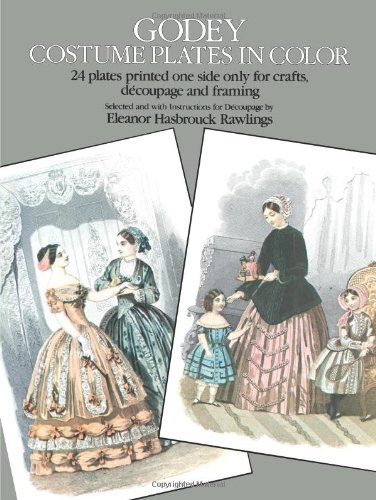
GODEY COSTUME PLATES IN COLOR 24 Plates Printed One Side Only for Crafts, Decoupage and Framing
Published by Dover, New York NY, 1979
ISBN 10: 0486238792 ISBN 13: 9780486238791
Softcover. Very Good- with no dust jacket; Edgewear, cover has light soiling; Color Illustrations; Unpaginated pages.
-

Grundkurs Decoupage. Papiere, Farben, Werkzeuge, Arbeitsweisen, Zips & Tricks. Mit sehr zahlr. farb. Abb.
Published by Rheinfelden, OZ-Verlags-GmbH, 2007
ISBN 10: 3866730071 ISBN 13: 9783866730076
Seller: Antiquariat Robert von Hirschheydt, Wedemark, Germany
Association Member: BOEV
Seller rating 5 out of 5 stars

61 S., Format ca. DIN A 4, Ppbd., fast neuwertig!
-

A. Saraillon LYON, Impressions Fot - s.d. (vers 1959) - FA.24x32 - Fascicule oblong en un cahier agrafé au dos; couverture cartonnée au premier plat illustré en couleurs par A. Saraillon, 4e de couverture blanc explicatif du découpage; illustrations en couleurs. Bon état. COMPLET (non découpé). "Choisissez et découpez une ribambelle, pliez la en accordéon. et découpez". Français Découpages.
-
PARIS, Éditions du Pélican Blanc, [Fournier & Cie Imp.] - s.d. - Double feuillet cartonné plié [29x44 cm --> 29x22 cm] imprimé au recto; illustrations couleurs. Bon état. COMPLET (non découpé). Français Découpages.
-
Gildas PARIS, Éditions du Pélican Blanc (505) - s.d. - Feuillet oblong cartonné [24x32,5 cm] imprimé au recto; illustrations couleurs. Bon état. COMPLET (non découpé). Français Découpages.
-
Éditions Touret 80 - s.d. - FA.22,5x24 - Fascicule oblong en un cahier agrafé au dos; couverture illustrée en couleurs; 8 feuillets de papier fort illustré en noir et 12 feuillets de papier cristal monocolore [6 couleurs différentes]. Bon état. OUVRAGE NON DÉCOUPÉ, COMPLET de tous ses feuillets de papier cristal. Français Découpages.
-
Slnd - Monic - Feuillet oblong cartonné [25x37 cm] imprimé au recto; illustrations couleurs: 4 avions et l'aéroport. Bordures roussies. Ensemble correct. COMPLET (non découpé). Français Découpages.
-
Slnd - Volumétrix - Feuillet oblong cartonné [27,5x29 cm] imprimé au recto; illustration couleurs. Bon état. COMPLET (non découpé). Français Découpages.
-

Éditions du Bois-Joli - s.d. - Feuillet cartonné dépliant de 4 panneaux [24x21,5 cm / 24x86 cm déplié]; vignettes couleurs de D. Lordey à découper. (Collection Découpage sans Ciseaux - 2). COMPLET, non découpé. Français Découpages.
-

Éditions Télé-Guide // Eindhoven Druk b.v. / Boekprodukties, Holland - 1981 - FA.28x21 - Fascicule en un cahier agrafé au dos; couverture couleurs; 8 pages de texte avec illustrations en noir non foliotées et 7 feuillets de papier fort (dont 3 dépliants) illustrés en couleurs, à découpés et à montés. (Collection Un grand Jeu plus une Histoire). Bel exemplaire. NON DÉCOUPÉ. Français Découpages.
-

Éditions Télé-Guide // Eindhoven Druk b.v. / Boekprodukties, Holland - 1981 - FA.28x21 - Fascicule en un cahier agrafé au dos; couverture couleurs; 8 pages de texte avec illustrations en noir non foliotées et 7 feuillets de papier fort (dont 3 dépliants) illustrés en couleurs, à découpés et à montés. (Collection Un grand Jeu plus une Histoire). Bel exemplaire. NON DÉCOUPÉ. Français Découpages.
-

Decoupage Serviettentechnik (4 - sprachig: d, it, fr, nl)
Seller: Sigrun Wuertele buchgenie_de, Altenburg, Germany
Seller rating 5 out of 5 stars
Condition: Gut - gebraucht. Broschiert 32 S. Guter Zustand Découpage Serviettentechnik Zustand: 3, Gut - gebraucht, Broschiert naumann & goebel , 2000 32 S. , Decoupage Serviettentechnik (4 - sprachig: d, it, fr, nl), Decoupage Serviettentechnik.
-

Condition: Gut. Zustand: Gut | Seiten: 44 | Sprache: Französisch | Produktart: Bücher | Keine Beschreibung verfügbar.
-
PARIS, Éditions du Pélican Blanc, [Fournier & Cie Imp.] - s.d. - Double feuillet cartonné plié [29x44 cm --> 29x22 cm] imprimé au recto; illustrations couleurs. Bon état. , COMPLET (non découpé). Français Découpages.
-
Paravent de six feuilles
Published by Johann Jacob Haid & son, Augsburg, 1740
Seller: Musinsky Rare Books, New York, NY, U.S.A.
Seller rating 4 out of 5 stars

Six tall narrow folio-sized engravings with etching (platemarks 400 x 207 mm., sheets 435 x 277 mm., deckle edges), unsigned but by Jacop Wangner after Watteau,?numbered 1-6 in the plate at lower right, imprint at lower right I. Haid et filius, excudit A. V. [Augustae Vindelicorum]. Upper edges archivally tipped to mats. Fine.*** A perfectly preserved suite of six large rococo engravings reproducing Watteau's paintings for a folding screen, intended to be cut out by ladies for use in furniture decoration.? Watteau's influence on 18th-century decorative arts throughout Europe, by way of the many engravings after his work published by Gersaint, has long been recognized, but the use of the engravings as actual sheets to be cut up and applied to household objects has garnered little attention until recently. The vogue for decoupage probably first appeared in the late seventeenth century, and by the 1720s the hobby of cutting out colored prints for application to various household objects and pieces of furniture was all the rage, in France, Germany, and beyond. The process, which remained a favorite pastime throughout the eighteenth century, was known as la d?coupure in French, as Ausschneidekunst in German, and as lacca contrafatta or lacca povera in Italian, although "the latter term appears to be a true misnomer, considering the amount of minute work involved" (Kisluk-Grosheide, p. 83). It consisted of neatly cutting out hand-colored engraved or woodcut motifs or figures, applying them to a textile or sometimes cardboard ground, and varnishing them. These creations were applied to furniture, as well as to "screens, folding screens, wall hangings, ceilings, the tops of coaches, and sedan chairs" (loc. cit.), affording a passable imitation of Asian lacquer. The craze, which created a goldmine for certain print publishers, reached the point that bibliophiles and collectors were warned to keep a vigilant eye on their most precious books, prints and paintings, lest eager young ladies attack them with scissors. In 1728, six engravings after Watteau's paintings for a folding screen were commissioned by the art collector Jean de Julienne as part of a vast program of reproductions of Watteau's painted oeuvre. They were engraved by Louis Cr?py fils and published by the Paris marchand-mercier, art dealer and print publisher Edm?-Fran?ois Gersaint. An announcement of their upcoming publication in the November 1727 Mercure de France explicitly described them (and two other Cr?py-Watteau engravings) as "marvelously appropriate for decoupages, with which ladies these days make such pretty furniture" ([Cr?py] grave actuellement six morceaux en hauteur . d'apr?s un Paravant peint par Watau, dont les compositions sont tr?s-galantes. De pareils sujets peints sur des fonds blancs, conviennent ? merveille aux d?coupures, dont les Dames font aujourd'hui de si jolis meubles (Mercure de France, 1 Novembre 1727, p. 2492 [digitized on Gallica]).??Indeed, the publisher himself highlighted this usage in his own note in a later issue of the Mercure (cited by Glorieux, p. 212): pointing out that all of the decorative motifs in the Watteau engravings were "most useful for painters, fan-makers, sculptors, goldsmiths, tapestry-weavers, embroiderers, etc.," he added that "all these ornaments can be perfectly used in decoupage" (tous ces ornements r?ussissent parfaitement en d?coupure).? These and other rococo engravings were quickly taken up by German publishers, especially in Augsburg (Metken, p. 102). This paravent (folding screen) suite was one of the first of the Watteau engravings to be copied in Germany. The present very close reverse copies of Cr?py's six plates appeared in Augsburg only a few months after their publication, in June 1728, in Paris: engraved by Jacob Wangner (or Wagner, ca. 1703-1781), they were published by the heirs of Jeremias Wolff in 1729.??This set is an otherwise unrecorded reissue of the Wangner copperplates. A lavishly decoupage-d.
-
Rapport sur la division du royaume en Arrondissemens Métropolitains, et sur la fixation des sièges des Evêchés dans chaque départment.
Published by Paris, Imprimerie de l'Assemblée Nationale, s.d. (1790), 1790
Seller: Librairie Historique F. Teissèdre, SAUVE, France
Association Member: ILAB
Seller rating 5 out of 5 stars
in-8, 16 pp., dérelié. Martin et Walter, 3818. - - VENTE PAR CORRESPONDANCE UNIQUEMENT - LIEN DE PAIEMENT, NOUS CONSULTER.
-
Rapport sur la convocation de la première législature. Dans la séance du 27 mai 1791
Published by Paris, Imprimerie Nationale, 1791, 1791
Seller: Librairie Historique F. Teissèdre, SAUVE, France
Association Member: ILAB
Seller rating 5 out of 5 stars
in-8, 35 pp., 8 tableaux dép., dérelié. Bien complet du décret et des 8 tableaux annoncés. L'auteur précise les modalités des élections à venir.Martin et Walter, 10100. - - VENTE PAR CORRESPONDANCE UNIQUEMENT - LIEN DE PAIEMENT, NOUS CONSULTER.
-
Any Poupée à Habiller Pour le Sport Pour la Ville Pour le Soir.
Published by Volumétrix, (c.1945)., 1945
6 feuillets. (37x29 Cm). Cartonnage souple illustré en couleur où figure la poupée de face sur la première couverture et de dos sur la dernière. Bords et dos un peu frottés. Toutes les figures sont à découper, même celles du titre. A l'intérieur se trouve le trousseau de la poupée, ses tenues de ville, de sport et du soir. Bel exemplaire.
-
PETIT TRAIN (Le). Un véritable jouet Un montage facile Un roulement assuré Un jouet long de 1,20 aucun collage.
Published by Sans lieu (Paris), Volumétrix. (c. 1940)., 1940
8 feuillets. (27x37 Cm). Les éléments à découper pour la réalisation sans collage de ce jouet long de 1,20 Cm sont intacts, et les instructions sont imprimées au dos de l'album.
-
Rapport sur le décret général relatif aux départemens du royaume.
Published by Paris, Imprimerie Nationale, 1790, 1790
Seller: Librairie Historique F. Teissèdre, SAUVE, France
Association Member: ILAB
Seller rating 5 out of 5 stars
in-8, 16 pp., dérelié. L'auteur examine quelques points précis relatifs au découpage du royaume en départements.Martin et Walter, 12188. - - VENTE PAR CORRESPONDANCE UNIQUEMENT - LIEN DE PAIEMENT, NOUS CONSULTER.
-
Original American Wallpaper and Decoupage Band Box
Published by United States, 1830
Seller: Capitol Hill Books, ABAA, Washington, DC, U.S.A.
Seller rating 5 out of 5 stars
Condition: Very Good. United States: ca. 1830. Original blue and yellow hand-made paper-covered band box (29x25x10cm) decorated with decoupage. Margins worn with exposure of original stitching beneath, some of the decoupage a bit dulled and starting to chip, else a Very Good, still bright example. Beautiful American band box decorated with sixteen pictorial pieces of decoupage, including patriotic American and fashionable French imagery, crests, and book illustrations. Date based in part on the presence of a woodcut illustration of the steamboat the Franklin, which was launched in 1827, " the paramount Lake Champlain steamer in both luxury and engineering" (from the Lake Champlain Maritime Museum blog).
-
Published by [France, c. 1850]., 1850
Seller: Justin Croft Antiquarian Books Ltd ABA, Faversham, United Kingdom
Seller rating 5 out of 5 stars
US$ 4,835.83
US$ 20.12 shipping
Ships from United Kingdom to U.S.A.Quantity: 1 available
Add to basketA bravura performance of recreational papercutting of elaborate wood engraved prints, many of large size. The name on the first leaf 'Mr Montagne' is constructed of historiated letters from various sources, which sets the tone for this rather astonishing and various collection of cut prints, apparently chosen for their delicacy and intricacy and the challenge they presented to the papercutter. After cutting, many have only minute filaments holding them together like a net. This is not an antiquarian collection, and most of the subjects seem to have come from French popular newspapers and journals of the day, others from pattern books - the best contemporary repositories of the wood engraver's art.Papercutting has developed in different branches all over the world, and in Europe (especially England and France) it bears an interesting relation to print culture. It demonstrates alternative ways of consuming products of the explosion of the production visual prints in the mid nineteenth-century, involving personal selection, manual interaction, curation and preservation.There are images here of contemporary notables: including a statue of the army surgeon, Dominique Jean Larre, erected in 1850 at Val-de-Grâce; Thomas Robert Bugeaut (d. 1849); Louis-Eugène Cavaignac; Emperor Louis-Napolèon III, first president of France (1848-1852); Queen Victoria; George Washington; Alexander II. Other subjects include flora and fauna, sometimes exotic, with some American falcons and exotic plants; coaches and carriages (with some more recherché conveyances, such as De Schevleing's sailing chariot); there are soldiers, and also a few caricatures. But perhaps the most impressive and decorative cuts are the prints of medieval applied art and architecture - with copious gothic detail - and the large cartouches and decorative panels, with their floral swags, leafy branches and tendrils, all offering a robust challenge even to the expert papercutter's hand. Oblong folio (295 × 450 mm), 72 leaves, all but one of stiff blue paper, each with elaborate papercut prints, mainly to one side but occasionally to versos too. Some prints on coloured paper, others with coloured elements. Original album binding with amateur late 19th century floral fabric covers, brocade borders and decoration, secured with long stitching over the front pastedowns.


