

Order Total (1 Item Items):
Shipping Destination:

Dellile (11 results)
Author:
dellile
Refine with Advanced Search
Skip to main search results
Search filters
Product Type
- All Product Types
- Books (11)
- Magazines & Periodicals (No further results match this refinement)
- Comics (No further results match this refinement)
- Sheet Music (No further results match this refinement)
- Art, Prints & Posters (No further results match this refinement)
- Photographs (No further results match this refinement)
- Maps (No further results match this refinement)
- Manuscripts & Paper Collectibles (No further results match this refinement)
Condition Learn more
- New (3)
- As New, Fine or Near Fine (4)
- Very Good or Good (3)
- Fair or Poor (No further results match this refinement)
- As Described (1)
Binding
Collectible Attributes
- First Edition (No further results match this refinement)
- Signed (No further results match this refinement)
- Dust Jacket (No further results match this refinement)
- Seller-Supplied Images (8)
- Not Print on Demand (9)
Language (2)
Free Shipping
Seller Location
Seller Rating
-

Condition: good. Photo non contractuelle. Envoi rapide et soigné.
-
Condition: Neuf.
-

OEUVRES AVEC LES NOTES de MM. Parseval-Grandmaison, de Féletz, de Choiseul-Gouffier, Aimé-Martin, Descuret, etc. EN 2 VOLUMES.
Published by CHEZ LEFEVRE, 1833
Couverture souple. Condition: bon. R260124925: 1833. In-8. Broché. Etat d'usage, Couv. légèrement passée, Dos fané, Quelques rousseurs. 914 pages en tout pour les deux volumes. Frontispice en noir et blanc avec serpente dans le premier volume. Texte sur 2 colonnes. Tome 1 : Manque sur le second plat. Coiffe en pied abîmée. Tome 2 : Un mors fendu, premier plat partiellement détaché. Tampons de bibliothèque. . . . Classification Dewey : 840-Littératures des langues romanes. Littérature française.
-

L'HOMME, MITHRIDATE, ANDROMAQUE, L'HOMME DES CHAMPS,
Published by Imprimerie Paul Dupont., 1800
Couverture rigide. Condition: bon. RO30004297: 1800. In-16. Relié. Bon état, Couv. convenable, Dos satisfaisant, Intérieur frais. Qu'est-ce que l'Homme: 63 pages; Mithridate: 63 pages; Andromaque:62 pages; L'homme des champs ou les géorgiques françoises: 259 pages illustrées d'une gravure noir et blanc en frontispice (Charles IV vers 406); cartonnage éditeur dos cuir, titre doré. . . . Classification Dewey : 840.04-XVII ème siècle.
-

L'ENEIDE - TRADUITE EN VERS FRANCAIS - TOME PREMIER / TROISIEME EDITION.
Published by MICHAUD L.G., 1824
Couverture rigide. Condition: bon. R320044714: 1824. In-18. Relié plein cuir. Etat d'usage, Coins frottés, Dos fané, Intérieur acceptable. 336 pages - Nombreuses piqures de ver altérant parfois la lecture - Plats et contre-plats marbrés - Tampons sur les pages de garde - Titre, tomaison et ornement dorés. . . . Classification Dewey : 840.08-XIX ème siècle.
-

Condition: Used: Good. Occasion - Bon Etat - Madoff et moi (2010) - Grand Format.
-
L'ÈNÈIDE , TRADUITE par Jacques DELILLE - PUBLII VIRGILII MARONIS AENEIS - Edition BILINGUE - TOMES I , II , III & IV
Language: French
Seller: LA FRANCE GALANTE, Saint MARTIN sur LAVEZON, France
Seller rating 5 out of 5 stars

Couverture rigide. Condition: Assez bon. Paris . Guiguet et Michaud . AN XII , 1804 . Quatre volumes in-12 en reliure demi cuir de l'époque , 426 pages , 396 pages , 360 pages et 436 pages . Chaque volume orné d'un frontispice de MONSIAU . Travail de vers en bas des premières pages du tome I , reliures défraichies avec mors frottés ou fissurés . Edition bilingue LATIN , FRANÇAIS .
-

L'Énéide traduite.
Published by Paris, Giguet et Michaud., 1804
Seller: Daniel Thierstein, Bern, Switzerland
Association Member: GIAQ ILAB VEBUKU
Seller rating 4 out of 5 stars

4 vol. 14,8x9,5 cm. Avec 4 frontispice gravés par J.M. Moreau le jeune. Reliure pleine veau glacée, pièce de titre lila en forme de rhombe, riche décor doré au dos et sur les plats. "Oeuvres de J.Delille, vol. 1-4." - Première édition de la traduction par Delille. Texte parallèle latin français. - Imprimé sur papier d'hollande. - Exlibris "Emile Scherer. Papier parteillement bruni. - Bel exemplaire bien relié, les pièces de titre "Oeuvres de J. Delille 1-4". Sprache: n.
-
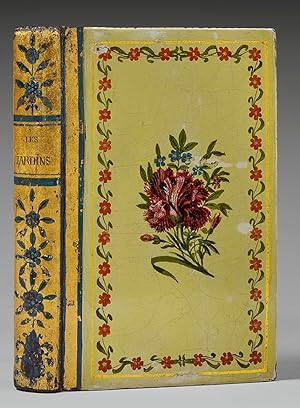
Les Jardins. Poëme.
Publication Date: 1807
Seller: Librairie Camille Sourget, Paris, France
Association Member: ILAB
Seller rating 4 out of 5 stars
Couverture rigide. Condition: Très bon. Paris, Stéréotype d'Hernan, 1807.In-12 de (2) ff., 211 pp., 4 figures. Qq. rousseurs. Reliure couverte d'un vernis vert pâle sur les plats et vert foncé sur le dos, encadrement de filets dorés et d'une guirlande de fleurs peinte en couleurs autour des plats, bouquet de fleurs peint en couleurs au centre, dos lisse entièrement doré avec en réserve le titre, et des fleurs qui apparaissent en bleu foncé, tranches dorées. Reliure de l'époque.142 x 93 mm.Dimensions de la reliure : 150 x 97 mm. --- Superbe spécimen de reliure au vernis sans odeur ou vernis Martin.Ce vernis, inventé en 1730 par les frères Martin pour imiter la laque orientale décorant les meubles et objets d'art, fut utilisé jusqu'au XIXe siècle : le secret des frères Martin consistait à coller des feuilles de papier, à les passer au four pour les durcir, à les peindre de toutes les couleurs, à les vernir à la résine de copal et à les glacer à la gomme arabique. Ce type de reliure demeure peu commun, et l'on a trace de deux manufactures au XIXe siècle.« Dans les années révolutionnaires, on commence à trouver des livres "reliés en carton" et le relieur-poète Lesné dans son poème La Reliure décrit en 1820 "les véritables cartonnages allemand", genre de reliure très en vogue, mais selon lui moins solides et moins agréable, qu'on attribue en France à un membre de la famille Bradel. Les reliures en carton, décorées en couleur et recouvertes de vernis, appelées reliures en vernis Martin sans odeur, sont d'une qualité supérieure. »Histoires de l'édition française, II, page 579.La présente reliure recouvre un ouvrage imprimé à l'aide du nouveau procédé de stéréotypie inventé par Louis-Etienne Herhan.La stéréotypie est un procédé d'imprimerie qui évite une composition lettres à lettres des pages au moyen de caractères d'imprimerie. Ici il s'agit de « créer, d'après une composition unique formée par l'assemblage des caractères mobiles, une ou /// Paris, Stéréotype d'Herhan, 1807.12mo [142 x 93 mm] of (2) ll., 211 pp., 4 figures. Occasional foxing. Covers lacquered with a pale green varnish, gilt fillet borders and flower garland painted in colors around the covers, flower bunch painted in the center, dark green varnished flat spine decorated in gilt and with blue flowers, gilt edges. Contemporary binding.Dimensions of the binding: 150 x 97 mm. --- A superb specimen of "en Vernis Martin binding".This varnish, invented in 1730 by the Martins brothers to imitate the eastern lacquer decorating the furniture and art objects, was used until the 19th century: the secret of the Martin brothers was to paste together paper leaves, harden them in the oven, then paint them in various colors, varnish them with copal-resin and glaze them with some gum Arabic. Binding of the Vernis Martin or Vernis-sans-odeur type is named for a varnish invented in 1730 by the Martin brothers of Paris. The varnish was used on objects such as carriages, furniture and boxes. During Louis XV's reign (1715-1774), the Martin brothers developed a lacquer similar to that found on Chinese furniture. Use on bindings became popular in Paris, c1790-c. 1820.This type of binding remains uncommon and we have traced only two manufactures in the 19th century.This binding covers a book printed with Louis-Etienne Herhan's new method of stereotyping."This mode of printing is now known by the term ?Stereotype'; and it is a curious fact that the stereotype process, said to have been invented by M. Herhan in Paris, and now practiced by him in that city, under letters of Napoleon, is precisely the same as that spoken of by Dr. Colden more than sixty years ago.It is more than probable that when Dr. Franklin went to France, he communicated Dr. Colden's ?new method of printing' to some artists there, and that it lay dormant till about sixteen years since; when Herhan, a German, who had been an assistant to M. Didot, the printer and type founder of Par.
-
![Seller image for L'imagination: poeme Volume 1 1819 [LeatherBound] for sale by True World of Books](https://pictures.abebooks.com/inventory/md/md31533395099.jpg)
L'imagination: poeme Volume 1 1819 [LeatherBound]
Publication Date: 2025
LeatherBound. Condition: New. BOOKS ARE EXEMPT FROM IMPORT DUTIES AND TARIFFS; NO EXTRA CHARGES APPLY. LeatherBound edition. Condition: New. Reprinted from 1819 edition. Leather Binding on Spine and Corners with Golden leaf printing on spine. NO changes have been made to the original text. This is NOT a retyped or an ocr'd reprint. Illustrations, Index, if any, are included in black and white. Each page is checked manually before printing. Pages: 288 As this print on demand book is reprinted from a very old book, there could be some missing or flawed pages, but we always try to make the book as complete as possible. Fold-outs, if any, are not part of the book. If the original book was published in multiple volumes then this reprint is of only one volume, not the whole set. Sewing binding for longer life, where the book block is actually sewn (smythe sewn/section sewn) with thread before binding which results in a more durable type of binding. Pages: 288 Volume 1 Language: French.
-
L'imagination: poëme Volume 1 1819 [Leather Bound]
Publication Date: 2025
Leather Bound. Condition: New. Language: French. Language: French. Presenting an Exquisite Leather-Bound Edition, expertly crafted with Original Natural Leather that gracefully adorns the spine and corners. The allure continues with Golden Leaf Printing that adds a touch of elegance, while Hand Embossing on the rounded spine lends an artistic flair. This masterpiece has been meticulously reprinted in 2025, utilizing the invaluable guidance of the original edition published many years ago in 1819. The contents of this book are presented in classic black and white. Its durability is ensured through a meticulous sewing binding technique, enhancing its longevity. Imprinted on top-tier quality paper. A team of professionals has expertly processed each page, delicately preserving its content without alteration. Due to the vintage nature of these books, every page has been manually restored for legibility. However, in certain instances, occasional blurriness, missing segments, or faint black spots might persist. We sincerely hope for your understanding of the challenges we faced with these books. Recognizing their significance for readers seeking insight into our historical treasure, we've diligently restored and reissued them. Our intention is to offer this valuable resource once again. We eagerly await your feedback, hoping that you'll find it appealing and will generously share your thoughts and recommendations. Lang: - French, Vol:- Volume 1, Pages:- 288, Print on Demand. If it is a multi-volume set, then it is only a single volume. We are specialised in Customisation of books, if you wish to opt different color leather binding, you may contact us. This service is chargeable. Product Disclaimer: Kindly be informed that, owing to the inherent nature of leather as a natural material, minor discolorations or textural variations may be perceptible. Explore the FOLIO EDITION (12x19 Inches): Available Upon Request. Volume 1 288 288.


![Seller image for L'imagination: poëme Volume 1 1819 [Leather Bound] for sale by Gyan Books Pvt. Ltd.](https://pictures.abebooks.com/inventory/md/md31419216538.jpg)