

Order Total (1 Item Items):
Shipping Destination:

Doucet Clement (4 results)
Skip to main search results
Search filters
Product Type
- All Product Types
- Books (3)
- Magazines & Periodicals (No further results match this refinement)
- Comics (No further results match this refinement)
- Sheet Music (1)
- Art, Prints & Posters (No further results match this refinement)
- Photographs (No further results match this refinement)
- Maps (No further results match this refinement)
- Manuscripts & Paper Collectibles (No further results match this refinement)
Condition Learn more
- New (No further results match this refinement)
- As New, Fine or Near Fine (No further results match this refinement)
- Very Good or Good (1)
- Fair or Poor (No further results match this refinement)
- As Described (3)
Binding
- All Bindings
- Hardcover (No further results match this refinement)
- Softcover (2)
Collectible Attributes
- First Edition (1)
- Signed (No further results match this refinement)
- Dust Jacket (No further results match this refinement)
- Seller-Supplied Images (4)
- Not Print on Demand (4)
Language (1)
Price
- Any Price
- Under US$ 25 (No further results match this refinement)
- US$ 25 to US$ 50
- Over US$ 50
Free Shipping
- Free Shipping to U.S.A. (No further results match this refinement)
Seller Location
Seller Rating
-

Chopiniata fantasie musicale sur les motifs de Chopin. - Hungaria novelty foxtrot. sur des motifs de Liszt. - Wagneria. Fantaisie musicale sur les Motifs de Wagner.
Published by Paris, Ed. Musicales Sam Fox (VN S.F. 152, 208, 209) 1927/1928, 1928
Seller: Musik-Antiquariat Heiner Rekeszus, Wiesbaden, WI, Germany
Seller rating 3 out of 5 stars

3 Hefte. Folio. 7, 7, 7 S. In den illustrierten Orig.-Umschlägen. * Prächtige Vereinigung von drei der berühmten "verjazzten" Klassikern des belgischen Pianisten Clement Doucet (1895-1950). Doucet, der eine klassische Ausbildung am Conservatoire zu Brüssel genossen hatte und zeitweise auch Schüler von Liszt gewesen sein soll, wurde nach dem I. Weltkrieg als Nachfolger von Jean Wiener Hauspianist des berühmten -auch heute noch an allerdings anderer Stelle existierenden- Restaurants "Le Boeuf sur le Toit". Er freundete sich mit seinem Vorgänger an und bildete mit diesem in den Jahren 1924-1939 das berühmte Klavier-Duo. - Jedes Heft mit prächtiger Titel-Illustration des renommierten Graphikers Raymond Erny. Auf den Rückseiten der "Chopinata" und der "Hungaria" auch fabelhafte, ganzseitige illustrierte Werbeanzeigen für "Felix the Cat le fox-trot endiablé.". - In sehr gutem Zustand, ohne Eintragungen - das Wagner-Heft mit kleineren Gebrauchsspuren. - In dieser Zusammenstellung sehr selten!
-

ALBUM WIÉNER-DOUCET - Corver d'aprés Paul Colin
Published by Wien-Leipzig: Universal Editions, 1929, 1929
Seller: °ART...on paper - 20th Century Art Books, Lugano, Switzerland
Association Member: ILAB
Seller rating 5 out of 5 stars

Sheet Music First Edition
Soft cover. Condition: Very Good. 1st Edition. 4° - (245x310mm) - Color lithograph by Paul Colin (1892-1985) French prolific master illustrator of Decorative Arts posters. Music score "Album Wiener Doucet" First edition. Original covers by Paul Colin. In Very good condition.
-
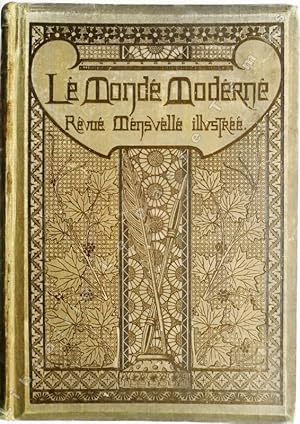
PARIS, Albert Quantin, Éditeur [5, rue Saint-Benoît /// May & Montteroz, Lib.-Imp. réunies, 7, rue Saint-Benoît] - 1896 - R.25,5x19x4,3 cm - L'ENSEMBLE DES 60 LIVRAISONS DU 1er SEMESTRE DE L'ANNÉE 1896, sous reliure éditeur, pleine percaline verte Art Nouveau (Fernandez & Cie), premier plat et dos illustrés en noir, plats biseautés; tranche de tête dorée; 960 pages en pagination continue (16 pages par livraison); importante iconographie illustrée ou photographique en noir; texte sur 2 colonnes. (Collection Le Monde Moderne - Revue mensuelle illustrée - 2e Année - Tome III - Janvier-Juin 1896 - L'Éditeur-Gérant: A. Quantin). Percaline passée et frottée; mors faibles, coupure sur 3 cm (1er plat) et 5 cm (2e plat); mouillure au dos. Ensemble solide et très correct. LE PREMIER SEMESTRE COMPLET DU TOME III (1896). ASINA. (p. 7 à 31 - G. Bergeret, 5 illustrations de Roux). *****___***** LA MOISSON. (p. 32 à 38 - F. Fabié, 7 illustrations de Gusman). *****___***** LES FEMMES D'ESPAGNE. (p. 39 à 54 - L. Garcia-Ramon, 12 illustrations de L. M. Vauzanges). *****___***** EN ÉRYTHRÉE. (p. 65 à 75 - L. Lanier, 6 illustrations de P. Steck). *****___***** L'ÉCOLE D'APPLICATION DE CAVALERIE DE SAUMUR. (p. 76 à 88 - L. d'Or, 14 illustrations de F. Régamay). *****___***** L'EXPOSITION DE 1900. (p. 97 à 117 - A. Robida, 26 illustrations de l'auteur). *****___***** LA MODE DU MOIS. (p. 150 à 151, 312 à 313, 474 à 475, 632 à 633, 792 à 793, 950 à 951 - B. de Présilly, illustrations). *****___***** ROUSSOT ET BLANCAS. (p. 161 à 176 - J. Rameau, 5 illustrations de F. Courboin). *****___***** POUR L'HISTOIRE DE L'ARMURE. (p. 177 à 187 - F. Maindron, 13 illustrations). *****___***** AUX ABATTOIRS DE LA VILETTE. (p. 188 à 196 - T. Bourrier, 10 illustrations de A. Lemaistre). *****___***** UNE MAISON DU VIEUX COLOGNE. (p. 197 à 205 - J. Adeline, 8 illustrations de l'auteur). *****___***** EXCURSIONS DANS LES ASILES DE NUIT d'hommes et de femmes à Paris. (p. 286 à 297 - P. Gsell, 15 illustrations de Seguin). *****___***** LE VOL. (p. 321 à 331 - G. Beaume, 5 illustrations de Etcheverry). *****___***** VIEILLARDS. (p. 347 à 350 - Edgy, 1 illustration de Mucha). *****___***** LE MÉTROPOLITAIN DE PARIS. (p. 353 à 368 - G. Cadoux, 11 illustrations et photographies). *****___***** LES CHIENS COURANTS. (p. 440 à 450 - P. Mégnin, 7 illustrations de C. Weisser). *****___***** MÈRE DES DOULEURS. (p. 481 à 497 - C. Lemonnier, 5 illustrations de Mucha). *****___***** DANS LE BEFFROI. (p. 526 à 176 - J. Doucet, 3 illustrations de A. Robida). *****___***** LES AFFICHES ILLUSTRÉES ÉTRANGÈRES. (p. 537 à 546 - J. Adeline, 10 reproductions). *****___***** THÉÂTRE DU CHAT NOIR. (p. 563 à 579 - P. Eudel, 18 illustrations dont 3 de Robida). *****___***** LES COURSES DE TAUREAUX. (p. 580 à 497 - P. Vrignault, 15 illustrations de D. Serlach). *****___***** L'ARTILLERIE EN CAMPAGNE. (p. 591 à 602 - E. Manceau, 9 illustrations de A. Lalauze). *****___***** REVUE DU MOIS. (p. 639 - 9 illustrations par Moloch). *****___***** LES PASSANTS. (p. 641 à 651 - A. Hermant, 5 illustrations de R. Lelong). *****___***** LES FÊTES FORAINES DE PARIS. (p. 652 à 660 - P. Vauthier, 8 illustrations de l'auteur). *****___***** HANOÏ ET SES ENVIRONS. (p. 676 à 602 - E. Jung, 7 illustrations de A. Montader). *****___***** LA MONNAIE. (p. 685 à 602 - C. de Néronde, 23 illustrations et photographies). *****___***** PROFIL DE COMÉDIENS DE SALON. (p. 709 à 718 - P. Bilhaud, 6 illustrations de E. Bayard). *****___***** UN COUVENT CATHOLIQUE A LONDRES. (p. 731 à 736 - L. P., 11 illustrations de G. Lambert). *****___***** UNE EXCURSION AU TRANSVAAL. (p. 737 à 753 - L. de Launay, 18 illustrations et photographies). *****___***** LE MOIS COMIQUE. (p. 799 - 9 illustrations par Moloch). *****___***** LES DEUX FILS FARCOT. (p. 801 à 817 - Masson-Forestier, 5 illustrations de C. Vaugneray). *****___***** CHANTEURS COMIQUES. (p. 926 à 932 - P. Frimm, 12 portraits illustrés de P. Frimm). *****___***** LE MOIS COM.
-
"From Le Boeuf sur le Toit to the Savoy Ballroom" [illustrated journal of an American tour; together with promotional brochure and small postcard-sized publicity photo].
Published by Various places & Paris: Columbia, 1931 & 1926, 1931
Seller: Peter Harrington. ABA/ ILAB., London, United Kingdom
Association Member: ABA ILAB PBFA
Seller rating 5 out of 5 stars
US$ 6,886.04
US$ 29.42 shipping
Ships from United Kingdom to U.S.A.Quantity: 1 available
Add to basketFrom the collection of Charlie Watts, a lively group of seven illustrated letters from Clément Doucet to Jean Wiéner's children, written during the duo's 1931 American tour. In a witty, cartoonish style, Doucet recounts their adventures as pioneers of "jazz à deux pianos", presenting sharp, affectionate vignettes of modern America filtered through a distinctly French musical sensibility. Trained in the conservatoire tradition yet rooted in Paris's avant-garde nightlife, Wiéner and Doucet forged an original Franco-American jazz idiom and moved easily between elite artistic circles, music-hall stages, and collaborations with major stars such as Josephine Baker and Maurice Chevalier. Their 1931 tour confirmed their standing abroad, and the letters capture the journey's colour and momentum. Each sheet features a vivid scene: an Akron reception hosted by "the Queen of Tyres"; a bustling Fifth Avenue; a packed Harlem Savoy dance floor; a comic hold-up on the streets of Chicago; a futuristic St. Louis cityscape; and Wiéner and Doucet encountering one-horse-town America in Warrensburg. The final drawing shows Wiéner, toga-like in a hotel bathtub, delivering a mock oration surrounded by giant banknotes, under the caption "I like America". Together with a Columbia Records promotional brochure and a Studio Harcourt publicity photograph, these letters offer an engaging, visually inventive record of two French jazzmen delighting in the energy of the country that inspired them. Jeffrey H. Jackson, Making Jazz French: Music and Modern Life in Interwar Paris, 2003; Denise Pilmer Taylor, La Musique Pour Tout Le Monde: Jean Wiéner and the Dawn of French Jazz, 1998. Seven letters from Doucet to Wiéner's children - Stephan and Maud - recounting the adventures of the renowned "jazz à deux pianos" on the road in America in a vivid, very stylish, cartoonish manner; all but one on headed hotel stationery, ink and pencil crayon with inked salutations, captions and subscriptions. Housed in a cloth box with chemsie made by The Chelsea Bindery. Promotional brochure: small octavo. Original pictorial light card self-wrappers, wire-stitched as issued. Design to front cover by Paul Colin; and publicity photographs. Letters a little toned, creases from old folds, but overall very good; brochure a little toned at the margins of the wrapperss, else very good.


![Seller image for "From Le Boeuf sur le Toit to the Savoy Ballroom" [illustrated journal of an American tour; together with promotional brochure and small postcard-sized publicity photo]. for sale by Peter Harrington. ABA/ ILAB.](https://pictures.abebooks.com/inventory/md/md31955593284.jpg)