

Order Total (1 Item Items):
Shipping Destination:

Driel Govert (26 results)
Skip to main search results
Search filters
Product Type
- All Product Types
- Books (26)
- Magazines & Periodicals (No further results match this refinement)
- Comics (No further results match this refinement)
- Sheet Music (No further results match this refinement)
- Art, Prints & Posters (No further results match this refinement)
- Photographs (No further results match this refinement)
- Maps (No further results match this refinement)
- Manuscripts & Paper Collectibles (No further results match this refinement)
Condition Learn more
- New (24)
- As New, Fine or Near Fine (No further results match this refinement)
- Very Good or Good (1)
- Fair or Poor (No further results match this refinement)
- As Described (1)
Binding
Collectible Attributes
- First Edition (No further results match this refinement)
- Signed (No further results match this refinement)
- Dust Jacket (No further results match this refinement)
- Seller-Supplied Images (21)
- Not Print on Demand (6)
Language (1)
Price
- Any Price
- Under US$ 25 (No further results match this refinement)
- US$ 25 to US$ 50 (No further results match this refinement)
- Over US$ 50
Free Shipping
- Free Shipping to U.S.A. (No further results match this refinement)
Seller Location
Seller Rating
-

Jebel Aruda: An Uruk period temple and settlement in Syria: Volume II: Plates of Room Contents (Papers on Archaeology of the Leiden Museum of Antiquities, Palma, 28)
Seller: Books From California, Simi Valley, CA, U.S.A.
Seller rating 4 out of 5 stars

hardcover. Condition: Very Good. Cover and edges may have some wear.
-

US$ 151.69
US$ 19.95 shipping
Ships from United Kingdom to U.S.A.Quantity: 1 available
Add to basketPaperback. Condition: Brand New. 390 pages. 11.00x8.27x1.10 inches. In Stock.
-

US$ 151.69
US$ 26.60 shipping
Ships from United Kingdom to U.S.A.Quantity: 2 available
Add to basketPaperback. Condition: Brand New. 452 pages. 11.00x8.27x1.18 inches. In Stock.
-

US$ 303.37
US$ 26.60 shipping
Ships from United Kingdom to U.S.A.Quantity: 2 available
Add to basketHardcover. Condition: Brand New. 390 pages. 11.00x8.27x1.10 inches. In Stock.
-
US$ 303.37
US$ 26.60 shipping
Ships from United Kingdom to U.S.A.Quantity: 2 available
Add to basketHardcover. Condition: Brand New. 452 pages. 11.00x8.27x1.38 inches. In Stock.
-
Studia Semitica Neerlandica 13. Van Gorcum, Assen, 1969. First edition. In-8, 240 pages, 6 plates. Original cloth with dust-jacket, a fine copy. Language: English. This book ships from Europe, shipping costs will be updated accordingly (BPF). Relevant subjects: Mesopotamia.
-

Jebel Aruda: An Uruk period temple and settlement in Syria (Volume II)
Language: English
Published by Sidestone Press Jul 2023, 2023
ISBN 10: 9464261730 ISBN 13: 9789464261738
Seller: BuchWeltWeit Ludwig Meier e.K., Bergisch Gladbach, Germany
Seller rating 5 out of 5 stars

Taschenbuch. Condition: Neu. This item is printed on demand - it takes 3-4 days longer - Neuware -Jebel Aruda, a prominent mountain ridge overlooking the Taqba Dam lake in northern Syria, was the location of a remarkable settlement that flourished between c. 3300 and 3100 BC during the so-called Uruk period. For the inhabitants the sacredness of this high place, evidenced by the discovery of a large temple complex, seems to have taken precedent over its impractical location far above the valley of the Euphrates River. The site was destroyed under unknown circumstances, leaving behind the spectacular remains of a well preserved temple complex and numerous houses filled with a rich collection of material culture and administrative tools such as bullae and tablets.A Dutch team excavated the site between 1972 and 1982 while the Tabqua Dam was under construction. These two volumes present the results of these excavations and subsequent research of the remains, with special emphasis on the relationship between the domestic architecture and the finds.These richly illustrated volumes aim to facilitate further research and analysis of an exceptional, short-lived Uruk period settlement, comprising domestic architecture associated with a monumental temple complex. It is intended to appeal to readers interested in Mesopotamia and ancient Syria, as well as archaeologists concerned with architectural and locational analysis in a broader perspective.Volume I presents the results of the excavation. In Volume II the contents of each individual house are listed and illustrated as discrete room assemblages, with the specific intention of making the evidence available for more detailed analysis of the relationship between material culture and architecture and to stimulate further research into aspects such as identity and the social structure of the settlement surrounding the temples.ContentsVOLUME II: PLATESIntroductionAbbreviationsConcordance I: Room NumbersConcordance II: Registered Find NumbersConcordance III: Registered Sample NumbersIllustrations of artefacts from each room context by House Plates 1-206 484 pp. Englisch.
-

Jebel Aruda: An Uruk period temple and settlement in Syria (Volume I)
Language: English
Published by Sidestone Press Jul 2023, 2023
ISBN 10: 9464261706 ISBN 13: 9789464261707
Seller: BuchWeltWeit Ludwig Meier e.K., Bergisch Gladbach, Germany
Seller rating 5 out of 5 stars
Taschenbuch. Condition: Neu. This item is printed on demand - it takes 3-4 days longer - Neuware -Jebel Aruda, a prominent mountain ridge overlooking the Taqba Dam lake in northern Syria, was the location of a remarkable settlement that flourished between c. 3300 and 3100 BC during the so-called Uruk period. For the inhabitants the sacredness of this high place, evidenced by the discovery of a large temple complex, seems to have taken precedent over its impractical location far above the valley of the Euphrates River. The site was destroyed under unknown circumstances, leaving behind the spectacular remains of a well preserved temple complex and numerous houses filled with a rich collection of material culture and administrative tools such as bullae and tablets.A Dutch team excavated the site between 1972 and 1982 while the Tabqua Dam was under construction. These two volumes present the results of these excavations and subsequent research of the remains, with special emphasis on the relationship between the domestic architecture and the finds.These richly illustrated volumes aim to facilitate further research and analysis of an exceptional, short-lived Uruk period settlement, comprising domestic architecture associated with a monumental temple complex. It is intended to appeal to readers interested in Mesopotamia and ancient Syria, as well as archaeologists concerned with architectural and locational analysis in a broader perspective.Volume I presents the results of the excavation, with a discussion of the individual houses and the history of the temple buildings, together with the pottery corpus, the administrative artefacts and sealings, as well as shorter chapters on other material categories (flint, stone etc). The contents of each individual house are presented in Volume II.ContentsVOLUME I: TEXTI Preface C. van Driel-MurrayII ForewordIII Explanatory notes to the text and illustrations, conventions and abbreviationsIV Previous publications1 The Site and its Exploration2 The Temple Area3 The site and the temples: aspects of architecture and urban planning. D.E. Boas-Vedder4 The Houses to the North of the Temples5 The Saddle with Houses SI, SII and SIII6 The Area at the Foot of the High Terrace: Houses SIVA, SIVB, SVIII and the Kitchen Area SIVC7 The High Terrace: Houses SVA, SVB, SVI and SVII8 The Pottery Corpus9 Administrative Artefacts: Tablets, Tokens, Seals and Sealings10 The Flaked Stone Assemblage at Jebel Aruda11 Summary Analysis of Botanical and Faunal Samples12 Miscellaneous Artefacts13 Evidence for Craft Production and Processing14 General Observations on the Domestic Complexes15 Conclusions16 Bibliography17 Appendix 1: Collected Sections18 Appendix 2: Room Summaries19 Appendix 3: Sherd Counts 380 pp. Englisch.
-

Condition: New. Dieser Artikel ist ein Print on Demand Artikel und wird nach Ihrer Bestellung fuer Sie gedruckt. Jebel Aruda, a prominent mountain ridge overlooking the Taqba Dam lake in northern Syria, was the location of a remarkable settlement that flourished between c. 3300 and 3100 BC during the so-called Uruk period. For the inhabitants the sacredness of this hi.
-

Condition: New. Dieser Artikel ist ein Print on Demand Artikel und wird nach Ihrer Bestellung fuer Sie gedruckt. Jebel Aruda, a prominent mountain ridge overlooking the Taqba Dam lake in northern Syria, was the location of a remarkable settlement that flourished between c. 3300 and 3100 BC during the so-called Uruk period. For the inhabitants the sacredness of this hi.
-

Taschenbuch. Condition: Neu. Jebel Aruda: An Uruk period temple and settlement in Syria (Volume I) | Govert van Driel (u. a.) | Taschenbuch | Papers on Archaeology of the Leiden Museum of Antiquities 28a | Englisch | 2023 | Sidestone Press | EAN 9789464261707 | Verantwortliche Person für die EU: preigu GmbH & Co. KG, Lengericher Landstr. 19, 49078 Osnabrück, mail[at]preigu[dot]de | Anbieter: preigu Print on Demand.
-

Taschenbuch. Condition: Neu. Jebel Aruda: An Uruk period temple and settlement in Syria (Volume II) | Govert van Driel (u. a.) | Taschenbuch | Papers on Archaeology of the Leiden Museum of Antiquities 28b | Englisch | 2023 | Sidestone Press | EAN 9789464261738 | Verantwortliche Person für die EU: preigu GmbH & Co. KG, Lengericher Landstr. 19, 49078 Osnabrück, mail[at]preigu[dot]de | Anbieter: preigu Print on Demand.
-

Jebel Aruda: An Uruk period temple and settlement in Syria (Volume II)
Language: English
Published by Sidestone Press Jul 2023, 2023
ISBN 10: 9464261730 ISBN 13: 9789464261738
Seller: buchversandmimpf2000, Emtmannsberg, BAYE, Germany
Seller rating 5 out of 5 stars
Taschenbuch. Condition: Neu. This item is printed on demand - Print on Demand Titel. Neuware -Jebel Aruda, a prominent mountain ridge overlooking the Taqba Dam lake in northern Syria, was the location of a remarkable settlement that flourished between c. 3300 and 3100 BC during the so-called Uruk period. For the inhabitants the sacredness of this high place, evidenced by the discovery of a large temple complex, seems to have taken precedent over its impractical location far above the valley of the Euphrates River. The site was destroyed under unknown circumstances, leaving behind the spectacular remains of a well preserved temple complex and numerous houses filled with a rich collection of material culture and administrative tools such as bullae and tablets.A Dutch team excavated the site between 1972 and 1982 while the Tabqua Dam was under construction. These two volumes present the results of these excavations and subsequent research of the remains, with special emphasis on the relationship between the domestic architecture and the finds.These richly illustrated volumes aim to facilitate further research and analysis of an exceptional, short-lived Uruk period settlement, comprising domestic architecture associated with a monumental temple complex. It is intended to appeal to readers interested in Mesopotamia and ancient Syria, as well as archaeologists concerned with architectural and locational analysis in a broader perspective.Volume I presents the results of the excavation. In Volume II the contents of each individual house are listed and illustrated as discrete room assemblages, with the specific intention of making the evidence available for more detailed analysis of the relationship between material culture and architecture and to stimulate further research into aspects such as identity and the social structure of the settlement surrounding the temples.ContentsVOLUME II: PLATESIntroductionAbbreviationsConcordance I: Room NumbersConcordance II: Registered Find NumbersConcordance III: Registered Sample NumbersIllustrations of artefacts from each room context by House Plates 1-206Books on Demand GmbH, Überseering 33, 22297 Hamburg 484 pp. Englisch.
-

Jebel Aruda: An Uruk period temple and settlement in Syria (Volume I)
Language: English
Published by Sidestone Press Jul 2023, 2023
ISBN 10: 9464261706 ISBN 13: 9789464261707
Seller: buchversandmimpf2000, Emtmannsberg, BAYE, Germany
Seller rating 5 out of 5 stars
Taschenbuch. Condition: Neu. This item is printed on demand - Print on Demand Titel. Neuware -Jebel Aruda, a prominent mountain ridge overlooking the Taqba Dam lake in northern Syria, was the location of a remarkable settlement that flourished between c. 3300 and 3100 BC during the so-called Uruk period. For the inhabitants the sacredness of this high place, evidenced by the discovery of a large temple complex, seems to have taken precedent over its impractical location far above the valley of the Euphrates River. The site was destroyed under unknown circumstances, leaving behind the spectacular remains of a well preserved temple complex and numerous houses filled with a rich collection of material culture and administrative tools such as bullae and tablets.A Dutch team excavated the site between 1972 and 1982 while the Tabqua Dam was under construction. These two volumes present the results of these excavations and subsequent research of the remains, with special emphasis on the relationship between the domestic architecture and the finds.These richly illustrated volumes aim to facilitate further research and analysis of an exceptional, short-lived Uruk period settlement, comprising domestic architecture associated with a monumental temple complex. It is intended to appeal to readers interested in Mesopotamia and ancient Syria, as well as archaeologists concerned with architectural and locational analysis in a broader perspective.Volume I presents the results of the excavation, with a discussion of the individual houses and the history of the temple buildings, together with the pottery corpus, the administrative artefacts and sealings, as well as shorter chapters on other material categories (flint, stone etc). The contents of each individual house are presented in Volume II.ContentsVOLUME I: TEXTI Preface C. van Driel-MurrayII ForewordIII Explanatory notes to the text and illustrations, conventions and abbreviationsIV Previous publications1 The Site and its Exploration2 The Temple Area3 The site and the temples: aspects of architecture and urban planning. D.E. Boas-Vedder4 The Houses to the North of the Temples5 The Saddle with Houses SI, SII and SIII6 The Area at the Foot of the High Terrace: Houses SIVA, SIVB, SVIII and the Kitchen Area SIVC7 The High Terrace: Houses SVA, SVB, SVI and SVII8 The Pottery Corpus9 Administrative Artefacts: Tablets, Tokens, Seals and Sealings10 The Flaked Stone Assemblage at Jebel Aruda11 Summary Analysis of Botanical and Faunal Samples12 Miscellaneous Artefacts13 Evidence for Craft Production and Processing14 General Observations on the Domestic Complexes15 Conclusions16 Bibliography17 Appendix 1: Collected Sections18 Appendix 2: Room Summaries19 Appendix 3: Sherd CountsBooks on Demand GmbH, Überseering 33, 22297 Hamburg 380 pp. Englisch.
-

Taschenbuch. Condition: Neu. nach der Bestellung gedruckt Neuware - Printed after ordering - Jebel Aruda, a prominent mountain ridge overlooking the Taqba Dam lake in northern Syria, was the location of a remarkable settlement that flourished between c. 3300 and 3100 BC during the so-called Uruk period. For the inhabitants the sacredness of this high place, evidenced by the discovery of a large temple complex, seems to have taken precedent over its impractical location far above the valley of the Euphrates River. The site was destroyed under unknown circumstances, leaving behind the spectacular remains of a well preserved temple complex and numerous houses filled with a rich collection of material culture and administrative tools such as bullae and tablets.A Dutch team excavated the site between 1972 and 1982 while the Tabqua Dam was under construction. These two volumes present the results of these excavations and subsequent research of the remains, with special emphasis on the relationship between the domestic architecture and the finds.These richly illustrated volumes aim to facilitate further research and analysis of an exceptional, short-lived Uruk period settlement, comprising domestic architecture associated with a monumental temple complex. It is intended to appeal to readers interested in Mesopotamia and ancient Syria, as well as archaeologists concerned with architectural and locational analysis in a broader perspective.Volume I presents the results of the excavation, with a discussion of the individual houses and the history of the temple buildings, together with the pottery corpus, the administrative artefacts and sealings, as well as shorter chapters on other material categories (flint, stone etc). The contents of each individual house are presented in Volume II.ContentsVOLUME I: TEXTI Preface C. van Driel-MurrayII ForewordIII Explanatory notes to the text and illustrations, conventions and abbreviationsIV Previous publications1 The Site and its Exploration2 The Temple Area3 The site and the temples: aspects of architecture and urban planning. D.E. Boas-Vedder4 The Houses to the North of the Temples5 The Saddle with Houses SI, SII and SIII6 The Area at the Foot of the High Terrace: Houses SIVA, SIVB, SVIII and the Kitchen Area SIVC7 The High Terrace: Houses SVA, SVB, SVI and SVII8 The Pottery Corpus9 Administrative Artefacts: Tablets, Tokens, Seals and Sealings10 The Flaked Stone Assemblage at Jebel Aruda11 Summary Analysis of Botanical and Faunal Samples12 Miscellaneous Artefacts13 Evidence for Craft Production and Processing14 General Observations on the Domestic Complexes15 Conclusions16 Bibliography17 Appendix 1: Collected Sections18 Appendix 2: Room Summaries19 Appendix 3: Sherd Counts.
-

Taschenbuch. Condition: Neu. nach der Bestellung gedruckt Neuware - Printed after ordering - Jebel Aruda, a prominent mountain ridge overlooking the Taqba Dam lake in northern Syria, was the location of a remarkable settlement that flourished between c. 3300 and 3100 BC during the so-called Uruk period. For the inhabitants the sacredness of this high place, evidenced by the discovery of a large temple complex, seems to have taken precedent over its impractical location far above the valley of the Euphrates River. The site was destroyed under unknown circumstances, leaving behind the spectacular remains of a well preserved temple complex and numerous houses filled with a rich collection of material culture and administrative tools such as bullae and tablets.A Dutch team excavated the site between 1972 and 1982 while the Tabqua Dam was under construction. These two volumes present the results of these excavations and subsequent research of the remains, with special emphasis on the relationship between the domestic architecture and the finds.These richly illustrated volumes aim to facilitate further research and analysis of an exceptional, short-lived Uruk period settlement, comprising domestic architecture associated with a monumental temple complex. It is intended to appeal to readers interested in Mesopotamia and ancient Syria, as well as archaeologists concerned with architectural and locational analysis in a broader perspective.Volume I presents the results of the excavation. In Volume II the contents of each individual house are listed and illustrated as discrete room assemblages, with the specific intention of making the evidence available for more detailed analysis of the relationship between material culture and architecture and to stimulate further research into aspects such as identity and the social structure of the settlement surrounding the temples.ContentsVOLUME II: PLATESIntroductionAbbreviationsConcordance I: Room NumbersConcordance II: Registered Find NumbersConcordance III: Registered Sample NumbersIllustrations of artefacts from each room context by House Plates 1-206.
-

US$ 129.08
US$ 56.37 shipping
Ships from Germany to U.S.A.Quantity: Over 20 available
Add to basketCondition: New. Dieser Artikel ist ein Print on Demand Artikel und wird nach Ihrer Bestellung fuer Sie gedruckt. Jebel Aruda, a prominent mountain ridge overlooking the Taqba Dam lake in northern Syria, was the location of a remarkable settlement that flourished between c. 3300 and 3100 BC during the so-called Uruk period. For the inhabitants the sacredness of this hi.
-

US$ 129.08
US$ 56.37 shipping
Ships from Germany to U.S.A.Quantity: Over 20 available
Add to basketCondition: New. Dieser Artikel ist ein Print on Demand Artikel und wird nach Ihrer Bestellung fuer Sie gedruckt. Jebel Aruda, a prominent mountain ridge overlooking the Taqba Dam lake in northern Syria, was the location of a remarkable settlement that flourished between c. 3300 and 3100 BC during the so-called Uruk period. For the inhabitants the sacredness of this hi.
-

Jebel Aruda: An Uruk period temple and settlement in Syria (Volume II)
Language: English
Published by Sidestone Press Jul 2023, 2023
ISBN 10: 9464261749 ISBN 13: 9789464261745
Seller: BuchWeltWeit Ludwig Meier e.K., Bergisch Gladbach, Germany
Seller rating 5 out of 5 stars
Buch. Condition: Neu. This item is printed on demand - it takes 3-4 days longer - Neuware -Jebel Aruda, a prominent mountain ridge overlooking the Taqba Dam lake in northern Syria, was the location of a remarkable settlement that flourished between c. 3300 and 3100 BC during the so-called Uruk period. For the inhabitants the sacredness of this high place, evidenced by the discovery of a large temple complex, seems to have taken precedent over its impractical location far above the valley of the Euphrates River. The site was destroyed under unknown circumstances, leaving behind the spectacular remains of a well preserved temple complex and numerous houses filled with a rich collection of material culture and administrative tools such as bullae and tablets.A Dutch team excavated the site between 1972 and 1982 while the Tabqua Dam was under construction. These two volumes present the results of these excavations and subsequent research of the remains, with special emphasis on the relationship between the domestic architecture and the finds.These richly illustrated volumes aim to facilitate further research and analysis of an exceptional, short-lived Uruk period settlement, comprising domestic architecture associated with a monumental temple complex. It is intended to appeal to readers interested in Mesopotamia and ancient Syria, as well as archaeologists concerned with architectural and locational analysis in a broader perspective.Volume I presents the results of the excavation. In Volume II the contents of each individual house are listed and illustrated as discrete room assemblages, with the specific intention of making the evidence available for more detailed analysis of the relationship between material culture and architecture and to stimulate further research into aspects such as identity and the social structure of the settlement surrounding the temples.ContentsVOLUME II: PLATESIntroductionAbbreviationsConcordance I: Room NumbersConcordance II: Registered Find NumbersConcordance III: Registered Sample NumbersIllustrations of artefacts from each room context by House Plates 1-206 484 pp. Englisch.
-

Jebel Aruda: An Uruk period temple and settlement in Syria (Volume I)
Language: English
Published by Sidestone Press Jul 2023, 2023
ISBN 10: 9464261714 ISBN 13: 9789464261714
Seller: BuchWeltWeit Ludwig Meier e.K., Bergisch Gladbach, Germany
Seller rating 5 out of 5 stars
Buch. Condition: Neu. This item is printed on demand - it takes 3-4 days longer - Neuware -Jebel Aruda, a prominent mountain ridge overlooking the Taqba Dam lake in northern Syria, was the location of a remarkable settlement that flourished between c. 3300 and 3100 BC during the so-called Uruk period. For the inhabitants the sacredness of this high place, evidenced by the discovery of a large temple complex, seems to have taken precedent over its impractical location far above the valley of the Euphrates River. The site was destroyed under unknown circumstances, leaving behind the spectacular remains of a well preserved temple complex and numerous houses filled with a rich collection of material culture and administrative tools such as bullae and tablets.A Dutch team excavated the site between 1972 and 1982 while the Tabqua Dam was under construction. These two volumes present the results of these excavations and subsequent research of the remains, with special emphasis on the relationship between the domestic architecture and the finds.These richly illustrated volumes aim to facilitate further research and analysis of an exceptional, short-lived Uruk period settlement, comprising domestic architecture associated with a monumental temple complex. It is intended to appeal to readers interested in Mesopotamia and ancient Syria, as well as archaeologists concerned with architectural and locational analysis in a broader perspective.Volume I presents the results of the excavation, with a discussion of the individual houses and the history of the temple buildings, together with the pottery corpus, the administrative artefacts and sealings, as well as shorter chapters on other material categories (flint, stone etc). The contents of each individual house are presented in Volume II.ContentsVOLUME I: TEXTI Preface C. van Driel-MurrayII ForewordIII Explanatory notes to the text and illustrations, conventions and abbreviationsIV Previous publications1 The Site and its Exploration2 The Temple Area3 The site and the temples: aspects of architecture and urban planning. D.E. Boas-Vedder4 The Houses to the North of the Temples5 The Saddle with Houses SI, SII and SIII6 The Area at the Foot of the High Terrace: Houses SIVA, SIVB, SVIII and the Kitchen Area SIVC7 The High Terrace: Houses SVA, SVB, SVI and SVII8 The Pottery Corpus9 Administrative Artefacts: Tablets, Tokens, Seals and Sealings10 The Flaked Stone Assemblage at Jebel Aruda11 Summary Analysis of Botanical and Faunal Samples12 Miscellaneous Artefacts13 Evidence for Craft Production and Processing14 General Observations on the Domestic Complexes15 Conclusions16 Bibliography17 Appendix 1: Collected Sections18 Appendix 2: Room Summaries19 Appendix 3: Sherd Counts 380 pp. Englisch.
-

Buch. Condition: Neu. Jebel Aruda: An Uruk period temple and settlement in Syria (Volume I) | Govert van Driel (u. a.) | Buch | Papers on Archaeology of the Leiden Museum of Antiquities 28a | Englisch | 2023 | Sidestone Press | EAN 9789464261714 | Verantwortliche Person für die EU: preigu GmbH & Co. KG, Lengericher Landstr. 19, 49078 Osnabrück, mail[at]preigu[dot]de | Anbieter: preigu Print on Demand.
-
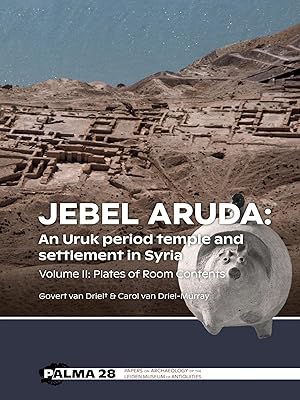
Buch. Condition: Neu. Jebel Aruda: An Uruk period temple and settlement in Syria (Volume II) | Govert van Driel (u. a.) | Buch | Papers on Archaeology of the Leiden Museum of Antiquities 28b | Englisch | 2023 | Sidestone Press | EAN 9789464261745 | Verantwortliche Person für die EU: preigu GmbH & Co. KG, Lengericher Landstr. 19, 49078 Osnabrück, mail[at]preigu[dot]de | Anbieter: preigu Print on Demand.
-

Jebel Aruda: An Uruk period temple and settlement in Syria (Volume I)
Language: English
Published by Sidestone Press Jul 2023, 2023
ISBN 10: 9464261714 ISBN 13: 9789464261714
Seller: buchversandmimpf2000, Emtmannsberg, BAYE, Germany
Seller rating 5 out of 5 stars
Buch. Condition: Neu. This item is printed on demand - Print on Demand Titel. Neuware -Jebel Aruda, a prominent mountain ridge overlooking the Taqba Dam lake in northern Syria, was the location of a remarkable settlement that flourished between c. 3300 and 3100 BC during the so-called Uruk period. For the inhabitants the sacredness of this high place, evidenced by the discovery of a large temple complex, seems to have taken precedent over its impractical location far above the valley of the Euphrates River. The site was destroyed under unknown circumstances, leaving behind the spectacular remains of a well preserved temple complex and numerous houses filled with a rich collection of material culture and administrative tools such as bullae and tablets.A Dutch team excavated the site between 1972 and 1982 while the Tabqua Dam was under construction. These two volumes present the results of these excavations and subsequent research of the remains, with special emphasis on the relationship between the domestic architecture and the finds.These richly illustrated volumes aim to facilitate further research and analysis of an exceptional, short-lived Uruk period settlement, comprising domestic architecture associated with a monumental temple complex. It is intended to appeal to readers interested in Mesopotamia and ancient Syria, as well as archaeologists concerned with architectural and locational analysis in a broader perspective.Volume I presents the results of the excavation, with a discussion of the individual houses and the history of the temple buildings, together with the pottery corpus, the administrative artefacts and sealings, as well as shorter chapters on other material categories (flint, stone etc). The contents of each individual house are presented in Volume II.ContentsVOLUME I: TEXTI Preface C. van Driel-MurrayII ForewordIII Explanatory notes to the text and illustrations, conventions and abbreviationsIV Previous publications1 The Site and its Exploration2 The Temple Area3 The site and the temples: aspects of architecture and urban planning. D.E. Boas-Vedder4 The Houses to the North of the Temples5 The Saddle with Houses SI, SII and SIII6 The Area at the Foot of the High Terrace: Houses SIVA, SIVB, SVIII and the Kitchen Area SIVC7 The High Terrace: Houses SVA, SVB, SVI and SVII8 The Pottery Corpus9 Administrative Artefacts: Tablets, Tokens, Seals and Sealings10 The Flaked Stone Assemblage at Jebel Aruda11 Summary Analysis of Botanical and Faunal Samples12 Miscellaneous Artefacts13 Evidence for Craft Production and Processing14 General Observations on the Domestic Complexes15 Conclusions16 Bibliography17 Appendix 1: Collected Sections18 Appendix 2: Room Summaries19 Appendix 3: Sherd CountsBooks on Demand GmbH, Überseering 33, 22297 Hamburg 380 pp. Englisch.
-

Jebel Aruda: An Uruk period temple and settlement in Syria (Volume II)
Language: English
Published by Sidestone Press Jul 2023, 2023
ISBN 10: 9464261749 ISBN 13: 9789464261745
Seller: buchversandmimpf2000, Emtmannsberg, BAYE, Germany
Seller rating 5 out of 5 stars
Buch. Condition: Neu. This item is printed on demand - Print on Demand Titel. Neuware -Jebel Aruda, a prominent mountain ridge overlooking the Taqba Dam lake in northern Syria, was the location of a remarkable settlement that flourished between c. 3300 and 3100 BC during the so-called Uruk period. For the inhabitants the sacredness of this high place, evidenced by the discovery of a large temple complex, seems to have taken precedent over its impractical location far above the valley of the Euphrates River. The site was destroyed under unknown circumstances, leaving behind the spectacular remains of a well preserved temple complex and numerous houses filled with a rich collection of material culture and administrative tools such as bullae and tablets.A Dutch team excavated the site between 1972 and 1982 while the Tabqua Dam was under construction. These two volumes present the results of these excavations and subsequent research of the remains, with special emphasis on the relationship between the domestic architecture and the finds.These richly illustrated volumes aim to facilitate further research and analysis of an exceptional, short-lived Uruk period settlement, comprising domestic architecture associated with a monumental temple complex. It is intended to appeal to readers interested in Mesopotamia and ancient Syria, as well as archaeologists concerned with architectural and locational analysis in a broader perspective.Volume I presents the results of the excavation. In Volume II the contents of each individual house are listed and illustrated as discrete room assemblages, with the specific intention of making the evidence available for more detailed analysis of the relationship between material culture and architecture and to stimulate further research into aspects such as identity and the social structure of the settlement surrounding the temples.ContentsVOLUME II: PLATESIntroductionAbbreviationsConcordance I: Room NumbersConcordance II: Registered Find NumbersConcordance III: Registered Sample NumbersIllustrations of artefacts from each room context by House Plates 1-206Books on Demand GmbH, Überseering 33, 22297 Hamburg 484 pp. Englisch.
-

Buch. Condition: Neu. nach der Bestellung gedruckt Neuware - Printed after ordering - Jebel Aruda, a prominent mountain ridge overlooking the Taqba Dam lake in northern Syria, was the location of a remarkable settlement that flourished between c. 3300 and 3100 BC during the so-called Uruk period. For the inhabitants the sacredness of this high place, evidenced by the discovery of a large temple complex, seems to have taken precedent over its impractical location far above the valley of the Euphrates River. The site was destroyed under unknown circumstances, leaving behind the spectacular remains of a well preserved temple complex and numerous houses filled with a rich collection of material culture and administrative tools such as bullae and tablets.A Dutch team excavated the site between 1972 and 1982 while the Tabqua Dam was under construction. These two volumes present the results of these excavations and subsequent research of the remains, with special emphasis on the relationship between the domestic architecture and the finds.These richly illustrated volumes aim to facilitate further research and analysis of an exceptional, short-lived Uruk period settlement, comprising domestic architecture associated with a monumental temple complex. It is intended to appeal to readers interested in Mesopotamia and ancient Syria, as well as archaeologists concerned with architectural and locational analysis in a broader perspective.Volume I presents the results of the excavation, with a discussion of the individual houses and the history of the temple buildings, together with the pottery corpus, the administrative artefacts and sealings, as well as shorter chapters on other material categories (flint, stone etc). The contents of each individual house are presented in Volume II.ContentsVOLUME I: TEXTI Preface C. van Driel-MurrayII ForewordIII Explanatory notes to the text and illustrations, conventions and abbreviationsIV Previous publications1 The Site and its Exploration2 The Temple Area3 The site and the temples: aspects of architecture and urban planning. D.E. Boas-Vedder4 The Houses to the North of the Temples5 The Saddle with Houses SI, SII and SIII6 The Area at the Foot of the High Terrace: Houses SIVA, SIVB, SVIII and the Kitchen Area SIVC7 The High Terrace: Houses SVA, SVB, SVI and SVII8 The Pottery Corpus9 Administrative Artefacts: Tablets, Tokens, Seals and Sealings10 The Flaked Stone Assemblage at Jebel Aruda11 Summary Analysis of Botanical and Faunal Samples12 Miscellaneous Artefacts13 Evidence for Craft Production and Processing14 General Observations on the Domestic Complexes15 Conclusions16 Bibliography17 Appendix 1: Collected Sections18 Appendix 2: Room Summaries19 Appendix 3: Sherd Counts.
-

Buch. Condition: Neu. nach der Bestellung gedruckt Neuware - Printed after ordering - Jebel Aruda, a prominent mountain ridge overlooking the Taqba Dam lake in northern Syria, was the location of a remarkable settlement that flourished between c. 3300 and 3100 BC during the so-called Uruk period. For the inhabitants the sacredness of this high place, evidenced by the discovery of a large temple complex, seems to have taken precedent over its impractical location far above the valley of the Euphrates River. The site was destroyed under unknown circumstances, leaving behind the spectacular remains of a well preserved temple complex and numerous houses filled with a rich collection of material culture and administrative tools such as bullae and tablets.A Dutch team excavated the site between 1972 and 1982 while the Tabqua Dam was under construction. These two volumes present the results of these excavations and subsequent research of the remains, with special emphasis on the relationship between the domestic architecture and the finds.These richly illustrated volumes aim to facilitate further research and analysis of an exceptional, short-lived Uruk period settlement, comprising domestic architecture associated with a monumental temple complex. It is intended to appeal to readers interested in Mesopotamia and ancient Syria, as well as archaeologists concerned with architectural and locational analysis in a broader perspective.Volume I presents the results of the excavation. In Volume II the contents of each individual house are listed and illustrated as discrete room assemblages, with the specific intention of making the evidence available for more detailed analysis of the relationship between material culture and architecture and to stimulate further research into aspects such as identity and the social structure of the settlement surrounding the temples.ContentsVOLUME II: PLATESIntroductionAbbreviationsConcordance I: Room NumbersConcordance II: Registered Find NumbersConcordance III: Registered Sample NumbersIllustrations of artefacts from each room context by House Plates 1-206.


