

Order Total (1 Item Items):
Shipping Destination:

Dutton Thomas Goldsworth (10 results)
Skip to main search results
Search filters
Product Type
- All Product Types
- Books (2)
- Magazines & Periodicals (No further results match this refinement)
- Comics (No further results match this refinement)
- Sheet Music (No further results match this refinement)
- Art, Prints & Posters (8)
- Photographs (No further results match this refinement)
- Maps (No further results match this refinement)
- Manuscripts & Paper Collectibles (No further results match this refinement)
Condition Learn more
- New (2)
- As New, Fine or Near Fine (No further results match this refinement)
- Very Good or Good (No further results match this refinement)
- Fair or Poor (No further results match this refinement)
- As Described (8)
Binding
- All Bindings
- Hardcover (1)
- Softcover (No further results match this refinement)
Collectible Attributes
- First Edition (1)
- Signed (No further results match this refinement)
- Dust Jacket (No further results match this refinement)
- Seller-Supplied Images (10)
- Not Print on Demand (10)
Language (1)
Free Shipping
- Free Shipping to U.S.A. (No further results match this refinement)
Seller Location
Seller Rating
-

The Iron Steam Ship, Great Britain, A5
Published by Contentum Ltd., Larnaca, Cyprus
Art / Print / Poster
Loose Leaf. Condition: New. Reproduction. Original title: The Iron Steam Ship, Great Britain German: Das Eisendampfschiff, Großbritannien French: Le navire à vapeur de fer, Grande-Bretagne Spanish: El barco de vapor de hierro, Gran Bretaña High-quality fine-art reproduction based on an original work from the Ycba. Creation period: 19th century (1852). Professionally printed on premium fine-art paper (Photo Matt Fibre) in size A5. The motif is printed with a white border (museum-style presentation). No.
-

Colombo and Cabral Floating Batteries Built for the Imperial Brazilian Navy, A5
Published by Contentum Ltd., Larnaca, Cyprus
Art / Print / Poster
Loose Leaf. Condition: New. Reproduction. None. No.
-
Yachting a series of twelve celebrated yachts sketched and drawn by. with descriptive text and list of winnings by "Red with White Maltese Cross".
Published by London John B. Day, 1877
Seller: Shapero Rare Books, London, United Kingdom
Association Member: ABA ILAB PBFA
Seller rating 5 out of 5 stars

First Edition
US$ 6,881.28
US$ 20.04 shipping
Ships from United Kingdom to U.S.A.Quantity: 1 available
Add to basketFirst edition; folio; half-title, 12 colour printed lithographic plates, colour printed flags within text, publisher's advertisements leaf at rear, bookplate, original blue cloth stamped in black and gilt, light wear to spine extremities, a very good copy. Dutton's scarce and beautiful series of coloured lithographs of yachting. Dutton was the foremost draughtsman and lithographer of shipping subjects of his day, and depicts a full range of pleasure craft from Queen Victoria's stately frigate of 2345 tons to the white sailed racers of the deep. Bobins 639 (this copy).
-

The Start for the Great Atlantic Race, December 11th, 1866. To the Commodore & Members of the New-York Yacht Club .
Published by William Foster, London, 1867
Seller: Donald A. Heald Rare Books (ABAA), New York, NY, U.S.A.
Seller rating 5 out of 5 stars
Art / Print / Poster
Hand-colored lithograph, by and after Dutton. A dramatic scene illustrating the start of the Trans-Atlantic race of 1866, by the celebrated maritime painter Thomas Dutton Depicts three yachts (from left to right) Henrietta, Vesta and Fleetwing in the waters off Sandy Hook, New Jersey. The ships set sail across the Atlantic on the 11th December 1866 and the race was won by Henrietta on Christmas Day after 13 days, 21 hours and 55 minutes. Thomas Dutton was one of the greatest nineteenth century maritime painters. His emotive works display a genuine love of the sea and his careful depiction of detail provides a wonderful record of the important vessels of the age.
-
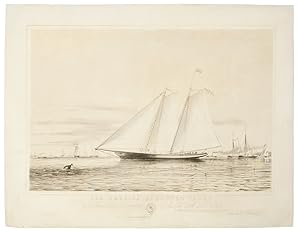
The "America" Schooner Yacht. C Stevens, Esq Commodore of the New York Yacht Club
Published by Ackermann & Co, London, 1851
Seller: Donald A. Heald Rare Books (ABAA), New York, NY, U.S.A.
Seller rating 5 out of 5 stars
Art / Print / Poster
Tinted lithograph drawn on stone by Dutton, printed by Day & Son. Expert repairs, some facsimile in titles Sheet size: 16 1/2 x 21 1/4 inches. The great yacht whose humiliating defeat of all British rivals led to the establishment of the greatest of all yachting challenge cup races: the "America's Cup". Owned by Commodore John C. Stevens and five other members of the New York Yacht Club, the America was built in New York to the revolutionary design of George Steers. Launched in May 1851, in June of the same year she sailed to challenge the English yachting establishment. After having two challenges for races turned down, Commodore Stevens entered America in the Royal Yacht Squadron Regatta and under the brilliant captainship of Richard Brown (a highly skilled member of the Sandy Hook Pilots) she beat the best of the British yachts "with great ease" (India House Collection, p.62). The syndicate returned to New York with their prize: a trophy that was to become the America's Cup. The America herself was sold to John, Lord de Blaquiere on 1st September 1851, and six days later the present image was published. In July 1857, the original owners of the America donated their prize through a Deed of Gift to the New York Yacht Club: the deed stipulated that the cup was to be held in trust as a 'challenge' trophy to promote friendly competition. "Stung by this blow to contemporary perceptions of invincible British sea power, a succession of British syndicates attempted to win back the cup, but the New York Yacht Club remained unbeaten for 25 challenges over 113 years, the longest winning streak in the history of sport. Matches were held in the vicinity of New York City from 1870 to 1920, . From 1930 to 1983, the races were sailed off Newport, Rhode Island for the rest of the NYYCs reign." (Wikipedia). A Descriptive Catalogue of the Marine Collection to be found at India House (New York: 1935) item number 252.
-

Clipperfregatschip met hulpstoomvermogen "Utrecht", kapitein A. Hoogenstraten.
Published by William Foster,, London,, 1869
Seller: Antiquariaat FORUM BV, Houten, Netherlands
Seller rating 5 out of 5 stars
US$ 1,485.15
US$ 28.84 shipping
Ships from Netherlands to U.S.A.Quantity: 1 available
Add to basketRare portrait of the ship Utrecht, a full-rigged clipper with auxiliary power and screw propellers, built in 1868 for the firm of Van Zeylen & Decker in Rotterdam and capable of carrying 2009 tons. During the subsequent years, the ship made several voyages between Rotterdam and Batavia (Jakarta) and Semarang, carrying passengers and goods. Although the ship was equipped with an auxiliary steam engine, this system proved a failure and was removed in 1870-1871. After being sold to the firm of Voorhoeve & Jelier in Rotterdam, the ship sailed between Rotterdam, The United Kingdom, Ireland, the Dutch East Indies and San Francisco. The ship was sold in 1888 to the firm of C.M. Matzen in Hamburg and afterwards possibly to a firm in Norway.The British lithographer Thomas Goldsworth Dutton was "not only the finest 19th century lithographer of shipping scenes and ship portraits but happily the most prolific" (Archibald). During his career he produced numerous portraits of ships, including mercantile vessels of international companies, a large number of war ships of the Royal Navy and several yachts, as well as naval actions during the Crimean War.In fine condition, with only a few spots.l Archibald, Dictionary of sea painters of Europe and America, p. 149; Holdsworth, Mail and passenger steamships of the nineteenth century, pp. 288-289; The Lloyd mail VII (1937), p. 509; Maritiemdigitaal (1 copy). Double-tinted lithograph, finished in colour (ca. 48 x 66.5 cm) in a passepartout and framed (ca. 67.5 x 88.5 cm).
-
[The Prince of Wales Yacht Dagmar in coastal waters off the Isle of Wight]
Published by [London, 1865
Seller: Donald A. Heald Rare Books (ABAA), New York, NY, U.S.A.
Seller rating 5 out of 5 stars
Art / Print / Poster
Tinted lithograph with added hand colour. Artist's monogram in lower right corner of image. A fine ship portrait of the Royal cutter by Dutton, one of the greatest marine lithographers. Thomas Dutton was one of the great nineteenth century maritime painters. His emotive works display a genuine love of the sea and his careful depiction of detail provides a wonderful record of the important vessels of the age. This spectacular print depicts the 33-ton cutter Dagmar. This impressive ship was built for the Prince of Wales (later Edward VII) in Wivenhoe in Essex, by Thomas and John Harvey. The present view shows the vessel under full-sail off the coast of the Isle of Wight, with Osborne House, the favorite residence of Queen Victoria, outlined on the cliff tops.
-
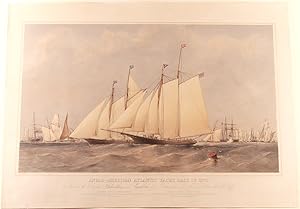
Anglo-American Atlantic yacht race of 1870. Start of the Yachts Dauntless and Cambria from Queenstown for New York on the 4th. July
Published by Published by Wm. Foster, London, 1871
Seller: Donald A. Heald Rare Books (ABAA), New York, NY, U.S.A.
Seller rating 5 out of 5 stars
Art / Print / Poster
Tinted lithograph, finished by hand, drawn on stone by Dutton after "a painting by R.L. Stopford", sheet size: 20 x 27 3/8 inches. Fine condition. A dramatic scene illustrating the start of the Trans-Atlantic race of 1870, by the celebrated maritime painter Thomas Dutton. Thomas Dutton was one of the greatest nineteenth century maritime painters. His emotive works display a genuine love of the sea and his careful depiction of detail provides a wonderful record of the important vessels of the age. The 108-foot Cambria, owned by James Ashbury of the Royal Harwich Yacht Club , raced the Dauntless, owned by James Gordon Bennett of the New York Yacht Club, from Queenstown, Ireland, to New York on 4 July 1870. The Cambria arrived first, making the crossing in 23 days, 5 hours 17 minutes and 15 seconds, just under two hours ahead of the Dauntless. After recuperating for 11 days the Cambria took part in the first true Americas Cup race. She competed against a field of 23 American yachts, and lost to the Magic by 40 minutes, finishing in 10th place overall. Dutton expertly captures the exciting moment of the start of the Trans-Atlantic race, and shows the great beauty and style of this remarkable ship.
-
![Seller image for The "America" Winning the Match at Cowes for the [Club Cup] . open to Yachts of all Classes, and Nations from the original sketch taken [on] the spo[t b]y Oswald W. Brierj[ey] for sale by Donald A. Heald Rare Books (ABAA)](https://pictures.abebooks.com/inventory/md/md1031579715.jpg)
The "America" Winning the Match at Cowes for the [Club Cup] . open to Yachts of all Classes, and Nations from the original sketch taken [on] the spo[t b]y Oswald W. Brierj[ey]
Published by Ackermann & Co, London, 1851
Seller: Donald A. Heald Rare Books (ABAA), New York, NY, U.S.A.
Seller rating 5 out of 5 stars
Art / Print / Poster
Tinted lithograph drawn on stone by Dutton after Brierley, printed by Day & Son. Small expert repairs. The great yacht whose humiliating defeat of all British rivals lead to the establishment of the greatest of all yachting challenge cup races: the "America's Cup". Owned by Commodore John C. Stevens and five other members of the New York Yacht Club, the America was built in New York to the revolutionary design of George Steers. Launched in May 1851, in June of the same year she sailed to challenge the English yachting establishment. After having two challenges for races turned down, Commodore Stevens entered America in the Royal Yacht Squadron Regatta and under the brilliant captainship of Richard Brown (a highly skilled member of the Sandy Hook Pilots) she beat the best of the British yachts "with great ease" (India House Collection, p.62). The syndicate returned to New York with their prize: a trophy that was to become the America's Cup. The America herself was sold to John, Lord de Blaquiere on 1st September 1851, and four days later the present image was published. In July 1857, the original owners of the America donated their prize through a Deed of Gift to the New York Yacht Club: the deed stipulated that the cup was to be held in trust as a 'challenge' trophy to promote friendly competition. "Stung by this blow to contemporary perceptions of invincible British sea power, a succession of British syndicates attempted to win back the cup, but the New York Yacht Club remained unbeaten for 25 challenges over 113 years, the longest winning streak in the history of sport. Matches were held in the vicinity of New York City from 1870 to 1920, . From 1930 to 1983, the races were sailed off Newport, Rhode Island for the rest of the NYYCs reign." (Wikipedia). Cf. A Descriptive Catalogue of the Marine Collection to be found at India House (New York: 1935) item number 252 (includes a lengthy note on the subsequent history of the America).
-
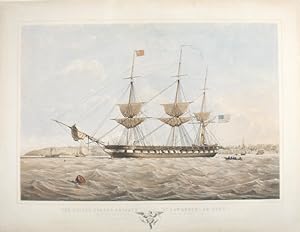
United States Frigate St Lawrence 50 Guns Sailing off Osborne, Isle of Wight
Published by Ackermann & Co, London, 1851
Seller: Donald A. Heald Rare Books (ABAA), New York, NY, U.S.A.
Seller rating 5 out of 5 stars
Art / Print / Poster
Hand-coloured lithograph by Dutton, printed by Day & Son. Sheet size: 21 1/4 x 27 2/8 inches. Beautiful portrait of United States Frigate "St. Lawrence" saluting off Osbourne, Isle of Wight, summer residence of Queen Victoria. The St. Lawrence was laid out in the 1820s by the Norfolk Navy Yard, but she remained uncompleted on the ways until work on her, interrupted by a shortage of funds, was resumed during the Mexican War and she was finally launched in late 1847 or early in 1848. She bore 8 VIII-inch guns and 42 32 pounders. A beautiful sailing ship, she represents an ideal of the pre-steamship days, superbly rendered by Dutton, who was probably the best printmaker of marine subjects during this period. Thomas Goldsworth Dutton (d. 1891) worked for Day & Haghe and Day & Son, producing refined lithographs of the great British ships of the period, as well as visiting battleships of other nations, as here. With Commander Joshua Sands in command, the St .Lawrence departed New York on the 20th February 1851, partially on a good-will visit but also carrying to England the exhibits from the United States for the Great Exhibition in London, the first modern world's fair which opened on 1st May, 1851. At some point before May 5th (the date this print was published) she evidently visited the Isle of Wight, where as a diplomatic courtesy she fired a salute to Queen Victoria. Her return voyage was made via Lisbon and she arrived back in New York on 11 August, 1851. Cf. A Descriptive Catalogue of the Marine Collection to be found at India House (New York: 1935) item number 363.


![Seller image for [The Prince of Wales Yacht Dagmar in coastal waters off the Isle of Wight] for sale by Donald A. Heald Rare Books (ABAA)](https://pictures.abebooks.com/inventory/md/md13340992600.jpg)