
Engels Friedrich: Signed (13 results)

Engels As Military Critic, Articles by Friedrich Engels Reprinted from the Volunteer Journal and the Manchester Guardian of the 1860s
Henderson, W.O. and Chaloner; W.H. (intro/eds.) and Engels, Friedrich
Published by Manchester University Press 1959
- Hardcover
- Signed
Seller: TotalitarianMedia, Los Angeles, CA, U.S.A.TotalitarianMedia
Contact seller4-star sellerCondition: Used - Good
US$ 20.00
US$ 6.00 shippingShips within U.S.A.Quantity: 1 available
Hardcover. Condition: Good. Dust Jacket Included. Engels As Military Critic, Articles by Friedrich Engels Reprinted from the Volunteer Journal and the Manchester Guardian of the 1860s, Henderson, W.O. and Chaloner; W.H. (intro/eds.), Manchester University Press, Manchester, 1959, 146p, hc w/ dj, dj bumped/scuffed/mottled/price c…lipped/in mylar, boards clean/square, CLEAN/unmarked text, brown spotting page edges, solid binding, SIGNED/INSCRIBED BY AUTHOR (CHALONER)---20.00. Signed by Author(s).
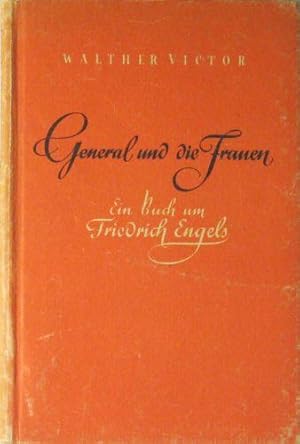
Published by Hamburg. (1947.), Hammerich & Lesser 1947
- Hardcover
- Signed
Seller: Rotes Antiquariat, Berlin, GermanyRotes Antiquariat
Contact seller4-star sellerCondition: Used
US$ 35.08
US$ 51.09 shippingShips from Germany to U.S.A.Quantity: 1 available
150 S., 1 Bl. 8°, Orig.-Pappbd. (Friedrich Schreck). 9.-17. Tsd. - Mit einer vierzeiligen, eigenhändigen Widmung des Verfassers auf dem Vakatblatt. - Einband stärker berieben, hinterer Rückenfalz zu ca. 60% eingerissen, Abplatzung am oberen Kapital. 350 gr.

Published by Bologna, Societa editrice il Mulino
- Softcover
- Signed
Seller: Inanna Rare Books Ltd., Skibbereen, CORK, IrelandInanna Rare Books Ltd.
Contact seller5-star sellerCondition: Used - Fine
US$ 91.22
US$ 31.79 shippingShips from Ireland to U.S.A.Quantity: 1 available
Condition: Sehr gut. 8°. pages 45 - 81 pp. Brochure. Inscribed / signed by Odilo Engels. [Annali dell'Istituto storico italo germanico - Quaderno 10] Sprache: Italiano.
Language: German
Published by Solingen Boll 1981
- Hardcover
- First Edition
- Signed
Seller: Antiquariat carpe diem, Monika Geyer, Bocholt, GermanyAntiquariat carpe diem, Monika Geyer
Contact seller5-star sellerCondition: Used
US$ 16.37
US$ 79.48 shippingShips from Germany to U.S.A.Quantity: 1 available
8°, 152 Seiten. mit 4 s/w. Photos. Orig.Leinen mit OSU. Erste Ausgabe mit mehrzeiliger Widmung des Autors. - Schutzumschlag mit winzigem, geklebtem Einriß.
 More images
Language: German
Published by HGBL, Leipzig 1974
- Hardcover
- Signed
Seller: Uli Eichhorn - antiquar. Buchhandel, Hohenstein-Ernstthal, GermanyUli Eichhorn - antiquar. Buchhandel
Contact seller5-star sellerCondition: Used
US$ 79.52
US$ 34.05 shippingShips from Germany to U.S.A.Quantity: 1 available
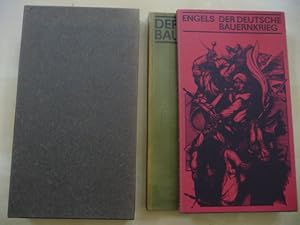
Leder. Condition: Gut erhalten. Hsg. vom Ministerium für Kultur und der HGBL aus Anlaß des 450. Jahrestages des deutschen Bauernkrieges. 118 S. mit 12 Orig.-Holzstichen im Text. Gesetzt aus der Maxima von Gert Wunderlich, der auch die Buchgestaltung besorgte. Druck in der HGBL. ***vorliegt 1 von 400 von der Dorfner-Werkstatt Wei…mar in grünem Ganzleder gebundenen Ex., im DV handschr. num. u. vom Künstler signiert. Zustand: Einband etwas ungleichmäßig verfärbt und gering fleckig, Rü. mit alter Knickspur; alte handschr. Widmung v. 1977 a.d. Vortitel; Exlibris. *** beiliegt dass.: illustr. Orig.-Broschur (mit dem 13. Holzstich der Folge). 1 v. 600 im DV handschr. num. u. vom Künstler signierten Ex. Zustand: sehr gut erhalten, Exlibris. ***beiliegt: Orig.-Abzug des Stiches S. 91 mit typogr. Text am unteren Blattrand. *** alles zusammen in einem braunem privatem, fachmännisch hergestellten Papp-Schuber. Preis gilt für beide Ausgaben zusammen. Karl-Georg Hirsch (illustrator). Vom Illustrator signiert.
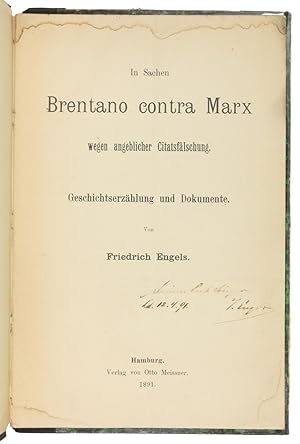
Published by Hamburg, Otto Meissner (Hesse & Becker in Leipzig), 1891. 1891
- Softcover
- Signed
Seller: Antiquariat INLIBRIS Gilhofer Nfg. GmbH, Vienna, A, AustriaAntiquariat INLIBRIS Gilhofer Nfg. GmbH
Contact seller5-star sellerCondition: Used
US$ 146,184.60
US$ 34.06 shippingShips from Austria to U.S.A.Quantity: 1 available
8vo. (4), 75, (1) pp. Contemporary marbled half cloth. Presentation copy, inscribed by the author: "Seinem Paul Singer Ld. 12.4.91. F. Engels." First edition of Engels's brochure against Brentano, inscribed in the week of publication to the Chairman of the Social Democratic Party, Paul Singer (1844-1911). - "This work consists o…f six chapters of exposition (in MEW 22:95-133) followed by a number of documents: excerpts from M's Inaugural address (#M397) and from Capital, vol. 1; reprints of #M737 and #M738 (M's replies to Brentano); the exchange between Eleanor Marx and Sedley Taylor in 1883-1884 (for which see Y. Kapp's Eleanor Marx, 2:725); excerpt from #E602 (a preface to Capital by E); and finally the text of #E374 (which is not found elsewhere in MEW). Also reprinted in this work are documents by Brentano and his supporters" (Draper, The Marx-Engels Register). - Singer, orphaned at a young age, was a draper's clerk, and together with his brother established the Singer ladies' coat factory. "At first a supporter of J. Jacoby's left liberals, he joined the Social-Democratic party in the early 1870s - secretly until 1878 when the Anti-Socialist Law was imposed; made large financial contributions. Elected to the Berlin city government (1883), he emerged as an outstanding administrator; elected to the Reichstag (1884); member of the party Central Committee (1887), its chairman (1890); also presidium member at international congresses; member (1890) of the International Socialist Bureau, Brussels. Singer was not a public figure but a capable administrator and organizer, who in politics followed Bebel's lead; despite his notable practicality, he opposed Revisionism to the end" (Draper, The Marx-Engels Glossary, p. 193). - Engels received copies of the present pamphlet before 10 April 1891, and between April 10 and 15 he sent copies to Sorge, Fisher, Niewenhuis and other friends and correspondents, including the present copy to Singer, who on April 2 had written to Engels, reminding him to send Bebel greetings on his silver wedding anniversary. - Spine defective, remains of paper label to front board; dampstain to upper margin and a lesser stain to lower margin, central vertical crease, presumably caused by folding for mailing before binding; inscription lightly abraded, but still very legible; a very good copy with a splendid association. - Rubel (Appendix) 111. Stammhammer I, 73, 13. Werchan et al., Das Werk von Marx und Engels in der Lit. der dt. Sozialdemokratie, no. 536. Draper E375.

Language: German
Published by Leipzig Hochschule für Grafik und Buchkunst 1974. 1974
- Signed
Seller: Rhönantiquariat GmbH, Hofbieber, GermanyRhönantiquariat GmbH
Contact seller3-star sellerCondition: Used
US$ 46.78
US$ 45.42 shippingShips from Germany to U.S.A.Quantity: 1 available
8° , Softcover/Paperback. 118 S. Nr 780 von 1000 Expl. Von Hirsch im Impressum signiert.In bester Erhaltung. Sprache: Deutsch Gewicht in Gramm: 1100 Aus Anlaß des 450. Jahrestag des deutschen Bauernkrieges.
 More images
Published by Belle-Vue, bei Constanz: Verlagsbuchhandlung zu Belle-Vue, 1846 1846
- First Edition
- Signed
Seller: Peter Harrington. ABA/ ILAB., London, United KingdomPeter Harrington. ABA/ ILAB.
Contact seller5-star sellerCondition: Used
US$ 5,762.76
US$ 28.96 shippingShips from United Kingdom to U.S.A.Quantity: 1 available
First edition of Engels's article, which fills pages 1-19 of the second volume of Püttmann's Rheinischer Jahrbücher zur gesellschaftlichen Reform, a true socialist periodical which ceased publication with volume two; this copy from the library of Friedrich Ludwig Tenge, inscribed by him on the front free endpaper in the year of…publication, "Tenge Barkh[ausen] 1846", with the later signature of "Dr. H. Tenge" in purple ink beneath. The landowner and industrialist Friedrich Ludwig Tenge (b. Osnabrück 1793-1865 d. Gut Barkhausen) studied agricultural economics from 1811 to 1813, first in Montpellier and then Göttingen. His first acquisition was the large Barkhausen estate in the Lippe district of North Rhine-Westphalia, in 1814, on which he subsequently built a vinegar factory, wheat mill, pottery, and coal mine. Tenge famously entertained many radical democrats and socialists at Barkhausen, which often acted as a haven for politically persecuted writers. His close friends and guests included not only the likes of Moses Hess, the brothers Karl and Albert Grün, Wilhelm Weitling and Hoffmann von Fallerslebel, but also both Friedrich Engels and Hermann Püttmann. Marx later had a brief affair with Therese Tenge, Friedrich's Italian wife, in Hannover, while waiting for the proof sheets for volume one of Kapital. At the time Therese was staying with the Kugelmanns. The first volume of Püttmann's Rheinischer Jahrbücher zur gesellschaftlichen Reform had been published in August 1845 in Darmstadt, with the intention to print quarterly numbers. German police intervention, however, delayed the second volume, the preface to which is dated July 1846. Other contributors to the periodical included Püttmann himself, Karl Grün, Moses Hess, Hermann Ewerbeck, and Eduard Weller. Draper E277.change description to include volume Octavo (213 x 127 mm). Contemporary ribbed and patterned dark purple cloth, spine direct lettered gilt, blue patterned edges. Two head and shoulders profile pencil sketches to rear free endpaper. Spine sunned, one or two small nicks to cloth, with some surface marking; scattered light spotting; a crisp, clean copy.
 More images
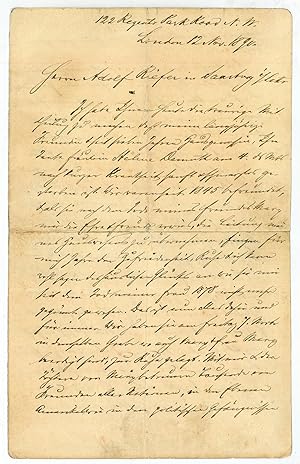
Published by London, 12 Nov. 1890. 1890
- Signed
- Manuscript
Seller: Antiquariat INLIBRIS Gilhofer Nfg. GmbH, Vienna, A, AustriaAntiquariat INLIBRIS Gilhofer Nfg. GmbH
Contact seller5-star sellerCondition: Used
US$ 280,674.42
US$ 34.06 shippingShips from Austria to U.S.A.Quantity: 1 available
Small 8vo (112 x 179 mm). 4 pp. on bifolium (torn through the fold, thus in two separate leaves). Watermark: St. Margarets' Superfine. - (Includes:) Cabinet photograph of Helene Demuth (albumen print, vintage), 100 x 141 mm on cardboard (100 x 160 mm) of the studio Charles J. Gearing, London (after 1880). - (And:) Extract from t…he birth registers of St. Wendel, illustrating the kinship between Adolf Riefer and Helene Demuth. 2 pp. in-folio. To Adolf Riefer in Sarrebourg, Lorraine, announcing the death of Riefer's aunt Helene Demuth, who had long served as housekeeper to Marx and Engels: "Ich habe Ihnen heute die traurige Mittheilung zu machen, daß meine langjährige Freundin & seit sieben Jahren Hausgenossin, Ihre Tante Fräulein Helene Demuth am 4. des Mts. nach kurzer Krankheit sanft & schmerzlos gestorben ist. Wir waren seit 1845 befreundet, & als sie nach dem Tode meines Freundes Marx mir die Ehre & Freude erwies, die Leitung meines Hauswesens zu übernehmen, fingen für mich Jahre der Zufriedenheit, Ruhe & ich kann wohl sagen des häuslichen Glücks an, wie sie mir seit dem Tod meiner Frau 1878 nicht mehr gegönnt gewesen. Das ist nun alles dahin und für immer. Wir haben sie am Freitag, 7. Novbr. in demselben Grabe, wo auch Marx & Frau Marx beerdigt sind, zur Ruhe gelegt. Mit mir & den Töchtern von Marx betrauern Tausende von Freunden aller Nationen, in den Ebenen Amerikas wie in den politischen Gefängnissen Sibiriens & in allen Ländern Europas ihren Verlust. Die Verstorbene hat ein Testament gemacht, worin sie den Sohn einer verstorbenen Freundin, den sie von klein auf sozusagen an Kindesstatt angenommen, und der sich allmählig zu einem braven & tüchtigen Mechaniker herausgebildet, Frederick Lewis, zu ihrem alleinigen Erben eingesetzt hat. Derselbe hat seit längerer Zeit aus Dankbarkeit und mit ihrer Einwilligung den Namen Demuth angenommen [.]". Engels states the value of the inheritance ("etwa vierzig Pfund Sterling") and inserts the original English text of Demuth's will, with a German translation. Her last will is dated 4 Nov. 1890 and is declared in the presence of the three witnesses: Engels, Eleanor Marx-Aveling (Marx's youngest daughter), and her husband Eduard Aveling. - After the death of her father in 1826, Helene Demuth (1820-90) had to work as a maid servant early in her life. In 1837 she entered the service of the respected Westphalen family of Trier; their daughter Jenny married Karl Marx in 1843. In 1845 Demuth was sent to Brussels to support the couple as housekeeper; she would remain with the Marx family also in Paris, Cologne, and during their exile in London. Jenny Marx passed away in 1881, Karl Marx in 1883; subsequently, she was responsible for Engels' household. - Scholarship accepts that her sole heir, Frederick Lewis Demuth (1851-1929), was almost certainly the illegitimate son of Karl Marx and Helene Demuth. All her life the mother concealed the identity of the boy's father, lest the affair provide Marx's political enemies with ammunition; even in this letter Engels obscures the young man's ancestry. Named Frederick (after Engels), the child was given into the care of the Lewis family, whose surname he took; his relations to his half-siblings are said to have remained easy all his life. Undoubtedly he ended up happier than they did: "Four of Marx's children predeceased him, and the two survivors both killed themselves. The only member of the family to escape the curse was Freddy Demuth, who lived and worked quietly in east London. He died of cardiac failure on 28 January 1929, aged seventy-seven. To the end, neither he nor anyone else suspected that Freddy might be a son of the man whose face and name were, by then, known throughout the world" (Wheen, Marx, p. 386). - Includes an original cabinet photograph of Helene Demuth, showing the housekeeper nearly in full figure at an advanced age (identified on the verso by a later hand in pencil and dated "1890"). - Further includes extracts from the birth re.
 More images
Published by [Paris, end of March 1848]. 1848
- Signed
Seller: Antiquariat INLIBRIS Gilhofer Nfg. GmbH, Vienna, A, AustriaAntiquariat INLIBRIS Gilhofer Nfg. GmbH
Contact seller5-star sellerCondition: Used
US$ 210,505.82
US$ 34.06 shippingShips from Austria to U.S.A.Quantity: 1 available
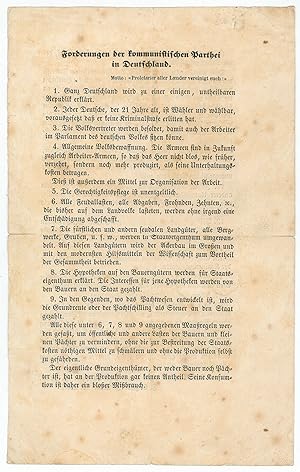
Leaflet, 140 x 223 mm. The "Demands of the Communist Party in Germany": extremely rare first printing, signed in letterpress by the committee of the "Communist League": Karl Marx, Karl Schapper, Andreas Heinrich Bauer, Friedrich Engels, Joseph Moll, and Wilhelm Wolff. - Threatened with deportation from France, Marx and Engels ha…d relocated to Brussels in 1845, where they founded the "Communist Correspondence Committee", ultimately instigating the transformation of Schapper's "League of the Just", founded by Weitling in 1836 and based in London since 1840, into the "Communist League". In early 1848 Marx and Engels completed their "Communist Manifesto", which was printed in London in February. At the end of March they formulated the central demands of their not yet existing party. "They shaped the political programme of the 'Communist League' in the nascent German Revolution. The 'Demands of the Communist Party in Germany' were printed in late March 1848 as a leaflet, then published in early April in the democratic newspapers 'Berliner Zeitungshalle', 'Mannheimer Abendzeitung', 'Trier'sche Zeitung', and 'Deutsche Allgemeine Zeitung'; they were also handed out as a directive to members of the 'Communist League' who were returning home. In the course of the revolution, Marx and Engels as well as their supporters endeavoured to familiarize the masses with this programmatic document. The 'Demands' were therefore reprinted as a new leaflet in Cologne before 10 September [this second version is the one published in MEGA]" (cf. MEGA V, p. 505). - "The 'Demands of the Communist Party in Germany' constitute the first classic example of the Communist Manifesto's general principles applied specifically to a country, to the specific conditions of the German Revolution of 1848/49" (cf. MEGA V, p. VI). - MEGA V, p. 3. Compare illustration at: DHM D1_00141.
 More images
Published by (London, 15 December "1848" [recte: 1847]). 1848
- First Edition
- Signed
Seller: Antiquariat INLIBRIS Gilhofer Nfg. GmbH, Vienna, A, AustriaAntiquariat INLIBRIS Gilhofer Nfg. GmbH
Contact seller5-star sellerCondition: Used
US$ 526,264.55
US$ 34.06 shippingShips from Austria to U.S.A.Quantity: 1 available
8vo. 8 pp. Disbound; Japanese paper spine. Stored in custom-made red half morocco solander case. The only known copy of this founding document of communism, the final stepping stone towards the Communist Manifesto. The eight-page leaflet is a circular addressed to the "Bund der Kommunisten" ("Communist League") by the participan…ts of its second and final congress. The League, a revolutionary, socialist secret society, had been formed but a few months previously as a successor to the "Bund der Gerechten" (the "League of the Just"). The pioneering new name was adopted under the guidance of its new members Karl Marx and Friedrich Engels at the League's first congress, held in London from June 2 through 9, 1847. Their ideas re-framed the League as an international organization with a coherent programme. Although the League would be formally disbanded in 1852, it is considered the precursor of the International Workingmen's Association, the first Marxist political party, and the nucleus of all later communist parties. - The League's second congress was held in Brussels from November 29 to December 8, half a year after the first. On both occasions the respective accounts were published under the heading "Der Congreß an den Bund": the former on June 9 and the present, latter one on December 15 ("1848" being a misprint for 1847). No copies of either of these two publications are recorded in library catalogues or in the usual bibliographical reference works. Only one or two copies of the circular of the First Congress are known: one in the estate of the Hamburg socialist and "Bund" member Joachim Friedrich Martens (SUB Hamburg, acquired in 1912); the other, apparently, in the Stiftung Archiv der Parteien und Massenorganisationen der DDR im Bundesarchiv (formerly in the Institut für Marxismus-Leninismus beim Zentralkomitee der SED, but not currently listed in the SAPMO's catalogues). While this first circular was republished in 1969 (in Bert Andréas's collection "Gründungsdokumente des Bundes der Kommunisten"), the present circular of the Second Congress has so far remained unknown to scholarship. As the Bund was still a secret society, the first circular was pseudonymously signed "Heide (Sekretär)" and "Karl Schill (Präsident)", standing for Wilhelm Wolff and Karl Schapper, respectively. While the name of Schapper, the president, is given undisguised in the present second circular, it may therefore be more than a simple typographical error that the secretary's name is here rendered as "J. Engels". - In his article "On the History of the Communist League", written and published in 1885, nearly four decades after the event, Engels provides what has become the received version of the genesis of the Communist Manifesto: "[at the Second Congress Marx] expounded the new theory in a fairly long debate [.] All contradiction and doubt were finally set at rest, the new basic principles were unanimously adopted, and Marx and I were commissioned to draw up the Manifesto". It is reasonable that Engels's account should be a retrospective condensation of a more complicated process, albeit one of which few contemporary documents have survived. Interestingly, the use of the term "Manifest der kommunistischen Partei" is not entirely consistent throughout the circular: it is stated that a work so titled, which was to replace the "Communist Creed" passed at the First Congress, had already been compiled, drafted, translated into various languages, and even enacted (p. 1 f.), but had yet to be published. Also, it was decided at the Congress that such a "Manifesto" should appear annually in various languages (p. 7). The "Manifesto" of 1847 is said to have been drafted by taking into account all suggestions submitted by members of the League (p. 7); it is also said already to have given the Communist movement its proper expression (p. 2). The present circular as here published is referred to as the "organ of the League in its new appearance" (p. 8), and the f.

- Signed
Seller: Herbst-Auktionen, Detmold, GermanyHerbst-Auktionen
Contact seller4-star sellerCondition: Used
US$ 1,695.74
US$ 9.65 shippingShips from Germany to U.S.A.Quantity: 1 available
Eigenhändige Bestätigung FÜR DEN AUSZUG mit Amtsbezeichnung als Reg.(ierender) Bürgermeister, Datum 16/7.(18)78 in Tinte signiert - unter Großer Urkunde (4 S. gr. folio, mit eingeprägtem Kopf : Königl. Regierung Cöln) Cöln, 12.VII.1878 - Feststellung für HEINRICH FERDINAND VON SYBEL, Gutsbesitzer zu Isenburg bei Mülheim am Rhein… und dessen Erben über das Verfahren zur Feststellung der Entschädigung wegen der im Wege der Enteignung von Grundflächen der Gemeinde Mülheim am Rhein. (Document with handwritten authentification of its content by Hermann Becker, Mayor of Cologne, called The Red Becker) VERY RARE / SEHR SELTEN ! BEILAGE : weiteres Dokument (2 S. gr. folio) zur Sache, signiert von einem Kölner Regierungs-Sekretär.

Language: German
- Signed
- Art Print
Seller: Antiquariat Clemens Paulusch GmbH, Berlin, GermanyAntiquariat Clemens Paulusch GmbH
Contact seller5-star sellerCondition: Used
US$ 140.34
US$ 30.54 shippingShips from Germany to U.S.A.Quantity: 1 available
Radierung v. Ernst Jazdzewski, um 1960, 16 x 12,5 (H) Blattgr. 33,6 x 24,4 (H) Kaltnadelradierung mit viel Plattenton auf festem Velin. Unten rechts mit Bleistift signiert "Eja" = Ernst Jazdzewski (Berlin 1907 - 1995 Berlin). - Sehr gut erhalten.


