

Order Total (1 Item Items):
Shipping Destination:

Fick Helmholtz (3 results)
Skip to main search results
Search filters
Product Type
- All Product Types
- Books (3)
- Magazines & Periodicals (No further results match this refinement)
- Comics (No further results match this refinement)
- Sheet Music (No further results match this refinement)
- Art, Prints & Posters (No further results match this refinement)
- Photographs (No further results match this refinement)
- Maps (No further results match this refinement)
- Manuscripts & Paper Collectibles (No further results match this refinement)
Condition Learn more
- New (No further results match this refinement)
- As New, Fine or Near Fine (No further results match this refinement)
- Very Good or Good (1)
- Fair or Poor (No further results match this refinement)
- As Described (2)
Binding
- All Bindings
- Hardcover (No further results match this refinement)
- Softcover (2)
Collectible Attributes
- First Edition (1)
- Signed (No further results match this refinement)
- Dust Jacket (No further results match this refinement)
- Seller-Supplied Images (1)
- Not Print on Demand (3)
Language (1)
Price
- Any Price
- Under US$ 25 (No further results match this refinement)
- US$ 25 to US$ 50 (No further results match this refinement)
- Over US$ 50
Free Shipping
- Free Shipping to U.S.A. (No further results match this refinement)
Seller Location
Seller Rating
-

"Ueber Diffusion", AND "Ueber Zusammensetzung von Spectralfarben" in Annalen der Physik
Published by Johann Barth, Leipzig, 1855
Seller: JF Ptak Science Books, Hendersonville, NC, U.S.A.
Seller rating 5 out of 5 stars

Soft cover. Condition: Very Good. Fick, Adolf. "Ueber Diffusion", in Annalen der Physik, volume 94, section 1, pp 1-176 (with four folding plates), with the Fick on pp 59-86. (Fick's Law of Diffusion.) Also, the Fick is preceded by a classic work in optics by Hermann v. Helmholtz, "Ueber Zusammensetzung von Spectralfarben", on pp 1-28 (which had been read by v.H. at the Hull meeting of the British Association for the Advancement of Science in 1854). This has been removed from a larger bound volume, and is complete in itself. [+] "Fick's laws of diffusion describe diffusion and were derived by Adolf Fick in 1855.[1] They can be used to solve for the diffusion coefficient, D. Fick's first law can be used to derive his second law which in turn is identical to the diffusion equation. A diffusion process that obeys Fick's laws is called normal or Fickian diffusion; otherwise, it is called anomalous diffusion or non-Fickian diffusion."--Wikipedia.
-
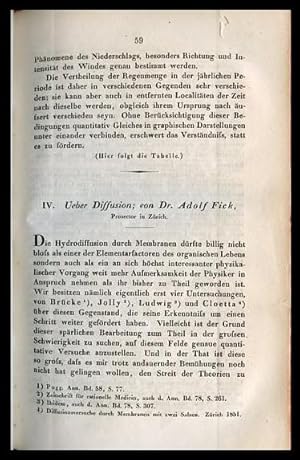
Über Diffusion (Fick, pp. 59-86) WITH Ueber die Zusammensetzung von Spectralfarben (Helmholtz, pp. 1-28) WITH Ueber die Empfindlichkeit der menschlichen Netzhaut fuer die brechbarsten Strahlen des Sonnenlichts (Helmholtz, pp. 205-212) in Poggendorff's Annalen der Physik und Chemie, 94, 1855
Published by Johann Ambrosius Barth, Leipzig, 1855
First Edition
1st Edition. FIRST EDITION OF A "SEMINAL" WORK, FICK'S CLASSICAL EQUATION OF DIFFUSION (Philibert, Fick, Einstein, Before and Beyond, 2005, 3). The laws Fick presents in this paper remain "the empirical foundations of many phenomena in the macroscopic world" and were of significant import to Einstein (Lepri, Thermal Transport, 305). Also included are two papers by Helmholtz on optics (see end of write-up). "Today, Fick's Laws form the core of our understanding of diffusion in solids, liquids, and gases (in the absence of bulk fluid motion in the latter two cases)" (Philbert, 5). While this paper also appeared in translation in the Phil Mag (and we offer that work separately, "On Liquid Diffusion") this German original includes ideas that "do not appear in the translation (Philbert, 4). Specifically, "Fick [here makes] allusion to the atomic theory, as accepted by most of the physicists as an aide to get "an insight, a description and a discovery", allowing a mechanical account of the observed phenomena. [While] these ideas about atoms and molecules are very far from our modern concepts, they nevertheless. were important to understand that dissolution and diffusion processes in water result from the movement of separate entities of salt and water. But Fick was unable on this basis to deduce a quantitative law. It took another fifty years for this ambitious purpose to be realized by A. Einstein" (ibid, 3). Inspired by earlier work by Thomas Graham and sensing a deep analogy between diffusion and the conduction of electricity or heat, Fick's experiments "dealt with measuring the concentrations and fluxes of salt, diffusing between two reservoirs through tubes of water" (Philbert, 5). "Fick's first law relates the diffusive flux to the concentration field, by postulating that the flux goes from regions of high concentration to regions of low concentration, with a magnitude that is proportional to the concentration gradient (spatial derivative). Fick's second law predicts how diffusion causes the concentration field to change with time" (ibid). Einstein's first paper on Brownian motion (to date his most cited) - "the irregular movement of macroscopic particles suspended in a liquid" - was published in 1905. By inverting a formula by Boltzmann, "Einstein described its mathematics, deriving the probability of a macroscopic state for the distribution of gas molecules" (Calaprice, 15). Einstein realized that Brownian motion was associated with diffusion, with laws already written by Fick in 1855 relating to the flux of particles arising from a gradient in concentration" (Jones, Diffusion MRI, 46). In the case of Brownian motion, no macroscopic concentration gradient is needed as the molecules undergo a process of â??self-diffusion' arising from local concentration fluctuations" (ibid). "Fick's laws were developed to describe the behavior of solute molecules as a consequence of a non-uniform concentration, the drifting from higher to lower concentration so as to equalize concentration gradients. This process, also known as "mutual diffusion", requires a countercurrent of solute and solvent particles to maintain the overall mas density. [What Einstein elucidated was] "that the language of Fick's laws still applied in the case of self-diffusion where no macroscopic gradient existed, provided one takes n(r, t) to be the local probability of finding the molecule (ibid). In no small part due to the work of Fick, as regards diffusion, "the bridge between the microscopic and macroscopic world was built by A. Einstein: his fundamental result expresses a macroscopic quantity - the coefficient of diffusion - in terms of microscopic data (elementary jumps of atoms or molecules)" (ibid). HELMHOLTZ PAPERS: "In 1851, Helmholtz revolutionized the field of opthalmology with the invention of the opthalmoscope; an instrument used to examine the inside of the human eye" (Wikipedia). These two papers are part of a continued study by Helmholtz of vision and color. The t.
-
Ueber Diffusion. (Fick). (+ Helmholtz:) Ueber Zusammensetzung von Spectralfarben. (Theilweis vorgetragen in der Zusammenkunft der British Association zu Hull in September 1854).
Seller: Herman H. J. Lynge & Søn ILAB-ABF, Copenhagen, Denmark
Seller rating 4 out of 5 stars

Leipzig, Johann Ambrosius Barth, 1855. Without wrappes. In: "Annalen der Physik und Chemie. Hrsg. von J.C. Poggendorff", 94. Bd., No 1 ("Heft" No 1, 1855). Pp. 1-176 a. 4 folded engraved plates. (Entire issue offered). Titlepage to vol. 94 (small stamp on verso). Fick's paper: pp. 59-86. Helmholtz's paper: pp. 1-28. Clean and fine. First appearance of Fick's importent paper in molecular physics in which he annouced his two laws of diffusion.Fick's first law relates the diffusive flux to the concentration field, by postulating that the flux goes from regions of high oncentration to regions of low concentration, with a magnitude that is proportional to the concentration gradient (spatial derivative). - Fick's second law predicts how diffusion causes the concentration field to change with time. (Wikipedia).First appearance of HELMHOLTZ'S fundamental paper in physiological optics in which he examined the sensitivity of the eye for the individual elements of the violet end of the spectrum" he was able to detect a whole series of distinct tones of purple: he alters the name 'invisible rays' to that of 'ultra-violet rays'" discussion of the relations of the wavelenghts of complementary colours and the intensity required if the mixture of simple complementarity colours is to produce white. He answered these questions quantatively. "THE TREATISE (the paper offered), WHICH HAS BEEN FUNDAMENTAL FOR ALL LATER WORK OF THE SAME KIND, concludes with an inquiry into the validity of Newton's Colour Circle, which Helmholtz designates as one of the most brilliant inspirations of that great thinker."(Leo Koenigsberge "Hermann von Helmholtz" pp. 131-133).


