

Order Total (1 Item Items):
Shipping Destination:

First Explicit Statement Ohms Law (1 results)
Skip to main search results
Search filters
Product Type
- All Product Types
- Books (1)
- Magazines & Periodicals (No further results match this refinement)
- Comics (No further results match this refinement)
- Sheet Music (No further results match this refinement)
- Art, Prints & Posters (No further results match this refinement)
- Photographs (No further results match this refinement)
- Maps (No further results match this refinement)
- Manuscripts & Paper Collectibles (No further results match this refinement)
Condition Learn more
- New (No further results match this refinement)
- As New, Fine or Near Fine (No further results match this refinement)
- Very Good or Good (No further results match this refinement)
- Fair or Poor (No further results match this refinement)
- As Described (1)
Binding
- All Bindings
- Hardcover (No further results match this refinement)
- Softcover (1)
Collectible Attributes
- First Edition (No further results match this refinement)
- Signed (No further results match this refinement)
- Dust Jacket (No further results match this refinement)
- Seller-Supplied Images (1)
- Not Print on Demand (1)
Language (1)
Price
- Any Price
- Under US$ 25 (No further results match this refinement)
- US$ 25 to US$ 50 (No further results match this refinement)
- Over US$ 50
Free Shipping
Seller Location
Seller Rating
-
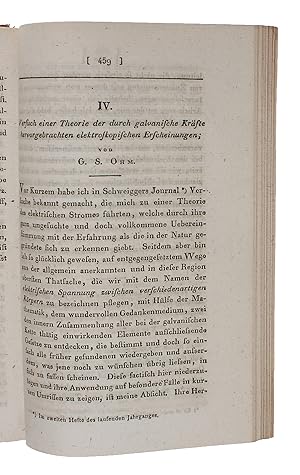
Versuch über einer Theorie der durch galvanische Kräfte hervorgebrachten elektroskopischen Erscheinungen. (+) (Beschluss) (+) Ein Nachtrag zu dem vorstehenden Aufsatz. (3 Theile).
Seller: Herman H. J. Lynge & Søn ILAB-ABF, Copenhagen, Denmark
Seller rating 4 out of 5 stars

Leipzig, Johann Ambrosius Barth, 1826. Without wrappers as issued in "Annalen der Physik und Chemie. Hrsg.von Poggendorff", Bd. 6 + 7, Viertes u. Fünftes Stück. (Entire issues 4 and 5 present). Titlepage to vol. 6. Pp. 369-514 a. 1 engraved plate, Titlepage to vol. 7. Pp. 1-136 a. 1 engreved plate. Ohms paper: pp. 459-469, pp. 45-54 a. pp. 117-118. Clean and fine. First appearence of a major paper in 19th century electrical theory, breaking new ground in associating an electric tension with both open and closed galvanic circuits, unifying the theory of Galvanic electricity, and containing Ohm's Law in the simpler and last form."Ohm's second major paper of 1826 announced the beginnings of a comprehensive theory of galvanic electricity based, he said, on the fact that the contact of heterogenous bodies produced and maintained a constant electric tension (Spannung). He deferred the systematic exposition of thsi theory to a later work, however, and limited himself to stating without derivation the two eqautions that constituted its heart: X=kw(a/l) and u-c = +/- (x/l)a,whereX is the strenght of the electric current in a conductor of lenght l, cross section w, and conductibility (Leitungsvermögen) k produced by a difference in electric tension a at its end points. By means of the first equation one can, .reduce the actual lenght of a wire of whatever cross section and conductibility to the equivalent lenght of one of the wire chosen arbitrarily as a standard. Letting l now be this equivalent lenght - called the reduced lenght (reducirte Länge) of the conductor - Ohm WROTE HIS FIRST LAW IN THE SIMPLER FORM X=a/l, THE EXPRESSION WHICH HAS BECOME KNOWN AS OHM'S LAW."(DSB X, pp. 188-89).
