Order Total (1 Item Items):
Shipping Destination:

French Enlightenment (7 results)
Skip to main search results
Search filters
Product Type
- All Product Types
- Books (6)
- Magazines & Periodicals (No further results match this refinement)
- Comics (No further results match this refinement)
- Sheet Music (No further results match this refinement)
- Art, Prints & Posters (No further results match this refinement)
- Photographs (No further results match this refinement)
- Maps (No further results match this refinement)
- Manuscripts & Paper Collectibles (1)
Condition Learn more
- New (No further results match this refinement)
- As New, Fine or Near Fine (1)
- Very Good or Good (1)
- Fair or Poor (1)
- As Described (4)
Binding
Collectible Attributes
- First Edition (3)
- Signed (No further results match this refinement)
- Dust Jacket (No further results match this refinement)
- Seller-Supplied Images (2)
- Not Print on Demand (7)
Language (1)
Price
- Any Price
- Under US$ 25 (No further results match this refinement)
- US$ 25 to US$ 50 (No further results match this refinement)
- Over US$ 50
Free Shipping
- Free Shipping to U.S.A. (No further results match this refinement)
Seller Location
Seller Rating
-
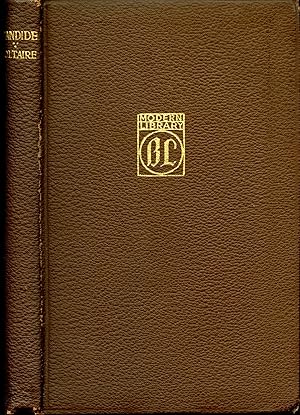
CANDIDE (ML# 47.1, BON & LIVERIGHT/TRUE FIRST MODERN LIBRARY EDITION, 1918)
Published by New York: Boni & Liveright /Modern Library Edition. 1918 True First Modern Library Edition., 1918
First Edition
Hardcover. Condition: Near Fine. No Jacket. 1st Edition. SHEPARDSON BOOKSTALL, 20 YEARS OF EXCELLENCE. SMALL IMPORTANT BOOK: RARE TRUE FIRST: Brown Leatherette; Brown Marble Endpapers; Spine 1; Gold BL logo on front with gold title and author's name on spine; Brown top-stain; C4 Catalog with 50 Titles at front. STORY: Candide, who wanders around the world, going from one misfortune to the next, all the while He feels that His optimistic philosophy is being challenged. It is an interesting read written as a criticism of optimism, and I recommend that everyone reads it at least once in a lifetime. (Wiki).
-

Il Tempio di Gnido nuovamente trasportato del Francese in Italiano.
Published by Paris, Prault., 1767
Seller: Hünersdorff Rare Books ABA ILAB, London, United Kingdom
Seller rating 3 out of 5 stars

US$ 186.71
US$ 30.21 shipping
Ships from United Kingdom to U.S.A.Quantity: 1 available
Add to basketHardcover. Condition: Fair. No Jacket. 12mo. [1]f + 45 + [3] + 147 + [8]p. With a charming engraved title. Contemporary calf, gilt spine; worn. Elegant pocket edition in a new Italian translation of a widely acclaimed prose poem on bucolic love based on classical Greek themes, anonymously published by the author in 1725, and a complete contrast to his renowned Lettres Persanes, and to his masterly and learned Esprit des Lois. The translator was Carlo Antonio Vespasiano (1713-93, found of the Berio Library, one of the most learned Genovese of the period. An old collector's stamp on verso of title, light waterstain at tailend margin of a few pages.
-
[ Suard, journalist etc ] Autograph Note Signed "Suard" referring to "Monsieur Panckoucke" and Rousseau. In French, some of which had me struggling.
Published by A Paris 13 aout, 1777
Seller: Richard M. Ford Ltd, London, United Kingdom
Seller rating 5 out of 5 stars

US$ 248.94
US$ 6.04 shipping
Ships from United Kingdom to U.S.A.Quantity: 1 available
Add to basketOne page, 8vo, small chip, otherwise complete and in good condition. "J'ai recu de Monsieur Panckoucke la [somme?] de Douze cent cinquante livres pour [.?] premiers moin de cette annee de la redevance du Journal historique & politique de Geneve, Sur laquelle [fourni?] de 1250 il a ete deduit celle de cent livres pour [.] de la redevance de M. Rousseau." Signature of Suard followed by "fol.311". See Image.
-
Système de la Nature ou des Lois du Monde Physique & du Monde Morale. Par M. Mirabaud.
Published by "Londres" (= Amsterdam, M.M. Rey), 1770
Seller: Hünersdorff Rare Books ABA ILAB, London, United Kingdom
Seller rating 3 out of 5 stars
First Edition
US$ 622.36
US$ 30.21 shipping
Ships from United Kingdom to U.S.A.Quantity: 1 available
Add to basketHardcover. Condition: Good. No Jacket. 1st Edition. 2 vols in 8vo. [6]f + 366p; with vignette on title and at end; [2]f + 391 + [1]p. Contemporary sheep, backstrips gilt; spine of first volume neatly repaired. Holbach's most famous work in which dialectical materialism is held to be the key that unlocks the mysteries of life. Considered the manifest of atheism,the work was sentenced to be burnt by the French Parlement in August of the same year. The physiocrats saw Holbach's treatise as an intellectual challenge. Voltaire criticised it mostly for stylistic reasons, whereas Grimm praised it, but attributed some passages to Diderot. The present set is mixed: the 1stvolume is of the first issue of the first edition (- see reproduction of title-page in Printing & the Mind of Man with long note), whilst the second volume is of the second issue; both are in different contemporary bindings. Volume I internally fresh with wide margins; volume II with a waterstain running through inner top blank margins and a small repair in blank title margin, else good. Caillet 5224.
-
L'Homme conduit par la raison.
Published by Paris: Chez Pillot, 1770., 1770
Seller: Michael R. Thompson Books, A.B.A.A., Los Angeles, CA, U.S.A.
Seller rating 1 out of 5 stars

This is a curious work, embodying enlightenment thought, and though the text is short in the use of proper names, the author is clearly familiar with Rousseau (the only philosopher mentioned in the body of the text, p. 189), Voltaire, and probably Locke and Hume. The work is dedicated to D***, and there are a number of quotes from the poetry of "D***" at the beginnings of chapters, along with quotes from Voltaire, Racine, Fenelon, Malesherbes, Corneille, Boileau, and Thomas. We have been unable to guess the identity of "D****," though he is the author of verse of a philosophic bent. The title-page bears his quotation: "Elle est du genre humain le trsor le plus beau;/On ne craint point d'ecueil en suivant son flambeau." Twelvemo. . xii, 309 pp., including approbation, permission statement from the king, and errata list. Woodcut title-page vignette, woodcut headbands, tail-pieces and initial letters. Contemporary stiff vellum with gilt leather spine label. A few spots on covers, including faint circular stain, minor foxing. A very good copy. First and only edition of a rare book. Searching OCLC, RLIN and COPAC, we could locate only copies at McGill, Koninklijke Bibliotheek, the Bibliotheque Nationale, and the National Library of Australia. The last of these is seriously defective. No catalogue listing assigns an author, and not in Barbier. The text consists of brief chapters on various subjects: De l'homme & de ses imperfections; Des passions; De la sagesse; Affectation; Belles manires; Education; Equit; Humeur; Imagination; Des plaisirs; etc. Like Rousseau, the author is convinced of the innate goodness of the human heart ("L'humanit reside principalement dans le coeur"Ñp. 147), but he is also an admirer of reason, education, and intelligence. He discusses the conflicts between loyalty to God and country, logic and emotion, decency and valor, and is convinced that in each case, one can value both. He is convinced that man and women have different characters and positions in life, yet his chapter on marriage (which glorifies the institution) shows an implicit belief in equality. The last fifteen pages contain an interesting list of short rules to live by: "De la puret de la Religion dpendent les moeurs des Peuples, & de la sagesse de la politique naissent les usages avantageux au Gouvernement"; "Faire du bien & entendre dire du mal de foi patiemment, c'est une vertue de Roi;" "C'est plus par les actions que par les paroles qu'on dcouvre les sentiments du coeur"; "Dans toutes les disputes, le plus foien raisonnements est toujours celui qui crie le plus fort; it croit trouver dans sa poitrine ce qui lui manque dans la tete.".
-
Autograph letter signed ("V").
Published by Ferney, 8. I. 1776., 1776
Seller: Antiquariat INLIBRIS Gilhofer Nfg. GmbH, Vienna, A, Austria
Association Member: ILAB PADA VDA VDAO
Seller rating 5 out of 5 stars
Manuscript / Paper Collectible
4to. 1 p. on bifolium (address panel on verso). Unpublished in the printed correspondence, in this late letter Voltaire addresses his "cher confrère" Audibert of the Académie de Marseille, casting a local administrative change as a victory for liberty: the Pays de Gex, he writes with relish, has "devenu aussi franc que Marseille", the agents of the Ferme having been "délogés"; he signs with the spare authority of his final years, "V". - The declaration is immediately grounded in the material life of Ferney. Voltaire notes that Marseille has already begun to send the goods that make a winter tolerable - "huile, vins de liqueur, sucre, caffé, épiceries" - a brisk inventory that turns fiscal policy into lived experience. - He then mobilises the Academy's social capital for commerce, commending to Audibert "un de nos grands négociant de Ferney" who has come to "prendre des arrangements" and who will, Voltaire hopes, benefit from his "bons offices". - The letter closes in Voltaire's characteristic register of wit and fatigue, opposing the Jura's cold to the Mediterranean climate ("Ferney n'est agréable que l'été"), recalling Audibert's earlier visit as a "belle fantaisie", and signing off as "Le vieux malade de ferney". - Written when Voltaire's château functioned as both intellectual embassy and economic experiment, the note neatly shows how Enlightenment sociability - provincial academies, personal patronage, and mercantile networks - could be pressed into the service of freer circulation and local privilege. - Small hole at the wax seal, without loss of text; otherwise fine.
-

Women's Education and Enlightenment Knowledge: Bibliothèque Universelle des Dames Histoire, Paris 1785-1788
Publication Date: 1785
Seller: Max Rambod Inc, Woodland Hills, CA, U.S.A.
Association Member: ABAA ILAB PADA
Seller rating 5 out of 5 stars
First Edition
First Edition. Bibliothèque Universelle des Dames Histoire, 1785-1788, multivolume educational work produced in late Enlightenment France as part of a publishing program intended to provide women readers with structured access to historical and general knowledge. The series formed part of a broader eighteenth century movement encouraging the intellectual education of women among elite and literate circles, presenting scholarly subjects in formats designed for domestic study. Issued in the years immediately preceding the French Revolution, the work reflects the expanding Enlightenment belief that education should extend beyond traditional male scholarly institutions and that women should participate in intellectual life through reading and study. Bibliothèque Universelle des Dames Histoire. Paris: rue d'Anjou, published with royal approval, 1785-1788. First edition. Thirty volumes. The series was issued to subscribers over a three year period and intended to provide accessible instruction in historical subjects for an audience of educated women. The set forms part of the larger Bibliothèque Universelle des Dames publishing project, which presented a range of scholarly subjects adapted for female readership during the late eighteenth century. Text printed in French and organized across the thirty volumes as a comprehensive historical survey. The Bibliothèque Universelle des Dames series emerged during a period when Enlightenment intellectual culture increasingly debated the scope of women's education and participation in literary life. Publishers and educators produced works designed to make subjects such as history, literature, and science accessible to female readers who were often excluded from formal academic institutions. Appearing only a few years before the French Revolution, the series reflects the educational aspirations and social structures of late eighteenth century France, where elite women frequently participated in salon culture and intellectual exchange through reading and discussion. Thirty volume set bound in full tawny brown leather with gilt decorated spines, black morocco spine labels with gilt titles, gilt ruled boards, marbled endpapers, and gilt edges. Minor wear and occasional small flaws to some bindings, boards secure and interiors generally clean and unmarked. Overall very good condition. A complete eighteenth century educational series illustrating the development of women's intellectual readership in Enlightenment France.