Order Total (1 Item Items):
Shipping Destination:

Gorlaeus David (2 results)
Skip to main search results
Search filters
Product Type
- All Product Types
- Books (2)
- Magazines & Periodicals (No further results match this refinement)
- Comics (No further results match this refinement)
- Sheet Music (No further results match this refinement)
- Art, Prints & Posters (No further results match this refinement)
- Photographs (No further results match this refinement)
- Maps (No further results match this refinement)
- Manuscripts & Paper Collectibles (No further results match this refinement)
Condition Learn more
- New (No further results match this refinement)
- As New, Fine or Near Fine (No further results match this refinement)
- Very Good or Good (No further results match this refinement)
- Fair or Poor (No further results match this refinement)
- As Described (2)
Binding
- All Bindings
- Hardcover (2)
- Softcover (No further results match this refinement)
Collectible Attributes
- First Edition (1)
- Signed (No further results match this refinement)
- Dust Jacket (No further results match this refinement)
- Seller-Supplied Images (1)
- Not Print on Demand (2)
Language (1)
Price
- Any Price
- Under US$ 25 (No further results match this refinement)
- US$ 25 to US$ 50
- Over US$ 50
Free Shipping
Seller Location
Seller Rating
-

David Gorlaeus (1591-1612). An enigmatic figure in the history of philosophy and science.
Seller: Antiquariaat A. Kok & Zn. B.V., Amsterdam, Netherlands
Seller rating 5 out of 5 stars

[Amsterdam], Amsterdam University Press, [2012]. 225 pp. B./w. ills. Orig. hardcover (boards).New price at the publisher 106,--. When David Gorlaeus (1591-1612) passed away at 21 years of age, he left behind two highly innovative manuscripts. Once they were published, his work had a remarkable impact on the evolution of seventeenth-century thought. However, as his identity was unknown, divergent interpretations of their meaning quickly sprang up. Seventeenth-century readers understood him as an anti-Aristotelian thinker and as a precursor of Descartes. Twentieth-century historians depicted him as an atomist, natural scientist and even as a chemist. The aim of this book is to shed light on Gorlaeus' family circumstances, his education at Franeker and Leiden, and on the virulent Arminian crisis which provided the context within which his work was written. It also attempts to define Gorlaeus' place in the history of Dutch philosophy and to assess the influence that it exercised in the evolution of philosophy and science, and notably in early Cartesian circles.
-
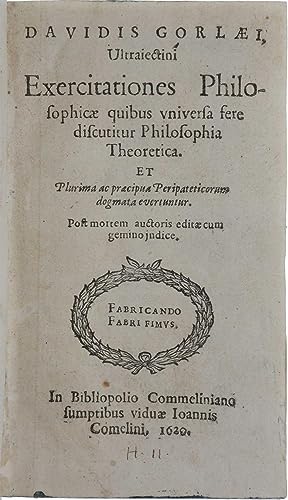
Exercitationes philosophic? quibus universa fere discutitur philosophia theoretica, et plurima ac pr?cipua Peripateticorum dogmata evertuntur . cum gemino indice
Published by in bibliopolio Commeliniano sumptibus viduae Joannis Comelini, [Leyden], 1620
Seller: SOPHIA RARE BOOKS, Koebenhavn V, Denmark
Seller rating 4 out of 5 stars

First Edition
Hardcover. First edition. EARLY ATOMISM. First edition, extremely rare, of one of the earliest modern works on atomism. ?Gorlaeus is counted among the founders of modern atomism, which he proposed as an alternative to Aristotelian matter theory. Because of his notion of atomic compounds, he is also regarded as a contributor to the evolution of chemistry? (DSB). ?When David Gorlaeus (1591-1612) passed away at 21 years of age, he left behind two highly innovative manuscripts. Once they were published [as the present work, and as Idea physicae (1610), his work had a remarkable impact on the evolution of seventeenth-century thought. However, as his identity was unknown, divergent interpretations of their meaning quickly sprang up. Seventeenth-century readers understood him as an anti-Aristotelian thinker and as a precursor of Descartes. Twentieth-century historians depicted him as an atomist, natural scientist and even as a chemist. And yet, when Gorlaeus died, he was a beginning student in theology. His thought must in fact be placed at the intersection between philosophy, the nascent natural sciences, and theology? (L?thy). This is a very rare book. In his review of L?thy?s book in 2012, Henri Krop wrote: ?until now Gorlaeus?s life and ideas have remained basically unknown because both his elaborate Exercitationes philosophicae and his Idea physicae are extremely rare and copies were unavailable in Dutch public libraries. (However since 1986 the libraries of both Leiden and Leeuwarden have acquired copies of the former.)? We have been unable to locate any copies in auction records. ?Gorlaeus?s atomism, which took center stage in his Idea physicae, is however more fully embedded in the Exercitationes philosophicae. There, philosophy is defined as ?the naked knowledge of entities? and thus identified with ontology. Each discipline, wrote Gorlaeus, tackles one type of entity, whereby physics deals with natural entities. His ontology distinguishes between self-subsisting entities (entia per se), which are defined as numerically unique, fully existing, unchanging, and indivisible, and the accidental compositions (entia per accidens) that are brought about when several entia per se gather. This view of reality is essentially atomistic, although primarily in a metaphysical sense. By denying universals and allowing only for individuals, it is also heavily indebted to medieval nominalism. The only self-subsisting entities are God, angels, souls, and physical atoms, whereas all other entities, including humans, are transitory composites. Gorlaeus?s definition of man as an ?accidental being,? which he took from Taurellus, was to be used in a 1641 university disputation by Ren? Descartes?s friend Henricus Regius and triggered the first conflict between Descartes and the Aristotelian university establishment. Since that episode Gorlaeus has, somewhat misleadingly, been seen as a forerunner of Cartesianism. ?Although his atomism is primarily metaphysical, Gorlaeus spent much time and effort to apply it to the realms of physics and chemistry. Rejecting Aristotle?s concept of place, he maintained that atoms move in an absolute space, which does not necessarily have to be filled. Possessing quantity, atoms are furthermore extended, and they come in two types, namely dry (as earth atoms) and wet (as water atoms). All natural bodies can be resolved into these two types of atoms. Fire is explained in terms of the friction of closely packed atoms, while air is defined as a real, but non-elementary substance, which fills all voids and which is capable of transmitting celestial heat, but not of combining into compounds. When bodies rarefy, this is due to the entrance of air between the atoms; air itself cannot be rarefied or condensed. The emergent physical and chemical properties of higher-level compounds are due to the mixing of the elementary qualities of wet and dry with the so-called ?real accidents? of warm and cold, which are communicated to the elementary atoms from th.